Issue 59
Aug 2026
IN VIVO
A medical student sees a patient for the first time. The patient presents troubling symptoms, displays convincing emotions and answers questions consistently. The interaction feels authentic, yet the patient is not a real patient.
The Yong Loo Lin School of Medicine, National University of Singapore (NUS Medicine) Standardised Patient (SP) Programme has enlisted the help of SPs for over two decades. SPs are professionals trained to simulate the signs, symptoms and emotional responses of real patients.
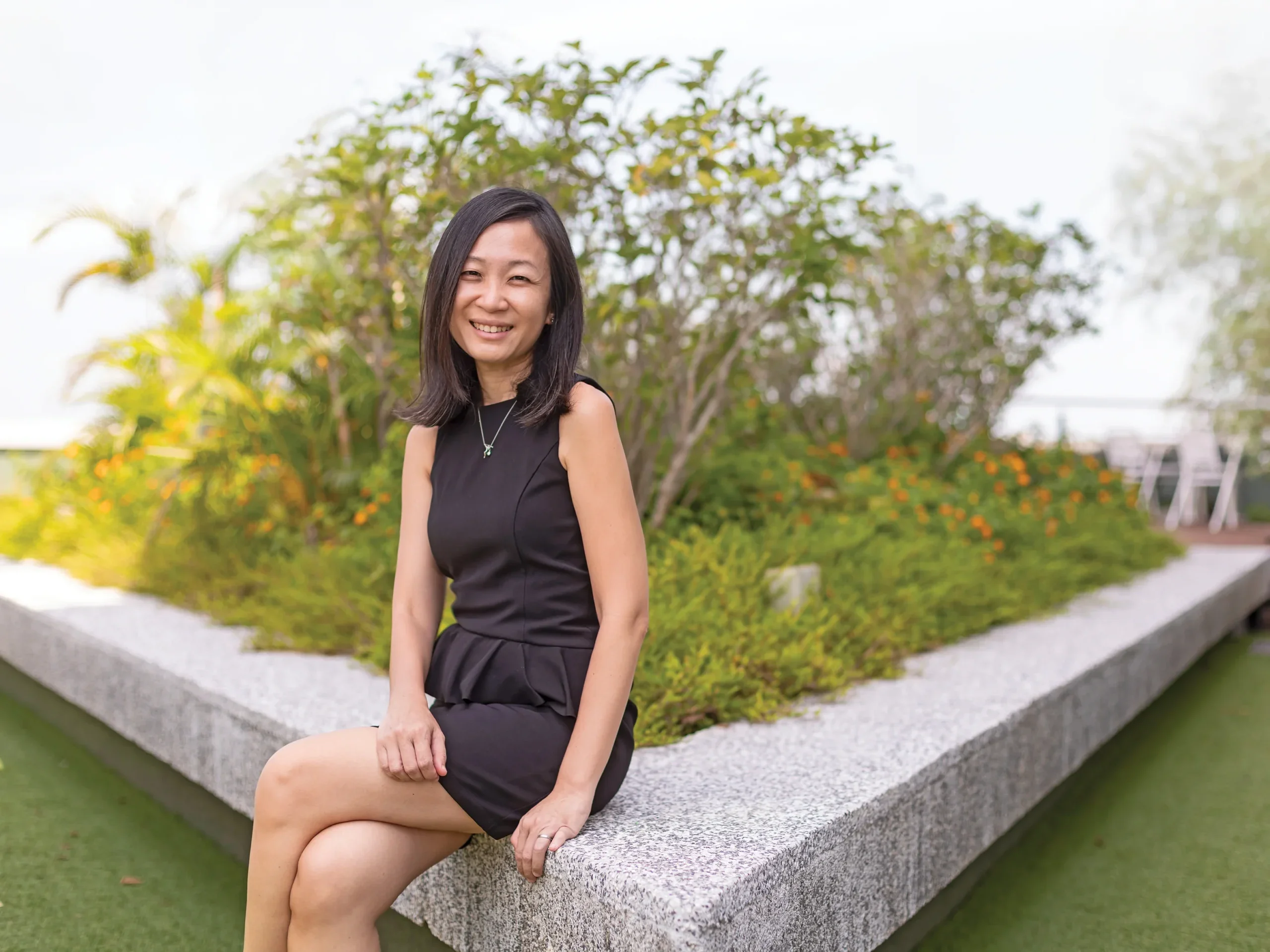
By recreating medical histories, as well as physical signs and emotional responses, SPs provide a safe and risk-free opportunity for learners in the healthcare professions to practise new skills and review existing ones without the time constraint of a busy clinical environment like a hospital or clinic. “They do not replace real patient experiences, but their interactions with learners provide realistic simulated encounters that enrich healthcare education while supporting curriculum delivery and assessment at NUS Medicine,” said Adjunct Associate Professor Nicola Ngiam, Director of the NUS SP Programme and Deputy Director of the Centre for Healthcare Simulation.
“To ensure consistency and authenticity, SPs undergo detailed training prior to each teaching or assessment session. Scenarios are carefully crafted around specific learning objectives, and SPs are trained to deliver their portrayals in a way that supports both teaching and assessment.”
Growing a community, patiently
Once a year, the NUS SP Programme holds a public outreach and recruitment drive to engage people who might be interested to join the programme. Selection is via an interview and a foundational training course. Successful applicants will then be registered in the database.
“When requests for SPs come in, SP educators will select eligible SPs from our database based on demographics and aptitude. These SPs will then be invited to accept the assignment. Once they accept the assignment, training sessions will be arranged to prepare for the session proper,” said Adj Assoc Prof Ngiam.
Today, NUS Medicine works with over 200 SPs, many of whom joined through word of mouth.
SPs do not replace real patient experiences, but their interactions with learners provide realistic simulated encounters that enrich healthcare education while supporting curriculum delivery and assessment at NUS Medicine.”
Julian (pseudonym) is one of them. An SP since the beginning of the programme, he has portrayed diverse patient roles and even a junior medical doctor in an Obstetrics and Gyneacology scenario once—which he confessed was one of the most challenging assignments. “Outside of SP work, I am a caregiver to my elderly mother, and have some personal health issues myself. This gives me a deep appreciation of the healthcare system from different sides—as an educator, a family member and a patient,” he said.
Julian added, “Working with medical students over the years, I get a glimpse of how demanding medical school can be, and the huge amount of information they are juggling at any one time.”
Starting small, thinking big
Leading the programme since 2012, Adj Assoc Prof Ngiam said, “When we first started the programme, SP methodology was largely limited to Objective Structured Clinical Examinations (OSCEs).”
A memorandum of understanding between NUS Medicine and Eastern Virginia Medical School (EVMS) marked a turning point for the programme. “EVMS sent a contingent of SP educators to train our team of SP educators and SPs on the foundations of the methodology, communication skills assessment and physical examination teaching,” she explained.
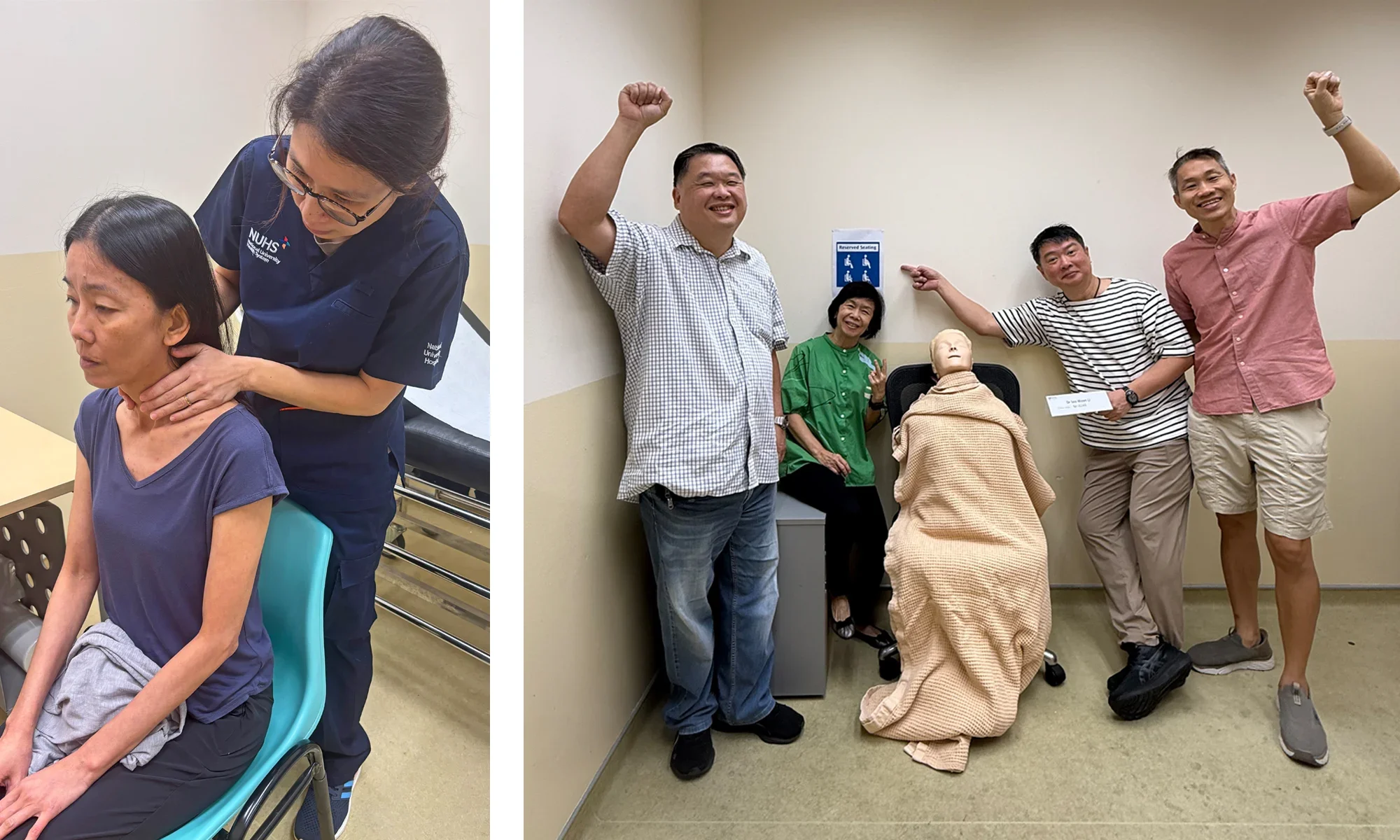
Since then, the programme has expanded to support the teaching and assessment of clinical and communication skills, physical examination teaching and structured feedback across Medicine, Nursing, Pharmacy, and Dentistry faculties.
Demonstrating the value of SP methodology to faculty was another challenge during the programme’s early years. “We responded by investing in high‐quality SP training so that SPs could consistently help students meet learning objectives,” she said. “Over time, their consistency and authenticity helped the programme grow to support about 23,000 hours of SP‐facilitated activities each year.”
The impact of that training is evident in the experiences of SPs such as Karine Sim, who has spent more than a decade helping learners develop communication skills, empathy and positive bedside manners. “By allowing learners to practise communication or physical examinations before encountering real patients, we help build their skills and confidence—and I am glad to have played a tiny little part in their medical journey,” she said.
Karine has also witnessed the emotional investment learners bring to their interactions with SPs. She recalled, “On several occasions, learners became so emotional when they had to ‘break bad news’ that they started crying with the patient. It was a reminder that healthcare professionals are human too, with genuine empathy and emotions.”
Learners are similarly grateful to the SPs. Karine remembers former students approaching her years later to express their appreciation for her support or share news of their graduation. Tan Hui Soon, who has been an SP since 2022, has likewise met nurses who passed their examinations and later returned to help guide their juniors.
For many SPs, these interactions are among the most rewarding aspects of the role. These rich personal experiences, coupled with a shared commitment to nurturing confident and empathetic healthcare professionals, underpin not only the growth of the NUS SP programme, but also the strong sense of community among SPs, programme facilitators and educators.
“I am most proud of the community we’ve built—one where SPs value the friendships they’ve formed and the support they receive from the team,” said Adj Assoc Prof Ngiam. “In particular, growing our Physical Examination Teaching Associate (PETA) programme and collaboration with the Department of Family Medicine to involve persons with disabilities as SPs inspire me and our team.”
For institutions looking to establish their own SP programmes, she offers a simple piece of advice: “Setting up a SP programme comes with challenges, but if you believe in the value of SP methodology and experiential learning, keep advocating for it. Start small—once faculty and students experience working with well-trained SPs, support and momentum will naturally follow.”
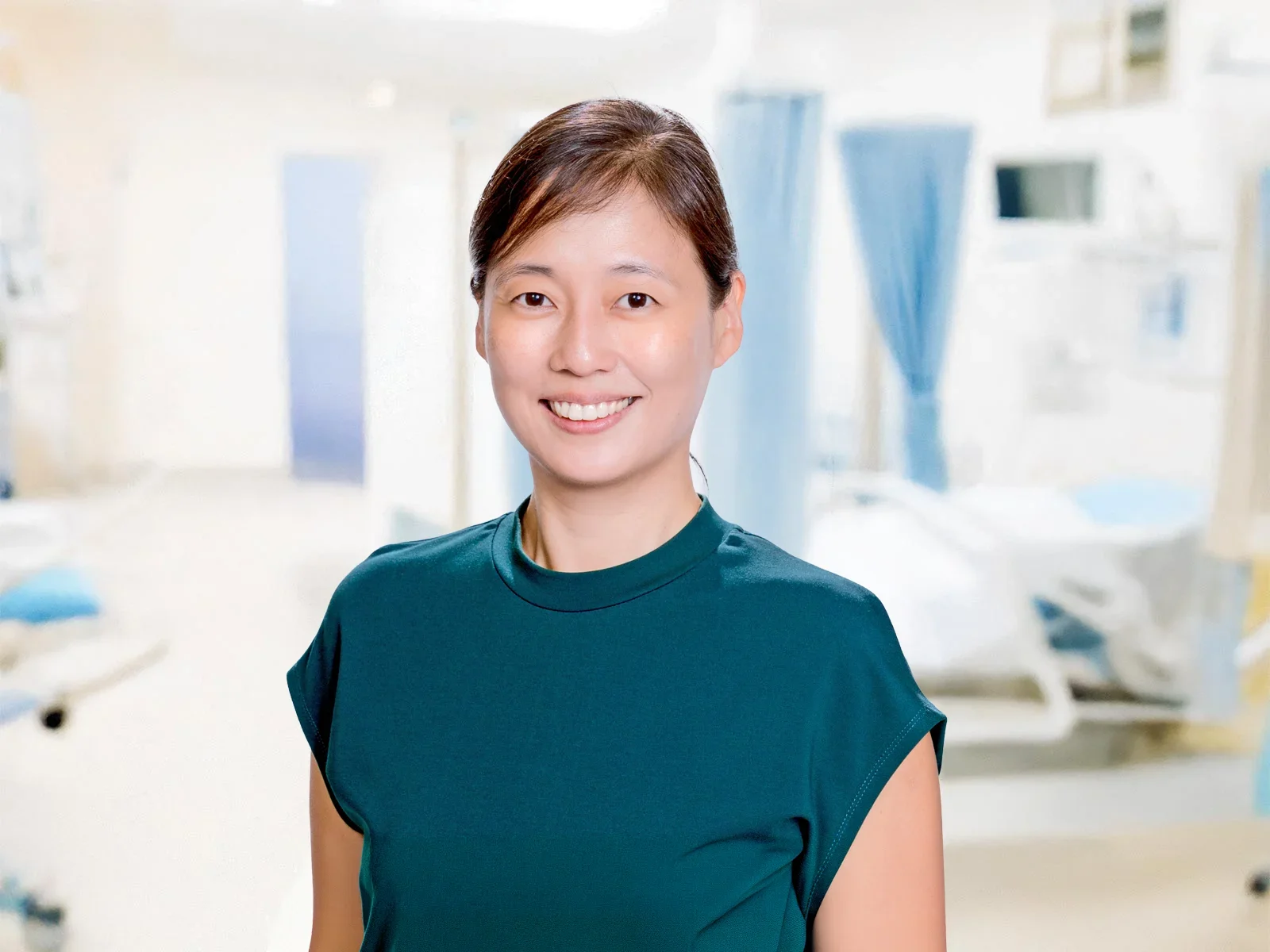
I am most proud of the community we’ve built—one where SPs value the friendships they’ve formed and the support they receive from the team. In particular, growing our Physical Examination Teaching Associate (PETA) programme and collaboration with the Department of Family Medicine to involve persons with disabilities as SPs inspire me and our team.”
More from this issue