Issue 59
Aug 2026
DOSSIER
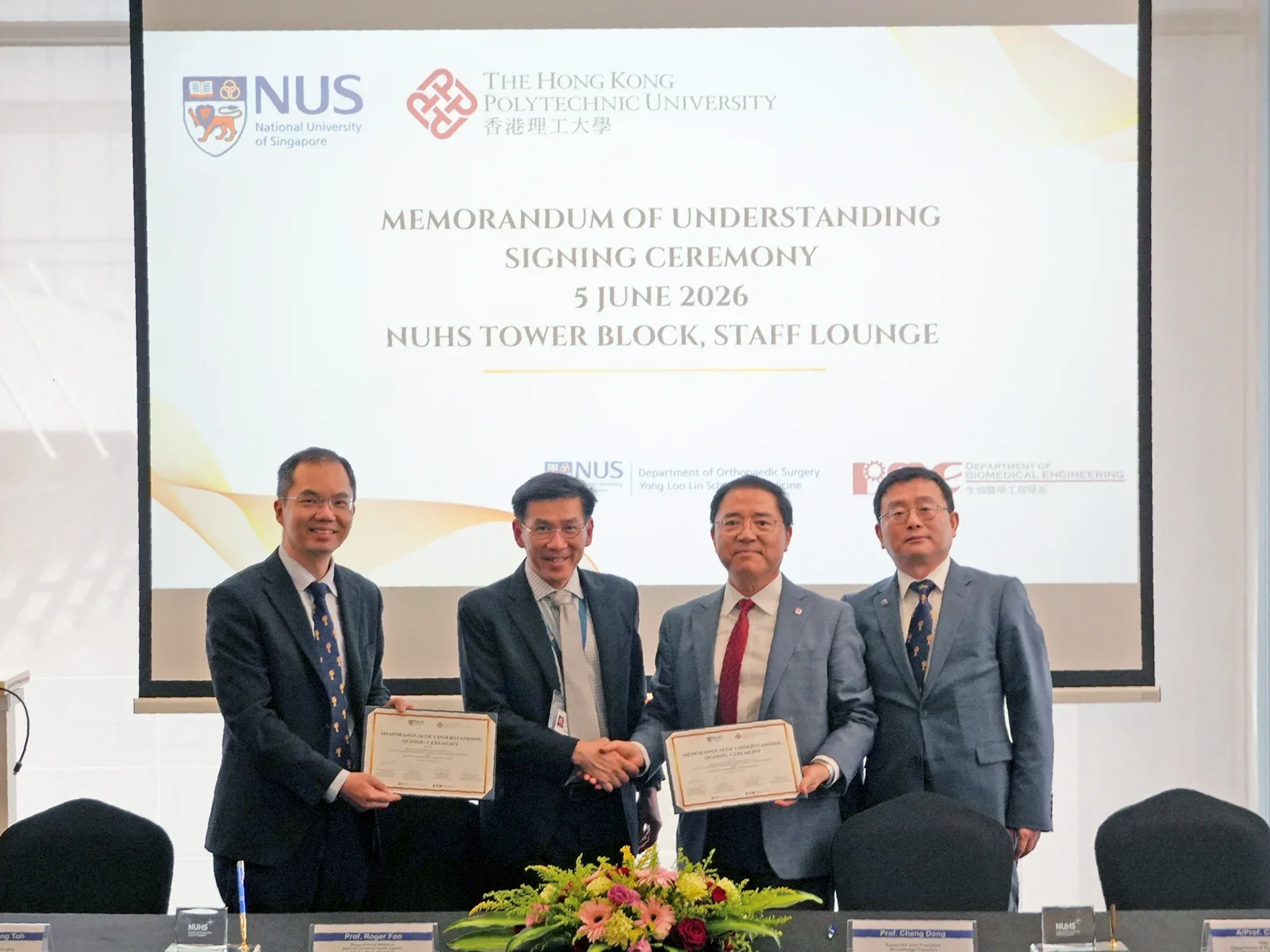
The Department of Orthopaedic Surgery at the Yong Loo Lin School of Medicine, National University of Singapore (NUS Medicine) has formalised a Memorandum of Understanding (MOU) with the Department of Biomedical Engineering at The Hong Kong Polytechnic University (PolyU) on 5 June 2026, establishing a strategic academic‐clinical partnership focused on healthy ageing, functional mobility and community-based musculoskeletal research.
At the centre of this partnership is the JointCare programme, an AI‐enabled initiative that integrates orthopaedic expertise, biomedical engineering and population health approaches to improve early detection, risk stratification and right‐siting of knee osteoarthritis (OA) in the community setting.
The programme will apply an AI‐enabled, label‐free motion profiling approach to assess lower‐limb movement patterns associated with knee OA outside traditional hospital environments. Together with a structured knee health questionnaire, this tool is designed to support community‐based risk stratification and triage, enabling more consistent right‐siting of care.
By distinguishing individuals suitable for conservative community management from those who may benefit from earlier specialist review, the model supports more appropriate referral patterns. It also has the potential to reduce unnecessary referrals, shorten time‐to‐review for clinically significant cases and improve overall efficiency in musculoskeletal care delivery.
NUS Medicine’s research mission is further strengthened through a platform for translational and implementation science, spanning AI‐driven assessment, service evaluation and population-focused musculoskeletal care in real‐world community settings. The initiative also expands education and academic capacity by creating opportunities for clinician-scientists, researchers, students and trainees to participate in a scalable, community‐embedded research programme, while building institutional capability in AI‐enabled healthcare delivery and population health research.
The project is expected to commence in the fourth quarter of 2026, with an initial pilot at Boon Lay serving as a proof‐of‐concept to evaluate feasibility and performance in a real-world setting, and refine workflows prior to broader implementation. Following successful validation, the programme will be progressively rolled out to communities across western Singapore, with a subsequent phase exploring expansion into a multi‐centre international research collaboration involving Hong Kong and potentially other countries.
Through this collaboration, the identification and management of knee OA in the community setting can be improved by enabling earlier intervention, improving care navigation and right-siting to reduce downstream burden on hospital services.
More from this issue