Issue 59
Aug 2026
THE LAST MILE
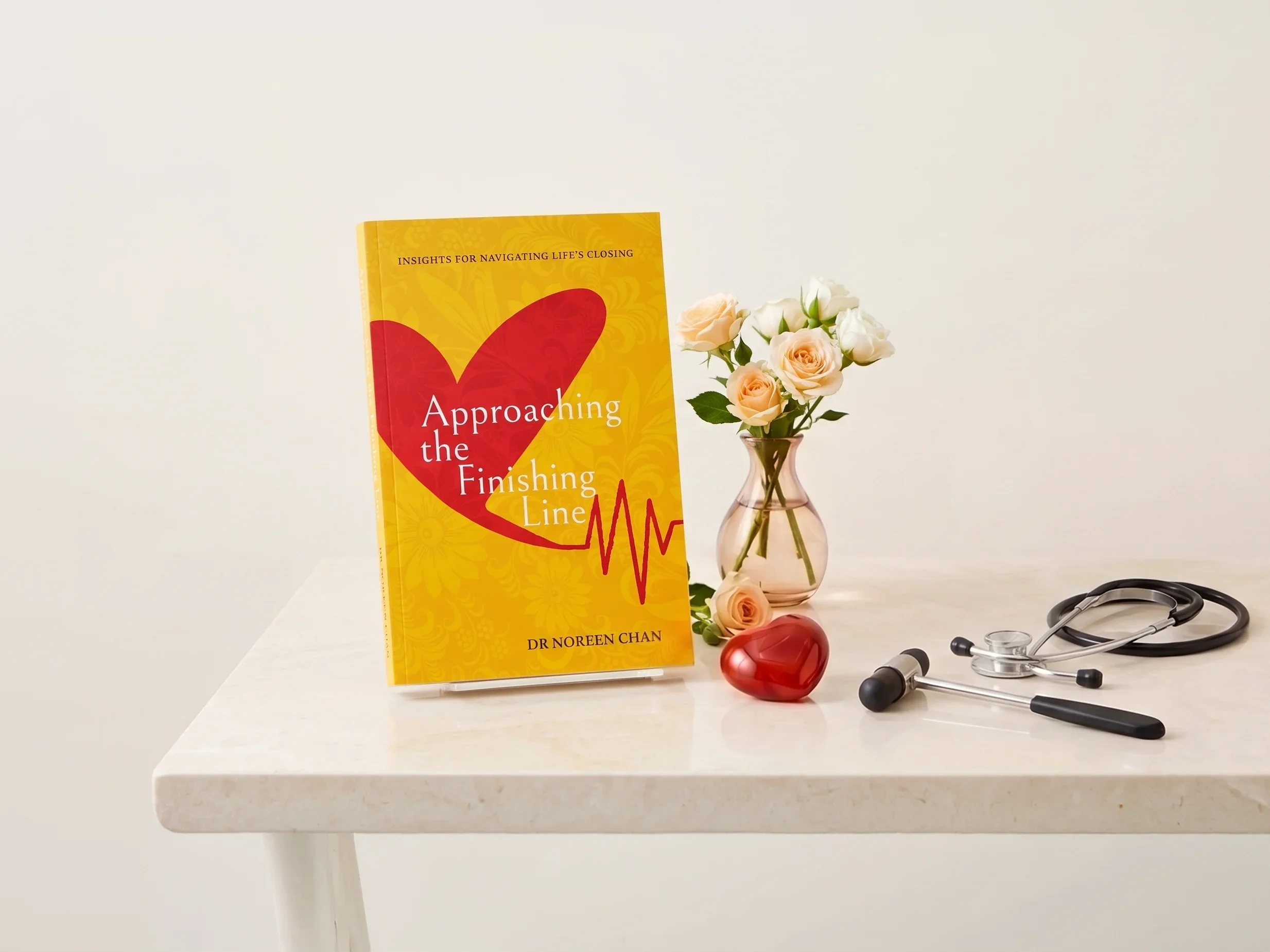
“The Last Mile” is one of the longest running columns in MediCine. Authored by palliative care specialist Dr Noreen Chan, the articles (36 and counting as of Issue No. 58) are her personal anecdotes of patients’ and families’ experiences, each offering insights into the practice of Palliative Medicine, and how individuals and their loved ones deal with impending mortality.
These stories recently found a second life when Dr Noreen Chan, Senior Consultant at the National University Cancer Institutes Division of Palliative Medicine, compiled a selection of them into “Approaching the Finishing Line”. Proceeds from the book will support the NUS Palliative Medicine Research Fund and undergraduate activities related to palliative care.
Reflecting on how the book came about, she said, “The book was the result of many helping hands. A colleague mooted the idea years ago and gently nudged me until I finally took action. Then Landmark Books generously agreed to take on the project despite it being ‘not commercially viable’. Last but not least were the donors who covered the printing costs and allowed me to focus on getting the book into as many hands as possible.”
But, before the book, there was the column. It began with a request from the NUS Medicine Communications Office to Dr Chan to participate in a television panel discussion on pain management and palliative care.
What is the role storytelling plays in Medicine and healthcare? Thirty‐six stories later, do you think you have achieved what you set out to?
A: I wanted to demystify the experience of serious illness and dying, and correct misconceptions about palliative care, in an accessible way.
Over the years, awareness of palliative care has increased through efforts of organisations like the Singapore Hospice Council and the Lien Foundation, as well as the experiences of thousands of patients and families who have received palliative care. I like to think that my articles are a small part of that collective effort.
It is never going to be a popular topic, but there is more readiness to talk about it these days, perhaps because we are an ageing society. Many of my friends and contemporaries are going through the challenges of losing or caring for elderly relatives, so it is no longer a theoretical possibility but a present reality.
That said, I still meet many people who have no idea of what palliative case is, and how it can help them and their loved ones through difficult times.
What are some areas you think we can do better where Palliative Medicine is concerned?
A: The fundamental principles of palliative care have not changed—we respond to suffering caused by illness, and we embrace patients and families in our circle of care. What this looks like on the ground is different in different countries and societies for many reasons—societal mores, health system issues, socio‐economic development, population, etc.
Singapore has done remarkably well over the past 40 years, from a small, peripheral grassroots movement to services integrated within a national healthcare system. Of course there is always more to be done. I think we could do better to encourage conversations around the realities of living and dying in the 21st century, and recognising that caring for the sick, vulnerable and dying is everyone’s business. In other words, support for patients and families should not come only from palliative care professionals and services. It should also come from individuals, families and communities.
On a more philosophical level, I am reminded of a passage in Paulo Coelho’s “Like the Flowing River” where he quotes his friend Jaime Cohen commenting on the “contradictoriness” of humans: “We are in such a hurry to grow up, and then we long for our childhood. We make ourselves ill earning money, and then spend all our money on getting well again. We think so much about the future that we neglect the present, and thus experience neither the present nor the future. We live as if we were never going to die, and die as if we had never lived.”
Your pieces are always very warm, personal and rich with personal anecdotes and reflections. How did you arrive at this style of writing?
A: Goodness! How does one answer that question? I just know that I have always enjoyed reading. I love words—what they mean, how they sound, and how they come together to convey meaning.
I write as I might speak. In fact, people tell me that when they read my writing, it is as if I am next to them having a chat. Simple, straightforward, and in my voice—just in written form. We spend decades coming to an understanding of who we are, and self-acceptance means living and expressing ourselves in an authentic way. I aim to reflect that in my writing.
What about the poems that accompany the stories? Why poems, and how do you decide on them?
A: There is an Indian proverb that says “everyone is a house with four rooms, physical, mental, emotional and spiritual. Most of us tend to live in one room most of the time, but unless we go into every room every day, even if only to keep it aired, we are not a complete person.”
Arts and the Humanities are crucial to our humanity because they are how we process and express the lived experience of humanity. When we admire a painting, read a book, consider a poem, listen to music, we get to be part of that collective experience, which in turn enriches our own understanding.
My friend and colleague Philip Iau, a trauma and breast surgeon, was once asked why he reads. He replied—and I paraphrase this—that if all he brought to the care of his patients was his direct life experience, how limited (and limiting) that would be. Reading opened windows into lives and worlds he might otherwise never know of, and gave him a broader perspective on life and work.
I chose poems because they echo what I was trying to convey, but in a different way, often with more impact. For example, in the article “How Long Have I Got?” I use Raymond Carver’s poem “What the Doctor Said”. You can sense the awkwardness, surprise, sadness … many different emotions come through in just a few simple words. Occasionally I have used song lyrics because they can do the same thing.
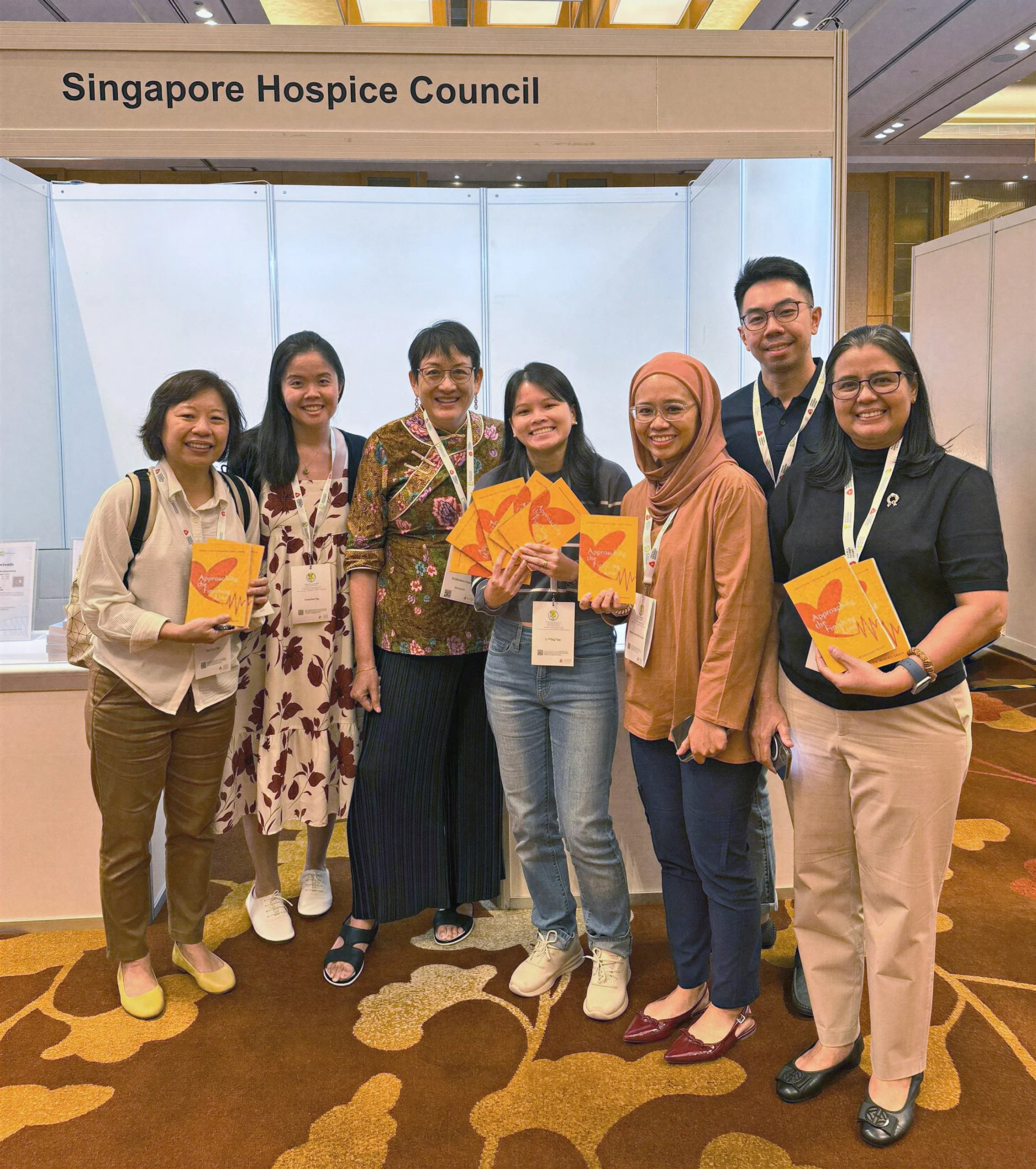
We are in such a hurry to grow up, and then we long for our childhood. We make ourselves ill earning money, and then spend all our money on getting well again. We think so much about the future that we neglect the present, and thus experience neither the present nor the future. We live as if we were never going to die, and die as if we had never lived.”
From “The Last Mile” to “Approaching the Finishing Line”, there is a clear parallel between the two. Was that coincidence or by design?
A: “The Last Mile” was inspired by logistics. The final stretch—getting the parcel to the customer once it arrives from overseas—can be the most complex, expensive, yet crucial part of the delivery process. Death and dying has parallels to this “last mile” concept because it is complex, crucial, and you have to get it right the first time.
As for the book, the title came from the publisher who also designed the cover. We chose “the finishing line” rather than “the finish line” because we found the word “finish” to be rather abrupt and therefore limiting, whereas “finishing” gives the impression of an unfolding process, which better reflects the experience.
What was it like revisiting eight years’ worth of stories for the book? Did the process lead to any new reflections about your own journey?
A: I wrote essays as the ideas came to me, so going through the whole collection was an interesting process. I had to arrange the articles in an order that makes sense to the reader. I also had to decide what to include—so not everything made it into the book—and which to use as an introduction.
Eventually, I began the book with essays on definitions and terms, before leading into the big middle section on “living with dying”—the practical aspects of living and dealing with illness in oneself or a family member, and rounding off with the last section on the dying process. Patient stories and reflections are woven throughout.
In the journey of putting together the book, I came to appreciate how much writing and creative expression has come to mean to me, and how my own self‐understanding has evolved. In my early professional career, my identity was defined by my work—first as a clinician, then as a teacher. But as I head towards retirement, progressively handing the baton to younger colleagues who will continue the clinical service and eventually my teaching leadership role, I am spending more time learning about and promoting my Peranakan culture—including training as a docent at the Peranakan museum.
I will always teach, I will always communicate, I will always advocate for compassionate care and mindful, intentional living. Just in different ways.
The book is a fundraiser supporting undergraduate activities related to palliative care. Why is it important to support medical students in palliative care education?
A: We’ve got to start them young. Our students learn how the body works, how it breaks down, and how to fix and maintain it, but not enough about what to do when it cannot be fixed. Holistic healthcare should be bio-psycho-social-spiritual, and our medical school is excellent at the “bio” part, fair on the “psycho-social”, but rather lacking in the “spiritual” part.
Palliative care teaches the importance of holistic care, and we hope our students can experience that through their short Palliative Medicine posting, and also through student activities outside the classroom.
I am not aiming to turn students into budding Palliative specialists—they will choose their own paths—but I want them to always keep in mind the PERSON beyond the disease.
If there is one takeaway from the book that readers should have, what is it?
A: It is not if, but when, where and how we die, and how we live from today until that last day. Life is a journey, but it is not how you start, but how to travel and how you finish.

More from this issue
STUDENT MATTERS
Making the InciSioN in Global Surgery