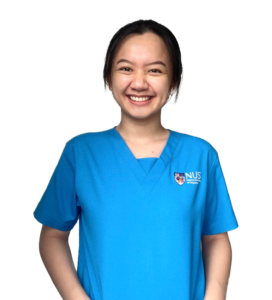


Is Nursing a calling, vocation or a profession? We think it’s all that and more—that’s why at Alice Lee Centre for Nursing Studies (NUS Nursing), National University of Singapore Yong Loo Lin School of Medicine, we help aspiring nurses to not just be empathetic clinicians and critical thinkers—but adaptable problem-solvers able to chart their own Nursing career.
From novice to nurse
Undergraduate programmes
Choosing a career is a major decision—perhaps even more so for a demanding profession such as Nursing. Students often come with their dreams and aspirations—and we have tailored our approach to ensure that students have what they need to become capable and caring nurse professionals.
|
|
Provide quality patient care There are many reasons for pursuing Nursing—whether it’s inspired by encountering nurses who have cared for loved ones or wanting to make a difference to patients’ lives. At the foundation of quality patient care is a solid grounding in clinical skills and knowledge. |
To enable our students to fulfil their aspirations, we have designed our curriculum to be rigorous and engaging. The academic curriculum is taught through a combination of classroom teaching, laboratory sessions, simulation and blended learning opportunities. More than expecting students to memorise and regurgitate information, having students play an active role in their learning helps them develop the skills to apply their knowledge effectively in the clinical setting.
|
|
Thrive in a changing healthcare landscape ‘Why do some patients fall into a readmissions spiral?’ ‘How do religious beliefs factor into work as a nurse?’ ‘What are the ways AI tools can help to improve patient care?’ |
Technological advances, global pandemics and ageing populations have transformed the healthcare landscape. Naturally, aspiring healthcare practitioners will be curious about social factors, ethics and professionalism, and technology in the healthcare setting.
To help Nursing students gain the knowledge and perspective to form their own answers and leverage available resources—the Common Curriculum for Health Professional Education covers topics such as social issues, ethics and professionalism, and digital literacy. We hope that by equipping them with these key skills, students will be able to advance patient care and improve health outcomes.
|
|
Contribute meaningfully as a member of the care team In the wards, nurses spend much of their time interacting with patients—monitoring vitals, administering medication and offering comfort. Their close interactions with patients mean that they are well-placed to be the patient’s advocate—and play a key role in communicating critical information to the rest of the healthcare team. |
As part of the Common Curriculum for Health Professional Education, Nursing students will learn alongside their peers from NUS Medicine, Dentistry and Pharmacy. This interprofessional learning experience builds rapport, familiarises students with working in interprofessional teams and smoothens the path for future collaborations in the workforce.
|
|
Gain real-world clinical experience before graduation Stepping into the wards as a young nurse can be nerve-wracking—lists of tasks to do, work flows to remember, patients to care for—which is why we ease our students into clinical practice through a structured curriculum. Students first pick up foundational skills by practising in supervised clinical laboratory sessions and simulation learning—followed by clinical attachments at a wide variety of healthcare settings and institutions. They will be attached to experienced nurse preceptors who will guide them throughout their placements. |
By experiencing a range of healthcare settings such as the emergency department, mental health, paediatrics and operating theatre, students also get to explore different facets of Nursing and specialties they might be interested in pursuing after graduation.
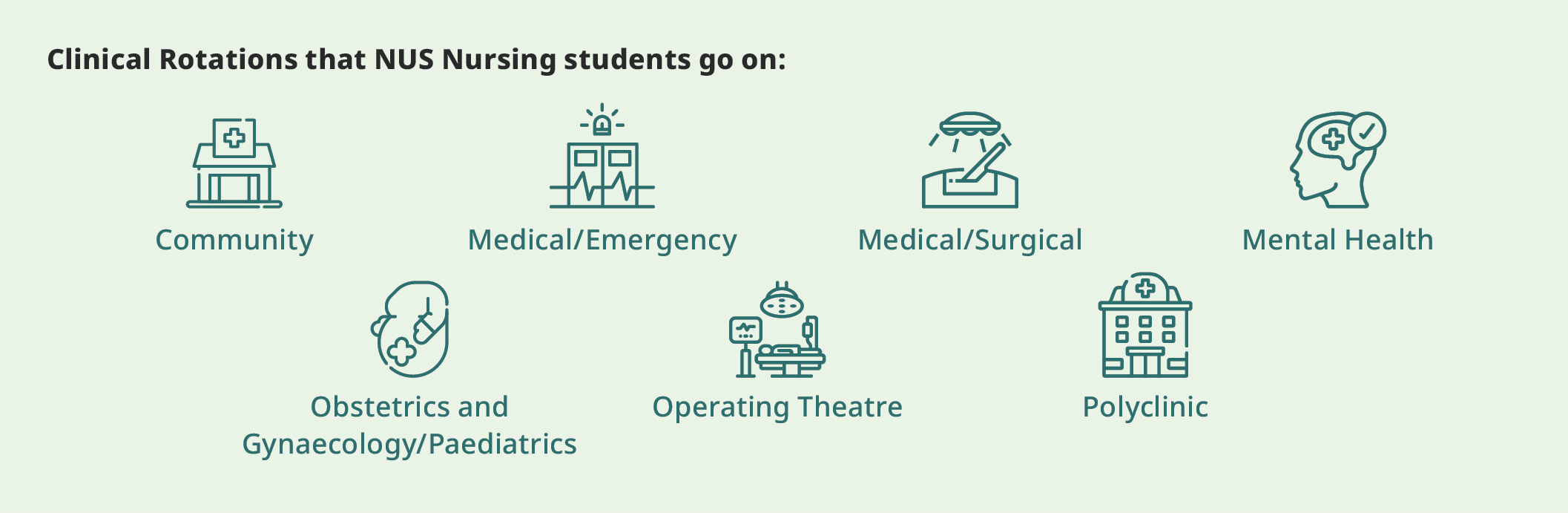
|
|
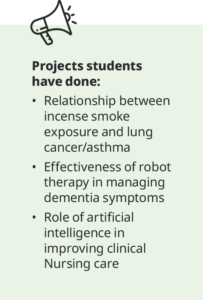
Do impactful research as an undergraduate Ways to improve chronic disease management, how social backgrounds influence patients’ medical outcomes, using data analytics to predict susceptibility to disease—in the course of their studies, Nursing students often have questions and ideas about what they encounter in class and out on clinical attachment. |
|
Our one-year Honours Programme nurtures this curiosity—enabling students to pick up research basics such as evidence-based healthcare practice and applied research methods. Guided by faculty members, students have the opportunity to research on a topic of their own choosing. Depending on their project, they may conduct studies in healthcare settings, and publish their findings in renowned Nursing journals—potentially influencing clinical practice and informing healthcare policy. |
|
|
|
Develop as a well-rounded student nurse Every day, nurses are called upon to exercise a whole range of skills—clinical skills to care for patients; time management to discharge their clinical and administrative duties; teamwork to collaborate with other members of the healthcare team; communication skills to connect with patients and their family members from all walks of life, amongst others. |
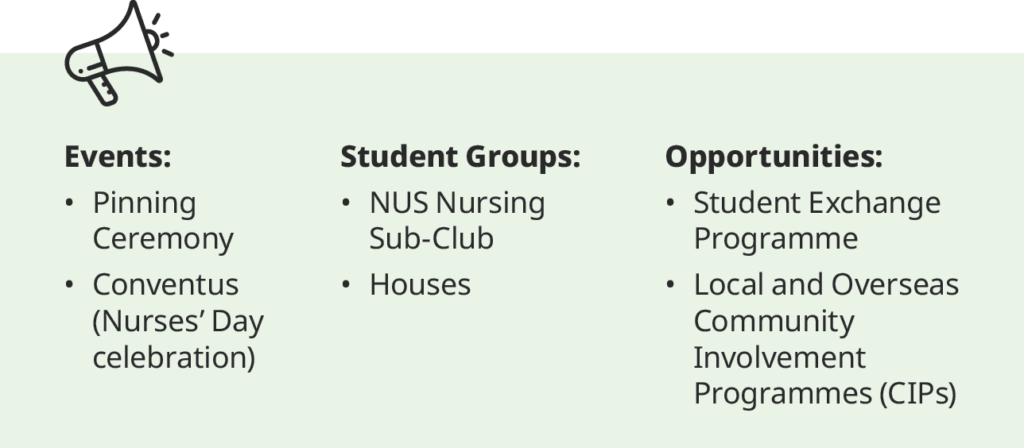
We recognise that the classroom is not the only place to learn such skills—and the wide range of student life opportunities on offer can be intimidating to new students. To ease them in, Nursing students are placed in our NUS Nursing House system and the Nursing Sub-Club upon matriculation. Besides getting to know their fellow Nursing students, seniors are also available to guide them along as they get used to university life.
With the university-wide launch of NUSOne in Academic Year 2024/2025, we are also working with faculty and students to upgrade our student life activities to offer a richer learning experience.
From competence to mastery
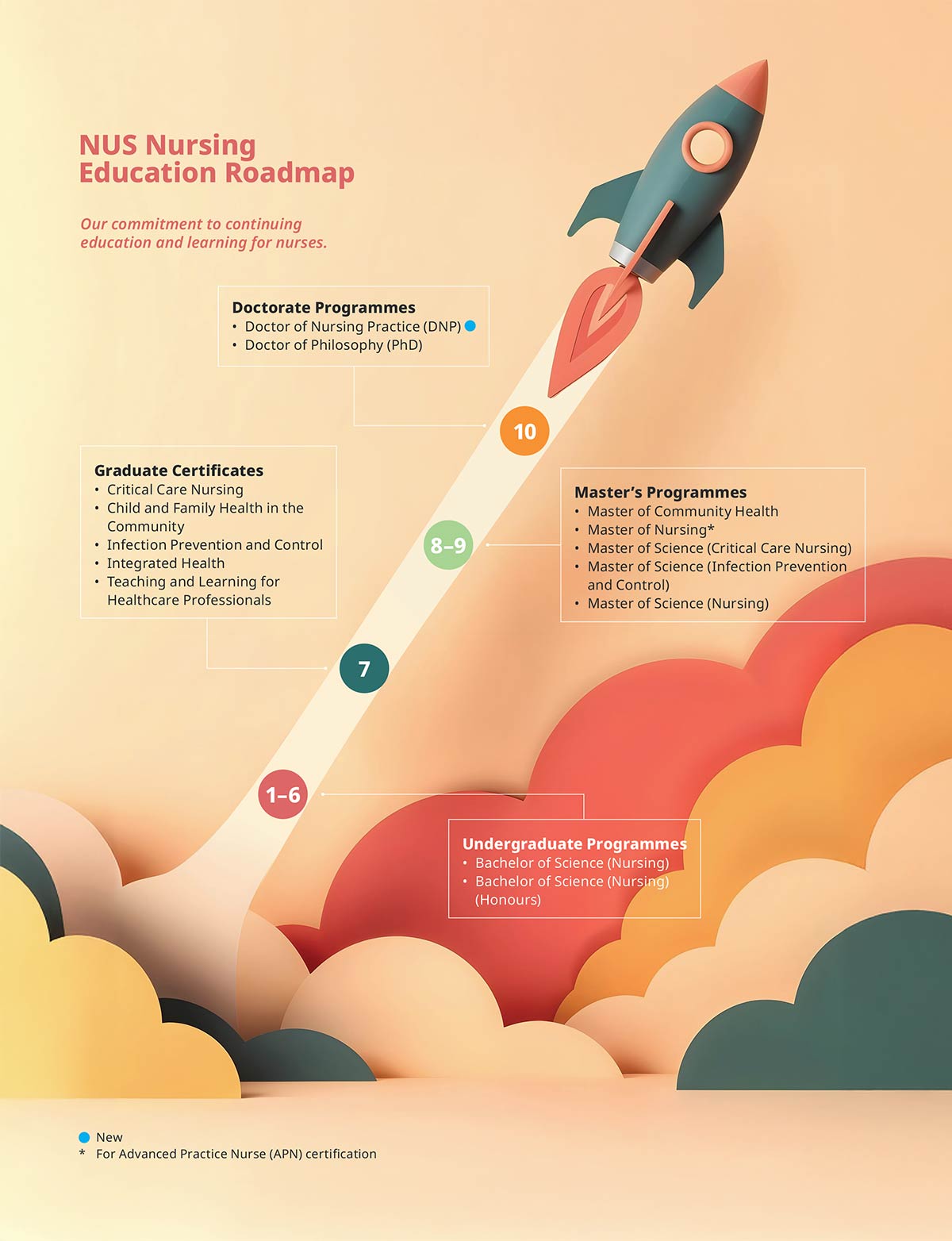
Post-graduate and continuing education programmes
After graduation, Nursing students step out into the world to pursue their dream careers and make a difference to patients’ lives—across different disciplines and institutions in the healthcare industry. But far from this being the end of our relationship, we remain committed to supporting our graduates throughout their Nursing journeys.
|
|
Keep up with the latest in Nursing Change is a given in the healthcare landscape as technology advances and our population demographics change. Our graduates may leave campus well-versed in current Nursing practices, but we recognise that clinical practices and standards of care can look very different just a few years down the road. |
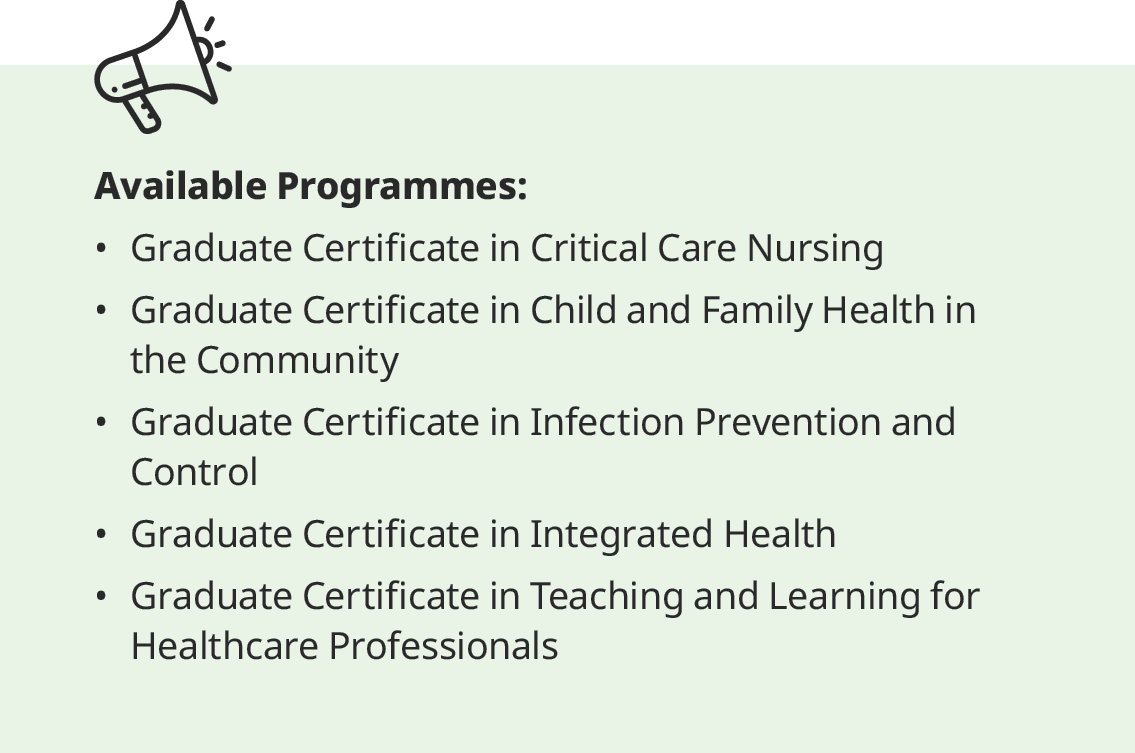
In addition to that, shift work and packed schedules make it difficult to take time away for skills upgrading. Spending too much time away from the bedside may also mean losing touch with workflows on the ground. With this in mind, our Graduate Certificate courses are offered part-time, as well as stackable towards Master’s degrees—enabling nurses to acquire new specialisations or stay up-to-date with the latest Nursing developments.
|
|
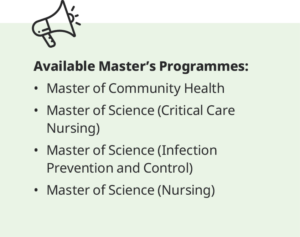
Achieve mastery for the next step up the career ladder Passion for their chosen specialisation often drives nurses to strive for mastery in their work and advance Nursing standards and practice in their field. Achieving these require strong clinical and leadership capabilities, which our Master’s programmes provide. |
For advanced clinical practice and Nursing leadership roles, our Master’s programmes offer ambitious nurses the academic foundation to hone their expertise and capacity for solving pressing issues in their fields.
|
|
Become an Advanced Practice Nurse (APN) APNs are expert Registered Nurses (having at least five years of clinical experience), with the capability to diagnose and manage common illnesses, run clinics independently and prescribe medications. To take on such expanded scope, aspiring APNs take the 18-month Master of Nursing (MN) course, followed by a 12-month internship. |
As the only Nursing school in Singapore to offer the Master of Nursing (MN) course leading to APN certification, we work closely with the Singapore Nursing Board and the Ministry of Health to prepare future APNs for greater responsibilities. Our APN graduates often share that while the road to APN certification may be gruelling—the result is more than well worth it as they grow their capability to make a positive difference to patients’ health.
|
|
Push the limits of Nursing leadership and research It may be previously unheard of—but nurses today are pushing the envelope of Nursing leadership and research. They are taking up C-suite roles and responsibilities and contributing to cutting-edge healthcare research. |
To help students prepare for that stage of their careers, we equip them with the knowledge and capabilities to dive into the complexities of Nursing practice, research, education and policy—where they are poised to contribute to improving healthcare practices and drive change across the healthcare system.