
83.2%
of respondents were able to correctly define the term “lifespan”, but just
41.3%
could correctly define “healthspan”
55.5%
of respondents reported interest in visiting healthy longevity medicine clinics

Issue 58
May 2026
LIFE, FULL OF YEARS
By Christian Ron Niembra Sotelo, Research Assistant and Operation Lead for HELO, NUS Academy for Healthy Longevity, NUS Yong Loo Ling School of Medicine, Jordi Morwani Mangnani, Research Fellow, NUS Academy for Healthy Longevity, NUS Yong Loo Ling School of Medicine, and Andrik Peter Furtado Fernandes, HELO intern, NUS Academy for Healthy Longevity, NUS Yong Loo Ling School of Medicine.

Life, full of years is a new column profiling the work of NUS Medicine researchers in longevity health. One such effort is the HELO Initiative at the NUS Academy for Healthy Longevity.
In Singapore, life expectancy is approximately 84 years. However, the average healthspan is around 74 years, meaning that many individuals spend nearly a decade in sub-optimal health, struggling with chronic conditions such as diabetes, cardiovascular disease or cancer. For many people around the world—and increasingly in Singapore—this scenario is becoming the norm rather than the exception.
Healthy longevity seeks to change this narrative by extending not only how long people live, but how long they live in good health. Rather than focusing solely on lifespan—the total number of years lived—the concept of healthspan emphasises the number of years lived free from major chronic disease or disability1.
This shift in focus towards helping people live full, healthy, long lives reflects a growing international priority. The World Health Organization (WHO) has declared 2021 to 2030 the “Decade of Healthy Ageing”, a global initiative aimed at improving the lives of older people, their families, and communities through healthier ageing policies and systems2,3.
To address this challenge, the NUS Academy for Healthy Longevity at the Yong Loo Lin School of Medicine, National University of Singapore (NUS Medicine), launched the Healthy Longevity (HELO) initiative. The initiative aims to understand how the public perceives healthy longevity and translate these perspectives into actionable insights for healthcare systems, policy development and clinical practice.
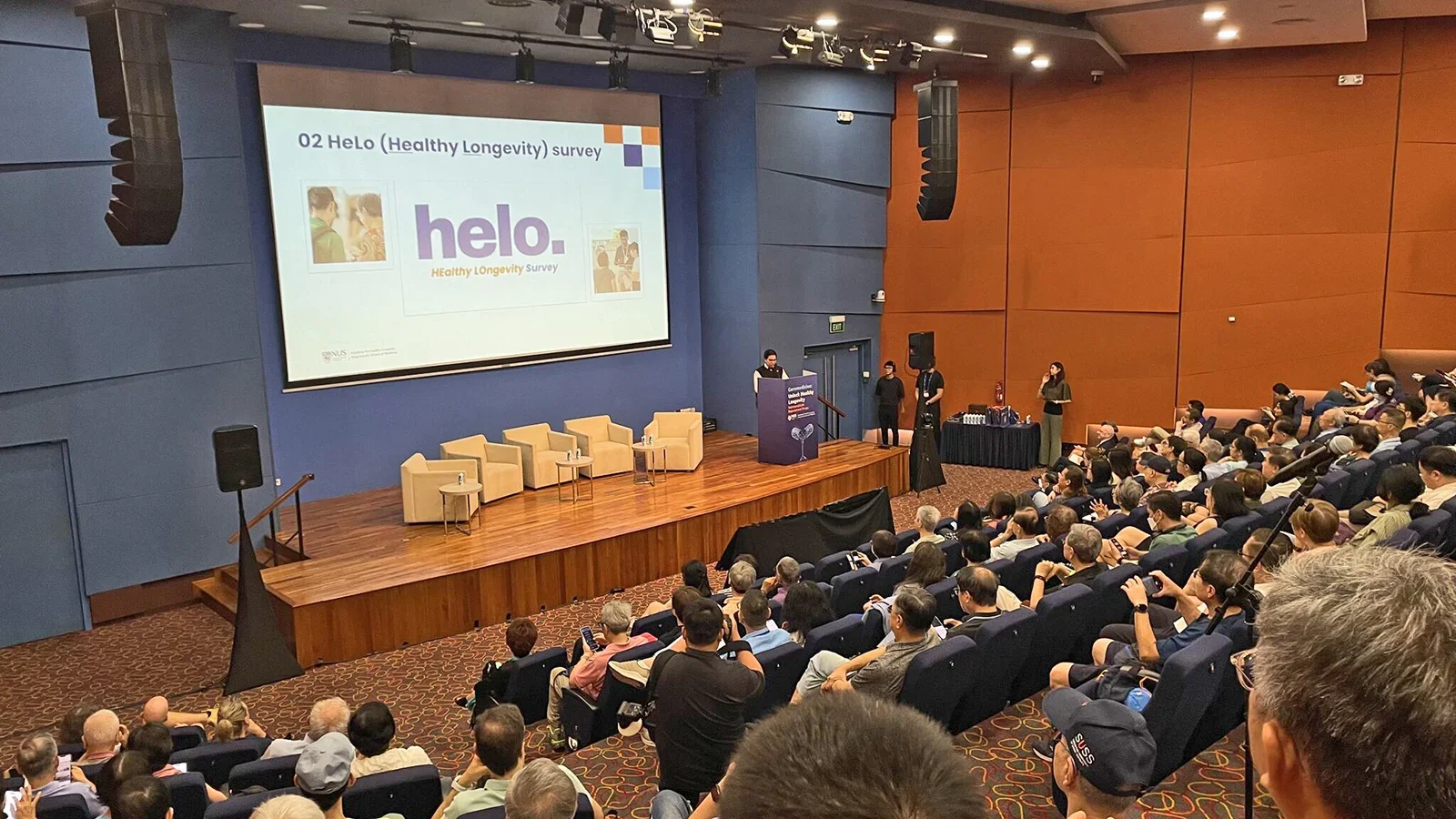
HELO Consortium presentation, Geromedicine Conference Public Open Day, March 28, 2026.
Understanding public perspectives on healthy longevity
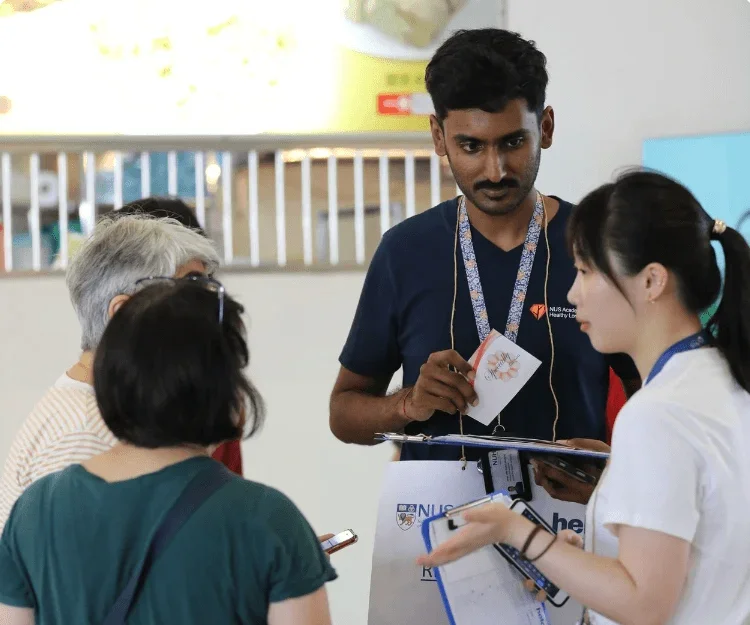
A key component of the HELO initiative is the survey. The first was conducted among 3,034 adults aged 18 years and above in Singapore between June and August 2024. Participants were recruited through 2,003 door‐to‐door interviews and 1,031 online responses, allowing perspectives from a broad cross‐section of the population to be captured4.
The study sample had a median age of 46 years, with 54% female participants, 71% identifying as Chinese, 83% Singapore citizens or permanent residents, and 22% reporting at least one chronic disease.
The research was guided by the HELO conceptual framework5, which organises public views on healthy longevity into two evidence‐based domains:
1. |
Awareness and knowledge of lifespan, healthspan and healthy longevity medicine (HLM) |
2. |
Motivational drivers—such as personality, behaviours, values/beliefs, health perceptions which influence individuals’ willingness to pursue strategies aimed at extending both lifespan and healthspan |
To operationalise these domains, the survey incorporated validated international measurement instruments, including the Big Five Inventory, WHO Ageism Scale, Aspiration Index5. These tools enabled researchers to study not only knowledge levels but also psychological and behavioural factors that shape attitudes toward healthy ageing.

Key findings from the Singapore HELO survey
While 82.3% of respondents were able to correctly define the term “lifespan”, just 41.3% could correctly define “healthspan”. This difference highlights a substantial opportunity for improving public awareness of healthy longevity concepts. The survey also revealed strong public interest once the concept of healthspan was explained. After learning about the idea of extending years lived in good health, 55.5% of respondents reported interest in visiting healthy longevity medicine clinics6.
These findings suggest that increasing awareness of healthspan may play a key role in encouraging individuals to engage with preventive healthcare strategies aimed at maintaining long-term health and functional independence.
From Singapore to the world: The global HELO consortium
Building on the insights from the Singapore survey, the NUS Academy for Healthy Longevity established the Global HELO Consortium in 2024, a collaborative international research network designed to examine public perspectives on healthy longevity medicine across countries and cultures.
By the first quarter of 2026, 15 countries have adopted the HELO survey, enabling researchers to explore how different populations understand and engage with healthy longevity practices.
The consortium includes partners from Australia, Chile, Hungary, Indonesia, the Netherlands, Poland, Qatar, Switzerland, Thailand, Nigeria, UAE, the UK and the US. Through this network, we aim to generate comparable international data that can inform healthy ageing strategies across different healthcare systems and cultural contexts.
In addition to surveying members of the public, the initiative is expanding to include healthcare professionals, academic leadership and policy stakeholders. This broader approach enables comparisons between the perspectives of the public, healthcare providers and decision-makers involved in shaping healthcare systems.
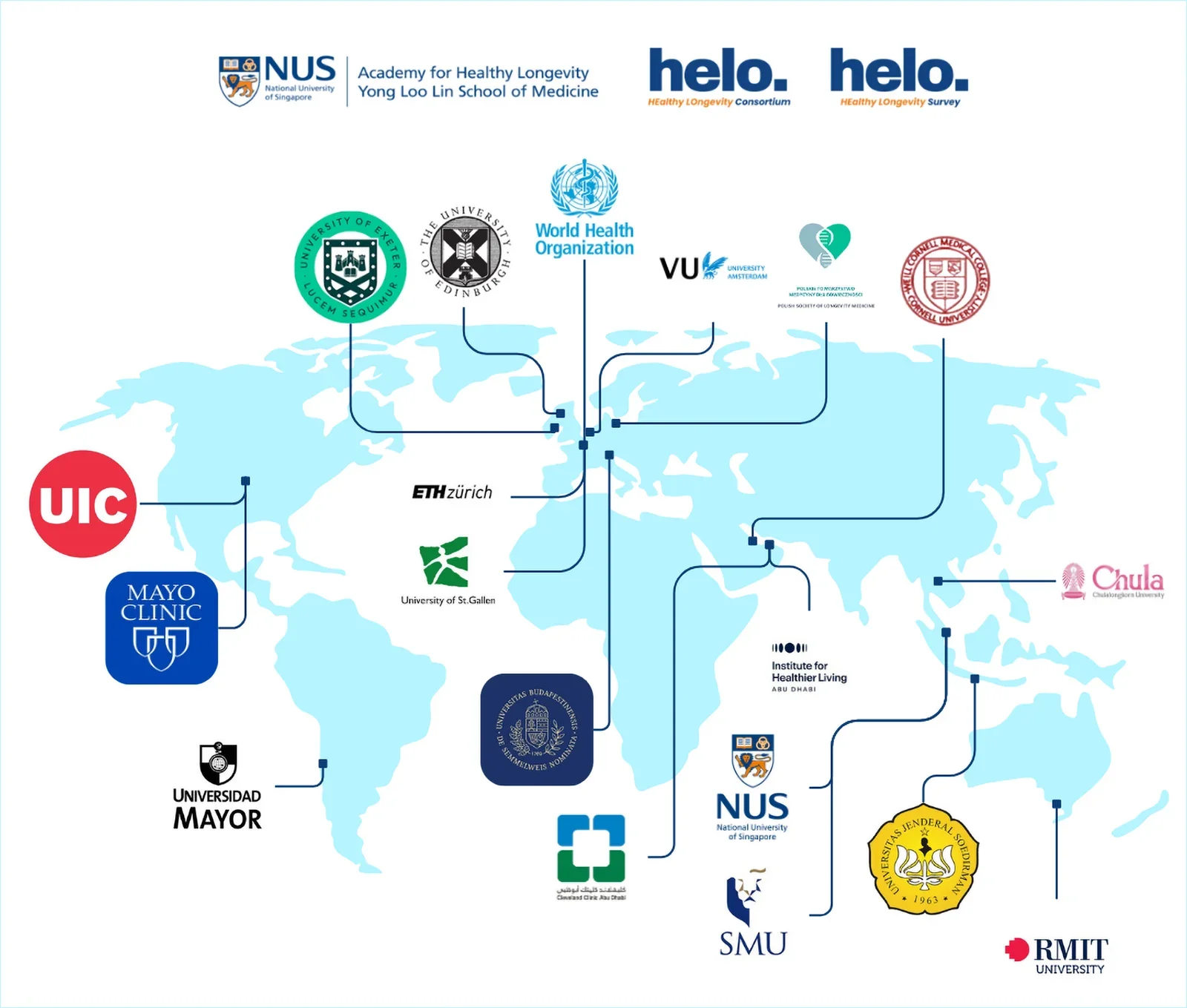
Global HELO Consortium Map.
From public perspectives to policy implementation to desired outcomes
The goal of the HELO initiative is to translate research insights into practical changes in healthcare systems and policy.
Findings from the Singapore survey highlight both a challenge and an opportunity. On one hand, public awareness of healthspan and healthy longevity medicine remains relatively limited. On the other hand, there is strong interest, particularly among younger and middle-aged adults, in taking a more proactive approach to maintaining health across the lifespan.
Bridging this awareness gap will require coordinated efforts in public education, healthcare innovation and policy development. Providing accessible information about healthy longevity, expanding preventive healthcare services, and developing healthy longevity clinics may help individuals take earlier and more active steps to maintain their health.
Through the Global HELO Consortium, the NUS Academy for Healthy Longevity aims to contribute evidence that supports governments, healthcare systems and institutions in developing strategies to extend both lifespan and healthspan.
As populations continue to age worldwide, initiatives such as HELO demonstrate how understanding public perspectives can help guide the planning and delivery of healthcare services, shifting the focus from treating disease to sustaining health throughout the human lifespan.
Bridging this awareness gap will require coordinated efforts in public education, healthcare innovation and policy development. Providing accessible information about healthy longevity, expanding preventive healthcare services, and developing healthy longevity clinics may help individuals take earlier and more active steps to maintain their health.
Masfiah, S., et al., Definitions of healthspan: A systematic review. Ageing Res Rev, 2025. 111: p. 102806.
Organization, W.H., Decade of Healthy Ageing. 2019.
Foundation, H., The Global Healthspan Report. 2024.
Amalaraj, J.J.P., et al., Towards Precision Geromedicine in Singapore. Geroscience, 2025. 47(5): p. 6399–6409.
Wang, B., et al., Awareness, knowledge, and motivations about lifespan, healthspan, and Healthy Longevity Medicine in the general population: the HEalthy LOngevity (HELO) conceptual framework. Geroscience, 2025. 47(3): p. 4567–4576.
Amalaraj, J.J.P., et al., Knowledge of lifespan and healthspan and interest in Healthy Longevity Medicine among the general population in Singapore: the Singapore HEalthy LOngevity (HELO) survey. GeroScience, 2026.
More from this issue

THE LAST MILE
Being Present to Suffering
THE BANYAN TREE
Redefining Healthcare through Design Thinking and AI Leadership
SCIENCE OF LIFE
Seeking Prometheus’ Fire
