NUS Medicine student conducts research to support caring for the carer
Published: 03 Sep 2026

Phoebe Sing, Year 4 NUS Medicine Student
Before Phoebe Sing started medical school, the current Year 4 NUS Medicine student began her healthcare journey by volunteering at a neighbourhood clinic for a year. Through countless interactions with colleagues and patients, she became increasingly aware of the challenges faced by healthcare professionals, from workplace abuse and job dissatisfaction to burnout and emotional fatigue. Witnessing these realities firsthand sparked a deep commitment in her to advocate for the well-being of those who dedicate their lives to caring for others.
Her advocacy efforts began in 2022, when she penned a commentary in The Straits Times titled “Healthcare workers can try four Ps to ease patients’ frustrations”. In the article, Phoebe highlighted how healthcare workers can apply Perceptions, Posture, Possibilities, and Patience, to strengthen patient-provider relationships and reducing instances of abuse towards healthcare workers. A pre-university student at the time, the article marked the beginning of her advocacy efforts.
Phoebe remained deeply committed to this cause while pursuing her medical studies at NUS Medicine. Together with her mentor, Dr Arthur Lau, a lecturer at the Department of Anatomy, she explored the body of research on workplace violence and abuse in healthcare settings. Through extensive literature reviews, analysis, and discussions, they identified gaps in existing knowledge and examined frameworks that could be adapted to address healthcare worker abuse within the Singapore context.
One finding that particularly resonated with Phoebe was that at least one in three healthcare workers in Singapore had experienced or witnessed abuse. The magnitude of the issue underscored the urgent need for change and reinforced her belief that greater respect and protection for healthcare workers must be cultivated across society.
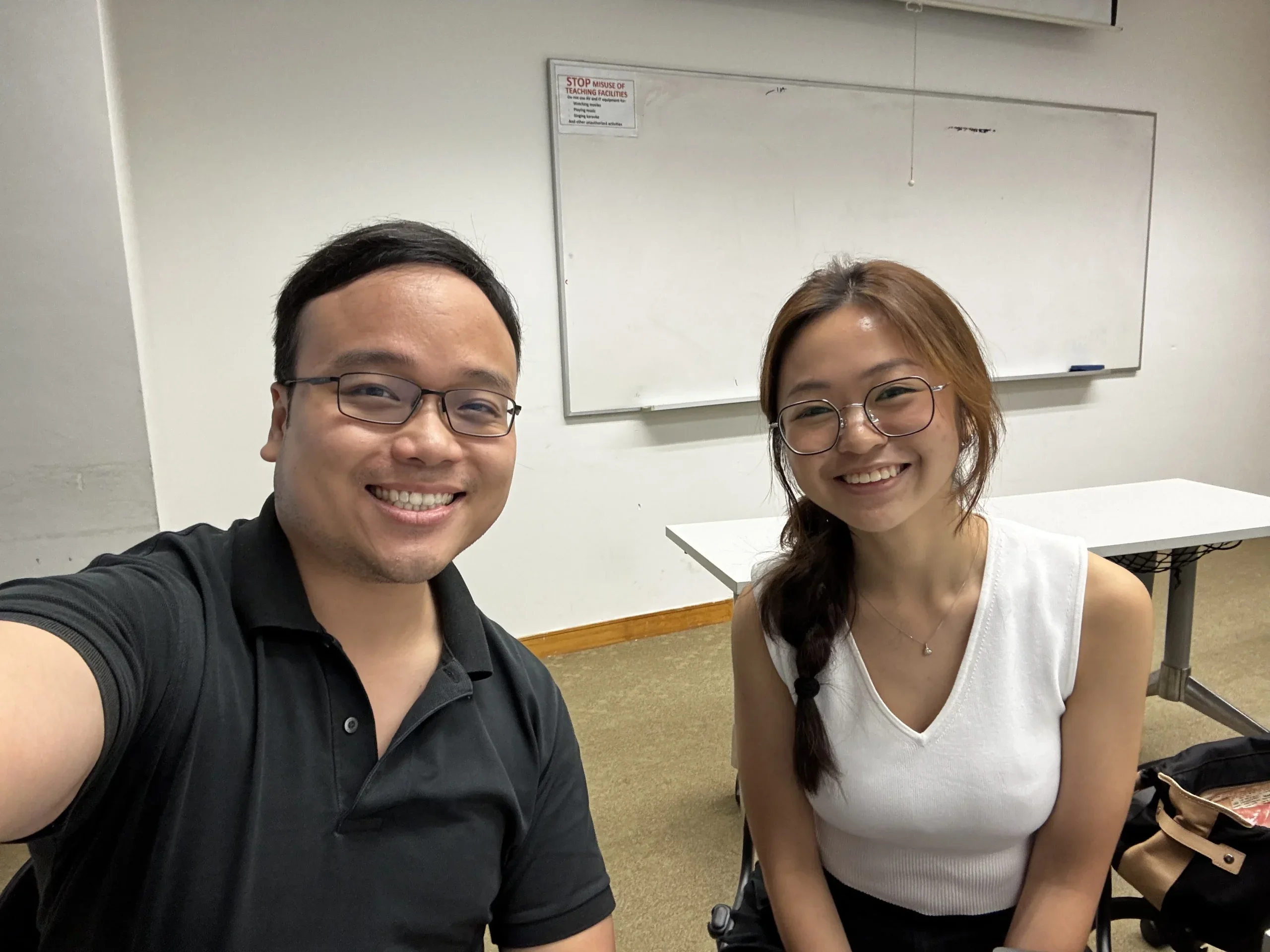
Phoebe (right) and her mentor, Dr Arthur Lau (left), collaborating on their research publication.
In 2025, Phoebe and Dr Lau published their research titled “A scoping review of workplace violence against healthcare workers in Singapore” in Frontiers in Public Health. Following the publication, she submitted an abstract to the AAHCI Student Leadership Initiative (ASLI) Ignite! 2026. Organised under the Association of Academic Health Centres International, a global network affiliated with the Association of American Medical Colleges, the initiative provided an opportunity to draw attention to workplace violence against healthcare workers on an international stage.
Representing NUS Medicine as a finalist at ASLI Ignite! 2026 was both an honour and a valuable learning experience for Phoebe. She is deeply grateful to her other mentors, including Professor Dinesh Kumar from the Department of Anatomy, as well as Dr Timothy Hart and Professor Helen Smith from the Centre for Infectious Disease Emergency Response, for their guidance and support throughout her journey. Beyond presenting her research, Phoebe engaged with healthcare leaders, students, and researchers from around the world, gaining insights into healthcare challenges and innovations from countries including Malaysia, the United States, and Colombia.

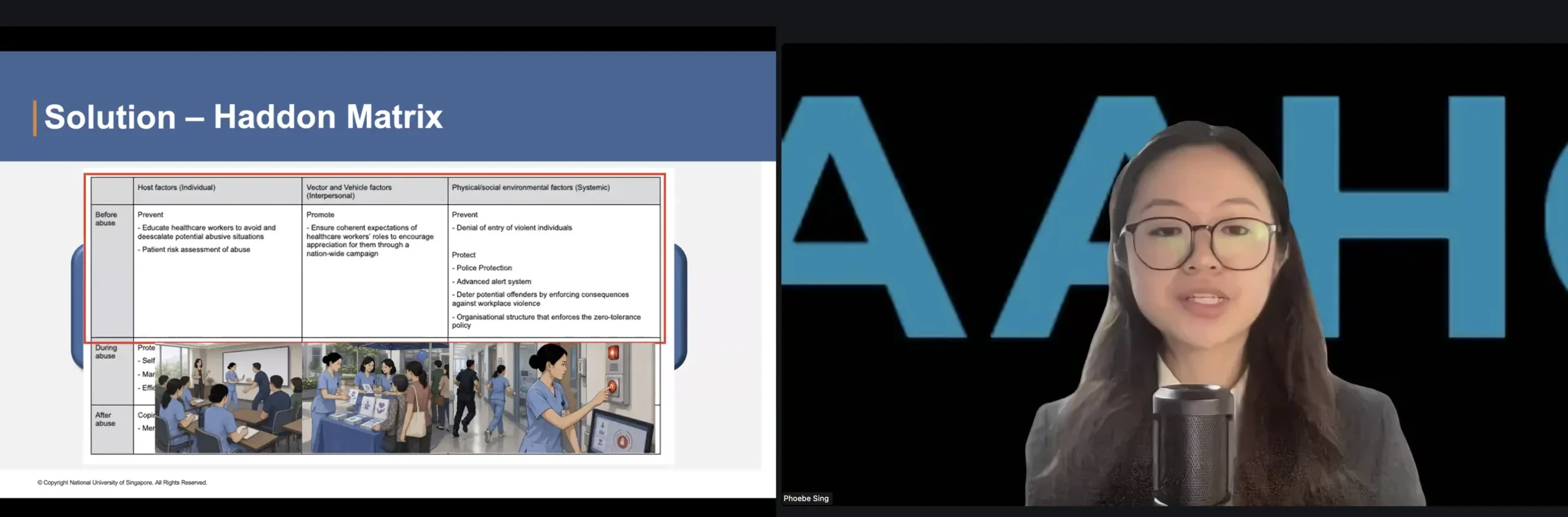
Phoebe Sing, a Year 4 medical student at NUS Medicine, sharing the Frontiers in Public Health publication during her presentation at the AAHCI Student Leadership Initiative (ASLI) Ignite! 2026
Her presentation highlighted three key messages. First, abuse against healthcare workers is increasing and has far-reaching consequences, including reduced patient safety and higher turnover intentions among healthcare professionals. Second, workplace abuse often exists within a self-reinforcing cycle characterised by inadequate consequences, learned helplessness, and underreporting. Third, this cycle can be disrupted through the application of the Haddon Matrix, a framework that targets contributing factors across different stages and stakeholders, coupled with a simple and accessible reporting system.
For Phoebe, the experience extended far beyond presenting research or representing her university internationally. It deepened her understanding of workplace violence in healthcare, strengthened the values that guide her work, and reaffirmed the purpose behind her advocacy.
As Phoebe continues her medical journey, she hopes to further advocate for the welfare, dignity, and well-being of healthcare workers, guided by a simple but powerful belief: those who care for others deserve to be cared for too.