New nanobody shows promise in targeting tumour-fuelling fluid in advanced abdominal cancers
Published: 20 Oct 2026
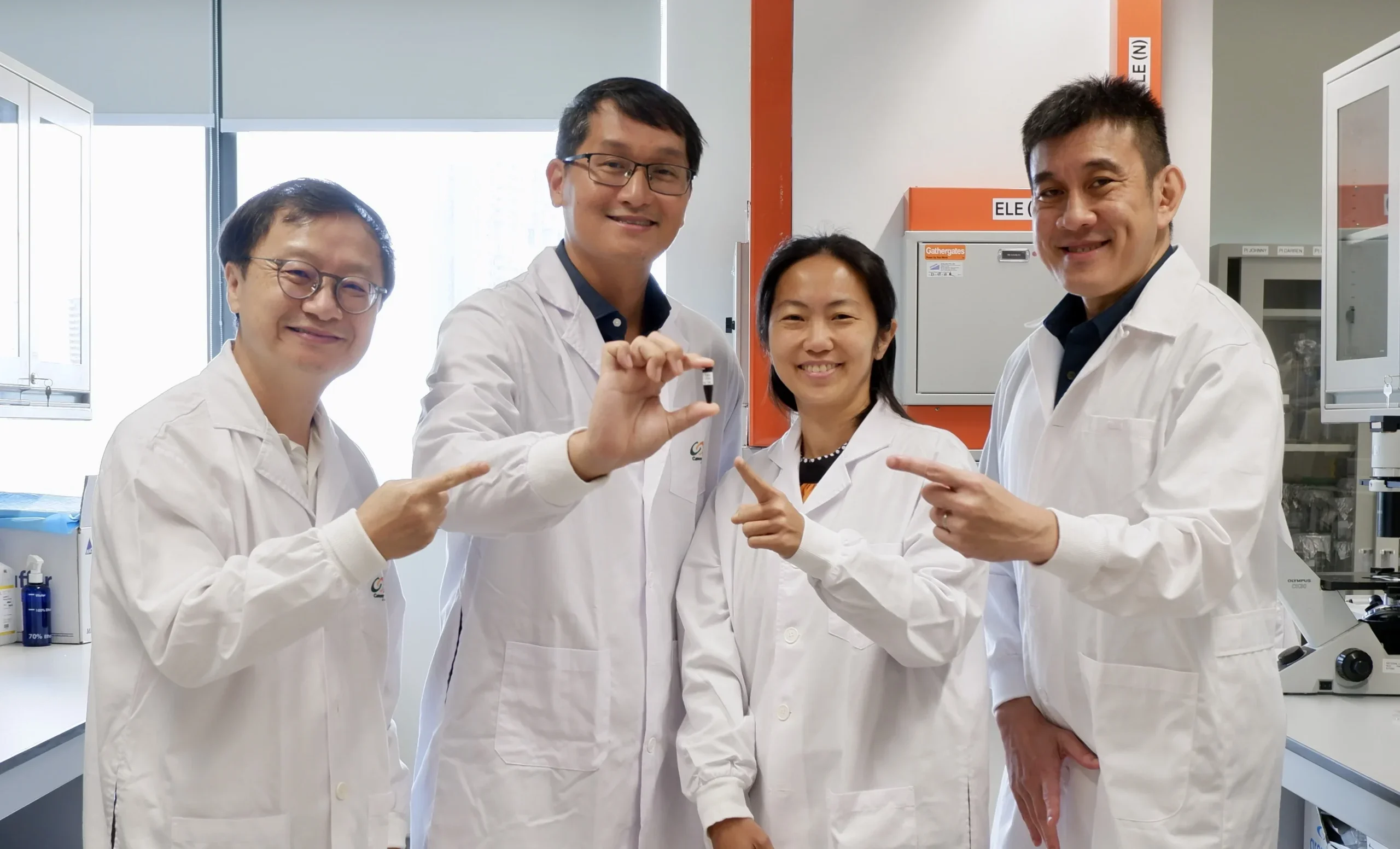
From left to right: Professor Jimmy So, Department of Surgery, NUS Medicine; Associate Professor Johnny Ong, Head, Department of Sarcoma, Peritoneal and Rare Tumours (SPRinT), SGH & NCCS; Clinical Associate Professor Claramae Chia, Senior Consultant, SPRinT, SGH & NCCS; and Professor Tony Lim, Chairman, Division of Pathology, SGH.
A research team led by the National Cancer Centre Singapore (NCCS), in collaboration with NUS Yong Loo Lin School of Medicine, the A*STAR Institute of Molecular and Cell Biology (A*STAR IMCB), and Singapore General Hospital (SGH), has developed a nanobody that suppresses tumour growth in preclinical models of peritoneal metastases.
Peritoneal metastases occur when cancer spreads to the lining of the abdominal cavity. The condition has limited treatment options and a median survival of less than nine months. Patients frequently develop ascites, a build-up of fluid in the abdomen that contains proteins capable of promoting tumour growth.
Published in Molecular Cancer in September 2026, the study analysed 397 ascites samples across 21 cancer types, identifying two proteins, PAI-1 and S100A10, as key drivers of tumour growth. The team subsequently developed a nanobody, E8, that targets PAI-1.
Using laboratory cell assays, laboratory models and human tumour tissue models, the researchers demonstrated that E8 could suppress tumour growth with minimal toxicity. Rather than targeting cancer cells directly, the approach focuses on the surrounding environment that supports tumour development.
The findings build on earlier NCCS research in 2022, which showed that targeting ascites could help inhibit tumour growth. The latest study further maps the fluid’s molecular composition and identifies potential therapeutic targets.
Professor Jimmy So, from the Department of Surgery at NUS Medicine, said, “This discovery is particularly encouraging because of its potential to pave the way for an effective therapy for peritoneal metastasis, a common and often deadly complication of many abdominal cancers. We hope this research can ultimately translate into better treatment options and renewed hope for patients facing this difficult condition.”
Professor So is also Head and Senior Consultant of the Division of General Surgery (Upper Gastrointestinal Surgery) at National University Hospital, and Head and Senior Consultant of the Division of Surgical Oncology at the National University Cancer Institute, Singapore.
The team is working to advance E8 towards clinical-grade development and a first-in-human clinical trial. It is also developing a companion biomarker test to identify patients with elevated PAI-1 levels who may be most likely to benefit from the treatment.
These efforts fall under the Melyorax Initiative, a biologics research programme led by Associate Professor Johnny Ong, the study’s senior author and Head of the Department of Sarcoma, Peritoneal and Rare Tumours (SPRinT), Division of Surgery and Surgical Oncology at SGH and NCCS. The initiative aims to develop novel treatments for patients with limited options, with E8 as its lead candidate.
Read more here.