NUS Medicine scientists develop swallowable nanocage for targeted gastric cancer therapy
Published: 20 Jul 2026
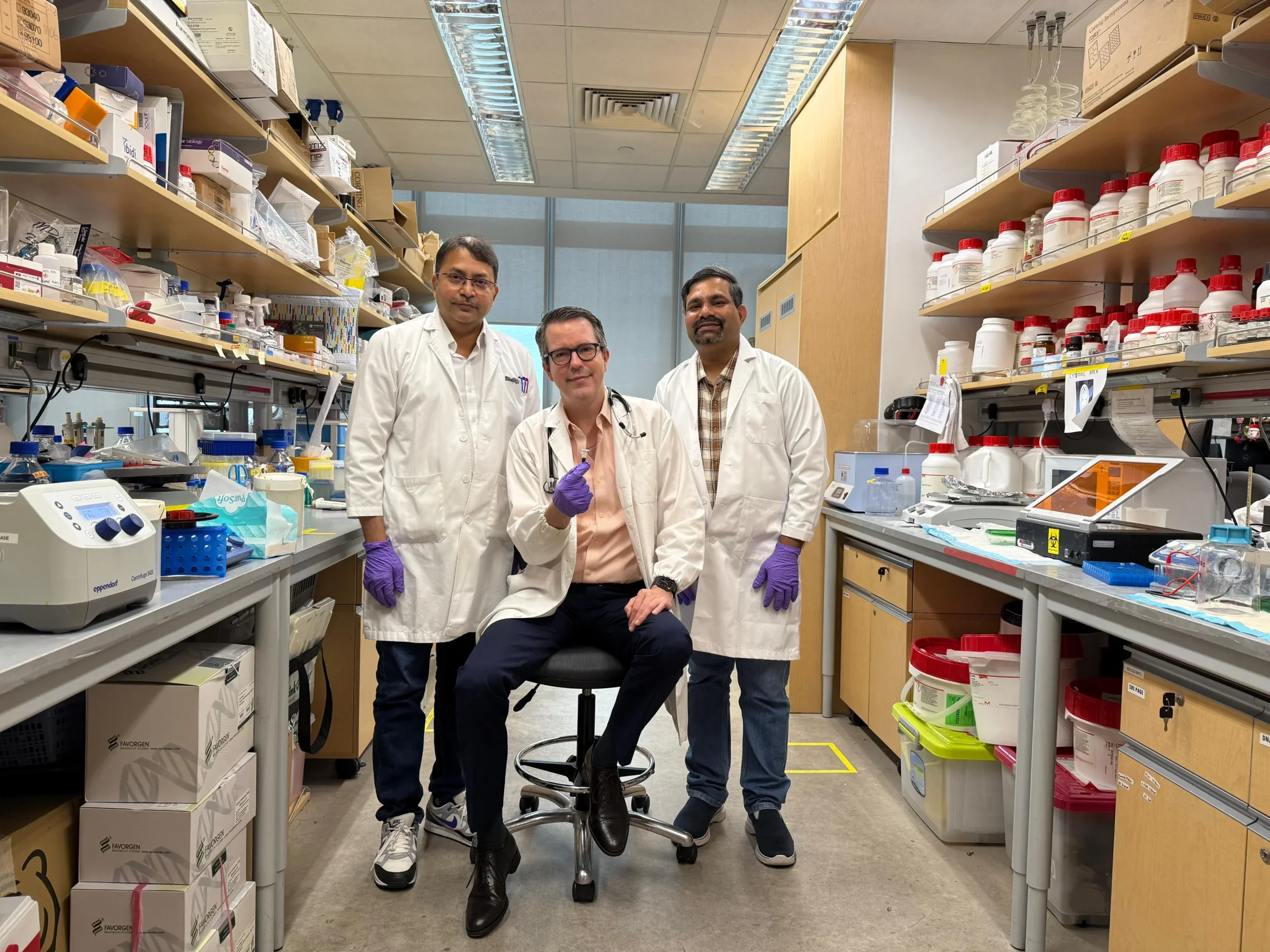
(from left to right) Dr Muthu Kumaraswamy Shanmugam, Associate Professor Chester Lee Drum, and Dr Girish Vallerinteavide Mavelli, NUS Medicine.
Researchers from NUS Medicine have developed a swallowable nanoscale delivery platform designed to transport therapeutic enzymes through the stomach’s acidic environment and activate a cancer-killing reaction at tumour sites. Early preclinical findings suggest that the approach may offer a new strategy for treating gastric cancer more precisely while reducing damage to healthy tissue.
The preclinical study, published in the Journal of Nanobiotechnology, was led by Associate Professor Chester Lee Drum, Department of Medicine and the Cardiovascular-Metabolic Disease Translational Research Programme (TRP), NUS Medicine, together with co-first authors Dr Muthu Kumaraswamy Shanmugam and Dr Girish Vallerinteavide Mavelli, both Senior Research Fellows at the Department of Medicine, NUS Medicine.
A nanocage built for the hostile gut
According to the Global Cancer Statistics, gastric cancer is the fifth most common cancer worldwide and the fourth leading cause of cancer-related death globally[1]. It remains one of the hardest cancers to treat, as it is often found late, can spread quickly, and may not always respond well to surgery or chemotherapy. One longstanding challenge has been how to deliver treatment directly to tumours in the stomach without degrading the therapy or affecting surrounding healthy tissue.
The acid and digestive enzymes in the stomach can break down fragile protein-based treatments before they reach their target. To overcome this, the team engineered disulfide-linked thermostable exoshells, or DS-tES, which are hollow protein nanocages about 15 nanometres in diameter, strengthened with carefully designed chemical links.
These reinforced exoshells are designed to survive stomach acid and protect their cargo until they reach gastric cancer tissue. Inside each nanocage, the team loaded horseradish peroxidase, or HRP, an enzyme that can trigger a specific chemical reaction. Once delivered to gastric cancer cells, HRP helps convert indole-3-acetic acid, or IAA, a naturally occurring plant-derived compound, into active molecules with anti-cancer effects. As IAA is largely inactive on its own, and HRP is protected inside the exoshell during delivery, the system is designed to produce its cancer-killing effect at the disease site while reducing unnecessary exposure to healthy tissue.
Killing cancer through an unexpected door
Many cancer treatments work by triggering apoptosis, a common form of programmed cell death. However, some tumours can develop ways to resist this process. The team’s approach instead activates necroptosis, another regulated form of cell death that may help overcome some forms of treatment resistance. In laboratory studies using two types of human gastric cancer cells, including HER2-positive and HER2-negative cells, the combined treatment system, known as DTHI, reduced cancer cell growth in a dose- and time-dependent manner. The treatment also activated key proteins involved in necroptosis, including RIP1, RIP3, and MLKL, and caused damage to the cancer cells’ mitochondria, which are the energy-producing parts of cells.
“We found that the reactive metabolites generated by our system trigger a form of cell death that bypasses the resistance mechanisms commonly seen with standard chemotherapy,” said Assoc Prof Drum. “By targeting the necroptotic pathway, we open a new avenue for treating gastric cancers that have become unresponsive to conventional drugs.”
The team further tested the platform in a laboratory model of chemically induced gastric cancer. Laboratory models treated with DTHI for six weeks showed significantly reduced stomach inflammation and tumour polyp growth compared with control groups. Tissue analysis also showed fewer polyps and reduced tumour development. The researchers also analysed blood plasma samples and confirmed that IAA had been converted into its active metabolites in the body. These active metabolites, including indole-3-carboxaldehyde and indole-3-carbinol, were detected only in laboratory models that received the full DTHI treatment, supporting the team’s proposed mechanism of local drug activation after oral administration.
Beyond its direct anti-cancer effects, the treatment was also linked to increased levels of antioxidant metabolites, including vitamin E and glutathione, in plasma. This suggests that the platform may also help influence oxidative stress and tumour-related inflammation, although further studies are needed to better understand these effects.
A versatile platform for gastrointestinal cancers
The exoshell platform is modular and adjustable, meaning doses can be fine-tuned and, in principle, different enzymes or inactive drug compounds could be paired for different treatment uses. The nanocage was also shown to enter gastric cancer cells through transferrin receptors, which are found on the surface of tumour cells and may help give the platform an added degree of tumour selectivity.
“What makes this platform exciting is its versatility,” said Dr Shanmugam. “The exoshell system is designed to be adapted — different enzymes and prodrugs can be paired to tailor the therapy to specific cancer types and patient needs, while maintaining the oral delivery advantage that is so important for patient quality of life.”
The team’s next steps include further investigation into the safety profile of necroptosis-based therapy, optimisation of the platform, and additional studies to assess its potential for future clinical translation.
Read the press release here.
[1] Yang WJ, Zhao HP, Yu Y, Wang JH, Guo L, Liu JY, et al. Updates on global epidemiology, risk and prognostic factors of gastric cancer. World J Gastroenterol. 2023; 29(16): 2452–68. DOI: https://doi.org/10.3748/wjg.v29.i16.2452