NUS Medicine organises Singapore Brain Bee Challenge 2026 to spark passion in neuroscience
Published: 09 Jul 2026

Guest-of-Honour, Assoc Prof Kevin Tan, Vice-Dean (Graduate Studies) at NUS Medicine, presenting the trophies and cash awards to winners of the Singapore Brain Bee Challenge 2026. (Left to right) Dr Deepika Kandilya, Mr Cheng Heng Kent (2nd Runner-up), Mr Zachary Chen (1st Runner-up), Ms Yong Wen Xuan (National Champion), Assoc Prof Kevin Tan, Prof S. Thameem Dheen and Dr Sara Kashkouli.
On 1 July 2026, nearly 200 students from across Singapore gathered at NUS Medicine for the Singapore Brain Bee Challenge 2026, demonstrating their knowledge of neuroscience while exploring future opportunities in medicine and biomedical sciences.
Organised annually by the Singapore Neuroscience Association (SNA), an affiliate of the International Brain Bee, the national competition is one of Singapore’s flagship neuroscience outreach initiatives. Open to pre-university students aged 14 to 19, the challenge aims to cultivate scientific curiosity, critical thinking and a deeper understanding of neuroscience, while inspiring the next generation of neuroscientists and healthcare professionals.
This year’s competition was led by National Coordinator Professor S. Thameem Dheen, together with Local Coordinator Dr Sara Kashkouli and Organising Secretary Dr Deepika Kandilya, all from the NUS Medicine Department of Anatomy. Around 200 students from 10 schools participated, representing Hwa Chong Institution, Raffles Girls’ School, NUS High School of Mathematics and Science, Victoria Junior College, Nanyang Girls’ High School, Cedar Girls’ Secondary School, River Valley High School, CHIJ St. Nicholas Girls’ School, Singapore Polytechnic and Singapore American School.
Participants also attended a series of educational lectures introducing the breadth of modern neuroscience. Delivered by faculty members from the School, the sessions explored topics including neuroanatomy, neurophysiology, neurodevelopment, cognition, neurological disorders, sensory systems and emerging advances in neuroscience research. Together with curated learning resources, the programme provided students with a strong foundation in neuroscience while offering opportunities to engage directly with educators and researchers.
The final stage of the competition saw the finalists advance to an oral viva, where they demonstrated their neuroscience knowledge, clinical reasoning and communication skills.
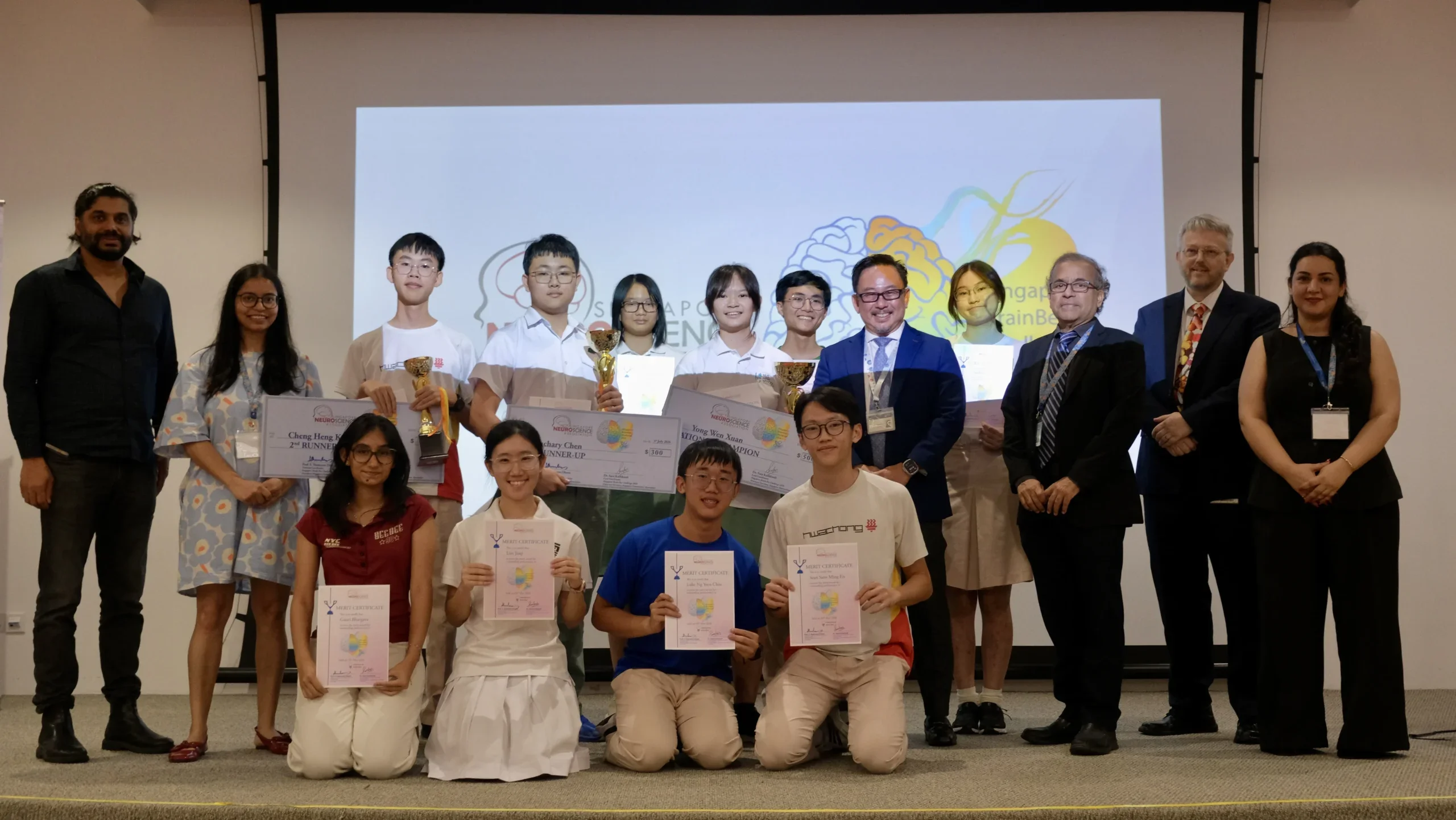
Assoc Prof Kevin Tan, Vice-Dean (Graduate Studies) at NUS Medicine, with the Singapore Brain Bee Challenge 2026 winners, merit awardees, and the organising team.
The competition concluded with an award ceremony officiated by Associate Professor Kevin Tan, Vice-Dean (Graduate Studies) and Head of the Department of Microbiology and Immunology at NUS Medicine. In his address, he congratulated participants on their enthusiasm, scientific curiosity and commitment to learning, while encouraging them to continue building both their knowledge and intellectual curiosity as they pursue future scientific challenges.
Ms Yong Wen Xuan from NUS High School of Mathematics and Science emerged as the Singapore Brain Bee Challenge 2026 National Champion and will represent Singapore at the 2026 International Brain Bee Championship. Mr Zachary Chen, also from NUS High School of Mathematics and Science, received second prize, while Mr Cheng Heng Kent from Hwa Chong Institution was awarded third prize. An additional 10 students received Merit Awards in recognition of their outstanding performance.
Dr Sara Kashkouli reaffirmed SNA’s commitment to nurturing future neuroscientists through education and outreach initiatives such as the Singapore Brain Bee Challenge. She also thanked the organisers, partners, volunteers, participating schools and all who contributed to the competition’s success.
Through initiatives such as the Singapore Brain Bee Challenge, NUS Medicine and the Singapore Neuroscience Association continue to inspire young minds, strengthen neuroscience education and encourage future generations of scientists, clinicians and healthcare professionals to advance our understanding of the human brain.