Stronger support for working parents needed to improve child development outcomes and Singapore's fertility outlook
Published: 22 May 2026

Population Association of Singapore (PAS) 2026 Annual Conference.
As Singapore grapples with one of the world’s lowest fertility rates, new Singapore studies presented at the Population Association of Singapore (PAS) 2026 Annual Conference jointly organised by the Yong Loo Lin School of Medicine, National University of Singapore (NUS Medicine) and PAS are shedding light on what modern families need to thrive and what policymakers, employers, and society can do to better support them.
The three studies using nationally representative data from the Singapore Longitudinal Early Development Study (SG-LEADS) led by Professor Jean Yeung Wei-Jun from the Department of Paediatrics at NUS Medicine, President of the PAS, and Director of Social Sciences at the A*STAR Institute for Human Development and Potential (A*STAR IHDP), explored how modern family life, from infant childcare and paternity leave to children’s growing use of AI, is reshaping parenting and child development.
Key insights from this conference will shape a joint white paper on fertility and human development by NUS Medicine and PAS. The paper, which will provide actionable policy and implementation recommendations, will be shared with Ms Indranee Rajah, Minister in the Prime Minister’s Office and Second Minister for Finance and National Development, who graced the event as Guest-of-Honour, and the newly formed Marriage and Parenthood Reset Workgroup.
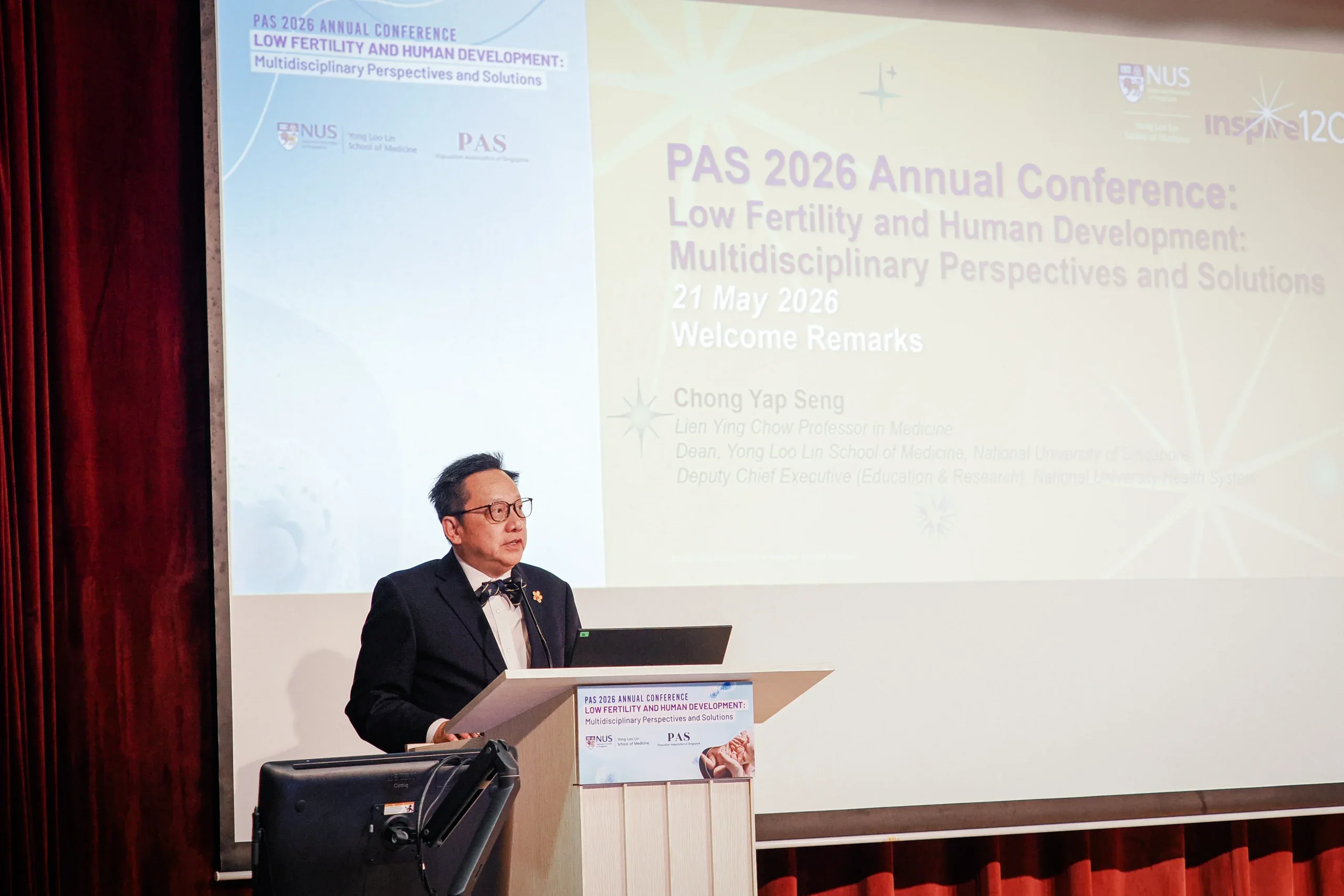
Professor Chong Yap Seng, Dean of NUS Yong Loo Lin School of Medicine delivering his welcome remarks.
In his welcome remarks, Professor Chong Yap Seng, Dean of NUS Yong Loo Lin School of Medicine emphasised that family formation should be understood in terms of long-term health and asked for the reframing of marriage and parenthood as drivers of healthy longevity.
“Family formation is not just a demographic goal; it can also be a pathway to healthy longevity. The evidence base suggests stable partnership and co-residence correlate with longer life. The marriage-longevity association is robust across over 140 years of research across multiple countries although the protective effect is modulated by gender and relationship quality. This is the same for parenthood.”
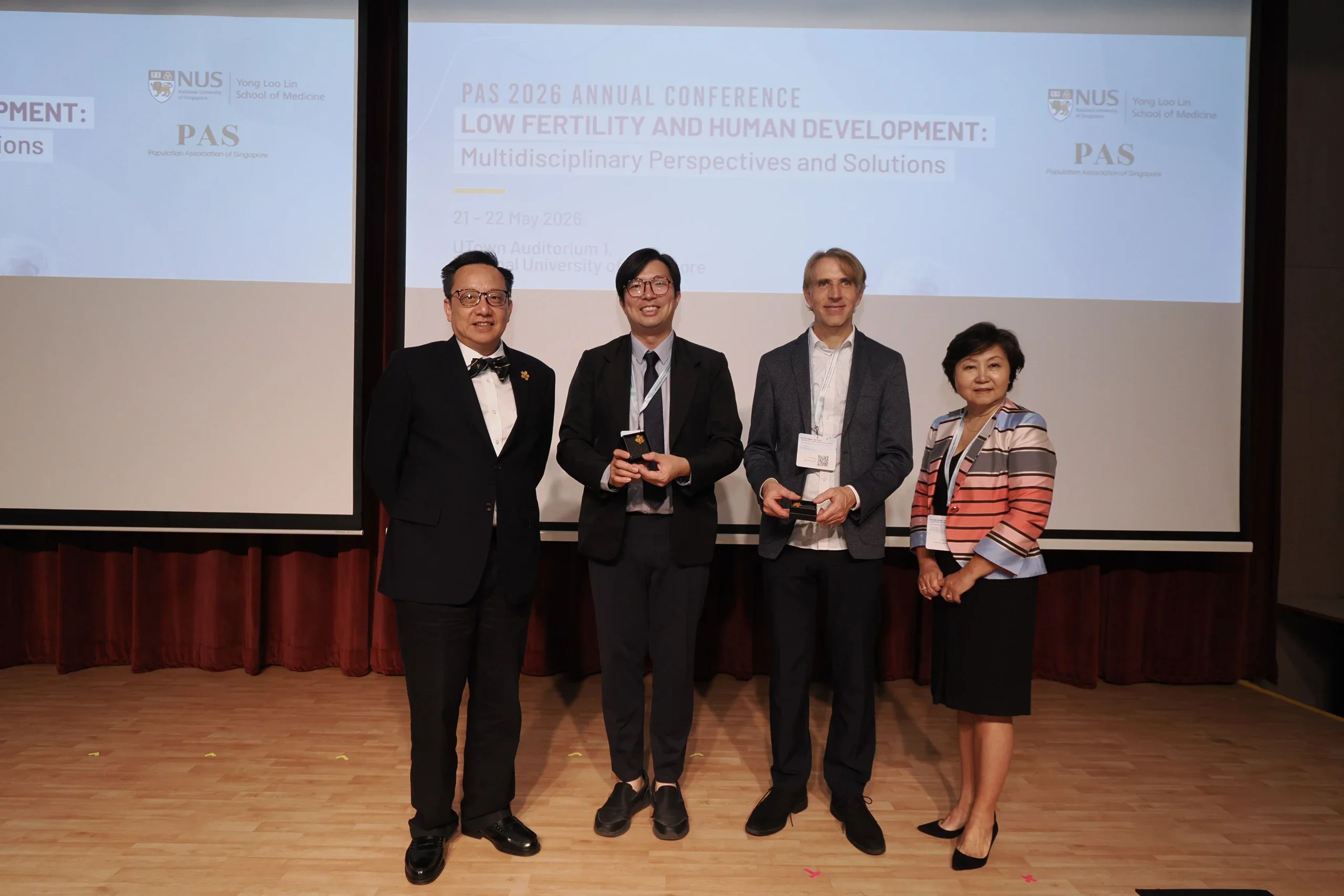
From left to right: Professor Chong Yap Seng, Dean of NUS Yong Loo Lin School of Medicine, Adjunct Assistant Professor Huang Zhongwei, Deputy Director at the NUS Bia-Echo Asia Centre for Reproductive Longevity and Equality (ACRLE), Mr Thomas Sobotka, Deputy Director, Vienna Institute of Demography, Professor Jean Yeung Wei-Jun, Department of Paediatrics, NUS Medicine.
Adjunct Assistant Professor Huang Zhongwei, Deputy Director at the NUS Bia-Echo Asia Centre for Reproductive Longevity and Equality (ACRLE) delivered a keynote on tackling biological drivers of low fertility in Asia and underscored the need for better translation of fertility biology into policy and care pathways. “Reproductive health and biology matter more than we think. Earlier fertility awareness, earlier assessment, and timely preconception care can help individuals make more informed decisions and seek support sooner.”
Read more about the new studies in the press release here.