

A robotic suit designed for nurses won two major awards at the NUS Medical Grand Challenge (MGC) in August, with trainee nurse Lin Jing Wen playing a significant role in the prototype’s development.
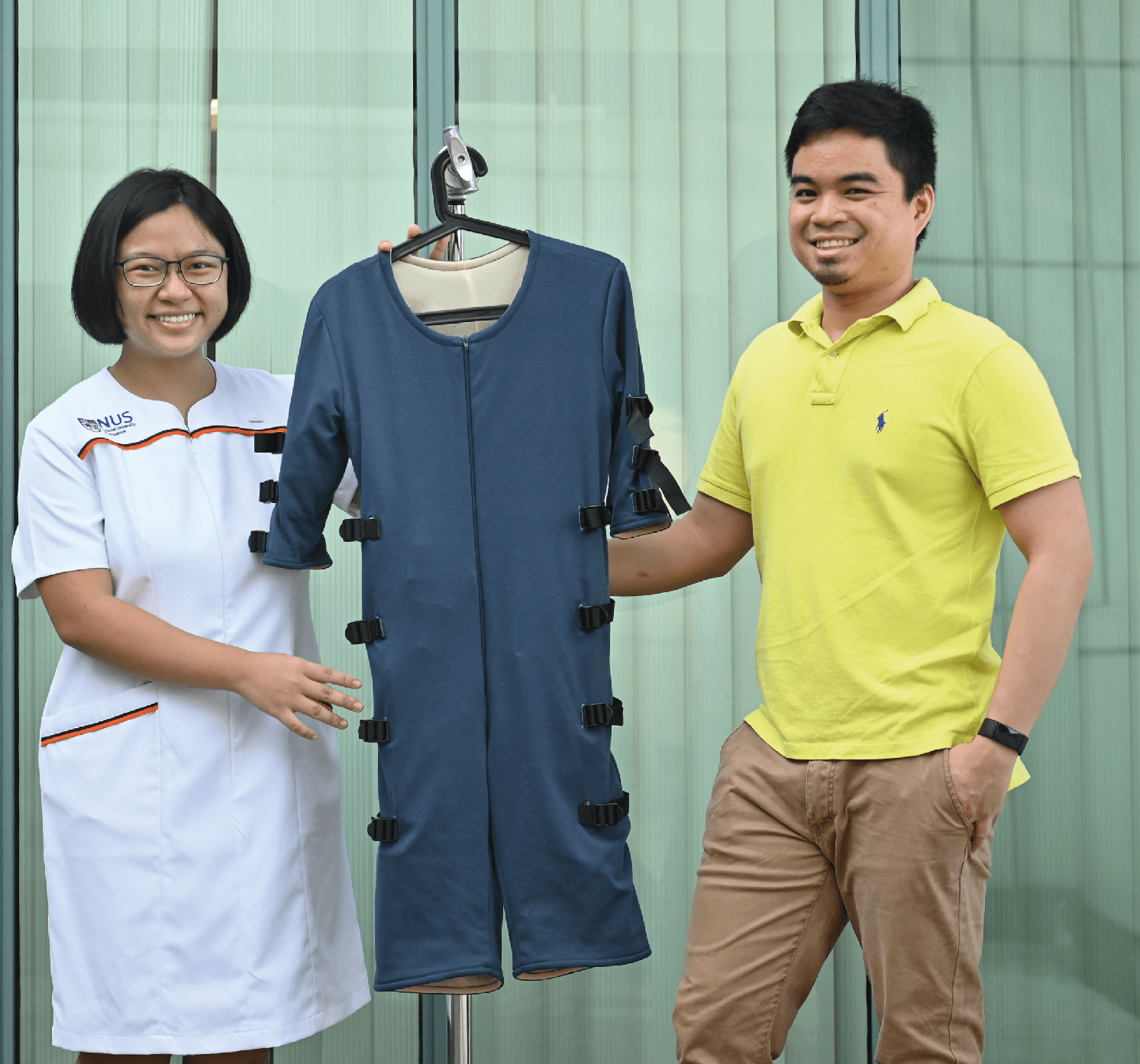
The ARMAS robotic suit is made up of fabric motors wrapped around the wearer’s muscles and limbs. When the motors are inflated, they help to supplement muscle function by reducing muscle strain by about 65 per cent.
“I knew back pain was a problem in the industry but I didn’t know it was such an extensive and serious problem,” said Ms Lin of the Alice Lee Centre for Nursing Studies, which is part of the Yong Loo Lin School of Medicine at the National University of Singapore (NUS).
“Almost all nurses have some form of pain, with varying severity. Some use pain medication or braces to cope with it, but others need surgery.”
Back pain is a common occupational health problem among nurses in Singapore, with the Ministry of Manpower’s Workplace Safety and Health Report 2019 ranking healthcare among the top three industries for work-related musculoskeletal disorders.
Ms Lin, a Year 3 Nursing undergraduate, first became aware of the physical stress involved in nursing during her freshman attachment at a community hospital.
While shadowing a nurse on her rounds, Ms Lin noticed that the nurse, who was in her late 20s, wore not only a back brace but also hand and wrist guards. Ms Lin later learnt that the nurse had a slipped disc that was likely caused by certain motions, such as frequent twisting and turning while lifting bedbound patients.
When Ms Lin, 21, heard about a prototype suit for nurses, she joined Dr Rainier Natividad and team ARMAS in May to help in its development.
Dr Natividad conceptualised the soft fabric-based exoskeletal ARMAS robotic suit for his PhD thesis with the aim of helping ease the physical demands on nurses. An engineer, Dr Natividad said that the involvement of the four students in team ARMAS, and Ms Lin in particular, proved essential.
“Jing Wen is a nurse, so she interacts with nurses on the ground and is aware of the practical issues they face. Her experience provides valuable inputs in the designing of the suit,” said Dr Natividad, 29.
INPUT FROM NURSES
In a qualitative survey on nine nurses, Ms Lin learnt that while they were enthusiastic about having a new tool to help them with their jobs, there were reservations about the suit’s convenience, comfort, safety and whether it would look professional.
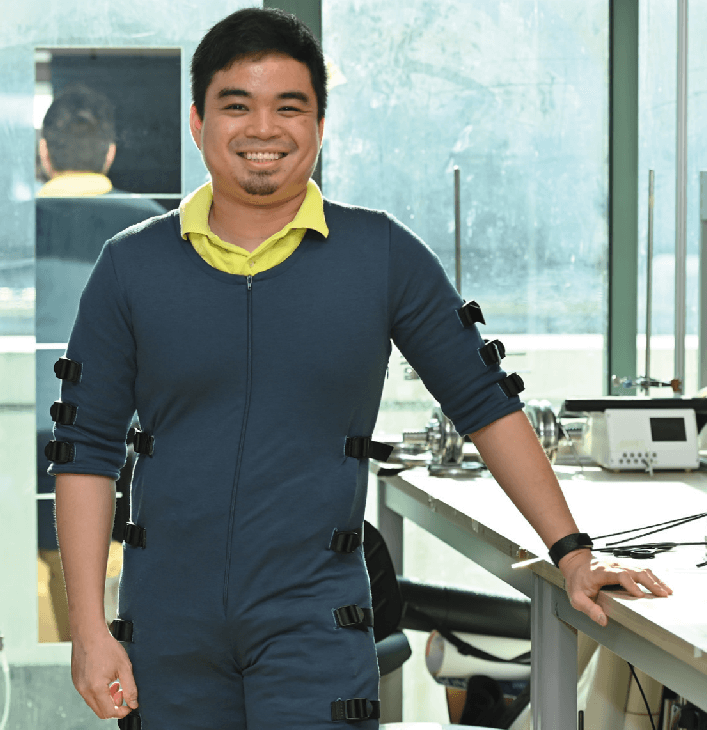
Armed with the feedback, the team could improve the existing prototype. For example, an airy, breathable material may be used to better suit nurses who have to work in non-airconditioned wards, while shorter sleeves and additional front buckles should allow nurses to wear or remove the suit in under a minute.
The suit, which is far from a metallic contraption, also promises great flexibility to allow nurses to carry out their regular duties while wearing the suit.
Dr Natividad and team ARMAS, which also includes two medical students and a pharmacy undergraduate, impressed the audience at this year’s MGC, which brings together cross disciplinary teams to solve healthcare problems. The team won the Open Category and People’s Choice Award, bagging a total of S$24,000 in prize money.
“We were overwhelmed by the double-win,” said Ms Lin. “I think the suit was popular because many healthcare innovations today are for patients, but ours seeks to support and empower healthcare professionals, who also need technological aids to serve their patients better.”
The team’s success is even more impressive given that the students have not even touched the suit since their involvement began in May, due to safe distancing measures enacted to combat the COVID-19 pandemic. Ms Lin and her team members conducted all their meetings virtually, while plans for pilot testing of the ARRMAS robotic suit with nurses had to be postponed.
Right now, Dr Natividad and the team have other challenges — they need to think of how to power the suit (via portable batteries or a connection to a power source) and how to clean it to meet infection control standards, depending on the needs of the nurses.
The plan now is to take the ARMAS robotic suit to the commercial market within two years. It is expected to cost approximately $2,000.
Ms Lin hopes to take her experience with this innovation further by gaining a deeper understanding of chronic back pain for her upcoming Honours thesis. She also hopes that nursing students will gain more exposure to healthcare innovation by having a related internship module in the nursing curriculum.
“I’ve observed that nurses in Singapore have heavy workloads, so the initiation of technological innovation or change often takes a back seat. Yet no one knows the needs and gaps of patients more than us as we spend the most time with them,” said Ms Lin.
“I hope that in the future, nurses will be able to use their ground knowledge to innovate and harness the potential of technology to better meet the vast needs out there.”