

Chronic heart failure, a clinical endpoint of many cardiovascular diseases, is a major public health burden in many countries. In Southeast Asia, approximately nine million people suffer from the chronic and debilitating condition, and its prevalence is approximately 4.5 per cent in Singapore.

Despite advancements in medical technology and pharmacological interventions, heart failure (HF) remains one of the most common causes of not only hospitalisation among older people, but also readmissions.
Concerned with high readmission rates in particular, researchers from the Alice Lee Centre for Nursing Studies — part of the Yong Loo Lin School of Medicine at the National University of Singapore (NUS) — set out to study the underlying causes and found poor self-care among recovering HF patients.
The four researchers — Associate Professor Wang Wenru, Dr Catherine Dong, Dr Jiang Ying and Dr Jocelyn Chew — presented their findings and papers on interventions to promote and support HF patients’ post-discharge patient self-care management at a webinar on Nov 17.
NURSING INTERVENTION TO ADDRESS POOR PATIENT SELF-CARE
At its simplest, managing HF post- discharge requires a treatment plan of medication and behavioural changes that prevent or minimise the signs, symptoms and progression of the disease. Despite its importance, self-care remains challenging for many HF patients.
Difficulties oft cited by patients include, among others, a lack of recall of basic elements of the disease, poor understanding of the links between symptoms and the condition, inadequate guidance by healthcare professionals and waning motivation over time to change old habits.
Like many other chronic diseases, there is no cure for chronic heart failure (CHF). The condition’s gloomy prognosis typically involves a progressive deterioration of a patient’s physical functioning, which adversely affects the quality of life and psychosocial well-being.
Key self-management strategies recommended by the European Society of Cardiology for the diagnosis and treatment of acute and CHF include recognising symptoms of deterioration, improving medication and treatment adherence, avoiding excessive fluid and salt intake, monitoring daily weight, and engaging in exercise.
But given the challenges patients encounter in self-care, intervention strategies have grown in clinical importance in the drive to mitigate the negative impact of CHF and help patients cope.
Many HF patients feel unprepared for their self- management, said A/Prof Wang. She added: “The baseline data clearly show that Singapore HF patients have poor self-care.”
PSYCHOSOCIAL EDUCATIONAL APPROACH
The positive results of a multicomponent nursing intervention study A/Prof Wang Wenru and research fellow Dr Jiang Ying completed this year may soon help towards improving patient self-care behaviours.
“This randomised controlled trial (RCT) is the first study in Singapore to adopt a nurse-led, home-based self-management programme with a psychosocial educational approach,” said Dr Jiang.
Called the HOMe-based HEart failure self- Management Programme (HOM-HEMP), the intervention development and evaluation process were guided by the UK Medical Research Council framework for developing and evaluating complex interventions.
Aside from the primary aim of assessing the intervention’s effectiveness in improving self-care behaviour among CHF patients in Singapore, the study also evaluated cardiac self-efficacy, psychological well-being, health- related quality of life, perceived social support and clinical outcomes in the sample group of 162 participants who completed the data collection.
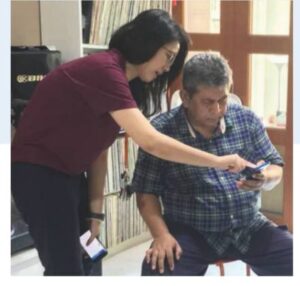
The six-week intervention consisted of a heart failure self-management toolkit and three bi weekly home visits by the research nurse.
Additionally, a supplementary smartphone app was developed and used in experimental group B. The control group, which received the usual care from a hospital, and group A, which received the usual care and HOM- HEMP intervention, did not get to use this app.
The toolkit was developed for patients to manage their HF condition at home and consisted of a HF education manual, a drinking mug with markings indicating fluid volume, pictures of
common foods in Singapore and their associated sodium content, a weight monitoring calendar with a graphical display of the participant’s weight trend, and a pill box with an alarm clock to remind patients to take their medication.
Meanwhile, the face-to-face interaction sessions allowed the research nurse to reinforce a patient’s self-management knowledge and self-care skills, as well as monitor the progress and provide on-site support, among others.
Dr Jiang said: “Self-care is not so simple for many HF patients. They need to learn and practise it. This intervention is for that timeframe between discharge and a patient’s first follow-up appointment, a period when there is usually no medical professional for hand-holding. It educates and teaches the patient to identify common signs and symptoms to look out for, as well as understand, interpret or take action if necessary.”
She added that the study found that when compared to the control group, participants in either experimental group A or B had higher levels of HF self-care and cardiac self-efficacy,
better health-related quality of life and lower depression levels after the study intervention.
“There’s also a higher proportion of participants in experimental group A or B with better New York Heart Association (NYHA) functional class at six-week and three-month follow-ups,” she said.
NYHA Classification provides a simple way of classifying the impact of HF on a patient’s ability to perform daily activities.
Moreover, the study results showed that this intervention approach can alleviate burden on the healthcare system.
“We saw significantly fewer cardiac-related unplanned hospital admissions and A&E visits at the six-month follow-up among recipients of the intervention,” said A/Prof Wang.
PSYCHOLOGICAL APPROACH
Psychological interventions, or those based on psychological principles, such as cognitive-behavioural therapy, motivational interviewing, non-directive counselling and supportive therapy, are part of the non-pharmacological interventions in CHF management.
While studies have been conducted on the effect of psychosocial interventions on the quality of life in CHF patients, the effects on patient self-care behaviours and psychological and health outcomes have been less clear.

A/Prof Wang and Dr Jiang plugged this dearth of information in a systematic review of evidence, titled “The effectiveness of psychological interventions on
self-care, psychological and health outcomes in patients with chronic heart failure — A systematic review and meta-analysis”, published in the International Journal of Nursing Studies in 2018.
The duo evaluated the effectiveness of RCTs using psychological methods or theory on patient self-care behaviours, anxiety and depression levels, health- related quality of life and physical function in studies published in English from January 2006 to December 2016.
The review’s findings, based on 29 articles consisting of 25 studies with 3,837 participants, showed that despite heterogeneity between studies, psychological interventions tend to improve self-care in CHF patients without clinical depression and cognitive impairment.
Moreover, pooled results also revealed that the intervention effect on short-term health-related quality of life, as measured by the Minnesota Living with Heart Failure Questionnaire, was in favour of the intervention group.
But the effect disappeared as the length of time from the intervention increased. In addition, the intervention effects on the participants’ anxiety level, as measured by the Hospital Anxiety and Depression Scales, and physical function, as measured by the 6-Min Walk Test, were not statistically significant, the study showed.

INTERVENTION FOR THE COGNITIVELY IMPAIRED
Meanwhile, Research Assistant Professor Dr Catherine Dong took a closer look at a subset of HF patients she deemed more vulnerable: Those with cognitive impairment (CI).
Her research paper, “Cognitive impairment in Asian patients with heart failure: prevalence,
biomarkers, clinical correlates, and outcomes” (featured in the August 2020 issue of NUrSing) had pegged the prevalence of undiagnosed CI among HF patients in Singapore
at 44%, with older patients at greater risk.
“This group of patients needs more intensive management, more medical attention,” she said. “CI is a concern given its link to mortality prediction. CI affects a HF patient’s ability to think, memorise and remember things related to patient self-care. That impacts the patient’s medical compliance, such as remembering instructions from doctors.”
Her systematic review, “Can Computerized Cognitive Training Improve Cognition in Patients With Heart Failure? A Review”, published in the Journal of Cardiovascular Nursing in 2018, sought to learn if computerised cognitive training (CCT) would be feasible and beneficial to HF patients.
CCT uses software to train cognitive functions to improve them. Prior studies had shown CCTs to be successful in improving cognition in older adults.
The results gleaned from four RCTs describing three cognitive training interventions showed that CCT could enhance the processing speed and working memory of HF patients.
The RCTs had used a combination of computerised visual and listening tasks to evaluate the effect on auditory processing speed, working memory, memory encoding and recall, among others.
“This review tells us that some sort of mental activity is useful to improve cognition, that even playing computer games shows promise. This kind of work is new and has not been done locally,” said Dr Dong.
She is working on a cognitive training programme customised for HF patients to address the lack of cognitive intervention for HF patients with mild memory and thinking problems.
SELF-CARE, MOTIVATION AND CHALLENGES
Research Fellow Dr Jocelyn Chew delved into the motivations of HF patients to enhance their self-care. She also examined the relationship between patient self- care, readiness to change, time perspective and executive function. With the findings from the studies, she developed a self-regulation programme effective in enhancing HF self-care.
She said: “Time perspective is an underexplored concept in nursing studies where we focus on the motivational effects of considering intended behaviour based on future consequences. It’s very much a psycho-behavioural concept.”
Knowing that HF patients’ self- care behaviours have to improve and become a sustainable habit, Dr Chew wanted to find out the motivations in patients to enhance patient self-care.
In her Temporal Self-Regulation Theory (TST)-based study published in the International Journal of Behavioral Medicine in 2019, 17 HF patients of a Singapore tertiary hospital were interviewed on motivators for intention to self-care, behaviour prepotency and self- regulation strategies.
“This is the first study that explores self-care motivation, challenges and self-regulation in a Southeast Asian multi-ethnic population living with HF. It is also the first to use TST as a guiding framework to understand the underlying mechanism of HF self-care behaviour change,” said Dr Chew.
Using thematic analysis with constant comparison, the data showed the consideration for one’s past and the family’s future to be self-care motivators while the fatalistic consideration of one’s own future to be a demotivator.
And barriers to behaviour change were difficulties in adopting physical activities and deviating from dietary habits and socio-cultural dietary norms.
Personalised strategies to overcome these challenges were described in 12 sub-themes that emerged. Themes and sub-themes were found to be well-fitted into the TST in explaining HF self-care intention-behavioural relationship, the study showed.
“Findings of the study indicated that participants were motivated by regret for not performing adequate self-care, worry that their families could not cope with the deterioration of their health, and the need to prevent further deterioration. Along the same grain, some were demotivated by the fatalistic thought of a shorter lifespan,” said Dr Chew.
“Patients were also troubled by socio-cultural derailments such as rebuke from servers at a food centre if they asked for low-salt food items. Strategies to overcome these barriers have to be developed by the patients themselves so their lifestyle would be more congruent with the strategies and they would be more willing to adhere to them. But developing coping strategies requires effortful cognitive control over existing habitual and suboptimal lifestyle habits.”
She added that motivation can be enhanced by stimulating considerations of the family’s future well-being and exemplifying real- life success stories to instil hope.
In another study to examine the relationship between patient self-care adherence, time perspective, readiness to change and executive function in HF self-care, Dr Chew had 147 HF patients complete questionnaires on the topics and cognitive tasks that reflect working memory and inhibition.
The results, published in 2019 in the Journal of Behavioral Medicine, showed positive correlation between self-care, future-oriented time perspective and readiness to change.
“Working memory is strongly correlated with self- care behaviours, meaning patients
need to remember their motivations, the self-care behaviours they need to perform, and the factors that constitute adequate self-care,” said Dr Chew.
The readiness to change was found to exert an indirect effect on self-care through time perspective. “This suggests the potential in improving HF self-care through interventions tailored according to one’s time perspective (eg. temporal framing), readiness to change (ie. stage of change) and working memory (eg. outsourcing memory load to planning and environmental stimuli),” she added.
Using the findings from her previous studies, Dr Chew developed a first-of-a-kind self-regulation programme, dubbed the Push-Pull-Hold programme, based on the TST.
“The three-month programme was designed to identify problematic lifestyle habits, evoke consideration of future consequences and engage the cognitive function to develop self- regulation goals, action and coping plans,” said Dr Chew.
An RCT on 144 participants showed the programme to be effective in enhancing HF self-care immediately after the intervention and the following three months.
“The results showed that self- regulation was associated with future-thinking and behavioural automaticity, suggesting the importance of equipping patients with the necessary self-regulation skills to cope with socio-environmental goal derailments,” added Dr Chew.
