

Video-assisted debriefing (VAD) made its debut at the Alice Lee Centre for Nursing Studies in 2014 but failed to take off as a result of the lack of a proper framework guiding its use, and students’ fear of being filmed.
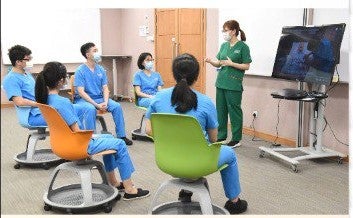
But new local research pointing to VAD’s efficacy in enhancing the debriefing experience may soon accelerate its integration into mainstream nursing curricula.
NUS Nursing lecturer Dr Yvonne Zhang Hui was a teaching assistant when VAD was first introduced. She recalls experiencing difficulties conducting an effective video debriefing session, and seeing that evidence evaluating VAD’s educational effects was mixed, she took it upon herself to explore the development of this unfamiliar teaching approach. She enrolled in a PhD programme at the Linkoping University in Sweden, and between 2017 and 2020, was the principal investigator of three studies on VAD alongside peers from Sweden and Australia. The studies were published in Nurse Educator and Nurse Education Today.

VAD SUPERIOR TO VD IN MOST ASPECTS OF LEARNING
Dr Zhang’s research on VAD started with an analysis of 23 pieces of related literature that evaluated its effectiveness on learners’ reactions, learning and behaviour, compared with verbal debriefing (VD).
Surprisingly, VAD did not emerge as a clear winner in all aspects. “It did not show advantages over VD on knowledge acquisition,” said Dr Zhang, adding that the VAD group with nursing students indicated a decrease in knowledge gain while those from the VD group saw an improvement.
Despite these findings, it was clear that VAD improved learners’ experience, attitude and performance. “For instance, there was a stark improvement in technical skills seen in VAD students. For non-technical skills, those from the VAD group were found to be superior in terms of situational awareness, clinical judgement, task management and decision-making,” said Dr Zhang.
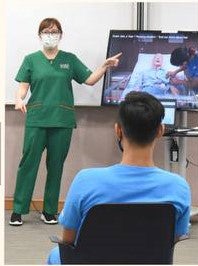
LOCAL QUALITATIVE STUDY UNCOVERS CHALLENGES IN VAD IMPLEMENTATION
In 2019, Dr Zhang conducted a local study to document the perspectives of pre-licensure Nursing students on VAD. “Gaining an understanding of our local learners’ attitudes and perceptions towards VAD would set the foundation for effective learning and integration of VAD into nursing curricula,” she explained.
The qualitative study comprised six focus group interviews with 27 students who had participated in a three-phase VAD session after attending a code blue simulation session, where they were assigned the role of performers or observers.
Thematic analysis was used to derive three major themes that described the students’ journey from traditional VD to VAD, their praise and criticism of VAD, and their journey to successful VAD.
“Students had praise for the inclusion of audiovisual support in the debriefing process as it offered objective evidence to eliminate bias and errors and allowed discussion based on precise recordings of events. The playbacks also allowed students to see how they performed, reducing hindsight bias in evaluating the scenarios,” said Dr Zhang.
The students also reported experiencing an “emotional roller coaster” when they underwent a video debriefing session. “VAD created psychological burdens, such as reluctance to be filmed and fear of being judged, but it is common for learners to feel discomfort in their first encounter with new technology and teaching strategy,” explained Dr Zhang.
“Self-reported high anxiety does not always impact negatively on cognitive growth. Optimal stress can help promote learning,” said Dr Zhang, adding that learners soon acclimatised and comfort levels increased after experiencing VAD a second time.
The study also uncovered some challenges associated with implementing VAD on the ground, such as its potential to be more time-consuming, occurrence of technical issues, and students losing focus during the actual scenarios as they knew they could fall back on VAD.
MIXED METHODS STUDY SHOWS DEBRIEFING EXPERIENCES IMPROVED WITH VAD WITHOUT ADDED STRESS
Further evidence convincing Dr Zhang of the efficacy of VAD came in a third study to evaluate the impact of a three-phase VAD approach on the experience of eight facilitators and 145 Nursing students in Singapore. In this study, Dr Zhang and her fellow researchers aimed to investigate the effects of the intervention in enhancing Nursing students’ debriefing experiences and perceived stress compared to VD. It also sought to explore its impact on facilitators’ debriefing practices.
A mixed-methods design was adopted. The quantitative phase involved a prospective controlled trial that randomised 72 students into the intervention cluster and 73 students into the control cluster. The debriefing experience scale (DE5), the stress visual analogue scale (Stress VAS), and the debriefing assessment for simulation in healthcare (DASH student version) were used as outcome measures. For the qualitative component, a purposive sample of eight facilitators evaluated their own debriefing practices using the DASH instructor version and each completed an open-ended question survey.
The simulation programme comprised two two-hour high-fidelity simulation sessions (one session per week), which included medication administration in one session and patient deterioration in the other. Each simulation session included one debriefing session, with a sequence of pre-briefing, scenario and debriefing. The sessions lasted 5 minutes, 15 minutes and 40 minutes, respectively. One facilitator facilitated one practice group of 10 or 11 students at a time in the simulated ward, with three to four students attending the scenario and the others observing it.
In the control cluster, the students received traditional VD. In the intervention cluster, the scenarios were video-recorded and the students received the three-phase video debriefing immediately after each scenario.
Results show that students from the intervention cluster significantly improved their debriefing experiences (p = 0.01), experienced comparable stress, and had better impressions of VAD facilitators’ practices (p < 0.001) compared to those in the control duster.
The facilitators’ feedback on VAD was generally positive, with most agreeing that the approach allowed for a more structured learning journey and helped minimise confusion. They also commented that they found themselves better equipped to identify learning gaps as they could replay video footage to reinforce discussion points.
The majority of the students also shared similar sentiments, noting that VAD facilitators were more effective in setting the stage and stimulating discussions. Most of them also agreed that video footage helped them review their performance better.
SUPPORTIVE ENVIRONMENT FOR VAD CRITICAL FOR SUCCESS
Overseas studies have identified a few effective elements for VAD practice. These include using experienced debriefers, curriculum-embedded simulations without formal grading, structured debriefing designs, and debriefing durations of between 10 and 90 minutes.
Dr Zhang also emphasised the importance of creating a supportive and respectful environment for video debriefing and building learners’ resilience to criticism.
“Some strategies to make learners feel safe and less threatened include reminding observer students not to record the simulations using their personal devices, and advising all students not to disclose the debriefing content to others outside the group.
“Facilitators can also assure students that the recorded video will be used only as a formative assessment to facilitate their learning, and that their performances in the scenarios will not be graded or affect their academic results. To minimise the risk of misuse, recorded videos should be deleted after class,” she said.
On overcoming time constraint for practical training, Dr Zhang suggested limiting video reviews to up to four short clips to highlight specific learning gaps. “The total time spent on video review should be less than 20 minutes, thus providing students sufficient time for skills practice,” she said.
Dr Zhang, who teaches medical-surgical nursing, has started incorporating VAD into her lesson plans. Going forward, she hopes to further explore VAD’s effects on learning transfer and its cost-effectiveness.