While people often associated nurses with bedside care in the past—today’s nurses are increasingly going beyond these traditional roles and taking on positions as leaders, educators, innovators and researchers. Couple this trend with a fast-evolving healthcare landscape, lifelong learning has become more relevant to the profession than ever before.
By 2030, one in four Singaporeans will be 65 and above1. As compared to younger adults, older adults are also four times more likely to be hospitalised and stay three times as long in the hospital2.
In addition to the ageing population, Singapore faces healthcare challenges such as future pandemic outbreaks—which scientists warn to be a matter of not ‘if’ but ‘when’3—and rising incidences of chronic conditions such as diabetes and high cholesterol due to lifestyle factors.
To equip nurses with the necessary knowledge and skills to help Singapore meet these challenges, Alice Lee Centre for Nursing Studies (NUS Nursing), National University of Singapore Yong Loo Lin School of Medicine, has launched Singapore’s first Doctor of Nursing Practice (DNP) programme and three new Master’s programmes. The Master’s programmes are Master of Community Health, Master of Science (Critical Care Nursing), and Master of Science (Infection Prevention and Control).
Deepening Nursing Expertise
For Master of Science (Critical Care Nursing) student, Melissa Chan (Senior Staff Nurse at Woodlands Hospital), her seven years of experience in the intensive care unit (ICU) has led her to observe marked shifts in Nursing. “I feel like the profession has gone beyond functional Nursing towards a more evidence-based approach,” Melissa shared. “To be able to help our patients, we need to know the latest in research and practices.”
That is why two years after completing her advanced diploma in critical care Nursing, she began to feel restless—and eager to further her knowledge in the specialty. “After my advanced diploma, I could better understand doctors’ diagnoses and the rationales behind patients’ care plans; and learning the latest standards like septic shock guidelines meant that I knew the proper protocol for treating patients. I began to see clearly how my work could positively impact the patients under my care.”
Her interest in the Master of Science (Critical Care Nursing) was piqued when a classmate from her NUS Nursing Bachelor’s days introduced her to the course—leading to her decision to apply after attending the preview talk online. Besides the familiar environment at NUS Nursing, having a local part-time Master’s programme was a bonus. “The advanced diploma was an intensive, full-time eight-month programme. In contrast, the Master’s requires balancing independent study with professional responsibilities. I value this structure as it allows me to apply new knowledge directly in practice, which reinforces and deepens my learning,” she said.
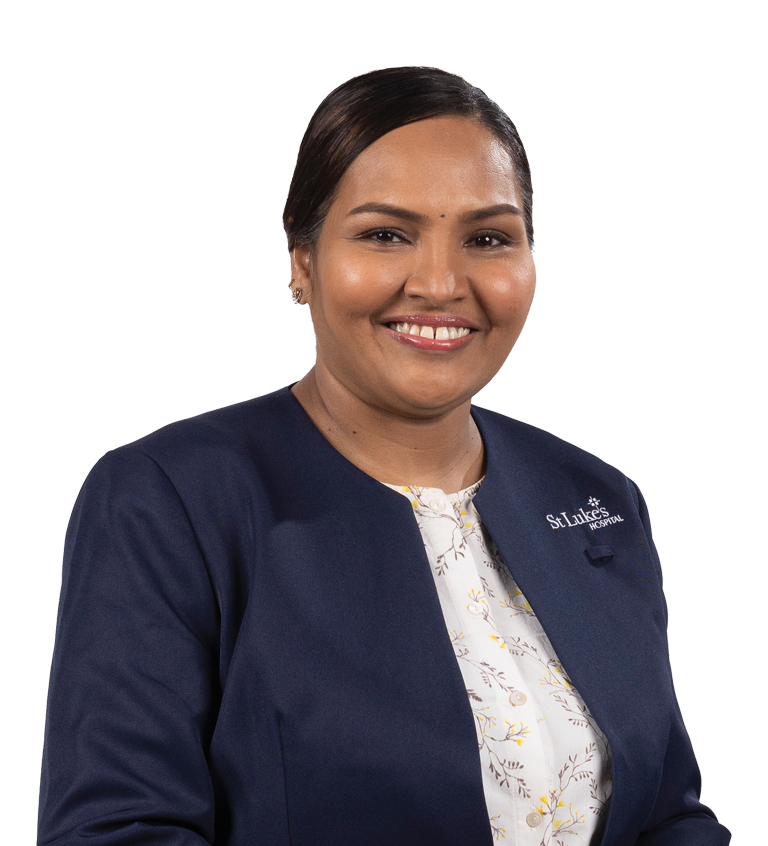
Like Melissa, Assistant Nurse Clinician Malathi Maruthasalamoorthy at St Luke’s Hospital harboured the desire to expand her expertise in her field—infection control and prevention (IPC). She began her Nursing journey as a staff nurse in the wards, where she was known for her meticulousness in hand hygiene, ward cleanliness and equipment disinfection. The constant focus on maintaining a clean, safe environment eventually sparked a deeper interest in infection control.
Recognising her aptitude, her Nursing leaders encouraged her to take up a new challenge in 2017—transitioning from bedside care to a hospital-wide IPC role after completing a Basic Infection Control Course. As an infection control nurse, her responsibilities expanded beyond a single ward to the entire hospital. In a community hospital, infection risks may be more complex as patients are typically older, have higher care needs, and require longer lengths of stay. As such, Malathi’s work now spans surveillance, audits, outbreak management, staff training and vaccination programmes.
To strengthen her theoretical grounding, Malathi enrolled in the Master of Science (Infection Prevention and Control) at NUS Nursing. “Especially after COVID—which stretched everyone’s IPC capabilities—I noticed the gaps in my own knowledge. Although I had extensive practical experience, my understanding of microbiology and immunology was basic,” she said. “This course has deepened my scientific foundation and equipped me with data analytics and leadership skills to design stronger prevention strategies.”
In addition, Malathi enjoys the synergy between what she learns in class and work. “Since the course is part-time, I can continue staying up-to-date on what’s happening at work, as well as connect the theory and best practices I learn with my workplace experiences.” She also appreciates the cross-institutional exchange of ideas. “Hearing from colleagues across healthcare sectors broadens my understanding of different challenges and solutions.”
People in her organisation were supportive of her intention to further her knowledge. “I received emails from my human resources, medical director and director of Nursing when the programme was announced,” she said. Their support continues today with the ongoing course. “My teammates cover for me when I’m away for class. Having the flexibility to work from home or take study leave when I have classes or assignments is also very helpful,” she added. “This support has given me peace of mind and the confidence to manage my studies and work responsibilities effectively.”
Elevating Singapore Nursing
While Melissa and Malathi are looking to step up and play expanded roles in critical care and IPC, Senior Nurse Managers Patrick Lin and Ryan Chua have their ambitions set on transforming Nursing practice and care at their institutions, in Singapore—and, eventually, across the region.
With the recent launch of the DNP programme, nurses now have a pathway to gain advanced knowledge and training that develops them into Nursing leaders who can drive and implement innovations at the clinical level, influence policy and address complex healthcare challenges across the entire healthcare system.
For Senior Nurse Manager Patrick Lin from Tan Tock Seng Hospital—who is part of the DNP’s inaugural cohort—the rollout of the programme couldn’t have been more timely. “My management and I were in discussion about pursuing further studies, and the DNP was on the cards, except that the context was overseas because there wasn’t a programme in Singapore then. That’s why we were excited to learn that NUS Nursing now offers the DNP programme,” he said.
“As they say, the rest was history,” he added. “As someone who’s very immersed in the clinical setting, the DNP’s emphasis on adapting evidence-based practice to our local context was very appealing.”
As part of his portfolio, Patrick is currently involved with a project on ICU transformation. The project looks at implementing a critical care outreach service. “Traditionally, ICU nurses practise within the ICUs. But we want to extend ICU expertise beyond the ICU itself—to places like the general wards where patients can receive early intervention before they become critical and get transferred into the ICU,” he explained.
However, such a project involves complex factors such as implementing guidelines to identify patients, as well as aligning care plans between the ICU and general ward teams, amongst others. “With the DNP’s focus on translating evidence-based practices, I hope to be able to implement this project in a systematic way with measurable outcomes and eventually, apply it to other projects down the line.”
Patrick’s experience so far interacting with classmates from different institutions and healthcare sectors has also broadened his perspectives. “Hearing from my classmates working in intermediate and long-term care has made me realise that I need to look at issues beyond the acute care point of view to across the entire healthcare continuum.”
Patrick’s DNP classmate, Ryan Chua, agreed. The Senior Nurse Manager from National Skin Centre said, “Classes like Global and Sustainable Health really drove home the message about looking beyond our local context. For example, hearing first-hand from the speaker on how vaccinations are distributed and administered in developing countries was eye-opening. Even though I administer vaccinations as part of my day-to-day work, the class got me to think differently about healthcare accessibility and availability.”
This expanded perspective of healthcare also dovetails with Ryan’s career aspirations to bring Singapore’s dermatology Nursing to the next level. He said, “The community of dermatology nurses in Singapore may be limited, but the National Skin Centre is quite known in the region and even globally. This strong reputation is attributed to both renowned dermatologists and the team-based dermatological Nursing care.”
With the DNP, Ryan hopes to further raise the profile of dermatology Nursing in Singapore and around the world. “There’s so much knowledge and best practices in dermatology out there. If we can adopt these practices effectively and share with others in the region, that would go a long way in putting Singapore on the world stage where dermatology Nursing is concerned. I want to use the translation skills I’ve learnt in the programme to help contextualise best practices in dermatology for our local settings.”
Unlocking Interdisciplinary Potential

NUS Nursing’s Master’s programmes are by no means only for nurses—that is a common misconception. Case in point: Tang Li Wen, who is currently doing her Master’s in Community Health. The Senior Occupational Therapist at SPD said, “Having worked in the healthcare space for more than a decade across different settings, I see health as broad-based. So I wanted to advance my knowledge in ways that broaden my perspectives and challenge me to offer more as an occupational therapist.”
A search online for healthcare-related courses led Li Wen to the Master of Community Health, where the emphasis on community and population health drew her interest. Did the fact that the course was offered by NUS Nursing give her pause? “Not really, especially when I clarified during the sharing session and found out that this course was open to various healthcare professionals,” Li Wen said. “I also enjoy how the classes have been quite diverse so far, since we’ve had expert speakers like doctors, social workers and even a professor from public health.”
Li Wen herself is also no stranger to nurses, “I’ve worked closely with Nursing teams before, especially during my time at an acute hospital. Learning alongside them in this course has been fruitful so far, especially when they shared about their work and experiences.” Being the only occupational therapist in class, she also enriches the classroom discussions by sharing her perspective.
Looking forward, she hopes to close the gaps she sees in occupational therapy and community health, as well as find new ways to support her clients.