

News
NUS and ITE launch new intra-professional nursing training programme to elevate teamwork and communication for enhanced patient care
19 June 2026 | Featured
A pioneering curriculum will integrate shared learning for Enrolled Nurse and Registered Nurse students across nursing programmes of NUS and ITE
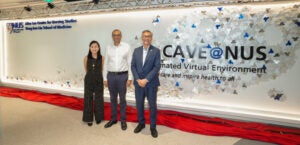 The launch of the Classroom Automated Virtual Environment at NUS (CAVE@NUS) was officiated by Guest-of-Honour, Dr Janil Puthucheary, Senior Minister of State, Ministry of Education and Ministry of Sustainability and the Environment, on 19 June 2026.
Singapore, 19 June 2026 – Marking a first for Singapore’s nursing education, the National University of Singapore (NUS) and the Institute of Technical Education (ITE) are introducing a joint training programme that brings nursing students from both institutions together to learn, train and collaborate before they enter the workforce.
At the heart of this programme is VERSE (Virtual Escape Room Simulation-based Education), developed by the Alice Lee Centre for Nursing Studies at NUS Yong Loo Lin School of Medicine (NUS Nursing) and NUS Information Technology (NUS IT), in partnership with ITE. VERSE leverages immersive virtual simulation to strengthen teamwork and communication between Enrolled Nurse (EN) students from ITE and Registered Nurse (RN) students from NUS. While these professionals work closely together in hospitals, they are typically trained separately during their studies. VERSE will be progressively integrated into the nursing curricula of both institutions from 2027, benefiting approximately 700 students annually.
Developed with support from the Ministry of Education’s Tertiary Education Research Fund, the VERSE initiative advances Singapore’s strategic efforts to foster greater collaboration across educational institutions. It aims to create a more integrated training ecosystem, where institutions complement one another’s strengths in preparing future healthcare professionals.
The VERSE programme was showcased at the launch of the Classroom Automated Virtual Environment at NUS (CAVE@NUS), a new virtual and immersive collaborative learning space. This innovative environment facilitates realistic healthcare simulations, making high-quality experiential learning accessible at scale for large student cohorts. The launch event was officiated by Guest-of-Honour, Dr Janil Puthucheary, Senior Minister of State, Ministry of Education and Ministry of Sustainability and the Environment.
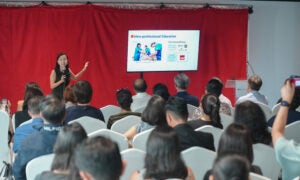 Professor Liaw Sok Ying, Head of NUS Nursing and Principal Investigator of VERSE, giving a presentation on VERSE.
Professor Liaw Sok Ying, Head of NUS Nursing and Principal Investigator of VERSE, said, “What makes VERSE unique is not just the technology, but the relationships it builds. By bringing students from different educational pathways together, we help them understand each other’s roles, communicate more effectively, and develop the trust needed to function as a cohesive nursing team. As one of the first initiatives of intra-professional education locally and globally, VERSE represents an important step towards a more integrated approach to nursing education and workforce preparation.”
“In healthcare, effective communication can make a real difference to patient outcomes. VERSE gives our students a safe environment to practise coordinating care and making decisions together with peers from another institution, while building confidence in teamwork and communication. We are pleased to harness technology in a meaningful way to enhance learning and better prepare students for practice. We hope that when they enter the workforce, they will be better prepared to work collaboratively and deliver the best possible care for their patients,” said Dr Lionel Lau, Director, School of Health Sciences, ITE.
During the pilot and randomised controlled trials, students responded positively to VERSE, particularly valuing how the realistic scenarios and relatable team dynamics mirrored actual nursing practice.
Tan Choon Kiat Bradley, Year 3 NUS Nursing student, commented, “What stood out about VERSE was that the virtual patient could respond to us. We had to listen, assess the situation, and react in real time. It also helped me appreciate the role of Enrolled Nurses in ways I hadn’t experienced before. Working together to decide how best to care for the patient felt much closer to actual clinical practice. It also helped me understand that effective patient care depends on good communication across the entire nursing team.”
Harini D/O Selvarajan, Year 3 ITE Higher Nitec in Nursing student, shared, “Being able to speak to one another through the headset made the simulation feel much closer to a real hospital setting. It felt as though I was working alongside a Registered Nurse in an actual hospital. The simulation helped me understand how Enrolled Nurses and Registered Nurses can better support each other in patient care. It also gave me more confidence to speak up and contribute as part of the team.”
ANNEXE A: FACT SHEET ON VIRTUAL ESCAPE ROOM SIMULATION-BASED EDUCATION (VERSE)
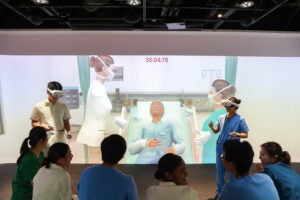 Nursing students from NUS and ITE working together to navigate realistic patient-care scenarios, as part of the Virtual Escape Room Simulation-based Education (VERSE) initiative.
Addressing a critical training gap
VERSE was specifically designed to foster collaborative learning among Enrolled Nurse (EN) and Registered Nurse (RN) students. Despite working side-by-side in patient care, their training has traditionally been separate, often leading to role ambiguity, communication gaps and hierarchical challenges. This programme enables students to develop both technological fluency and essential human-centred skills by collaboratively managing patient-care scenarios, solving problems, communicating effectively and making clinical decisions as a unified team.
Proven pedagogy, Technology-enabled
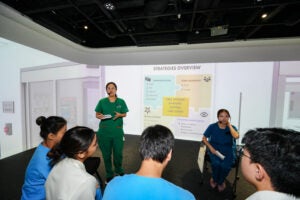 VERSE combines preparatory learning, virtual simulation and faculty-led debriefing to help students strengthen their clinical decision-making, communication and teamwork skills.
Developed since 2024, VERSE has undergone rigorous testing, with studies in 2025 and 2026 involving nearly 200 nursing students in NUS and ITE. Participants consistently demonstrated significant improvements in knowledge acquisition, teamwork and collaboration. Student feedback also indicated strong satisfaction. Over 70 per cent found it easy to use and felt it enhanced their learning experience, with more than 80 per cent expressing willingness to use it again. Students also reported confidence in using the platform and collaborating with their peers from the other institution.
At its core, VERSE features a virtual escape room where EN and RN students navigate realistic patient-care scenarios, with success hinging on effective collaboration. Students solve puzzles and respond to deteriorating patient conditions, requiring them to recognise clinical signs, communicate effectively and coordinate care using tools such as ISBAR (Identify, Situation, Background, Assessment and Recommendation), CUS (Concerned, Uncomfortable and Safety issue), and check-back techniques that are widely used in healthcare settings.
Grounded in experiential learning and designed for future artificial intelligence (AI) integration, the programme follows a structured approach. Students begin with preparatory learning, followed by virtual simulations and structured faculty-led debriefing sessions where they reflect on their decisions, communication and teamwork. This ensures technology enhances, rather than replaces, the critical human interactions vital for professional development.
ANNEXE B: FACT SHEET ON CAVE@NUS
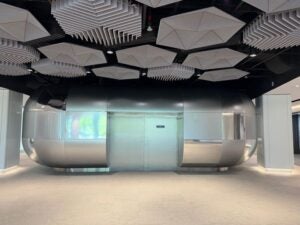 CAVE@NUS is an innovative learning facility designed to support immersive and collaborative healthcare education.
The Classroom Automated Virtual Environment at NUS (CAVE@NUS) is an advanced learning hub developed by NUS Nursing in partnership with NUS IT, integrating virtual reality, simulation and collaborative learning to revolutionise healthcare professional education.
Designed to transcend traditional classroom teaching, CAVE@NUS enables students to learn through experience, reflection and discussion in highly immersive environments, scaling these experiences across large cohorts.
At the heart of the facility is an immersive CAVE, a highly realistic simulation space, supported by nine connected learning rooms that collectively facilitate simultaneous experiential learning, observation, discussion and debriefing for multiple student groups.
Bridging the training gap
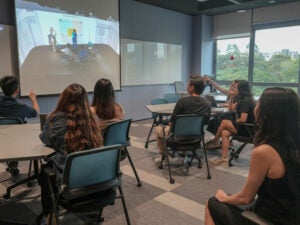
Modern healthcare demands multidisciplinary teamwork and communications, yet traditional virtual reality learning remain conducted individually and remotely. CAVE@NUS bridges this critical gap by integrating immersive technologies with collaborative learning. It enables students to learn and reflect together, fostering teamwork, communication and clinical reasoning essential for contemporary healthcare.
The facility supports a unique model where students first engage with realistic scenarios, then collectively discuss, analyse and learn from those experiences in a shared environment.
Pillars of innovation
CAVE@NUS stands apart through its three core principles:
a) Immersive Learning
Students step into realistic virtual healthcare scenarios, experiencing real-world clinical situations firsthand rather than just reading about them.
b) Collaborative Learning
Designed as a social learning environment, CAVE@NUS fosters communication, teamwork and clinical reasoning through facilitated debriefs, group reflection and peer observation.
c) Learning at Scale
Unlike conventional immersive environments that typically cater to small groups, CAVE@NUS scales learning beyond the immersive space. Experiences can be streamed to adjoining classrooms, allowing faculty to facilitate discussions and debrief sessions for large cohorts of learners to observe, participate, analyse decisions and share perspectives simultaneously. This transforms immersive learning from a small-group activity into a scalable educational experience.
Diverse applications
CAVE@NUS supports a wide range of educational applications, including:
· Immersive virtual reality learning
· Healthcare simulation and training
· Interprofessional education
· Intra-professional education
· Clinical communication training
· Team-based learning
· Debriefing and reflective learning
· Healthcare education research
A prime example is VERSE (Virtual Escape Room Simulation-based Education), which enables NUS and ITE nursing students to collaboratively develop communication and clinical decision-making skills in immersive virtual environments.
Future-proofing healthcare education
CAVE@NUS is a dynamic platform for future educational innovations, including mixed reality, simulation-enhanced learning and next-generation healthcare training. As healthcare rapidly digitises, CAVE@NUS serves as a vital testbed for developing and evaluating new experiential learning approaches, ensuring future healthcare professionals are prepared for increasingly complex and technology-enabled care environments.
Facility Overview
· Gross Floor Area: Approximately 2,320 sqm
· Facilities: 1 immersive CAVE and 9 connected learning rooms
· Capacity: Up to 350 learners
· Construction Period: January–July 2025 (7 months)
