

Alice Lee Centre for Nursing Studies (NUS Nursing), National University of Singapore Yong Loo Lin School of Medicine is a place that sees inspired students return to give back to their alma mater as members of the teaching staff. Senior Lecturer Dr Siriwan Lim and her student-turned-colleague Dr Ronel Tan are examples of this mentoring culture, which has seen 20 alumni rejoin NUS Nursing as faculty staff.
The duo first met in 2010 in class at Ngee Ann Polytechnic—Dr Lim was the teacher, and Dr Tan was her student. They crossed paths again in a different academic setting in 2013—this time at NUS Nursing, as teacher and student. Today, they are colleagues, research collaborators—and mentor and mentee.
2010: Polytechnic Days
They may have come a long way since the beginning, but both vividly remember their first impressions of each other. “Dr Siriwan’s classes were always well-structured and detailed—I particularly enjoyed how she delivered her content in a personalised and authentic manner,” Dr Tan said. “But she was also a very strict educator. At the same time, she was very caring—she would take time to interact with us. She was definitely a teacher who left an impression.”
Similarly, Dr Tan left a deep impression on Dr Lim. “Seeing Ronel so fit and strong now, it is hard to imagine that he was once rather small-built. I recall feeling concerned about whether he could handle patients’ weight—which is sometimes necessary in the wards. But more than his physical build, he stood out as a student who was both hardworking and driven. He was always prepared for class and did his work diligently.
“It is always a joy to teach students like Ronel, who take ownership of their own learning—because that is when true learning takes place.”
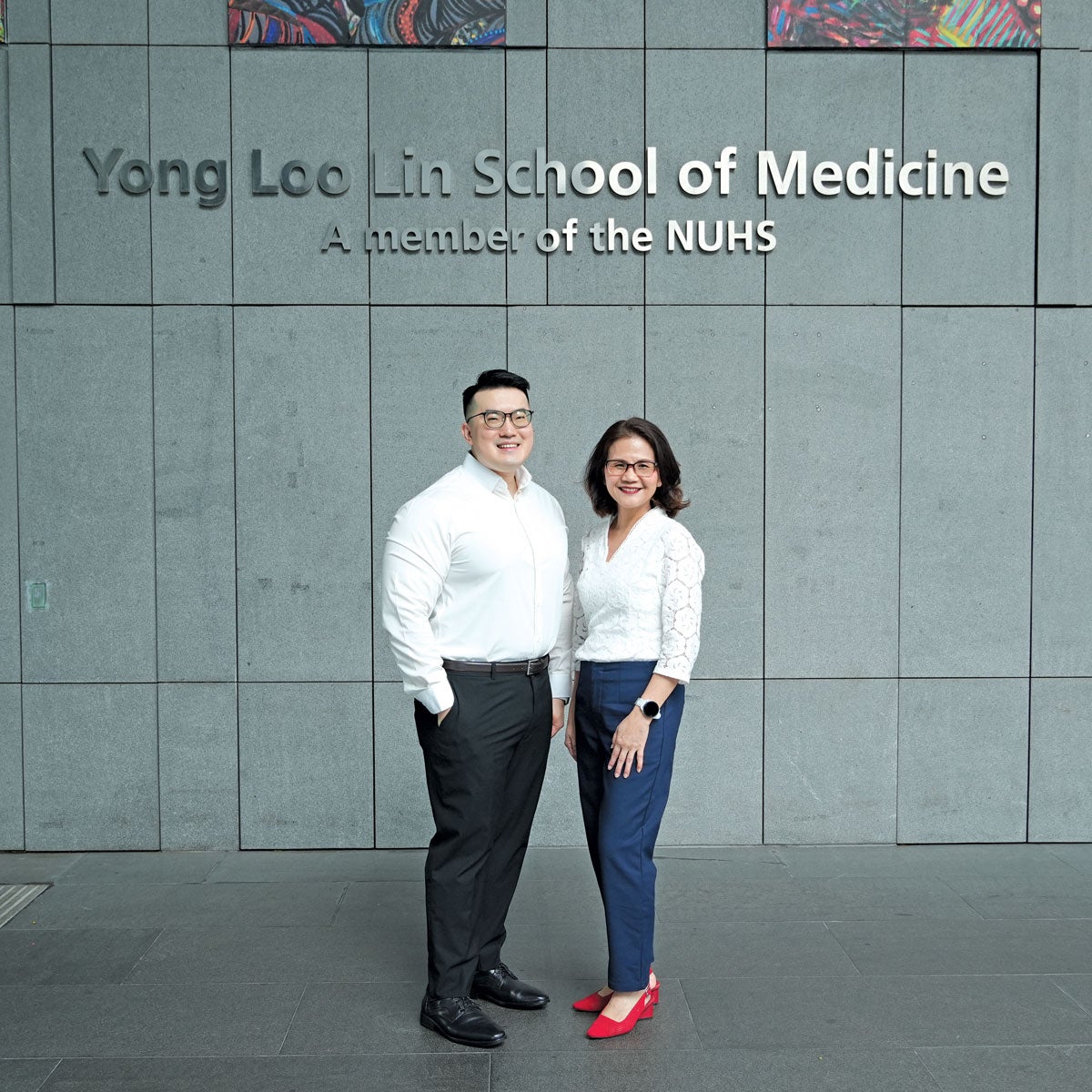
Dr Tan (left) with Dr Lim (right) at MD6.
2013: Reconnecting at NUS Nursing
They stayed in touch through Dr Tan’s graduation and his National Service (NS). “We were Facebook friends. Dr Siriwan would occasionally leave comments on my posts. It so happened that after my NS, I was thinking to further my studies. I knew Dr Siriwan was with NUS Nursing—so I reached out to find out more about the pathways and opportunities available,” Dr Tan shared. “She told me about the vibrant student life—and the interdisciplinary pedagogy here.”
Heeding Dr Lim’s advice, Dr Tan pursued his Bachelor’s degree with NUS Nursing—which proved to be the start of a long and fruitful journey. He said, “NUS Nursing has really shaped me into who I am today. While my involvement in the overseas immersion programme during my undergraduate days offered insights into healthcare systems in other countries, the chance to collaborate and learn alongside other disciplines enriched my learning. I also had my first taste of research at NUS Nursing—which subsequently cemented my interest in pursuing it further through a PhD.”
Meeting Dr Lim again as her student was a happy occasion. He joked, “Dr Siriwan was exactly as I remembered her—with just a tad more mellowness to her—catering to the different student demographics here.”
Adding to Dr Tan’s observation, Dr Lim said, “Because our aspiration at NUS Nursing is to groom students into Nursing leaders, the students we admit naturally possess a certain aptitude—curious, vocal and motivated—and it takes a different approach to engage and develop their potential. But I enjoy my interactions with them—they challenge and keep me on my toes.”
She continued, “The way I see it, learning goes both ways—even as I impart my experiences and expertise in the domains I’ve been trained in, I am also learning from their perspectives on issues and their relationship with technology as digital natives.”
2020: From Teacher and Student to Mentor and Mentee
After NUS Nursing, Dr Tan served as a Senior Staff Nurse at the National University Hospital for four years. There, he acquired valuable experience and skills in Critical Care Nursing. Contemplating his next career move, he reached out to Dr Lim for advice.
“When Ronel approached me and shared his priorities, he told me what he hoped for in his career forward. I was very touched. For him to share his thoughts with me so openly and humbly shows the level of trust and respect he had for me,” Dr Lim recalled.
Her advice and Dr Tan’s deep interest in Nursing and healthcare research brought Dr Tan back to NUS Nursing to pursue his PhD studies. Coincidentally, Dr Lim was assigned as his mentor when Dr Tan joined NUS Nursing as a faculty member. “It just so happened that Dr Siriwan was there at every stage of my Nursing journey. She was there when I was a Nursing student, when I became a staff nurse, and more recently when I joined NUS Nursing after my PhD studies as a faculty member,” he smiled.
“But more than that, I truly appreciated how she offered guidance every step of the way. She gave me practical and constructive tips on how to manage a huge cohort, how to improve my teaching, and how to familiarise myself with pedagogies. She made me feel very supported in this journey.”
Dr Lim added, “I was just paying it forward. I wouldn’t have completed my own PhD without the support of our Heads of Department—Sally, Emily and Sok Ying—along with access to quality learning resources and opportunities to engage with subject and research experts. I knew how difficult and challenging it was. Plus, Ronel started his PhD during the pandemic—so his research faced many hurdles. That is why I made it a point to check in with him now and then, just to encourage him and tell him not to give up.”
His positive teaching experience sparked a love for teaching but it also led to a dilemma: whether to pursue a research or education pathway at NUS Nursing. Dr Lim simply told him, “I see an educator in you.” She explained, “Ronel was undecided whether to explore education or focus on research—so I reassured him that he could still do research even if he chose the education pathway.”
|
2024: Research Collaborators and Educators Dr Lim’s words rang true. Today, they have completed an education research project together—with a second one in progress. The first project, which involved an Honours student, explored how artificial intelligence (AI) and simulation could support students in learning about infection control by combining theory and practice into a comprehensive learning experience. From the analysis of the collected data, the team was able to demonstrate AI’s effectiveness in helping students respond appropriately to simulation scenarios. They are currently preparing to submit the findings for publication. |
In comparison, the project they are currently working on has a much more ambitious agenda. “A big part of building a strong Nursing workforce is ensuring that nurses who have undergone rigorous training transition into clinical settings smoothly. To help them ease into clinical settings, we are leveraging a grant from the Ministry of Education (MOE) to develop a hybrid mentoring programme,” Dr Lim said.
“Through the programme, we aim to connect students with alumni mentors who can support them as they enter the workforce. At the same time, we are integrating technologies like AI into mobile applications to help young nurses navigate the fast-paced, volatile, and potentially stressful clinical environment. The whole idea is to let them know that they are not alone—and that there is a community here to support them.”
The team hopes to foster a cohesive, inclusive and nurturing Nursing community. Dr Tan said, “I am excited to see how the app will turn out—and hear the students’ feedback—especially since the younger generation is very tech savvy and critical of content and its creation. But more importantly, I am interested to see if the app can support student nurses in their transition to full-fledged registered nurses by helping them cope with stress and build resilience.”
They are in the early stages of the three-phase project, having only recently completed the alumni and student co-design engagement session. However, there is little doubt that the project is set up for success. “I work very well with Dr Siriwan. With her, I can always speak my mind openly and honestly,” Dr Tan mused.
His colleague-mentor appreciated the perspectives that Dr Tan brings to the work. “Although Ronel was once my student, I have no problem at all treating him as a peer now. In fact, it is so fun to work with him. He brings fresh perspective and adds a new dimension to our study by drawing from his own PhD experience—which is invaluable to making our work more efficient and robust,” Dr Lim said. “And when I see how far he’s come, and how much he’s grown—I feel humbled by his achievements and am incredibly proud of him.”
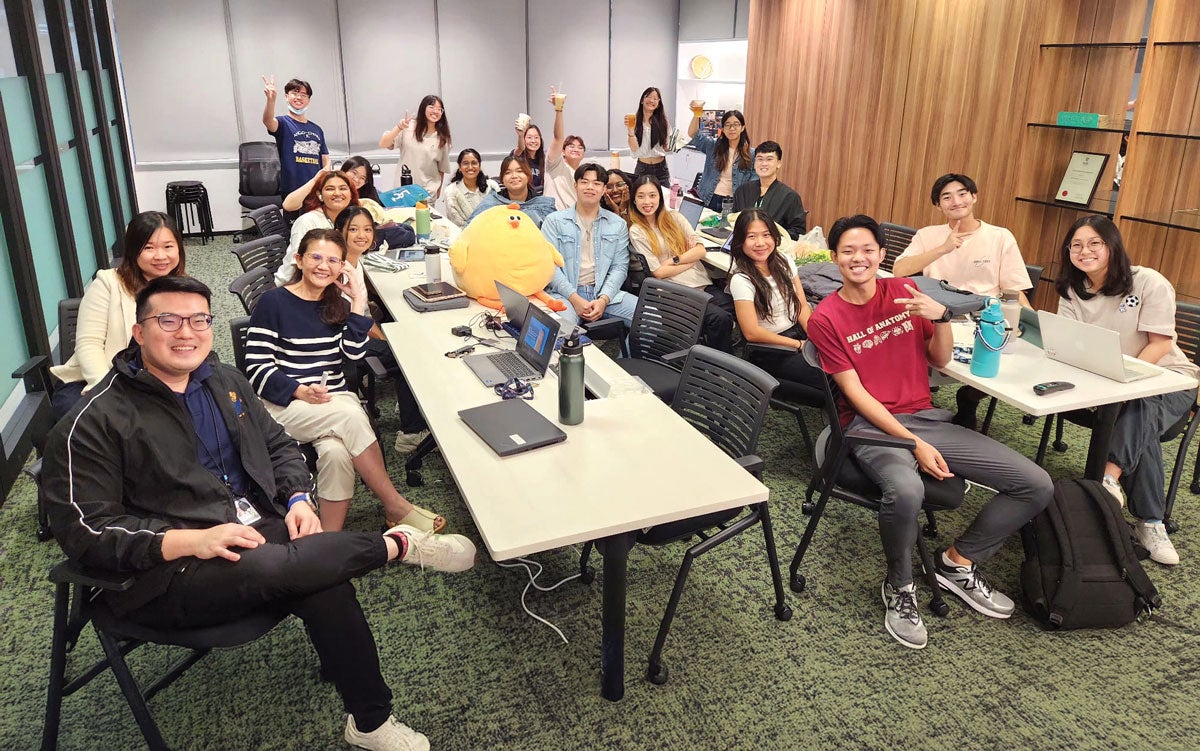
Dr Lim and Dr Tan at an NUS Nursing House meeting.
Beyond research, they also work closely in another capacity—promoting cohesion and building rapport among Nursing students outside of class. The NUS Nursing House system was first established in 2015. In 2022, Dr Lim took over as Chair and revamped the programme.
“It was right after the pandemic, during which, there was no activity at all. So I set out to put in place a peer mentoring system—find out what students need, conduct structured workshops to train peer mentors, and engage with House advisors (who are faculty members),” Dr Lim recalled. “I am thankful to have very supportive House advisors who spared no effort in contributing to the effort.”
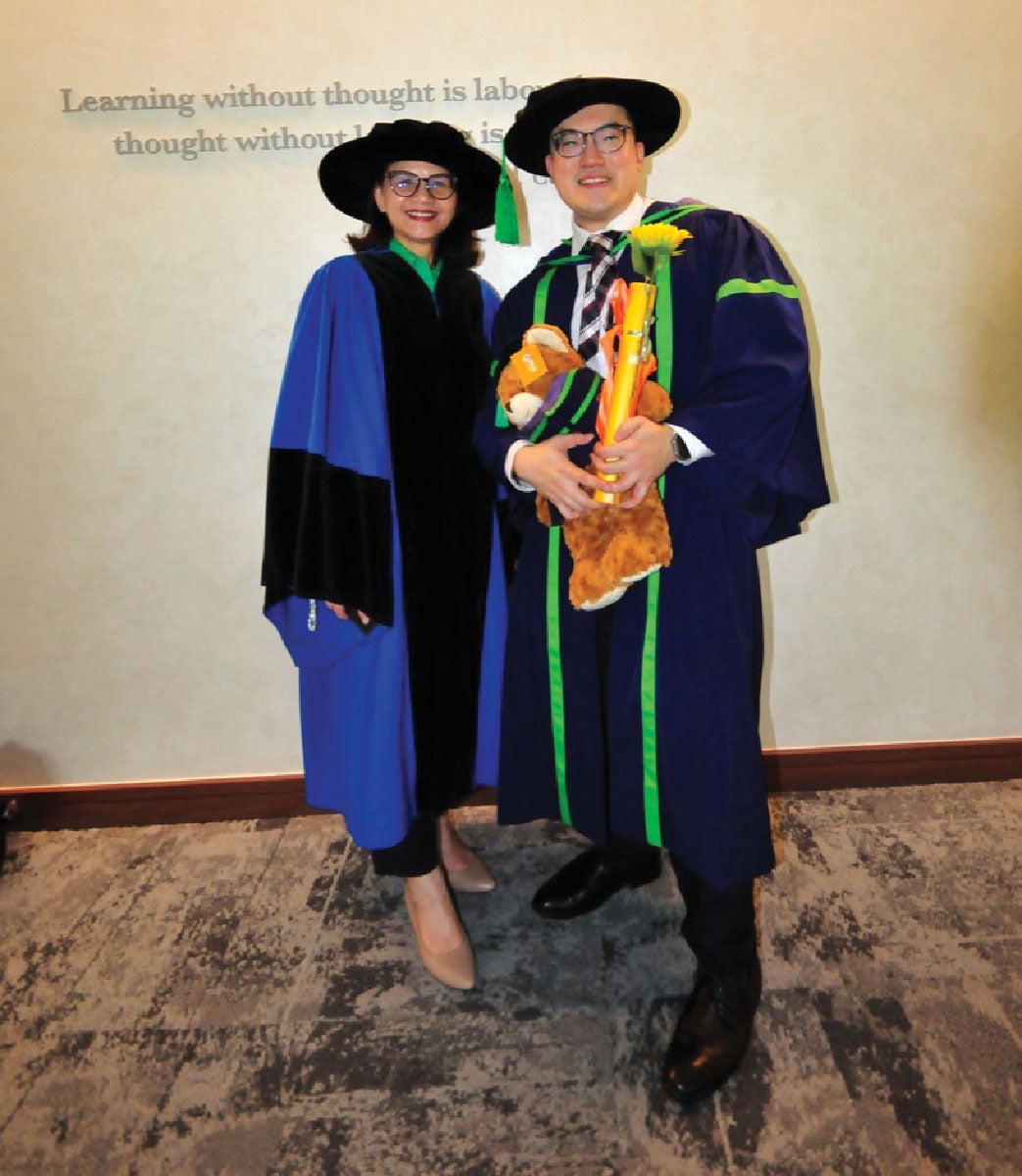
Dr Tan (right) at his PhD conferment ceremony with Dr Lim (left). |
Dr Tan is one of them. As the House advisor for Nightingale House, he offers guidance to student mentors on the implementation of activities to ensure that students under their care are well-supported. Today, the peer mentoring programme is structured such that Year 1 students receive support from their Year 2 seniors to help them adapt to university life. Year 3 students guide Year 2s in managing anxiety about clinical placements and interacting with actual patients. And alumni mentors support Year 3 and 4 students in their transition into the Nursing workforce. |
“Our current House system is well-structured, and its activities are grounded in students’ needs. But we recognise that these needs evolve over time—so in the way forward, we aim to keep our programmes relevant by staying innovative and adaptable to students’ changing circumstances,” Dr Lim summed up. “With a clear direction and positive outcomes, I hope to leave behind a roadmap that empowers future House Chairpersons to take it to the next level.”


