

News
Turning Nursing into a Board Game: How NUS Nursing Honours students gamified health education for older adults
23 March 2026
Rich health, rich life. That was the guiding idea behind Fa Cai, a board game created by final-year NUS Nursing students to make preventive health education more accessible and engaging for older adults
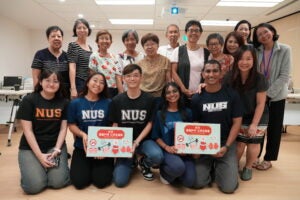
The minds behind Fa Cai (first row, from left to right): Wong Yu Lin, Jolene Wong Wei Ling, Lim Kai Zhe, Aramvalartha Nayagi and Dalvinder Singh S/O Varinder Singh.
Education plays a crucial role in healthy ageing. Understanding what supports good health—and what increases the risk of chronic disease—empowers individuals to make better choices over the long term. This challenge formed the basis of a problem statement given to students in the Preventive Health and Chronic Disease Management track of the Bachelor of Science (Nursing) (Honours) programme: design a product or service that supports preventive care in the community.
One student team chose to bridge the gap between healthcare education and older adults through gamification, transforming complex health concepts into an interactive, social learning experience.
Fa Cai: a board game that teaches health
Their solution, Fa Cai, is a board game designed to raise awareness of chronic disease risks and healthy living habits—particularly for those approaching older age. While the primary audience is older adults, the game also equips caregivers and younger players with practical health knowledge to better care for themselves and others.
To ensure the game is relevant and inclusive, the team conducted research, interviews and multiple playtests. With support from Fei Yue Community Services, they engaged older adults and caregivers in active ageing centres, gathering insights that shaped the game’s design, content and mechanics. Decisions on which chronic conditions to feature—and how prevention strategies should be presented—were directly informed by this ground-level feedback.
Inclusivity was a core design principle. Medical jargon and complex health concepts were translated into clear, simple English, ensuring the game remained approachable and enjoyable for players of varying health literacy levels.
Health education is woven directly into gameplay. For example, players who land on another player’s “property” can pay a reduced amount if they correctly answer a question related to healthy living. The team spent seven weeks on initial planning and ideation, followed by iterative refinements based on real-world testing.
“I have learnt quite a bit about healthcare even though I have only attended two sessions. The game’s health tips are especially valuable for people my age,” shared Angie Ng, a 67-year-old participant at JiaYou Senior & Caregiver Hub at Chinatown Point.
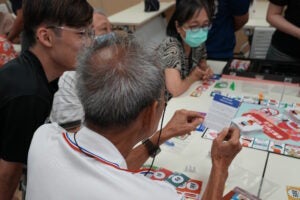 A property card being triggered, with its owner quizzing the player who landed on his property.
Designing with, not just for, older adults
One of the team’s biggest challenges was understanding the preferences and needs of older players.
“Workshopping was a continuous process—we were still making tweaks even in the tenth week,” shared Lim Kai Zhe, a member of the Fa Cai team. “We met outside curriculum time and took direct feedback from trial runs, adjusting things like the size of the dice and the number of spaces on the board.”
This iterative, user-centred approach reflects the applied nature of the Honours programme by coursework, where students are encouraged to test ideas in real settings and refine them based on evidence and feedback.
Honours at NUS Nursing: Learning Beyond the Classroom
Launched this academic year, the Bachelor of Science (Nursing) (Honours) programme by coursework is designed to cultivate innovation by integrating students’ interests in research, clinical practice, education and management, with a particular focus on refinement, continuous improvement, and implementation science for real-world impact. Through close engagement with area specialists, students address healthcare challenges grounded in practice-based contexts.
The programme adopts a hybrid learning model that blends self-directed study, peer learning, faculty-led seminars, and individualised one-to-one mentorship —nurturing independence, innovation and collaboration. Projects like Fa Cai exemplify how Honours students translate academic learning into practical solutions that serve the community.
“Not every student envisions themselves as a researcher who pursue academic publication; and that is completely valid. The Honours by Coursework pathway recognises this by offering a different perspective of research that places value on application, innovation and impact. Rather than completing a thesis, students engage in guided learning and applied projects that respond to real healthcare needs. This pathway allows them to pursue diverse interests, while building strong critical thinking and leadership capabilities. For many, it becomes a more authentic and meaningful way to experience their Honours year; one that aligns closely with who they are and the kind of nurses they aspire to be,” said Dr Lim Fui Ping, Course Lead.
Looking ahead: the future of Fa Cai
The team is looking to refine the game which may include reviewing and improving the question cards to ensure they are as relatable and meaningful as possible for all players.
“Beyond that, we hope to find a supplier to mass-produce Fa Cai, which could help lower costs. In the future, we’d like to explore different language versions, expansion packs, and even collaborations with healthcare institutions,” said Kai Zhe.
How is the game played?
Each player begins at the “GO” tile and moves around the board based on his or her dice roll. Spaces on the board represent healthcare-related locations or actions, such as visiting polyclinics or choosing healthier food options. These tiles can be purchased using healthpoints, the in-game currency.
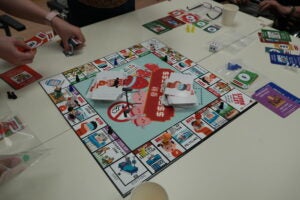
The Fa Cai Board.
Polyclinics are intentionally more expensive to buy and maintain, highlighting their importance in preventive and primary care. Reflecting Singapore’s geography, the featured polyclinics represent the North, South, East and West regions. Each segment of the board also focuses on a specific chronic condition, including lung disease, stroke, dialysis, hypertension and hyperlipidemia.
Going to the Intensive Care Unit (ICU) is also represented in the game. The board features an ICU and a “Missed Medication” tile. Players are sent to the ICU if they either land on the “Missed Medication” tile or are unlucky from drawing Heng or Aiyo cards.
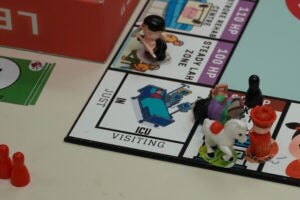
Those who happen to land on the ICU tile from a dice roll rest in the “JUST VISITING” section.
Players can either pay 500 healthpoints or miss a turn to get out of the ICU. This was an intentional design choice by the team to show the real-life implications of patients missing their chronic medications, such as an increased risk of developing complications or worsening symptoms. Furthermore, the design choice of “missing a turn” for exiting the ICU mirrors how people can miss out on life’s events if they miss their medication.
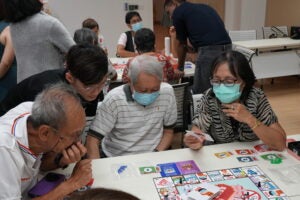
A Heng Card in action.
Special tiles—Aiyo and Heng—introduce elements of chance and learning. Aiyo cards trigger immediate negative or positive effects such as losing or gaining healthpoints or being sent to the ICU. Heng cards, unique to Fa Cai, prompt another player to quiz the person who landed on the tile. Correct answers earn healthpoints, reinforcing learning through friendly competition.
The game ends after a predetermined number of rounds. Players tally their healthpoints and liquidate their properties, with the highest total emerging as the winner.
