
News
Solving the healthcare challenges of tomorrow, today
15 September 2025
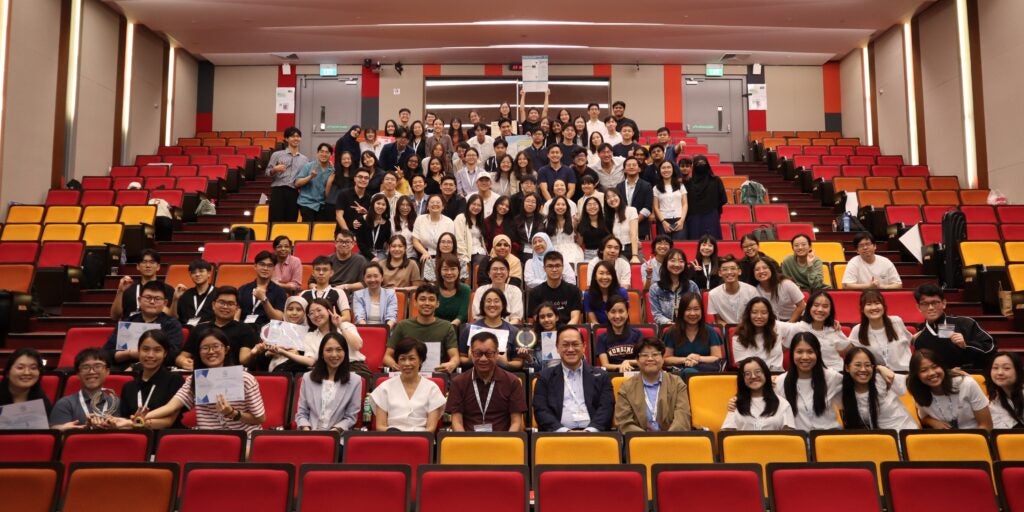
Participants, mentors and the judging panel of SHIFT gathered for a photograph at the end of the final showcase.
“No man is an island.” This maxim held true during the inaugural Shaping Healthcare Innovation For Tomorrow (SHIFT) hackathon, a ground-up hackathon that empowers students to co-create innovative solutions to real-world healthcare challenges.
Organised by the Singapore Nursing Innovation Group (SNIG), a student-led initiative under the NUS Alice Lee Centre for Nursing Studies (NUS Nursing), over 100 students from five local universities and polytechnics — NUS, the Singapore Institute of Technology (SIT), Ngee Ann Polytechnic , Nanyang Polytechnic (NYP) and the Institute of Technical Education — collaborated on winning innovations spanning three subthemes: Chronic Disease Prevention & Early Detection, Lifestyle & Behavioural Health Modification, and Ageing Population & Preventive Care.
Held from 31 August to 6 September 2025, the interdisciplinary hackathon comprised almost 30 teams, with at least one Nursing student per team, offering a valuable opportunity for students to collaborate across fields and gain mentorship from healthcare professionals.
At the final showcase on 6 September 2025, three teams walked away with top honours for their innovative ideas — a smart sock, an Artificial Intelligence (AI) social network, and a behavioural change virtual pet — all poised to shape the future of healthcare.
Grand Prize: SafeStep Smart Sock
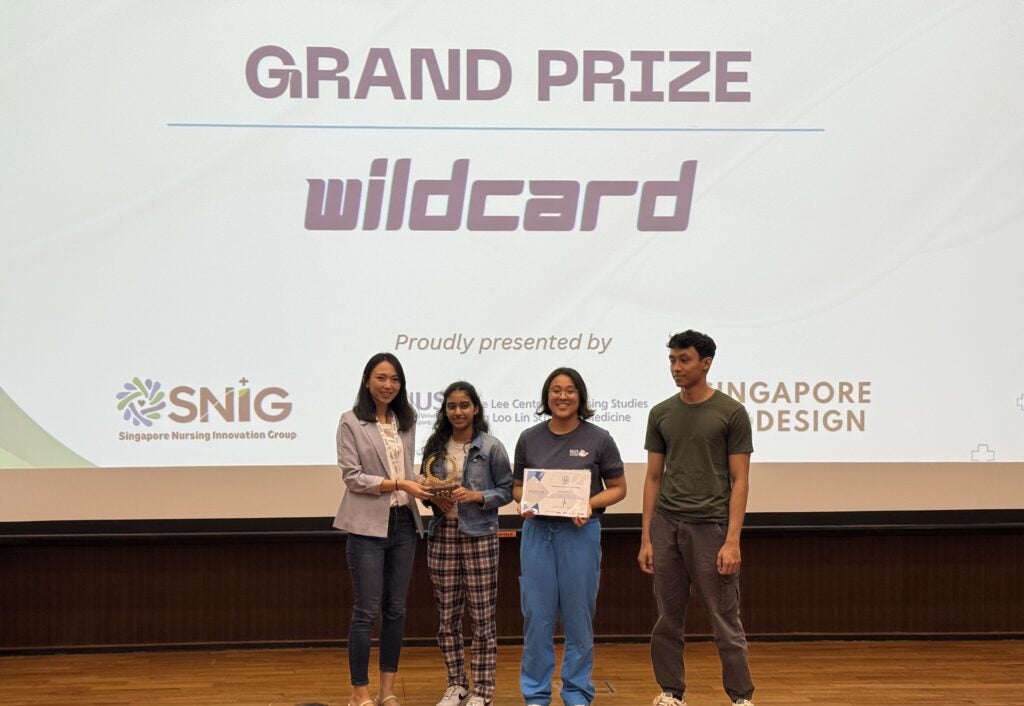
NUS Nursing Assistant Professor Jocelyn Chew, also the founder of SNIG, presented the grand prize to Team Wildcard.
The top prize went to Team Wildcard — a trio from NUS comprising Magdalene Lim from NUS Nursing, Roopashini Sivananthan from NUS College of Design and Engineering, and Hanzalah bin Azmi from the NUS Faculty of Law. Their prototype, SafeStep, is a breathable smart sock equipped with sensors that detect falls in real time and alert both wearer and caregiver. Designed for visually impaired elders, the sock aims to reduce fall-related injuries, one of the greatest impediments to seniors’ independence.
The smart sock is not the team’s first healthcare project. The trio, who first met at a design thinking workshop, had earlier collaborated on a pacifier for babies with cleft palates. They are now testing the viability and user experience of SafeStep by advancing it into the prototyping stage, with plans to conduct user interviews and design validation to ensure it meets patient and caregiver needs.
For Magdalene, the hackathon was a chance to bridge classroom learning with real-world insights. “As a student nurse, I don’t always have the full picture of what is being done in the community,” she said. “Our mentor’s wealth of experience really helped us see where the true pain points and gaps lie. That guidance shaped how we refined our idea, and it gave me a much deeper appreciation of how innovation must be rooted in real-world practice.”
1st Runner-Up: KampongNET for Seniors
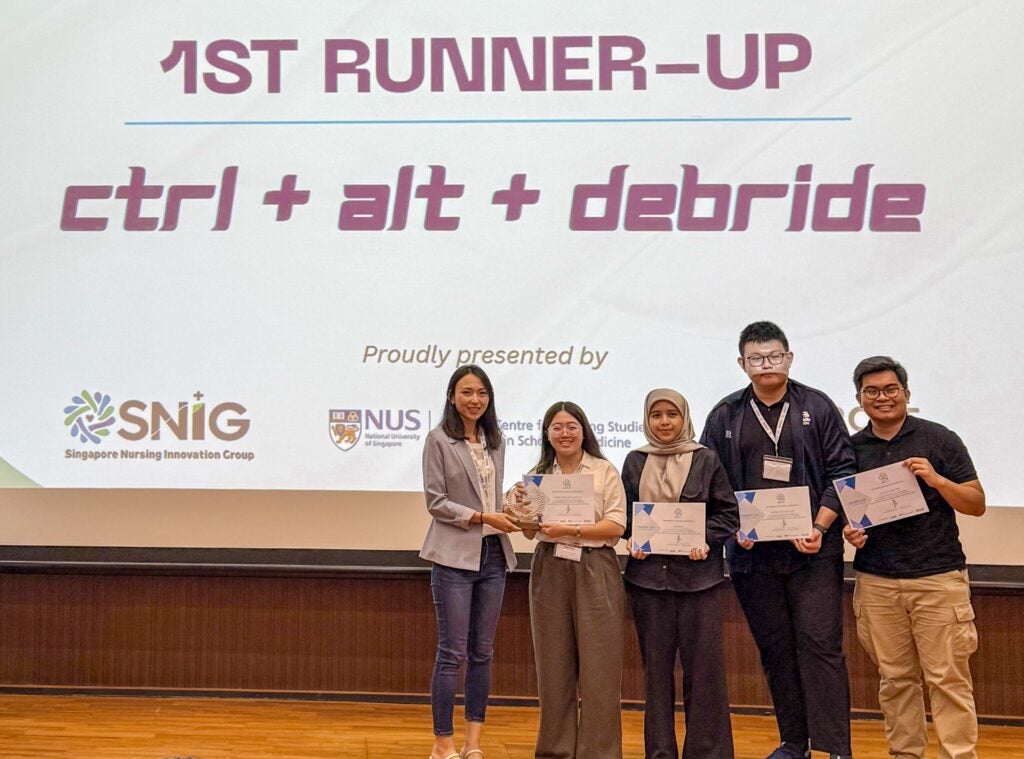
NUS Nursing Asst Prof Jocelyn Chew presented the first runner-up prize to Team Ctrl + Alt + Debride.
Ctrl + Alt + Debride — comprising Winnie Low and Ivan Tan from NUS Nursing and NUS Faculty of Science (FoS), Maryam Syamilah Binti Mahmood Shah from SIT Computing Science, and Yi Jiaxin and Onquit Jake Davis Areglo from NYP School of Information Technology — took second place with KampongNET, a digital social platform with an AI voice assistant. Built for seniors living in rental homes within Silver Zone areas, the solution combats social isolation by fostering conversations and connections.
Several members of the team first met in NYP as volunteers. Winnie was the catalyst who brought them together, spurred by the opportunity to merge two disciplines rarely seen side by side. “Coding and nursing are such distinct fields, but through this hackathon we finally had the opportunity to merge them. I don’t see many nursing-focused hackathons — most are technically heavy and can feel daunting. When I saw this opportunity, I wanted to give it a try, especially with friends I knew from NYP,” she said.
2nd Runner-Up: HabiTot Virtual Pet
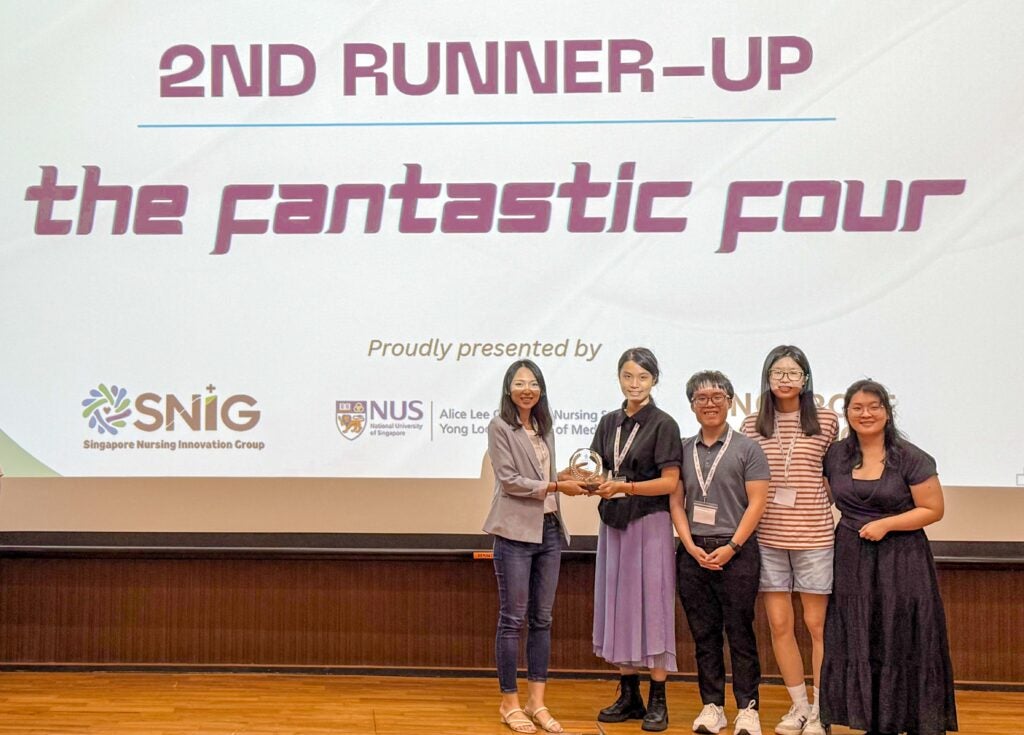
NUS Nursing Asst Prof Jocelyn Chew presented the second runner-up prize to Team The Fantastic Four.
In third place, The Fantastic Four — Jin Li Yao and Daniel Chong Zhao Yang from FoS), Guo Xinyi from NUS Nursing, and Peh Jia En Leticia from NUS Faculty of Arts and Social Sciences — developed HabiTot, a Tamagotchi-inspired virtual pet that rewards children for spending less time on screens. The playful interface nudges kids toward social interaction, hobbies, and healthier daily routines.
Team member Li Yao said the hackathon provided a springboard for the team to think bigger. “We see real potential in HabiTot, and when time allows, we hope to expand the idea into a patent and explore collaborations to turn it into a working prototype. This hackathon gave us a starting point, and we’re excited to see how far it could go with the right partners.”
For NUS Nursing Asst Prof Jocelyn Chew, who founded SNIG, this stemmed from a conviction that nursing should be recognised not only for its role in bedside care, but also for its strength in problem-solving at the frontlines.
Her vision is for SNIG to grow into a national platform where nurses at all levels engage in cross-institutional collaboration, entrepreneurship, and evidence-based change. “We want to create an ecosystem that empowers nurses to go beyond solely delivering care, to also design the systems, technologies, and models of care that will shape the future of healthcare,” she said. That philosophy inspired SNIG’s first flagship project, the SHIFT Hackathon — a proving ground where students, practitioners, technologists, and community partners came together to co-create solutions.
SHIFT’s student organising committee, led by third-year NUS Nursing students Weslyn Low and Magdalene Tong, spearheaded the planning of the hackathon. They were supported by 25 nursing mentors from hospitals across Singapore, who guided teams through the fast-paced ideation and prototyping process.
Dr Lee Yee Mei, Deputy Director of Nursing at National University Hospital and one of the mentors, described the hackathon as both inspiring and a proud moment for the profession. Seeing students step up to innovate, she said, showed their potential to create ideas that benefit patients and nurses alike. She encouraged students to view innovation as part of nursing education itself — where even something as basic as measuring vital signs can be re-imagined.
Mr Wong Kok Cheong, Deputy Director of Nursing at Changi General Hospital and one of the judges for the hackathon, shared that it was indicative of a larger shift in nursing as a profession. “Nursing innovation is the next milestone for nurses – with an ageing population and shrinking workforce, innovation is essential to improving productivity and patient outcomes.”
This article was first published in NUS News on 11 September 2025.
