Short mitochondrial protein may help protect the ageing heart from inflammation and failure
Published: 01 Sep 2026
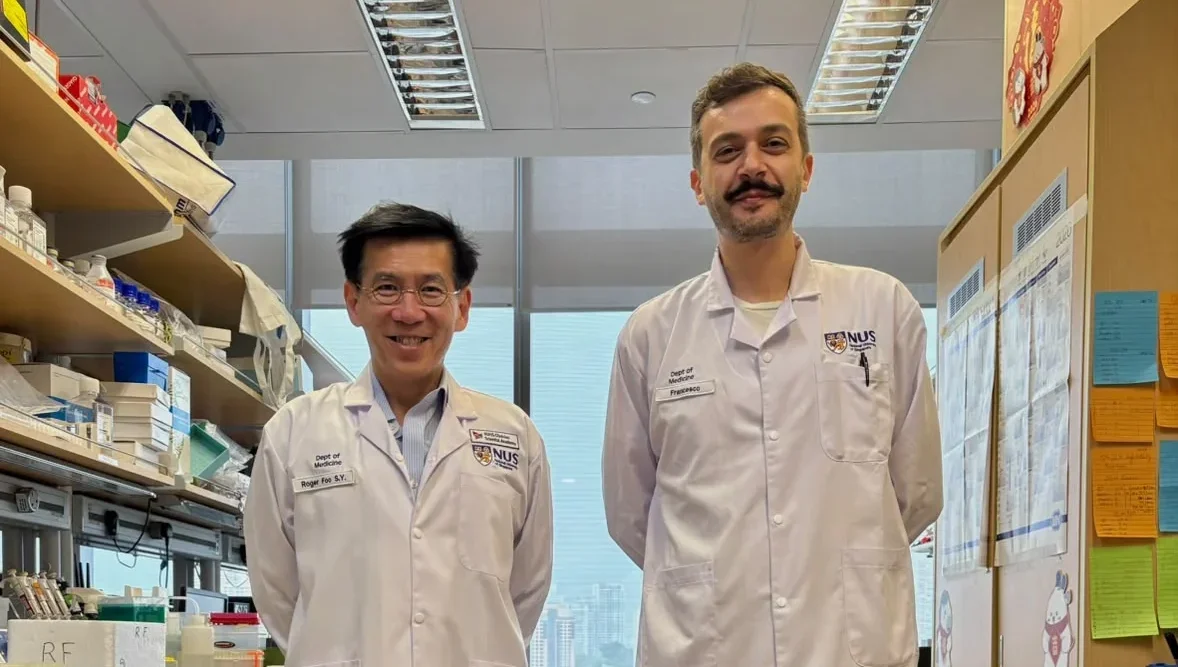 Professor Roger Foo and Dr Francesco Paolo Ruberto, both from the Cardiovascular-Metabolic Disease Translational Research Programme (CVMD TRP) at NUS Medicine.
Researchers at NUS Medicine have discovered that a relatively short protein may play an important role in protecting the ageing heart. The protein, known as STMP1, is made up of 47 amino acids and helps maintain the internal structure of mitochondria, which are parts of cells that produce energy. The preclinical findings were published in Circulation.
Heart failure is a major cause of illness and death, particularly among older people, and ageing is linked to “inflammaging”, a state of long-term, low-grade inflammation that can contribute to age-related disease. To understand how this begins in the heart, the researchers studied heart tissue and cellular data from laboratory models and humans.
They found that levels of STMP1 fell specifically in cardiomyocytes (muscle cells that enable the heart to contract) and were also lower in human hearts affected by dilated cardiomyopathy. Laboratory models which were unable to produce STMP1, developed mitochondrial damage, persistent inflammation, reduced pumping ability, enlargement of the heart’s main pumping chamber, scarring, and heart muscle cell death. Restoring STMP1 or blocking the inflammation early significantly protected heart function.
Dr Francesco Paolo Ruberto, first author of the study and research fellow at the Department of Medicine and Cardiovascular-Metabolic Disease Translational Research Programme (CVMD TRP), NUS Medicine, said, “STMP1 is an exceptionally small protein, but our findings show that it has an important role in keeping the mitochondria of heart muscle cells structurally stable. When it is lost, this can set off a chain of mitochondrial damage, inflammation, and heart failure.”
Using advanced three-dimensional electron microscopy, the researchers examined the mitochondria in detail. They found that the loss of STMP1 damaged cristae, which are folded inner membranes that support energy production. This caused mitochondrial DNA to leak into the surrounding cell. Because DNA is not normally found there, the cell mistook it for a sign of infection and activated an immune alarm known as the cGAS–STING pathway. This produced a persistent inflammatory response, disrupted the cells’ energy production, and contributed to the death of heart muscle cells. Importantly, signs of inflammation appeared before laboratory models developed clear heart failure, suggesting that inflammation may help drive the disease.
Potential new treatment approaches
The researchers tested two ways of interrupting this process. First, they used a gene-delivery system to restore STMP1 in the heart. This improved mitochondrial structure, reduced inflammation, and restored heart function in the laboratory models.
Second, they used a drug to block STING. When given early, the treatment preserved heart function and reduced signs of inflammation, cardiac stress, and scarring in laboratory models. However, it did not restore heart function when treatment began after significant mitochondrial damage had developed.
Professor Roger Foo, Zayed bin Sultan Al Nahyan Professor in Medicine, CVMD TRP, NUS Medicine, and corresponding author of the study said, “Age-related heart decline is often seen as unavoidable wear and tear, but our study identifies a specific biological process that may be contributing to it. Targeting STMP1 or the inflammation pathway it controls could eventually help us treat an underlying cause of heart failure, rather than only its symptoms.”
The findings suggest that STMP1 could become a possible treatment target or biomarker for identifying an ageing or failing heart. However, the research remains at the preclinical stage, and further studies are needed before these approaches can be tested in patients. The researchers will next evaluate STMP1 restoration and inflammation-blocking treatments in larger and more disease-relevant models. They will also study how STMP1 supports mitochondrial structure and whether its levels could be measured to identify people at risk of heart failure earlier.
View the full press release here.