Embryo screening choices reveal a gap between attitudes and actions
Published: 27 Aug 2026
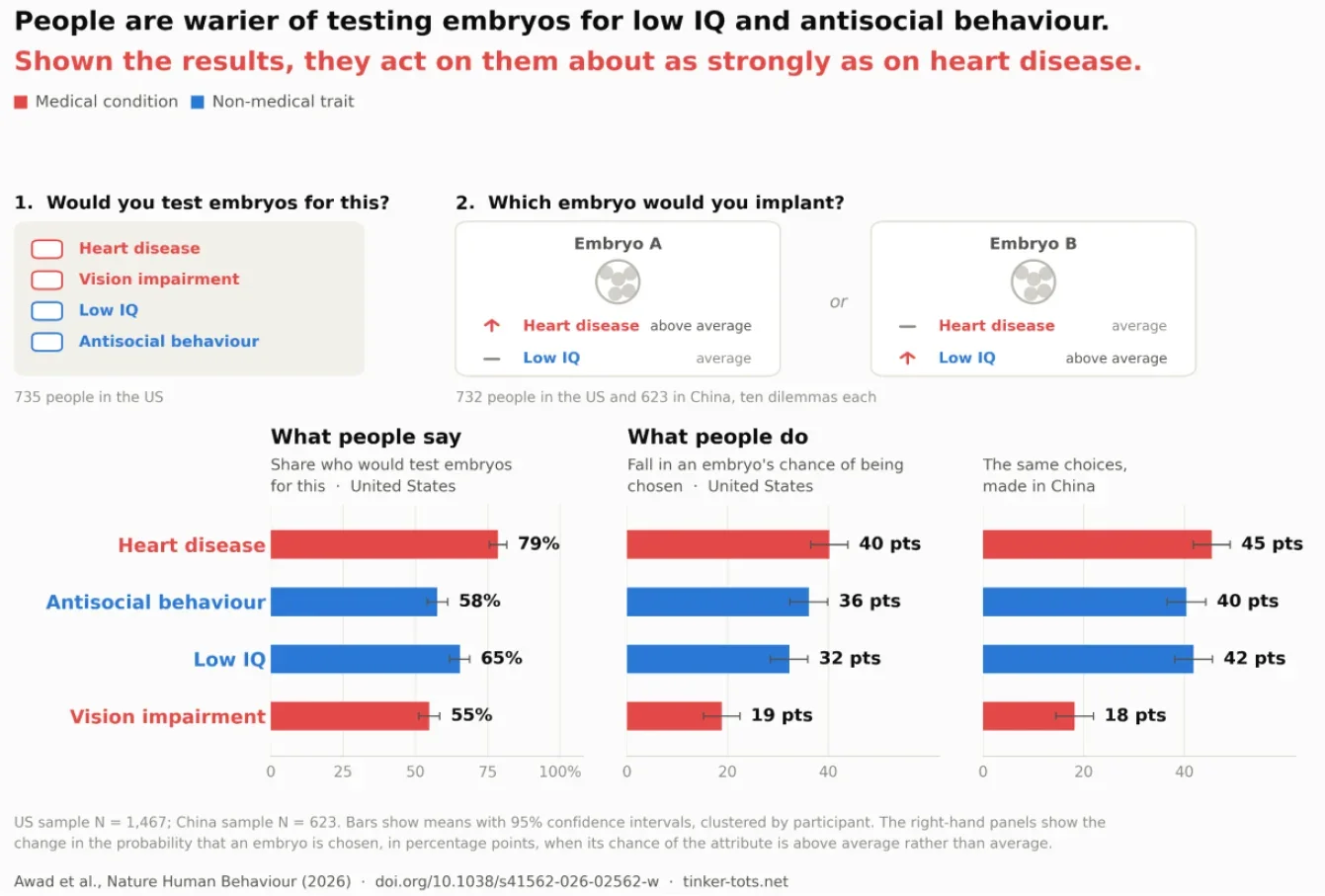
Credit: Awad et al. Nature Human Behaviour (2026)
A study of more than 2,000 people in the United States and China has found that public attitudes towards embryo testing may be more complex than current regulations assume. Published in Nature Human Behaviour, the study was conducted by researchers from the University of Oxford, the University of Exeter, NUS Yong Loo Lin School of Medicine, and colleagues in the UK, Canada, China and Australia.
Most countries regulate embryo testing by distinguishing between medical and non-medical traits. Previous surveys suggested that people are more willing to test embryos for serious diseases than for traits such as low IQ or antisocial behaviour. However, the new study separated two questions: whether people want the information, and how they act if the information is already available.
In a US sample of 1,467 adults, participants were more willing to test embryos for medical conditions such as heart disease than for non-medical traits. But when another group was shown genetic information about pairs of embryos and asked to choose between them, the distinction narrowed. Embryos with a raised chance of low IQ or antisocial behaviour were avoided almost as often as embryos with a raised chance of heart disease. A similar pattern was found in a sample of 623 adults in China.
Dr Edmond Awad of the University of Exeter and the Uehiro Oxford Institute, who led the study, said, “People are uneasy about asking for this kind of information, but they act on it once it is in front of them. Psychologists call that deliberate ignorance. Choosing not to look is not the same as not caring.”
Professor Julian Savulescu, Chen Su Lan Centennial Professor in Medical Ethics, and Head of the Centre for Biomedical Ethics, NUS Medicine, and the study’s senior author, added, “Regulation in this area rests on a category. Our results suggest people do not think in categories when the choice is in front of them. If policy is going to track what matters to people, it will have to talk about the effect a condition or trait has on a child’s life, not the label attached to it.”
The authors carefully highlight that the study measured hypothetical choices, not decisions made in clinical settings. They also cautioned that real-world polygenic prediction, especially for behavioural traits, is more limited than the simplified scenarios used in the study. The team is now expanding the research through Tinker Tots (https://tinker-tots.net), an online citizen-science platform exploring embryo selection dilemmas across more traits and countries.
View the full press release here.