Bioinspired nanoparticles deliver gene editing to lower “bad” cholesterol
Published: 25 Aug 2026
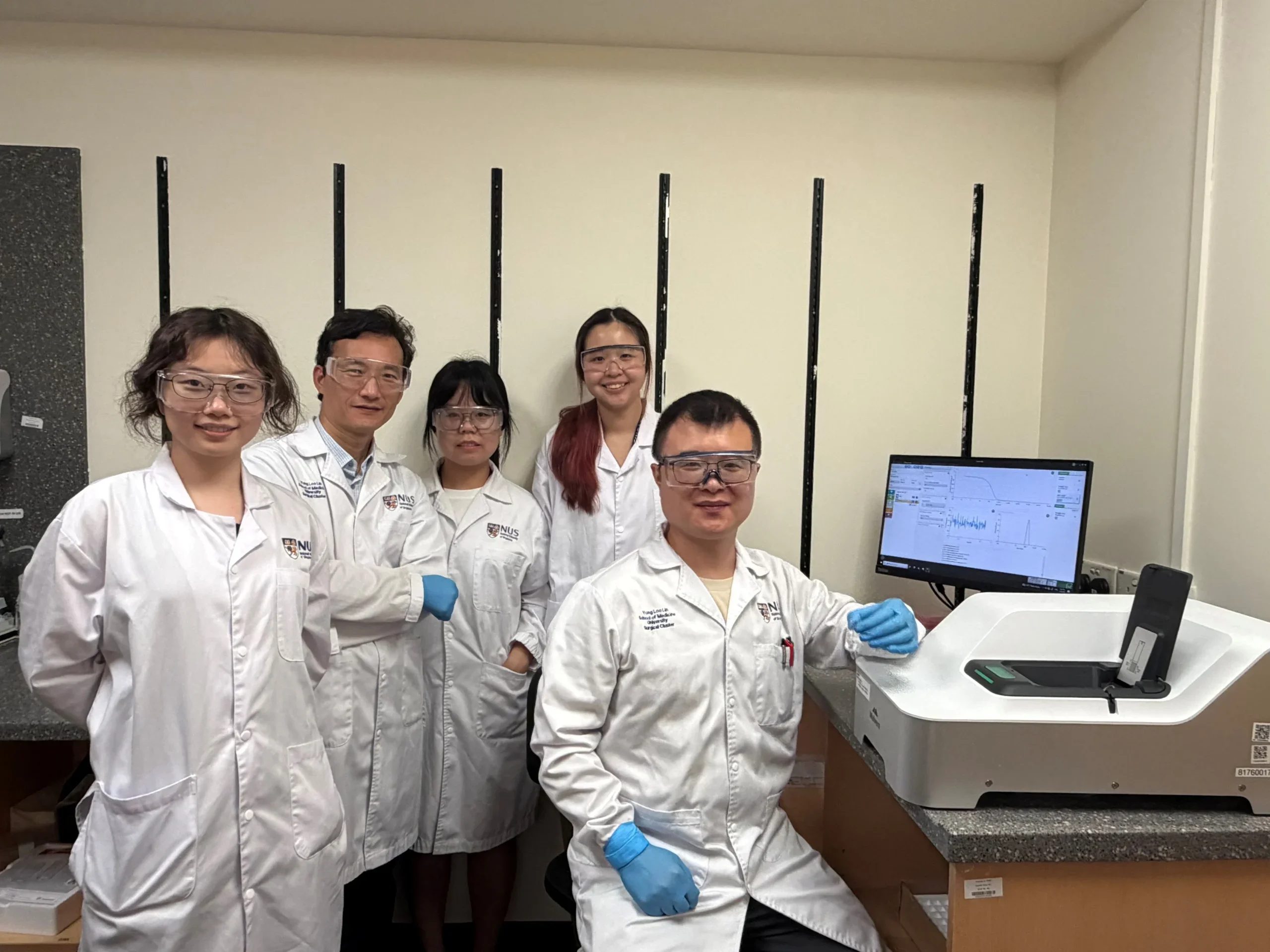
From L to R: Ms Wenhui Cui, Assistant Professor Jiong-Wei Wang, Ms Shilin Wang, Ms Jin Ying Ashlyn Ng, and first author of the study, Mr Xiao Hou.
Researchers from NUS Medicine and Tianjin Medical University General Hospital have developed a bioinspired lipid nanoparticle (LNP) that can deliver gene-editing machinery to the liver and reduce low-density lipoprotein (LDL) cholesterol, commonly known as “bad” cholesterol. The nanoparticles reduced LDL and total cholesterol by more than 20 per cent after two doses, while showing fewer signs of inflammation and toxicity than the comparator formulations. The findings were published in the Journal of Controlled Release.
The research team designed the LNP using materials inspired by molecules naturally found in the body, with the aim of improving the safety of messenger RNA (mRNA) delivery. mRNA is a temporary set of genetic instructions that tells cells how to make a specific protein. Once the instructions have been used, the mRNA is naturally broken down by the body.
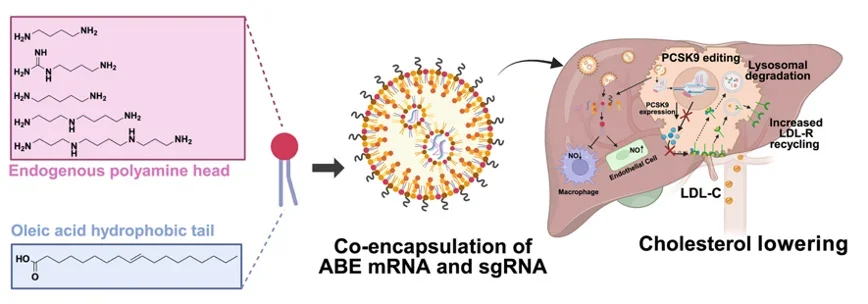
LNPs protect mRNA and transport it into cells, but some conventional formulations contain laboratory-made lipids that may trigger inflammation as they break down. To develop a potentially more biologically compatible carrier, the researchers combined naturally occurring polyamines with oleic acid, a fatty acid found in the body. The strongest-performing candidate, agmatine-oleic acid, or Agm-oa, carried and protected about 98 per cent of its mRNA payload and delivered it effectively to cultured liver cells and laboratory models. Following administration, the nanoparticles accumulated mainly in the liver.
“Many studies focus primarily on the therapeutic cargo, but how that cargo is delivered is equally important,” said Assistant Professor Jiong-Wei Wang, Department of Surgery and Department of Physiology, and the Cardiovascular-Metabolic Disease Translational Research Programme at NUS Medicine, who led the research. “Our aim was to develop a delivery platform using building blocks inspired by endogenous metabolites, which are molecules our bodies naturally produce or use. By considering what happens to the nanoparticle after it has delivered its payload, we hope to create RNA delivery systems that are not only effective, but also more biologically compatible.”
Editing a cholesterol-regulating gene
The team used the nanoparticles to deliver an adenine base editor targeting PCSK9, a gene that regulates LDL cholesterol. Reducing PCSK9 activity allows more LDL receptors to remain on liver cells, helping the liver remove cholesterol from the bloodstream. In cultured cells, the nanoparticles edited about 68 per cent of the intended PCSK9 target. No unintended changes were detected at the six most likely off-target sites examined, although broader genome-wide testing is still required. In high-fat-diet laboratory models, two intravenous doses given one week apart reduced LDL and total cholesterol by more than 20 per cent compared with untreated models and those given RNA without the nanoparticle carrier.
“PCSK9 is a well-established target for lowering LDL cholesterol, but effective gene editing depends on delivering the editor safely and efficiently to the liver,” said Professor Xin Zhou, a senior cardiologist in the Department of Cardiology, Tianjin Medical University General Hospital. “Our findings provide proof of concept that this bioinspired nanoparticle can transport the necessary gene-editing components, modify the PCSK9 pathway, and produce a measurable cholesterol-lowering effect in laboratory models.”
More than a passive delivery vehicle
The material may also do more than carry mRNA. In cell experiments, it reduced a molecule linked to inflammation in immune cells, while increasing the same molecule in blood-vessel-lining cells, where it may support healthy blood flow. The nanoparticles did not cause detectable additional liver damage, and no clear signs of toxicity were found in the other organs examined. They also produced lower levels of markers linked to cell damage and acute inflammation than the comparator LNP formulations.
The researchers stressed that the findings remain pre-clinical. Longer-term studies are needed to determine how long the effects last, assess possible unintended genetic changes, and confirm safety before the technology can be considered for human studies.
“While there is still considerable work ahead, this study shows that endogenous-metabolite-inspired materials can serve as functional building blocks for RNA delivery,” Asst Prof Wang added. “The broader opportunity is to design carriers that contribute positively to treatment rather than acting only as passive packaging.”
View the full press release here.