The Science of LOVING – Singapore’s largest parenting intervention study on sensitive caregiving to recruit 624 families
Published: 04 May 2026
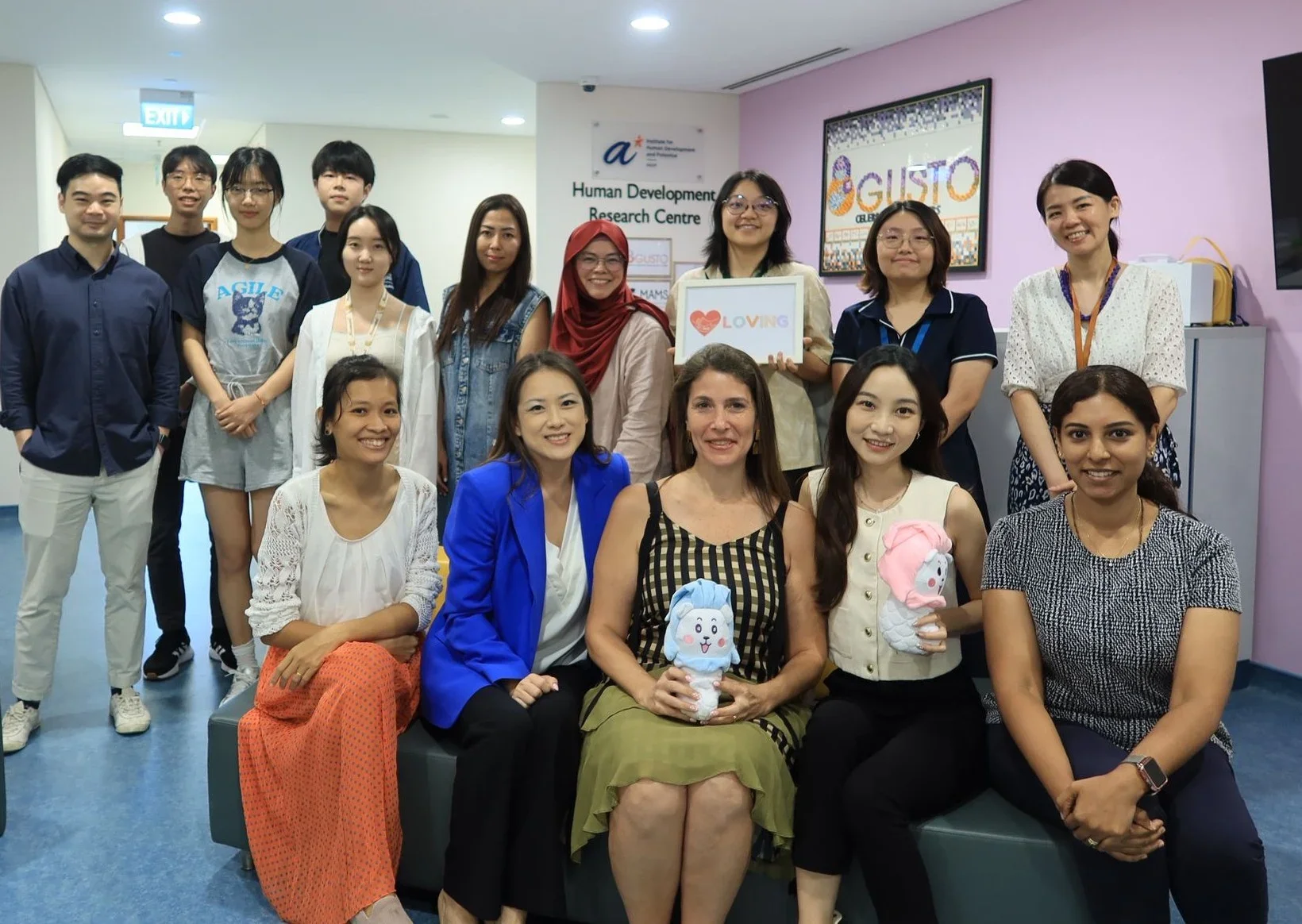
A/Prof Anne Rifkin-Graboi, seated third from left, and members of the LOVING team.
Raising young children in Singapore is more complex than ever. As families weave through hectic and time-scarce modern lifestyles, increasing digital exposure and screen-time, and rising health and developmental concerns, early childhood has become a critical window for shaping a child’s long-term outcome and well-being. Yet many parents face challenges in balancing caregiving demands with work and other responsibilities. Strengthening support for caregivers and empowering them with the right tools to build positive parent-child relationships and interactions, is increasingly recognised as a key strategy in promoting children’s overall well-being and development.
To understand more about sensitive caregiving and its role in children’s development, researchers from the Yong Loo Lin School of Medicine, National University of Singapore (NUS Medicine) and Saw Swee Hock School of Public Health, NUS, A*STAR Institute for Human Development and Potential (A*STAR IHDP), KK Women’s and Children’s Hospital (KKH), Nanyang Technological University (NTU), National Institute of Education (NIE), and other international institutes, will begin recruitment for their large-scale study on 26 May, 2026, to examine how strengthening caregiving behaviours can improve young children’s emotional, cognitive, and physical health outcomes.
The LOVING (Learning about Our behaviour is Valuable for Increasing Nurturing relationships and health Growth) study will commence Singapore’s largest, parenting-focused, three-arm randomised controlled trial (RCT) involving 624 families with young children from median- to lower-income households. The study focuses on enhancing parental sensitivity, which is a key factor linked to children’s behavioural regulation and social and cognitive development. In addition, there is also some evidence that sensitive parenting is linked to a decrease in obesity risk.
“Through the LOVING study, we want to better understand how supporting modern parents in building responsive relationships with their children can make a real difference to their emotional well-being, learning and physical health,” lead researcher of the LOVING study, Associate Professor Anne Rifkin-Graboi, from the Departments of Psychological Medicine & Paediatrics, NUS Medicine, said. “By examining strong local evidence, we hope to guide how programmes and policies can better support families in Singapore.”
“Childhood emotional-behavioural difficulties and early obesity are rising concerns in Singapore, particularly among lower-income families. The LOVING study takes a preventive, upstream approach, focusing on caregivers rather than children, with the goal of improving developmental outcomes early in life. By integrating psychological, neurocognitive, neurophysiological, and physical health frameworks, our study aims to generate insights that could inform early childhood policy, clinical practice, and public health strategies in Singapore,” added Assoc Prof Rifkin-Graboi.
The Three Arms of the LOVING RCT Study
The LOVING programme has been developed across earlier stages involving 75 families in the developmental phase and 36 families in the pilot RCT stage and will now be comprehensively evaluated through an RCT involving 624 families. Participants will be randomly assigned to one of three caregiver-focused programmes:
- VIPP-SD-SingH: (The Video-Feedback Intervention to Promote Positive Parenting and Sensitive Discipline Adapted for the Singapore Context with a Health Component) A home-based intervention programme designed to enhance sensitive caregiving, based on a well-established international programme and adapted for Singapore’s cultural and health contexts.
- CARE-SD (Caregiver Awareness of Relationships through E-learning for Sensitivity and Discipline): A digital parenting programme, derived from the VIPP-SD, using locally contextualised video scenarios to guide caregiving behaviours across areas such as feeding, physical activity, and relaxation.
- NeuroEducation for Parents: An online programme covering key topics such as brain development, emotion, learning, and social relationships in young children.
Parents from the earlier stages who participated in the VIPP-SD-SingH and CARE-SD programmes shared feedback through surveys and interviews. Many of them said the sessions helped them to better understand their own behaviour and their child’s needs, and reported positive changes in their child’s behaviour and emotional well-being. Parents also felt more confident in their parenting styles, gaining practical strategies and reassurance in their approach.
One family who participated in the VIPP-SD-SingH programme was Sarah Lee, her husband Benjamin Voon, and their 6-year-old son, Asher Voon. She said, “Before the programme, my husband and I would feel stressed out whenever Asher threw tantrums. We weren’t entirely sure how to handle his big emotions when they surfaced and would end up getting frustrated when he couldn’t calm down. This ended up becoming a vicious cycle for our family.”

Sarah Lee and her two sons, Asher and Judah Voon. Sarah and Asher participated in the VIPP-SD’s developmental phase.
“Through the programme, I learnt several helpful tips on building a stronger emotional connection with my son, such as taking the time to play together with him and hugging him regularly,” added Sarah, “By doing so, I realised that Asher is more likely to turn to me when he is having a difficult time, and this helps me to understand the reasons behind his challenging behaviour. I also learnt practical ways in which I can manage particularly difficult behaviour, such as giving him space to cool down, and ensuring that we end on a positive note by acknowledging that what he is going through is hard for him.”
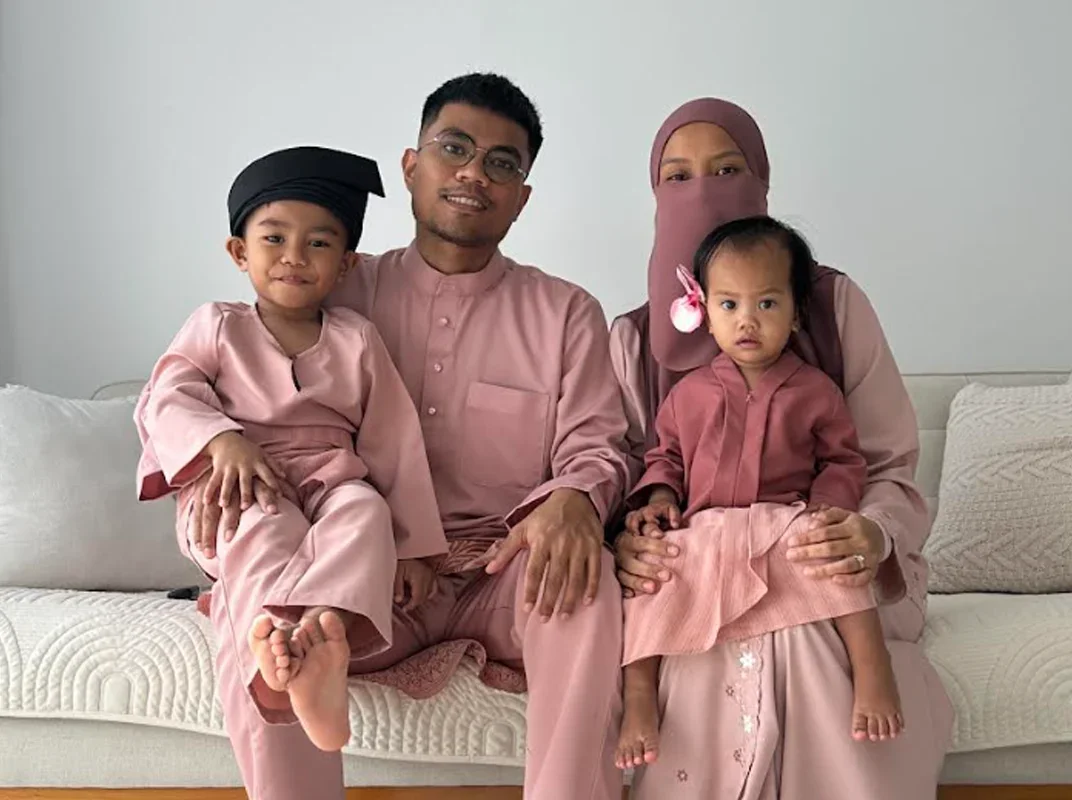
Nurin Qaisara and her husband, Alif, along with their two children, Ali and Aisha. Nurin and Ali participated in the CARE-SD’s developmental phase.
Nurin Qaisara’s family participated in the CARE-SD programme with her 4-year-old son Ali. She said, “Each session deepened my understanding of my child and what I can do as a parent to stay calm and support his needs. Over time, I saw a real difference when Ali became less distressed, and I learnt how to be more patient and responsive. I also appreciated the guidance from the team, which made it easier to apply what I learnt at home.”
The “NeuroEducation for Parents” programme was similarly well received by parents from the earlier stages. The participants shared that it was easy for them to follow through, and many found the topics on emotions and social development especially helpful. Most parents watched the videos once or twice and tended to spend more time on the main content videos, suggesting strong interest in the material compared to quiz-based segments.
“The findings from the LOVING study could help shape how Singapore approaches early childhood development and prevention. In the future, if these programmes are shown to be effective via rigorous research, we hope they may be scaled to reach a wider range of families, including those not typically targeted by public health interventions. Combined with cost-effectiveness analyses, the study will also provide a strong evidence base for policymaking. Beyond Singapore, the study will contribute valuable insights to global research on how caregiving influences children’s brain development, behaviour, and long-term health,” added Assoc Prof Rifkin-Graboi.
View the press release here.