NUS Medicine researchers develop a better and more accurate biological ageing clock
Published: 09 Jun 2025
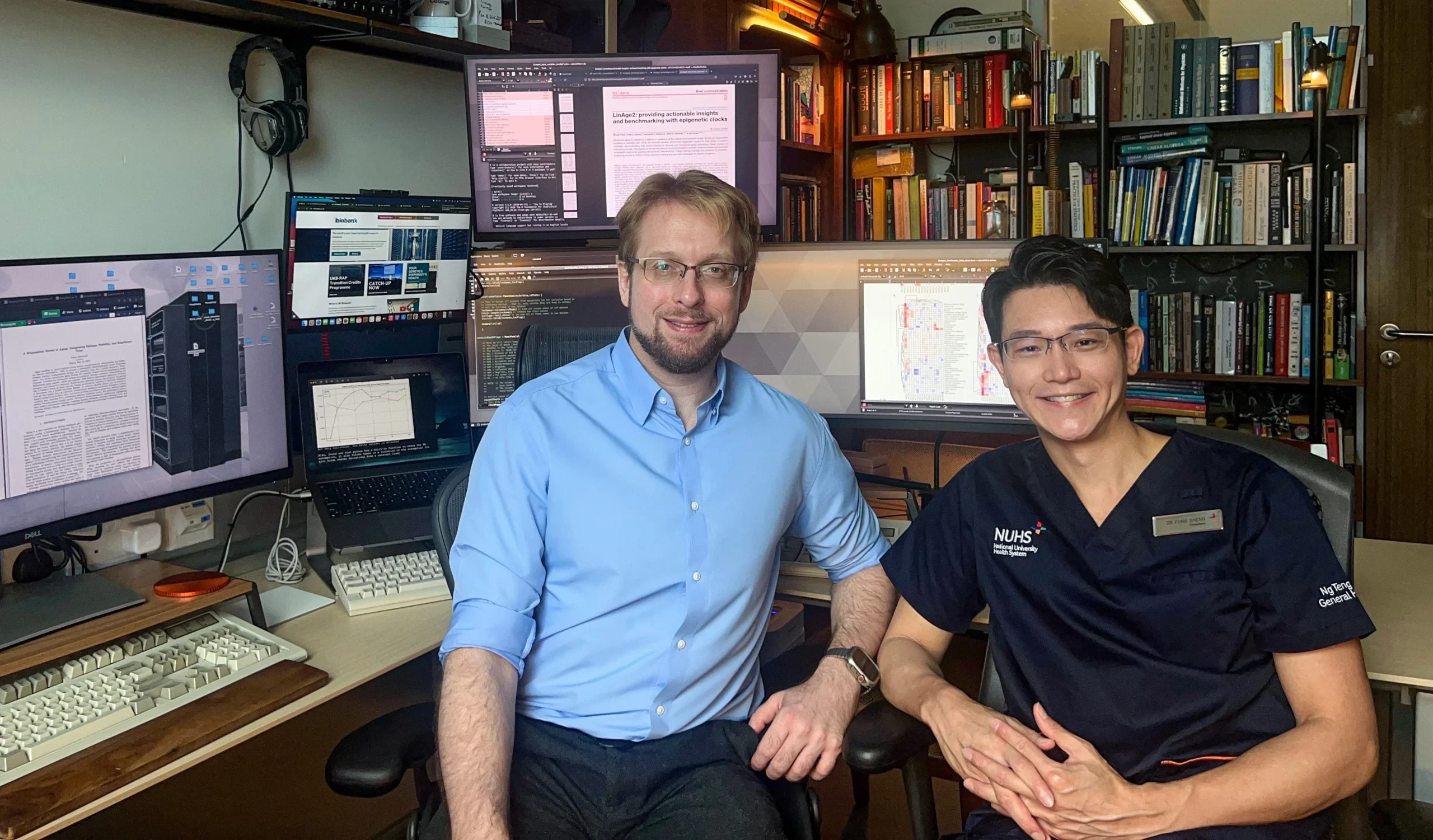
Associate Professor Jan Gruber, Department of Biochemistry, and Healthy Longevity TRP, NUS Medicine; and Dr Fong Sheng, Consultant in Geriatric Medicine, Ng Teng Fong General Hospital. Credit: NUS Medicine
Researchers from the Yong Loo Lin School of Medicine, National University of Singapore (NUS Medicine) have developed an improved biological ageing clock, LinAge2, that offers doctors a practical and more accurate way to assess how quickly a person is ageing, and what can be done to slow it down.
The new algorithm-powered tool builds on earlier clinical ageing clocks known as PCAge and LinAge. These older models, derived from blood and urine tests and health questionnaires, demonstrated strong predictive capability for long-term mortality and functional decline. PCAge, in particular, outperformed standard cardiovascular risk scores and could forecast ageing trajectories well before the onset of disease. This approach was adapted and integrated for clinical use, which paved the way for LinAge2’s enhancements in accuracy, interpretability, and ease of use.
Published in npj Aging, LinAge2 not only outperformed other clinical models but also surpassed leading epigenetic clocks in predicting long-term mortality and health outcomes. Key findings include:
• More accurate mortality prediction: LinAge2 performed better than chronological age and biological ageing clocks in indicating likely mortality within 10 and 20 years
• Links to functional health: Individuals with lower LinAge2 biological age walked faster, had better cognitive scores, and were more likely to be independent in daily living.
• Actionable insights: The model identifies specific health issues, such as smoking or metabolic syndrome, that accelerate ageing, enabling tailored interventions.
“Chronological age tells us how many years we’ve lived, but it doesn’t reflect our actual health risks,” said Associate Professor Jan Gruber, senior author of the study and principal investigator at the Department of Biochemistry and Healthy Longevity Translational Research Programme (TRP) at NUS Medicine. “That’s where biological ageing clocks, like LinAge2, come in — they’re computational algorithms that integrate clinical data into a single measure of biological age. LinAge2 captures how fast a person is really ageing inside, which can help inform personalised treatment strategies, lifestyle interventions, and ultimately extend healthy years of life.”
The research team tested LinAge2’s ability to predict both mortality and functional health, such as gait speed, cognitive performance, and independence in daily activities. Compared to popular DNA-based ageing clocks like PhenoAge DNAm and GrimAge2, LinAge2 consistently demonstrated stronger predictive power. The model was further refined by removing complex lab tests, adjusting for gender differences, and ensuring results were not skewed by extreme values. A visual tool was also developed to help users identify which specific health factors are accelerating ageing, making LinAge2 an accessible and actionable resource for clinicians and researchers.
LinAge2 was co-developed with clinician collaborator Dr Fong Sheng, Consultant in Geriatric Medicine at the Ng Teng Fong General Hospital. He said, “Our long-term vision is to embed tools like LinAge2 into everyday medical practice, which doctors can use during check-ups, to help them tailor treatment plans based on a person’s true biological condition and not just their age in years. By identifying who is ageing faster inside, we can help patients act early to slow it down through lifestyle changes, medical treatments, or preventive care. This can lead to better quality of life and longer healthspan, not just life expectancy.”
A/Prof Gruber added, “It is our hope that validation of LinAge2 in various cohorts and populations will bring us closer to a future of preventive, personalised, and proactive medicine — where we address ageing itself, not just the diseases it causes.”
Read more in the press release here.