
Study Methodology of Singapore Chinese Health Study (SCHS)
Baseline Survey
This is a population-based prospective cohort study. The cohort was drawn from permanent resident or citizens of Singapore who resided in government-built housing estates. During the recruitment period from April 1, 1993 through December 31, 1998, 86% of the Singapore population resided in government-built housing estates.
The eligible criteria of participants for the study were 45 to 74 years and belonged to one of the two major dialect groups of Chinese in Singapore – the Hokkiens and the Cantonese, whose were decedents of Chinese in Fujian and Guangdong provinces, respectively, in southern China. Total 63,257 subjects were recruited into the study during April 1993 to December 1998.
For enrollment in the study, each participating subject was interviewed in person at home by a trained interviewer using a structured questionnaire.
The questionnaire elicited information on demographics, body weight and height, history of cigarette smoking and use of other tobacco products, usual dietary intake habits, history of occupational exposures, exposure to incense as a measure of indoor air pollution, physical activity, sleep quantity and quality, menstrual and reproductive history (women only), medical history, and family history of cancer.
The cohort distributions of demographics are shown in table 1.
Baseline biospecimen collection
Beginning in April 1994, a random 3% sample of cohort participants were asked to provide blood and a single void urine samples. If the subject declined for blood donation, a mouthwash sample was collected instead. Fasting was not required for collection of blood sample. The biospecimens were collected by a phlebotomist at subject’s home and immediately stored in an insulated box with ice (0-4oC). The collection of biospecimen operation was extended to all surviving cohort participants beginning in January 2000 and closed in April 2005. In total 32,235 subjects provided any biospecimens including 28,346 blood samples, 4,400 mouthwash sample, and 32,120 urine samples.
The blood components (serum, plasma, buffy coat, red blood cells) were separated at the study laboratory within 4 hours of the blood collection. Multiple vials of each blood components, buccal cells, and urine samples were stored at -80oC immediately after processing.
Follow-up surveys
Follow-up I survey
The first follow-up interview to all surviving subjects was conducted by a trained interviewer using a structured questionnaire through a telephone between July 1999 and December 2003. The follow-up I questionnaire (form) updated information cigarette smoking, alcohol drinking, medical history, current body weight and height, current menopausal status (women only). The follow-up I questionnaire additionally elucidated information on history of passive (i.e., second-hand) smoking, history of respiratory diseases, blood transfusion, and use of medication. The follow-up I interviews were completed on 52,326 subjects, representing a consent rate of over 90%.
Follow-up II survey
The second follow-up interview to all surviving subjects was conducted by a trained interviewer using a structured questionnaire through a telephone between June 2006 and May 2010. The follow-up II questionnaire (form) updated information active and passive cigarette smoking, alcohol drinking, tea and coffee drinking, physical activity, history of respiratory diseases, medical history, use of medication, current body weight and height, and current menopausal status (women only). The follow-up II questionnaire additionally elucidated information on current work status, and indoor air pollution from home cooking. The follow-up II interviews were completed on 39,528 subjects, representing a consent rate of over 82%.
Follow-up III survey
The third follow-up interview began in July 2014. The follow-up III questionnaire updated information on current weight, cigarette smoking, tea and coffee drinking, sleep quantity and quality, and medical history. The main aim of follow-up III was to re-enroll original study participants into a new initiative – the Health Aging Cohort Study. For each re-consented subject, we conducted the Mini Mental State Exam that included the assessment of the cognitive functions, geriatric depression and anxiety scales, social support and stress scales, quality of life and independent living scale. At the time of interview, additional aging related Physical Strength domain including Hand-Grip and Timed Up and Go Tests were performed, and blood and urine samples were collected from consented subjects. These assessments were performed on 17,108 subjects.
Current status
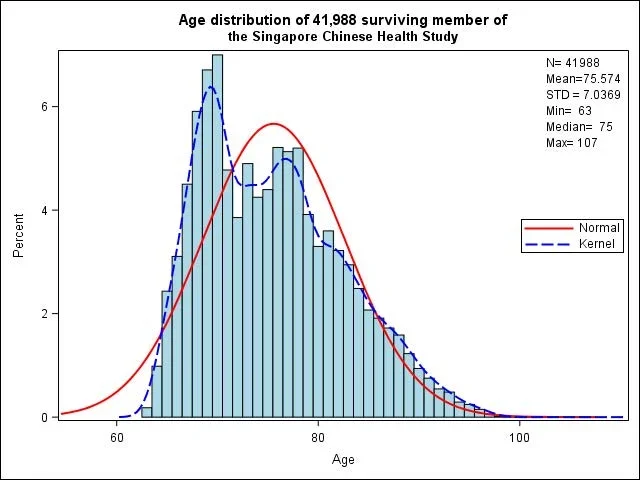
As of record linkage analysis with databases of the Singapore National Birth and Death Registry in 2016, 21,213 (33.5%) of the 63,257 original cohort members died, and 56 subjects were known to be lost to follow-up due to migration out of Singapore. Thus 41,988 (66.4%) original cohort participants were alive as of 12/31/2016. The mean age was 75.6 years (SD 7.0) with a range from 63 to 107 years (Figure 1).