NUS Medicine Inspire120 Professorial Lecture: The past, present and future of multiple myeloma
Published: 20 Aug 2025

Prof Chng Wee Joo delivered a talk on multiple myeloma at the inaugural edition of the NUS Medicine Inspire120 Professorial Lectures
Multiple myeloma, the world’s second most common blood cancer, was once considered incurable. Over the past two decades, however, advances in treatment – marked by the approval of over 10 new drugs – have more than doubled patient survival rates, with many now living beyond a decade after diagnosis.
“The main challenge in treating multiple myeloma has been that the response to treatment does not last very long. Twenty years ago, the median survival was only 3 to 4 years. However, with improved treatments, remissions now last longer and patients are living longer. Currently, remission rates for newly diagnosed myeloma with the treatments we provide are above 90%,” said Professor Chng Wee Joo, Yong Loo Lin Professor in Medical Oncology, NUS Yong Loo Lin School of Medicine, at the inaugural edition of the School’s Inspire120 Professorial Lectures, on 13 August 2025.
Highlighting the significant improvements in survival, Prof Chng projected that by 2035 to 2040, multiple myeloma patients could potentially achieve survival of 20 years or more and even be cured following less than a year of treatment. He attributed this remarkable progress to advances in understanding the biology and genomics of the disease, the dedication of clinician-scientists, strong leadership, and robust partnerships with donors and industry – all of which have accelerated research in multiple myeloma.
Prof Chng also discussed the transformative potential of artificial intelligence (AI) in tailoring optimal drug combinations for individual patients and explored how the lessons learned from myeloma may pave the way for breakthroughs in other diseases. He explained, “Myeloma serves as an excellent model for personalised medicine due to the wide variety of drugs available for treating different stages of the disease, resulting in countless possible treatment combinations. This makes AI particularly valuable in identifying and prioritising the most effective regimens for individual patients. Additionally, myeloma monitoring relies on a blood-based biomarker, reducing the need for multiple repeated scans.”
A hematologist by training, Prof Chng is an esteemed researcher in the fields of genomics, therapeutics and hematologic malignancies, with extensive experience spanning clinical practice, administration, and leadership. He is also Vice President (Biomedical Sciences Research), Office of the Deputy President (Research and Technology), NUS; Group Director, Research Office, National University Health System (NUHS); and Senior Consultant, Division of Haematology, Department of Haematology-Oncology, National University Cancer Institute, Singapore (NCIS).
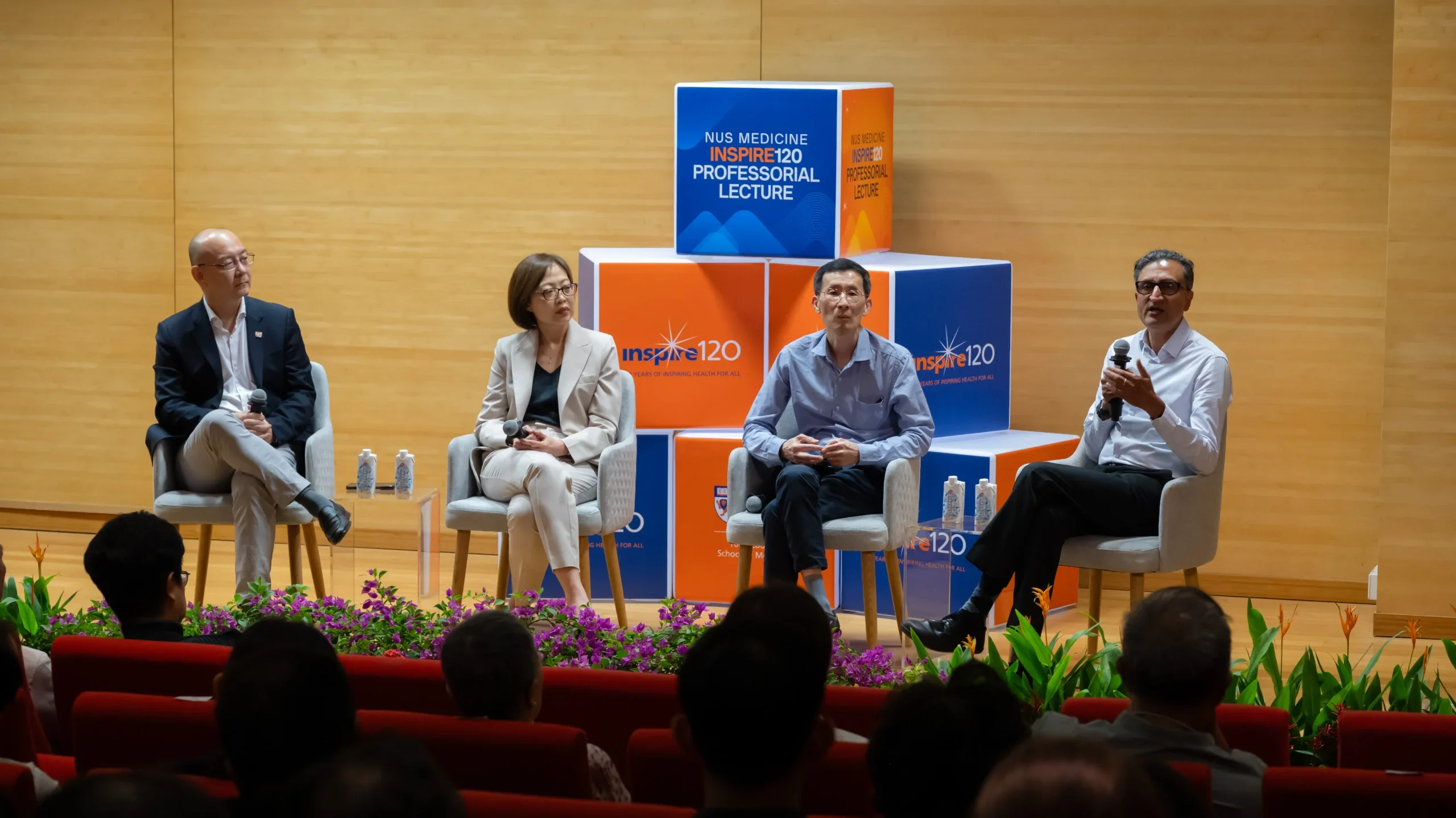
From left: Prof Chng Wee Joo, Adj A/Prof Chee Cheng Ean, Prof Goh Boon Cher, Prof Ashok Venkitaraman, in a fireside chat discussing the future of cancer treatment
Following Prof Chng’s lecture, he held a fireside chat exploring the future of cancer treatment with Adjunct Associate Professor Chee Cheng Ean, Executive Director, NCIS; Professor Ashok Venkitaraman, Director, CSI Singapore; and Professor Goh Boon Cher, Deputy Director, CSI Singapore. Both Prof Ashok and Prof Goh are also Director and Deputy Director of the NUS Centre for Cancer Research at NUS Medicine respectively. They discussed the challenges in advancing research in multiple myeloma, and the importance of regional and international cooperation in overcoming them as a community.
To find out more, watch the lecture here: https://youtu.be/Nt7Zmkw8Cv4, and the fireside chat here: https://youtu.be/VYvga1-AQF8
Introduced as part of NUS Medicine’s 120th anniversary celebrations, the Inspire120 Professorial Lectures celebrate over a century of excellence in medical education, research, and health, while recognising the transformative impact of academic philanthropy in advancing medical breakthroughs. The inaugural lecture by Prof Chng marks the 29th anniversary of the Yong Loo Lin Professorship in Medical Oncology, established in 1996 by the Yong Loo Lin Trust in honour of the late Dr Yong Loo Lin, a successful doctor, businessman and strong advocate of education. This Professorship has been instrumental in advancing cancer research, clinical care, and medical education in Singapore. Cancer is the leading cause of death in Singapore and with an ageing population, the need for cutting-edge care and has never been greater. The Professorship plays an important role in enabling eminent experts to push the boundaries of oncology and drive innovation in research and education in medical oncology, strengthening Singapore’s growing regional and international role.
Join us in building this legacy. Your support can help shape the future of cancer care. Contribute to our Inspire120 initiatives here or connect with the Development Office at giving_med@nus.edu.sg to find out how you can make an impact to our research and other initiatives at NUS Medicine.