NUS Medicine’s Integrated Blended Medical Curriculum Awarded Bronze at the QS Reimagine Education Awards 2025 in London
Published: 18 Dec 2025
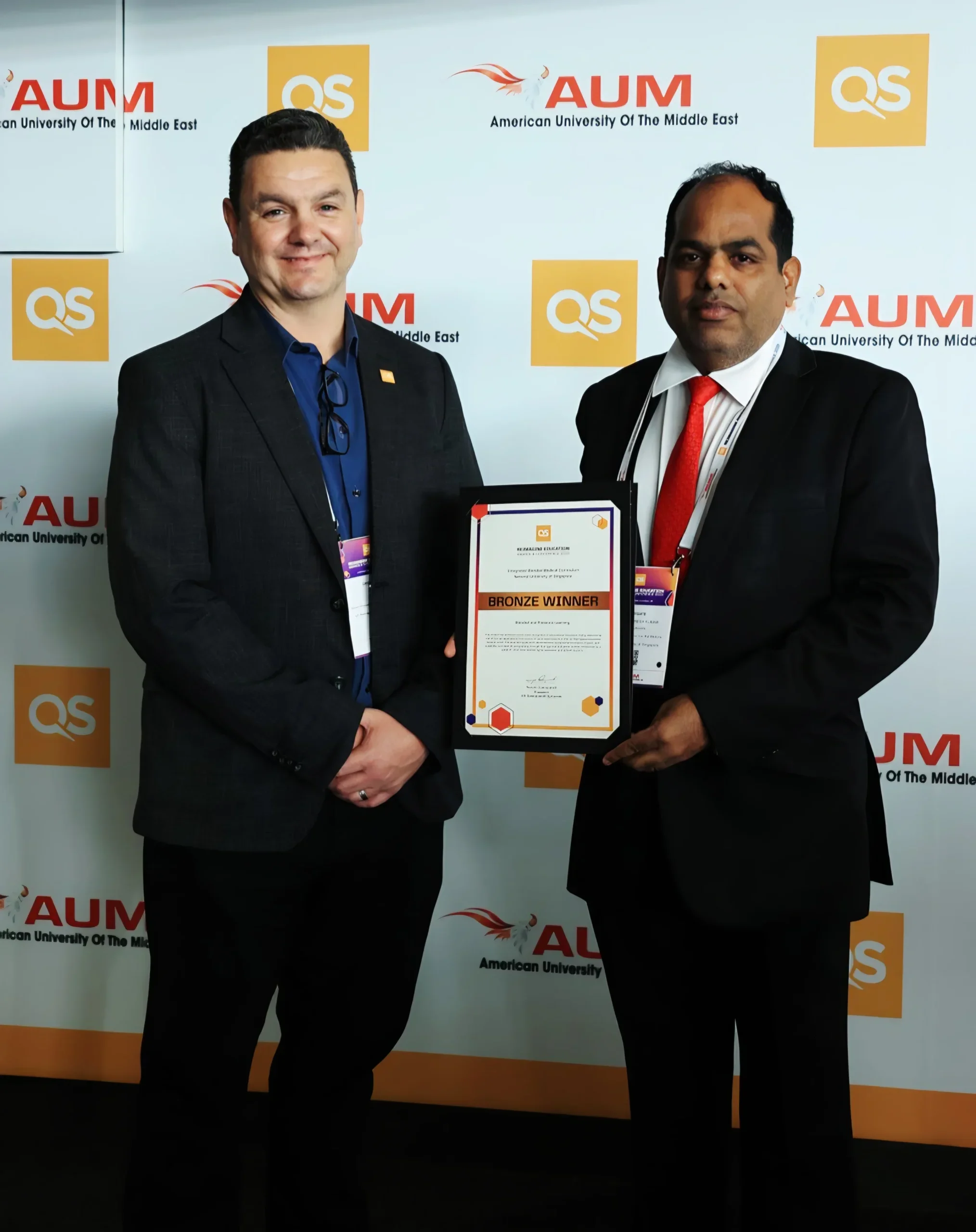 Assoc Prof Dinesh Kumar Srinivasan (right), Medical Science Lead for Cardiovascular System Block and Lead of Continuing Education and Training (CET) at NUS Medicine, receiving the Bronze Award in the Blended and Presence Learning category at the QS Reimagine Education Awards 2025 in London.
The Yong Loo Lin School of Medicine, National University of Singapore (NUS), has received international recognition for its innovative approach to medical education, with its Integrated Blended Medical Curriculum winning the Bronze Award in the Blended and Presence Learning category at the QS Reimagine Education Awards 2025.
The award was presented at the QS Reimagine Education Conference held in London from 1 to 3 December 2025, one of the world’s leading global platforms celebrating excellence and innovation in higher education.
The curriculum is led by Assoc Prof Dinesh Kumar Srinivasan, Medical Science Lead for the Cardiovascular System at NUS Medicine, who presented the work at the conference and received the award for innovative curriculum design on behalf of the interdisciplinary team.
This recognition places NUS Medicine among the top innovators in education globally. The Integrated Blended Medical Curriculum was selected from over 1,600 submissions worldwide, advancing through four rigorous evaluation rounds conducted by a panel of 1,300 international experts in higher education and educational technology. Submissions were assessed for innovation, impact, scalability, and relevance to future learning needs.
Redefining early medical education
NUS Medicine’s Integrated Blended Medical Curriculum reimagines early medical education by bringing together system-based integration, purposeful blended delivery, and AI-enabled learning support at scale.
Moving away from traditional discipline-based teaching, the curriculum adopts a system-based block structure that is co-designed and co-delivered by basic scientists and clinicians. Teaching and assessments are anchored in clinical scenarios, enabling students to develop interdisciplinary reasoning skills from the outset, rather than learning subjects in parallel silos.
The blended approach goes beyond digitising lectures. Learning is intentionally sequenced through self-directed learning (SDL) followed by face-to-face capstone sessions, aligned with a flipped-classroom model and integrated across disciplines. These sessions emphasise active, team-based learning and case-based discussions, encouraging students to apply knowledge collaboratively in clinically relevant contexts.
To further enhance learning support, the team piloted an AI-powered question-and-answer platform, providing students with personalised, on-demand assistance while helping to manage staff workload. This combination of pedagogy, technology, and clinical integration was highlighted by the QS judges as a key strength of the submission.
A collective achievement
Assoc Prof Dinesh expressed gratitude for the international recognition, emphasising the collaborative effort behind the medical curriculum.
“It was a highly competitive process, and we are grateful to receive this award for our blended and presence-based learning initiative,” he said. “This international recognition reflects the collective hard work, innovation, and dedication of our entire interdisciplinary team.”
The award recognises the collaborative efforts of the team, including Prof Lau Tang Ching, Vice Dean (Education); Prof Hooi Shing Chuan from the Department of Physiology; Assoc Prof Lian Derrick Wen Quan, Assistant Dean (Students); Assoc Prof Chen Zhi Xiong, Assistant Dean (Education); Dr Lai Mitchell Kim-Peng from the Department of Pharmacology; and Dr Nathasha Luke from the Department of Physiology.
“This award inspires us to keep striving for excellence in medical education, and we look forward to continuing this meaningful work to further advance the University’s commitment to educational excellence,” Assoc Prof Dinesh shared.
This effort and recognition underscores NUS Medicine’s ongoing commitment to advancing medical education through thoughtful integration of pedagogy, technology, and clinical relevance, preparing future doctors for the evolving demands of healthcare.
View the short clip on QS Reimagine Education, under the Blended and Presence Learning category, titled “Reimagining Early Medical Education through Integrated Blended Learning, National University of Singapore“.