Increased risk of developing alcohol addiction linked to gene mutation
Published: 27 Oct 2025
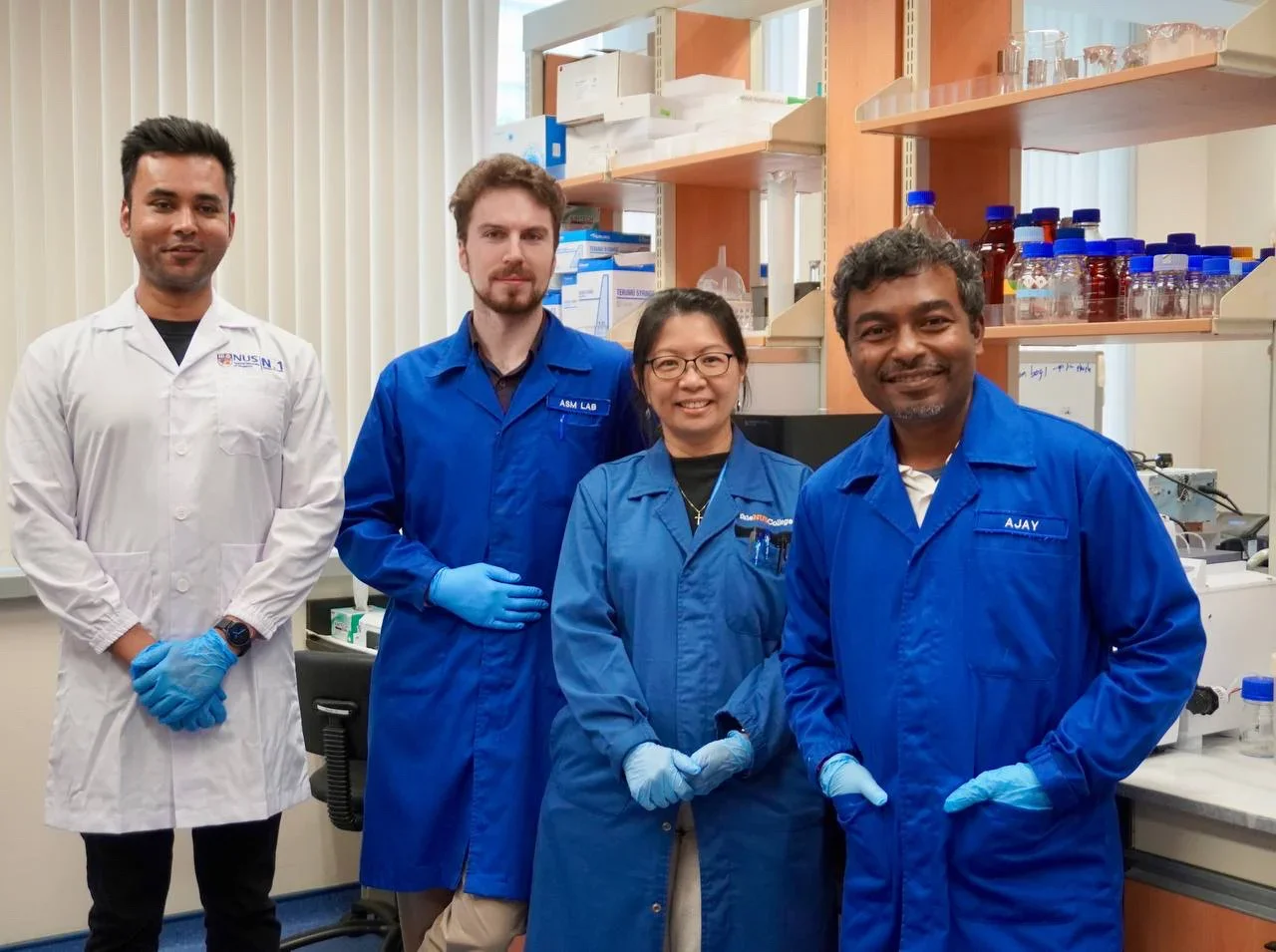 Members of the study (Left to right): Dr Tirtha Das Banerjee, Department of Biological Sciences, NUS; Dr. Joshua Raine, Research Fellow; Dr. Caroline Kibat, Senior Research Fellow; Study Lead Associate Professor Ajay S. Mathuru, Department of Physiology, NUS Medicine.
A new study from the Yong Loo Lin School of Medicine, National University of Singapore (NUS Medicine), has revealed how variation in a single gene, chrna3, can alter alcohol sensitivity and influence drinking behaviour.
Published in The Journal of Neuroscience, the study identified the chrna3 gene as a major regulator of alcohol sensitivity. Mutations in this gene, which controls signalling in the brain’s communication pathways, made laboratory models less sensitive to alcohol’s calming effects, causing them to self-administer more and tolerate higher doses. The findings not only deepen current understanding of the biological mechanisms underlying alcohol use disorders, but may also pave the way for personalised treatment strategies.
The study was led by Associate Professor Ajay S. Mathuru from the Department of Physiology at NUS Medicine with first author, Dr. Joshua Raine, Research Fellow, and Dr. Caroline Kibat, Senior Research Fellow, from the same department. They discovered that the mutation was associated with altered brain expression of glutamatergic and GABAergic receptor genes, which regulate excitatory and inhibitory signalling respectively.
By linking the chrna3 gene to measurable behavioural and brain changes, this study strengthens the biological understanding of addiction risk and offers insights into genetic predisposition to alcohol dependence.
“Our study provides direct experimental evidence that chrna3 regulates alcohol sensitivity,” said Assoc Prof Mathuru. “Variants altering this gene’s function may increase the risk of developing alcohol use disorders in humans, a possibility that needs further investigation. Finding such risk factors can help develop more effective prevention and treatment strategies.” Assoc Prof Mathuru is a Joint Principal Investigator at Institute of Molecular and Cell Biology, A*STAR. He holds appointments with N.1 Institute for Health at NUS, the Institute of Digital Medicine (WisDM), and the Healthy Longevity Translational Research Programme at NUS Medicine. Collaborators of the study include Professor Antónia Monteiro and Dr Tirtha Das Banerjee from the Department of Biological Sciences at NUS.
The researchers also developed a refined, low-cost self-administration test used in this study to understand how genetic changes affect voluntary alcohol intake. The technique enables faster and more precise investigations into addiction biology, with potential applications for targeted therapies.
Looking ahead, the team plans to analyse CHRNA3 variants in human populations to determine similar alcohol sensitivity. Their ongoing research also extends to the CHRNA5–CHRNA3–CHRNB4 gene cluster, which has been implicated in various forms of substance addiction.
The researchers hope to uncover new therapeutic targets and inform personalised interventions for individuals at risk of addiction, paving the way toward a future where prevention begins with genetic understanding.
Read more in the press release here.