Global health gets a boost with NUS–RKI strategic partnership
Published: 23 Jul 2025

MOU signing ceremony by NUS Medicine and RKI representatives, A/Prof Justin Chu Jang Hann (NUS Medicine) and Prof Dr Med Lars Schaade (RKI).
The Yong Loo Lin School of Medicine, National University of Singapore (NUS Medicine) and Robert Koch Institute (RKI), Berlin, Germany have entered a strategic partnership with the signing of a Memorandum of Understanding (MOU) to collaborate on joint operations in scientific, academic and training initiatives, focusing on pandemic preparedness and public health.
The MOU was signed on 2 June 2025 at Robert Koch Institute, Berlin, Germany. Representing NUS were Associate Professor Chu Jang Hann Justin, Biosafety Level-3 (BSL-3) Core Facility Director; Dr Tessy Joseph, Senior Assistant Director; and Dr Tan Kai Sen, Research Director. They were received by the RKI delegation including Professor Dr Lars Schaade, RKI President and Dr Andreas Kurth, Head of Biosafety Level-4 Laboratory of the Centre for Biological Threats and Special Pathogens. The MOU was signed by A/Prof Chu and Prof Schaade on behalf of their respective institutions.
 A/Prof Justin Chu Jang Hann from the NUS Medicine delegation presenting a Token of Appreciation to RKI President, Prof Dr Med Lars Schaade in commemoration of the MOU signing between NUS and RKI.
This partnership marks a significant step forward in leveraging the strengths of both institutions to promote innovation, knowledge exchange, and applied research in advancing biomedical and public health research and training for combating biological threats and improving population health. The collaboration aims to enhance capacity building, develop cutting-edge solutions, and support sustainable practices through collaborative research and shared operational frameworks.
Key areas of cooperation outlined in the agreement include:
- Exchange of scientific, academic and technical information
- Joint research and development initiatives in disciplines of mutual interest
- Joint academic and scientific activities including seminars and conferences
The initial areas of focus will centre on high-containment infectious disease research, with a particular emphasis on training, benchmarking of biorisk management systems, and sharing of operational expertise in BSL-3 and BSL-4 laboratory environments. To date, two exploratory visits by NUS Medicine BSL-3 Core Facility staff to RKI have taken place, involving site tours and seminar exchanges aimed at identifying joint research opportunities and operational synergies.
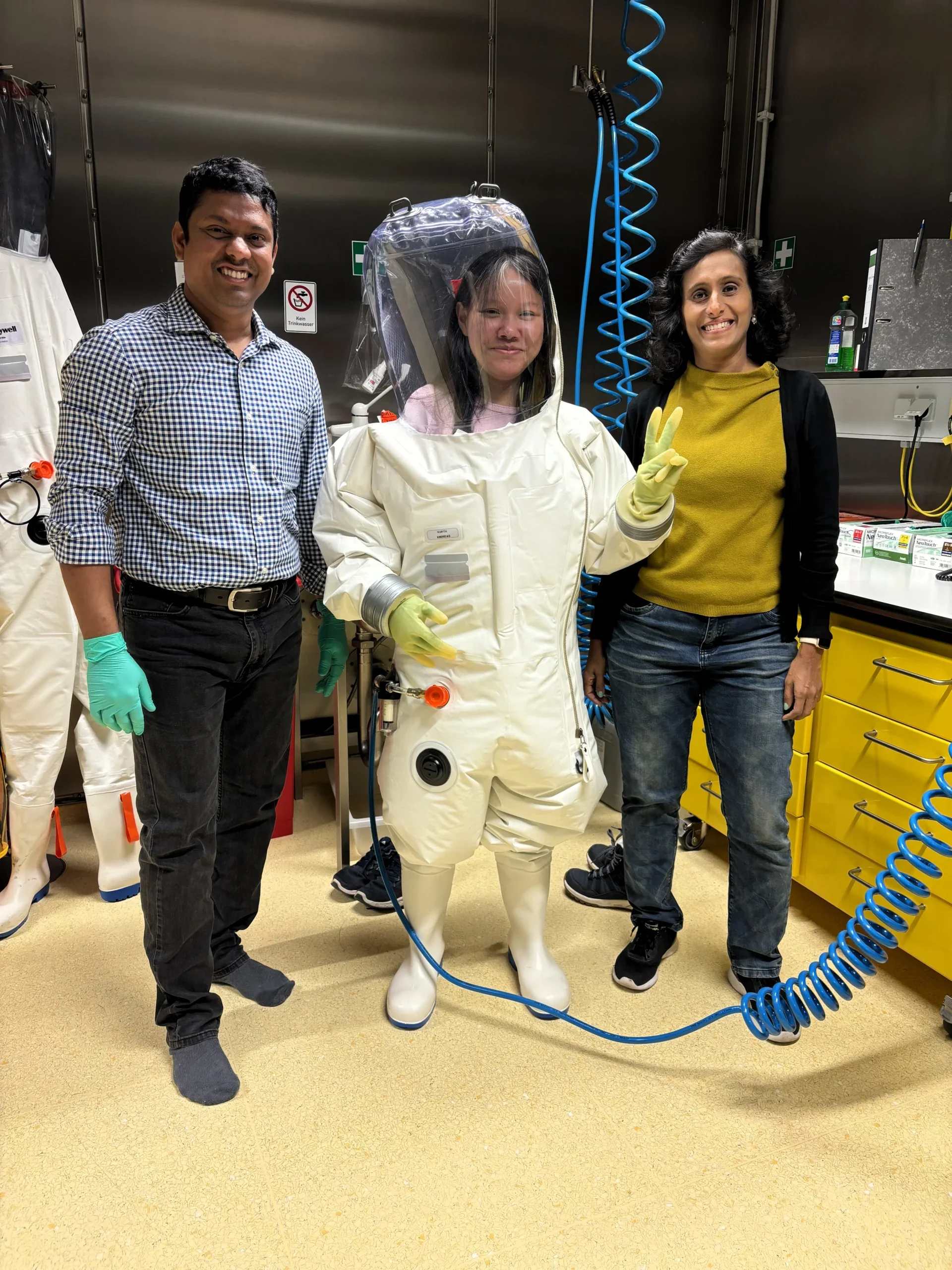
Training visit by NUS Medicine BSL-3 Core Facility operations team members to the BSL-4 laboratory in RKI, Berlin, Germany.
“The signing of an MoU between NUS and RKI marks a significant milestone for advancing medical and public health research. The initial focus on high-risk pathogen research, spearheaded by the NUS Medicine BSL-3 Core Facility and RKI Centre for Biological Threats and Special Pathogens, is expected to foster the exchange of expertise, resources, and innovative ideas,” said A/Prof Chu. “This will definitely enhance both the quality and impact of ongoing and future research efforts, accelerating scientific breakthroughs for addressing critical challenges in pandemic preparedness.”
Professor Roger Foo Sik Yin, Vice-Dean (Research) at NUS Medicine said, “Infectious disease threats are global in nature, and addressing them requires global collaboration. This partnership between NUS Medicine and the Robert Koch Institute (RKI) marks a strategic convergence of scientific strengths and institutional values. Together, we are committed to advancing research and capacity-building efforts that strengthen public health systems and enhance pandemic preparedness. We are proud to join hands with a world-renowned partner like RKI, and look forward to co-creating innovative and grounded solutions to achieve real-world impact.”

NUS Medicine and RKI delegations at the bust of Robert Koch in the RKI main campus. From left: Dr Tessy Joseph (NUS Medicine BSL-3 Core Facility Senior Assistant Director), Prof Dr Med Lars Schaade (RKI President), A/Prof Justin Chu Jang Hann (NUS Medicine BSL-3 Core Facility Director), Dr Andreas Kurth (Head of Biosafety Level-4 Laboratory of the Centre for Biological Threats and Special Pathogens), Dr Tan Kai Sen (NUS Medicine BSL-3 Core Facility Research Director)
This MOU represents a commitment by both institutions to drive progressive expansion of collaborative efforts into broader domains of biomedical science, health systems research, and public health policy. It underscores the alignment of both institutions’ missions in academic excellence, translational research, and meaningful community engagement.