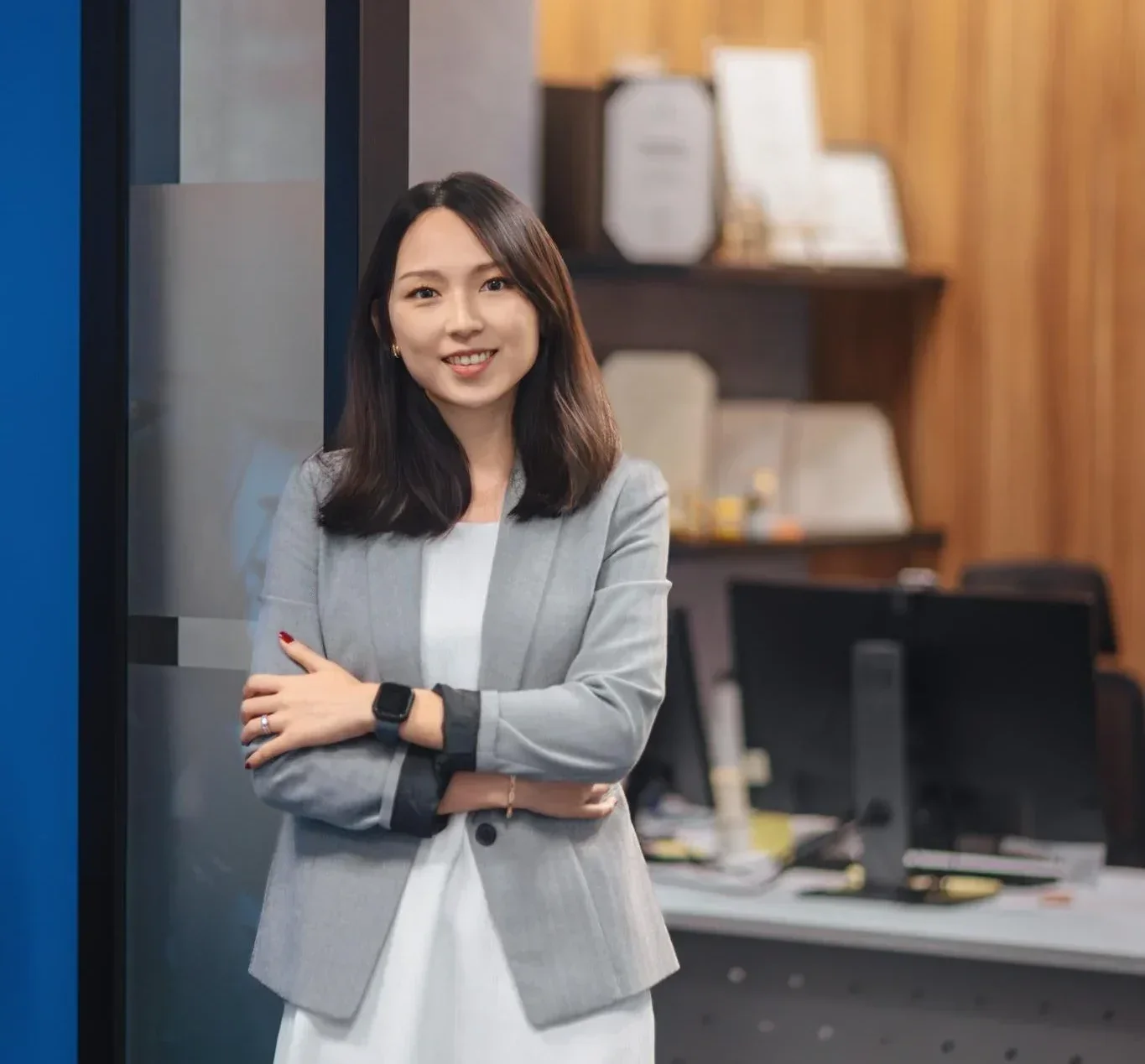
"We Hope to Create an Ecosystem for Innovation": Assistant Professor Jocelyn Chew's Vision for Nursing Excellence
Published: 03 Jul 2025
Assistant Professor Jocelyn Chew stands out as a pioneer who’s transforming healthcare through technology and behavioural science. The youngest nurse in Singapore to obtain a PhD, A/Prof Chew’s innovative approach to obesity management is redefining how we address one of Singapore’s most pressing health challenges.
Her revolutionary app called eTRIP (Eating Trigger-Response Inhibition Program), which is currently being rebranded and renamed to ME (Mindful Eating), uses Artificial Intelligence (AI) to predict and prevent dietary triggers, potentially impacting thousands of patients struggling with excess adiposity and cardiometabolic diseases.
From Bedside to Breakthrough
A/Prof Chew’s journey into research began with curiosity and personal experience. “I had a lot of burning questions,” she recalls of her nursing education. “I was very intrigued by behaviour.”
Her quest for answers led her to Hong Kong to pursue her PhD. When asked what she gained from her time there, she highlighted—“resilience and rigour.” The high standards and expectations cultivated during her time in Hong Kong continue to influence her meticulous approach to research and innovation today.
As the first nurse to receive training in the Stanford Biodesign methodology, A/Prof Chew represents a new generation of healthcare innovators who combine clinical expertise with technological innovation – a combination that is increasingly vital in modern healthcare.
Tackling Obesity as a Chronic Disease
Central to A/Prof Chew’s research is her conviction that obesity should be treated as a chronic disease rather than merely a lifestyle choice. “Mindsets need to change,” she explains.
This perspective shift was partly inspired by personal experience. “When I first started doing research, it was on heart failure because my grandmother had this condition,” she shares. As her grandmother’s condition deteriorated into multi-organ failure, A/Prof Chew realised that interventions at advanced disease stages often came too late.
“I slowly realised that it’s very difficult to change behaviours when you’re already at that terminal stage,” she reflects. “I decided I needed to look upstream at cardiometabolic diseases, particularly diabetes. But then I thought, why not go even further upstream to obesity? It became clear to me that this was really the root cause of so many health issues we were treating too late.”
Her approach emphasises prevention over cure, addressing health behaviours years before symptoms manifest. “Prevention is indeed better than cure,” she notes, though the challenge remains convincing people to make lifestyle changes a decade or more before symptoms appear.
The Power of AI in Personalised Healthcare
The ME app represents A/Prof Chew’s innovative approach to weight management. Unlike conventional applications, ME uses machine learning to understand each user’s unique dietary triggers and provides personalised interventions at critical moments, what some may term as just-in-time adaptive interventions (JITAIs).
“We use a machine learning model to detect personalised triggers,” she explains. What makes the app distinctive is its adaptability to different communication styles. “Some people really need to be coddled,” she notes. “But some people respond better to ‘tough love.’” The app adjusts its messaging approach based on user preferences for optimal outcomes.
A/Prof Chew’s research revealed that technology alone isn’t enough. “For the first few versions of the app, I tried to use it as a standalone intervention, but a large majority of participants said they still need a human,” she shares. This insight led to combining the app with health coaching – technology provides the nudges, while human connection creates accountability. Her team has seen encouraging results with participants losing an average of 5kg over 3 months.
This blend of human touch and technological innovation represents the future of behavioural change interventions, where personalised support meets scalable solutions.
Nurturing Innovation in Nursing
Beyond her research, A/Prof Chew is passionate about elevating the role of nurses in healthcare innovation. As founder of the Singapore Nursing Innovation Group (SNIG), she works to create opportunities for nurses to develop innovative solutions to healthcare challenges.
“I think nurses today are very well-versed with technology. They can do much more as long as they are supported,” she emphasises. Her efforts aim to change perceptions of nursing innovation, moving beyond small-scale improvements to transformative healthcare solutions.
When speaking about SNIG, she explains, “We hope to create an ecosystem to support this kind of innovation.” This includes organising events like health hackathons, where each team must include at least one nurse, ensuring nursing perspectives are central to healthcare innovation.
Research with Global Impact
This pioneering approach hasn’t gone unnoticed globally. Her work has earned significant international recognition, with her 2024 inclusion among the world’s top 2% most-cited researchers acknowledging both her scholarly impact and nurses’ growing influence in research leadership.
By redefining obesity management, leveraging AI for behavioural change, and empowering nurses as innovators, A/Prof Chew is helping to create a healthcare system that truly addresses the root causes of chronic disease – one patient, one factor, and one nudge at a time.