-
Adapting to change during challenging times
Dujeepa D. Samarasekera & Matthew C. E. Gwee
Centre for Medical Education (CenMED), NUS Yong Loo Lin School of Medicine,
National University Health System, SingaporeIn our January 2020 Editorial, we drew the attention of our readers to “Grit in Healthcare Education and Practice”. In particular, we focused on developing the “Grit” of students and trainees; medical students who are well-equipped with the ‘Power of Grit’ will display a “passion for patient well-being and perseverance in the pursuit of that goal [which] become social norms at the individual, team and institutional levels” (Lee & Duckworth, 2018). However, never could we imagine then that such an attribute (i.e. ‘Grit’) would become contextual so soon, as exemplified by the passion and perseverance of healthcare practitioners in patient care in their response to the serious disruptions in individual health (including fatalities) caused by the Covid-19 pandemic!
-
Fixing the leaky pipeline: Tips to promote gender equity in Academic Medicine
Dora J. Stadler1,2, Halah Ibrahim3,4, Joseph Cofrancesco Jr4 & Sophia Archuleta5,6
1Department of Medicine, Weill Cornell Medical College, Doha, Qatar; 2Walter Reed National Military Medical Center in Bethesda, United States of America; 3Department of Medicine, Sheikh Khalifa Medical City, Abu Dhabi, United Arab Emirates; 4Department of Medicine, Johns Hopkins University School of Medicine, Baltimore, United States of America; 5Division of Infectious Diseases, Department of Medicine, National University Hospital, Singapore; 6Department of Medicine, Yong Loo Lin School of Medicine, National University of Singapore, National University Health System, Singapore
Abstract
Introduction: Gender equity in academic medicine is a global concern. Women physicians lag behind men in salary, research productivity, and reaching top academic rank and leadership positions.
Methods: In this Global Perspective, we provide suggestions for overcoming gender bias, drawn from a multidisciplinary literature and personal experiences working as clinician educators in the international academic arena. These suggestions are not exhaustive but inform a tool kit for institutions and individuals to support the advancement of women in academic medicine.
Results: Barriers include limited access to same gender role models and mentors, fewer networking opportunities, fewer nominations for awards and speakership opportunities, as well as implicit gender bias. Institutional interventions can address disparities along the career continuum focusing on scholarship, promotion and leadership opportunities. Women faculty can also seek out professional development programmes and mentorship to support their own advancement. Informal and formal networking opportunities, using a variety of platforms, including social media, can help build relationships to enhance career development and success, and provide social, emotional and professional support to women at all stages of their career. The National University Health System’s Women in Science and Healthcare project is an example of a successful group formed to empower women and foster personal and professional development.
Conclusion: Successful incentives and policies need to consider local institutional and cultural contexts, as well as approaches to mitigate implicit bias. Achieving gender parity in academic medicine will promote a personally and professionally fulfilled global healthcare workforce to improve patient care and clinical outcomes worldwide.
-
Never waste a good crisis: Resilient health professions education
Lambert Schuwirth1 & Ardi Findyartini2
1Prideaux Centre for Research in Health Professions Education, College of Medicine and Public Health, Flinders University, Australia; 2Department of Medical Education, Faculty of Medicine, Universitas Indonesia, Indonesia
This quote is attributed to Nicolo Machiavelli, an Italian Renaissance political philosopher. And it may sound reasonable, but at a time where the Covid-19 pandemic is still very active around the world it is also callous to think of a crisis as an opportunity. We want to acknowledge this and we want to send our deepest sympathy to all those who have been personally affected by this pandemic.
-
The predictive brain model in diagnostic reasoning
Tow Keang Lim
Department of Medicine, National University Hospital, Singapore
Abstract
Introduction: Clinical diagnosis is a pivotal and highly valued skill in medical practice. Most current interventions for teaching and improving diagnostic reasoning are based on the dual process model of cognition. Recent studies which have applied the popular dual process model to improve diagnostic performance by “Cognitive De-biasing” in clinicians have yielded disappointing results. Thus, it may be appropriate to also consider alternative models of cognitive processing in the teaching and practice of clinical reasoning.
Methods: This is critical-narrative review of the predictive brain model.
Results: The theory of predictive brains is a general, unified and integrated model of cognitive processing based on recent advances in the neurosciences. The predictive brain is characterised as an adaptive, generative, energy-frugal, context-sensitive action-orientated, probabilistic, predictive engine. It responds only to predictive errors and learns by iterative predictive error management, processing and hierarchical neural coding.
Conclusion: The default cognitive mode of predictive processing may account for the failure of de-biasing since it is not thermodynamically frugal and thus, may not be sustainable in routine practice. Exploiting predictive brains by employing language to optimise metacognition may be a way forward.
Keywords: Diagnosis, Bias, Dual Process Theory, Predictive Brains
-
Insights for medical education: via a mathematical modelling of gamification
De Zhang Lee1, Jia Yi Choo1, Li Shia Ng2, Chandrika Muthukrishnan1 & Eng Tat Ang1
1Department of Anatomy, Yong Loo Lin School of Medicine, National University of Singapore, Singapore; 2Department of Otolaryngology, National University Hospital, Singapore
Abstract
Introduction: Gamification has been shown to improve academic gains, but the mechanism remains elusive. We aim to understand how psychological constructs interact, and influence medical education using mathematical modelling.
Methods: Studying a group of medical students (n=100; average age: 20) over a period of 4 years with the Personal Responsibility Orientation to Self-Direction in Learning Scale (PRO-SDLS) survey. Statistical tests (Paired t-test) and models (logistic regression) were used to decipher the changes within these psychometric constructs (Motivation, Control, Self-efficacy & Initiative), with gamification as a tool. Students were encouraged to partake in a maze (10 stations) that challenged them to answer anatomical questions using potted human specimens.
Results: We found that the combinatorial effects of the maze and Script Concordance Test (SCT) resulted in a significant improvement for “Self-Efficacy” and “Initiative” (p<0.05). However, the “Motivation” construct was not improved significantly with the maze alone (p<0.05). Interestingly, the “Control” construct was eroded in students not exposed to gamification (p<0.05). All these findings were supported by key qualitative comments such as “helpful”, “fun” and “knowledge gap” by the participants (self-awareness of their thought processes). Students found gamification reinvigorating and useful in their learning of clinical anatomy.
Conclusion: Gamification could influence some psychometric constructs for medical education, and by extension, the metacognition of the students. This was supported by the improvements shown in the SCT results. It is therefore proposed that gamification be further promoted in medical education. In fact, its usage should be more universal in education.
Keywords: Psychometric Constructs, Medical Education, Motivation, Initiative, Self-efficacy
-
Sri Lankan dental students’ perspective on the effectiveness of e-learning
Rasika Manori Jayasinghe1, Indika Priyanthi Thilakumara1, Bandara Dhanushka Leuke2, Gishan Edirisinghe3, Manil Christopher Nishan Fonseka3, Manjula Attygalla4 & Ruwan Duminda Jayasinghe2
1Department of Prosthetic Dentistry, Faculty of Dental Sciences, University of Peradeniya, Sri Lanka; 2Department of Oral Medicine and Periodontology, Faculty of Dental Sciences, University of Peradeniya, Sri Lanka; 3Department of Restorative Dentistry, Faculty of Dental Sciences, University of Peradeniya, Sri Lanka; 4Department of Oral Surgery, Faculty of Dental Sciences, University of Peradeniya, Sri Lanka
Abstract
Introduction: E-learning resulted in a revolution in dental education with continuous educational experiences. General objective of this study was to assess the perspective of undergraduate dental students on effectiveness of e-learning in the Bachelor of Dental Surgery (BDS) programme. Specific objectives were to identify students’ opinion on the factors that promote e-learning, awareness on the effectiveness of using different platforms and social media, barriers imposed and suggestions for the improvement of e-learning in the BDS programme.
Methods: This was a cross sectional descriptive study among undergraduate dental students of the Faculty of Dental Sciences, University of Peradeniya, Sri Lanka using a self-administered pre-tested questionnaire administered via a web-based survey form. Frequencies and percentages were obtained for categorical data and Chi-square test was used to determine the association between variables.
Results: The majority received the e-learning experience well. Fifty-four percent of the participants felt it was better compared to traditional face-to-face learning and the difference between the semesters (p=0.000) and genders was statistically significant (p=0.000). Difference in overall satisfaction on e-learning material across the different semesters was statistically significant. Students felt that e-learning should be used as a supplementary tool mainly by means of procedural videos during delivery of the skill component. Fifty percent participants felt that conducting assessments online is fair for all the students.
Conclusion: A positive learning experience was achieved through the e-learning modalities in comparison to traditional face-to-face learning though in terms of skills training, e-learning modalities should only be considered as a supplementary tool.
Keywords: E-Learning, Perspective, Dental Undergraduates, Dental Education
-
A systematic scoping review of teaching and evaluating communications in the intensive care unit
Elisha Wan Ying Chia1,2, Huixin Huang1,2, Sherill Goh1,2, Marlyn Tracy Peries1,2, Charlotte Cheuk Yiu Lee2,3, Lorraine Hui En Tan1,2, Michelle Shi Qing Khoo1,2, Kuang Teck Tay1,2, Yun Ting Ong1,2, Wei Qiang Lim1,2, Xiu Hui Tan1,2, Yao Hao Teo1,2, Cheryl Shumin Kow1,2, Annelissa Mien Chew Chin4, Min Chiam5, Jamie Xuelian Zhou2,6,7 & Lalit Kumar Radha Krishna1,2,5,7-10
1Yong Loo Lin School of Medicine, National University of Singapore, Singapore; 2Division of Supportive and Palliative Care, National Cancer Centre Singapore, Singapore; 3Alice Lee Centre for Nursing Studies, National University of Singapore, Singapore; 4Medical Library, National University of Singapore Libraries, National University of Singapore, Singapore; 5Division of Cancer Education, National Cancer Centre Singapore, Singapore; 6Lien Centre of Palliative Care, Duke-NUS Graduate Medical School, Singapore; 7Duke-NUS Graduate Medical School, Singapore; 8Centre for Biomedical Ethics, National University of Singapore, Singapore; 9Palliative Care Institute Liverpool, Academic Palliative & End of Life Care Centre, University of Liverpool; 10PalC, The Palliative Care Centre for Excellence in Research and Education, Singapore
Abstract
Introduction: Whilst the importance of effective communications in facilitating good clinical decision-making and ensuring effective patient and family-centred outcomes in Intensive Care Units (ICU)s has been underscored amidst the global COVID-19 pandemic, training and assessment of communication skills for healthcare professionals (HCPs) in ICUs remain unstructured
Methods: To enhance the transparency and reproducibility, Krishna’s Systematic Evidenced Based Approach (SEBA) guided Systematic Scoping Review (SSR), is employed to scrutinise what is known about teaching and evaluating communication training programmes for HCPs in the ICU setting. SEBA sees use of a structured search strategy involving eight bibliographic databases, the employ of a team of researchers to tabulate and summarise the included articles and two other teams to carry out content and thematic analysis the included articles and comparison of these independent findings and construction of a framework for the discussion that is overseen by the independent expert team.
Results: 9532 abstracts were identified, 239 articles were reviewed, and 63 articles were included and analysed. Four similar themes and categories were identified. These were strategies employed to teach communication, factors affecting communication training, strategies employed to evaluate communication and outcomes of communication training.
Conclusion: This SEBA guided SSR suggests that ICU communications training must involve a structured, multimodal approach to training. This must be accompanied by robust methods of assessment and personalised timely feedback and support for the trainees. Such an approach will equip HCPs with greater confidence and prepare them for a variety of settings, including that of the evolving COVID-19 pandemic.
Keywords: Communication, Intensive Care Unit, Assessment, Skills Training, Evaluation, COVID-19, Medical Education
-
Transformation on the run—Digitising medical education during the COVID-19 pandemic
Wei-Han Hong1a, Vinod Pallath1b, Chan Choong Foong1, Christina Phoay Lay Tan2, Mary Joseph Marret3, Yang Faridah Abdul Aziz4 & Jamuna Vadivelu1
1Medical Education Research and Education Unit, Faculty of Medicine, Universiti Malaya, Malaysia; 2Department of Primary Care Medicine, Faculty of Medicine, Universiti Malaya, Malaysia; 3Department of Paediatrics, Faculty of Medicine, Universiti Malaya, Malaysia; 4Department of Biomedical Imaging, Faculty of Medicine, Universiti Malaya, Malaysia
a,bJoint first author
Abstract
Introduction: The article is a succinct summary of events and process for emergency digitisation and transition to remote teaching during the COVID- 19 pandemic. The challenges of such transition included the need for enhanced infrastructure facilities, compliance to directives from regulatory bodies, providing an equivalent learning experience in the virtual learning environment (VLE) and ensuring the end user capacity to utilise the VLE created.
Methods: To accomplish this task a suitable instructional design and transition model was utilised to create an integrated Moodle and Microsoft Teams platform as the VLE. The curriculum was recreated in the VLE through review of existing infrastructure and resources, deconstructing the demands of the curriculum, reconstructing the learning experiences of curriculum in VLE and innovating to improve. The end user training was also provided using the same VLE created, which ensured capacity building. Virtual Clinical Assessments (VCA) were created to ensure the completion of assessment tasks.
Results: The utilisation of the ACTIONS transition model resulted in the evolution of instructional delivery from a Web Enhanced approach to a customised Web Centric approach and implementation of Virtual Clinical Assessments. Students expressed their satisfaction in the learning experience through VLE, but were anxious about their clinical training and connectivity issues.
Conclusion: This transition demonstrated the need of future directions in terms of learner readiness to be more self-directed and self-determined, design thinking for transformation to a Web Centric curriculum, faculty readiness to change and develop the competency of Technological Pedagogical Content Knowledge (TPACK).
-
Perspectives of the Asian standardised patient
Nicola Ngiam1,2 & Chuen-Yee Hor1
1Centre for Healthcare Simulation, National University of Singapore, Singapore; 2Khoo Teck Puat-National University Children’s Medical Institute, National University Hospital, Singapore
Abstract
Introduction: Standardised patients (SPs) have been involved in medical education for the past 50 years. Their role has evolved from assisting in history-taking and communication skills to portraying abnormal physical signs and hybrid simulations. This increases exposure of their physical and psychological domains to the learner. Asian SPs who come from more conservative cultures may be inhibited in some respect. This study aims to explore the attitudes and perspectives of Asian SPs with respect to their role and case portrayal.
Methods: This was a cohort questionnaire study of SPs involved in a high-stakes assessment activity at a university medical school in Singapore.
Results: 66 out of 71 SPs responded. Racial distribution was similar to population norms in Singapore (67% Chinese, 21% Malay, 8% Indian). SPs were very keen to provide feedback to students. A significant number were uncomfortable with portraying mental disorders (26%) or terminal illness (16%) and discussing Human Immunodeficiency Virus/Acquired Immunodeficiency Syndrome (HIV/AIDS, 14%) or Sexually Transmitted Diseases (STDs, 14%). SPs were uncomfortable with intimate examinations involving the front of the chest (46%, excluding breast), and even abdominal examination (35%). SPs perceive that they improve quality of teaching and are cost effective.
Conclusion: The Asian SPs in our institution see themselves as a valuable tool in medical education. Sensitivity to the cultural background of SPs in case writing and the training process is necessary to ensure that SPs are comfortable with their role. Additional training and graded exposure may be necessary for challenging scenarios and physical examination.
Keywords: Standardised Patients, Perspective, Asian, Medical Education, Survey
-
Teleconferencing as a teaching modality for clinical year medical students: Lessons from COVID-19
Xin Rong Goh1, Chee Wai Ku2,4, Rajeswari Kathirvel1,2,4,5 & Kok Hian Tan1,3,4
1Lee Kong Chian School of Medicine, Nanyang Technological University, Singapore; 2Department of Obstetrics and Gynaecology, KK Women’s & Children’s Hospital, Singapore; 3Department of Maternal Fetal Medicine, KK Women’s & Children’s Hospital, Singapore; 4Duke-NUS Medical School, Singapore; 5Yong Loo Lin School of Medicine, National University of Singapore, Singapore
Abstract
Introduction: Disease outbreaks (DO) result in unprecedented changes to the healthcare industry with far-reaching implications for medical education. The need to adapt to the fluidity during DO requires the delivery of the clinical medical curriculum to be flexible and effective. There is a lack of well-established guidelines on how medical education should be delivered during DO. This study aimed to explore the efficacy of teleconferencing-based platforms (TBP) as a teaching modality to overcome the challenges of clinical year medical education amidst a global pandemic and possibility of its use when there are no disease outbreaks (NDO).
Methods: A cross-sectional survey amongst 144 undergraduate clinical year students from a medical school in Singapore was conducted from May to June 2020, to explore their perspectives on TBP compared to physical venue-based platforms (PVBP). The survey consisted 5-point Likert scale and open-ended questions. Statistical and thematic analyses were performed.
Results: TBP provides greater convenience in travelling, note-taking and ability to overcome administrative challenges. Students strongly recommended its use in DO and NDO. However, students faced increased distractibility, decreased engagement and ease of raising questions, with a lower efficacy in content delivery. The above is dependent on the type of lessons delivered – clinical skills-based or didactic sessions.
Conclusion: TBP is a promising teaching modality for DO with promising possibility of extending its use to NDO. We propose a tri-faceted approach to target improvement in content delivery on TBP, mainly with measures to target propensity for decreased engagement and increased distractibility and to address the technology-related concerns.
Keywords: Medical Education, Teleconferencing, Teaching Modalities, Medical Students, COVID-19, Disease Outbreaks, Pandemics
-
Education of medical students in child and adolescent psychiatry
Yit Shiang Lui, Abigail HY Loh, Tji Tjian Chee, Jia Ying Teng, John Chee Meng Wong & Celine Hsia Jia Wong
Department of Psychological Medicine, National University Health System, Singapore
Abstract
Introduction: A good understanding of basic child-and-adolescent psychiatry (CAP) is important for general medical practice. The undergraduate psychiatry teaching programme included various adult and CAP topics within a six-week time frame. A team of psychiatry tutors developed two new teaching formats for CAP and obtained feedback from the students about these teaching activities.
Methods: Medical students were introduced to CAP via small group teaching in two different modes. One mode was the “Clinical Vignettes Tutorial” (CVT) and the other mode “Observed Clinical Interview Tutorial” (OCIT). In CVT, tutors would discuss clinical vignettes of real patients with the students, followed by explanations about theoretical concepts and management strategies. OCIT involved simulated-patients (SPs) who assisted by acting as patients presenting with problems related to CAP, or as parents for such patients. At each session, students were given the opportunity to interview “patients” and “parents”. Feedback was given following these interviews. The students then completed surveys about the teaching methods.
Results: Students rated very-positive feedback for the teaching of CAP in small groups. Almost all found these small groups enjoyable and that it helped them apply what they had learnt. Majority agreed that the OCIT sessions increased their level of confidence in speaking with adolescents and parents. Some students agreed that these sessions had stimulated their interest to know more about CAP.
Conclusion: Small group teaching in an interactive manner enhanced teaching effectiveness. Participants reported a greater degree of interest towards CAP, and enhanced confidence in treating youths with mental health issues as well as engaging their parents.
Keywords: Child Adolescent Psychiatry, Medical Education, Small Group, Teaching
-
Medical education adaptation in South Korea during the COVID-19 pandemic
Young-Mee Lee1 & Hyunmi Park1,2
1Department of Medical Education, Korea University College of Medicine, Seoul, South Korea; 2Department of Brain Convergence Research Center, Korea University College of Medicine, Seoul, South Korea
Abstract
Introduction: We describe the circumstances and adaptations in the South Korean medical education during the COVID-19 pandemic and discuss areas in need of improvement in preparation of a worsening situation or for similar future public health crises.
Methods: Literature reviews, focusing on research papers about medical educational changes in South Korea during the COVID-19 pandemic were performed. Selective data collected from a nationwide online survey by the Korean Association of Medical Colleges on the status of curricular changes in medical schools during the COVID-19 was presented.
Results: All lectures have moved online, but clinical students continued their hospital placements during the pandemic, except for the first 3-5 weeks during the first surge in 2020. Initial technical naivety of the faculty and lack of technical resources were short-lived and the medical students settled well showing a much higher than expected student satisfaction level over online education. Practical skills sessions which benefit most from onsite hands-on experiences such as anatomy dissection, were delivered through a blended approach in some medical school. Student evaluation is the area of least change, mainly due to the students’ lack of trust in online assessments.
Conclusion: South Korea’ underwent major changes in medical education brought upon COVID-19 and the readiness of the technology adoption has been much increased. Student evaluation is the area of least transformation. Adoption of a programmatic assessment system should be considered to enhance not only learning but also improve trust among stakeholders of medical schools.
-
Impact of COVID-19 on health profession education in Singapore: Adoption of innovative strategies and contingencies across the educational continuum
Claude Jeffrey Renaud1, Zhi Xiong Chen2,6, Heng-Wai Yuen3, Lay Ling Tan4, Terry Ling Te Pan5 & Dujeepa D. Samarasekera6
1Department of Medicine, Khoo Teck Puat Hospital, Singapore; 2Department of Physiology, Yong Loo Lin School of Medicine, National University of Singapore, Singapore; 3Department of Otorhinolaryngology-Head & Neck Surgery, Changi General Hospital, Singapore; 4Department of Psychological Medicine, Changi General Hospital, Singapore; 5Department of Anaesthesiology, National University Health System, Singapore; 6Centre for Medical Education, Yong Loo Lin School of Medicine, National University of Singapore, Singapore
Abstract
Introduction: The Coronavirus-19 pandemic has had profound effects on health professions education (HPE) posing serious challenges to the continued provision and implementation of undergraduate, postgraduate and continuing medical education (CME). Across these HPE domains, the major disruptions included the exclusion of undergraduate learners from clinical learning environments, restricted intra-, inter-institutional and overseas movement of medical professionals, termination of face-to-face learner-educator interactions, deployment of postgraduate learners into non-scope service settings, and CME postponement.
Methods: In this review we report on how in Singapore various adaptive measures were instituted across the 3 HPE domains at institutional and national level to maintain adequate resources at the frontline to meet service exigencies, promote healthcare professionals’ wellbeing and safety as well as mitigate the spread of the pandemic.
Results: We identified several strategies and contingencies developed to address these challenges. These involved the use of online learning platforms, distributed and asynchronous learning, an undergraduate Pathway Programme, and use of innovative hands-on technology like simulation. Robust, well pre-planned pandemic preparedness, effective communication, as well as provision of psychological support resources ensured maintenance of service and academic continuity, trust and resilience within HPE. However, several challenges remain, namely the timing and manner of conducting formative and summative assessments, cybersecurity, and the indispensable hands-on, in-person experiential learning for surgical training.
Conclusion: Strong leadership with vision and planning, good communication, prioritising learners’ and educators’ wellbeing and safety, and harnessing existing and emerging online learning technologies are crucial elements for effective contingencies for HPE disruption during pandemics.
Keywords: Pandemic Preparedness, COVID-19, Curriculum Development, Online Learning and Assessment, Learner Wellbeing and Safety, Health Profession Education
-
Validation of the perceived stress scale (PSS-10) in medical and health sciences students in Hong Kong
Julie Yun Chen1,2, Weng-Yee Chin1, Agnes Tiwari3, Janet Wong3, Ian C K Wong4, Alan Worsley4, Yibin Feng5, Mai Har Sham6, Joyce Pui Yan Tsang1,2 & Chak Sing Lau7
1Department of Family Medicine and Primary Care, Li Ka Shing Faculty of Medicine, The University of Hong Kong, Hong Kong; 2Bau Institute of Medical and Health Sciences Education, Li Ka Shing Faculty of Medicine, The University of Hong Kong, Hong Kong; 3School of Nursing, Li Ka Shing Faculty of Medicine, The University of Hong Kong, Hong Kong; 4Department of Pharmacology and Pharmacy, Li Ka Shing Faculty of Medicine, The University of Hong Kong, Hong Kong; 5School of Chinese Medicine, Li Ka Shing Faculty of Medicine, The University of Hong Kong, Hong Kong; 6School of Biomedical Sciences, Li Ka Shing Faculty of Medicine, The University of Hong Kong, Hong Kong; 7Department of Medicine, Li Ka Shing Faculty of Medicine, The University of Hong, Hong Kong
Abstract
Introduction: The demanding nature of medical and health sciences studies can cause stress among students in these disciplines affecting their wellbeing and academic performance. The Perceived Stress Scale (PSS-10) is a widely used measure of perceived stress among medical students and healthcare professionals that has not yet been validated among medical and health sciences students in Hong Kong. The aim of this study is to establish the construct validity and reliability of the PSS-10 in this context.
Methods: 267 final year medical and health sciences students were surveyed using the PSS-10. The data were analysed using exploratory factor analysis for construct validity and Cronbach’s alpha coefficient and corrected item-total correlations for reliability.
Results: Exploratory factor analysis revealed a two-factor structure for PSS-10, with Cronbach’s alpha of 0.865 and 0.796, indicating good internal consistency. Corrected item-total correlations showed satisfactory correlation ranged from 0.539 to 0.748 for all items and their respective subscale. Both tests supported PSS-10 as a two-factor scale.
Conclusion: The PSS-10 is a valid measure for assessing perceived stress in Hong Kong medical and health sciences students.
Keywords: Undergraduate Students, Medicine, Nursing, Pharmacy, Health Sciences, Validation, Perceived Stress
-
Trainee doctor clinics after 24-hour shifts: Effects on patient satisfaction and prescription errors
Chee Yang Chin1, Si Qi Tan2, Swee Leng Kui1,2, Kurugulasigamoney Gunasegaran1 & Jill Cheng Sim Lee3
1Department of Cardiovascular Medicine, National Heart Centre Singapore, Singapore; 2Ministry of Health Holdings, Singapore; 3Department of Obstetrics and Gynaecology, KK Women’s and Children’s Hospital, Singapore
Abstract
Introduction: Sleep deprivation impacts clinical performance. However, literature is conflicting, with insufficient focus on patient outcomes. The aim of this study was to assess if patient satisfaction and prescription errors in outpatient clinics were adversely affected when consulting post-call versus non-post-call registrars.
Methods: This prospective, quantitative study was set in a large teaching hospital in Singapore. Between November 2015 and February 2016, patients from clinics run by a registrar after 24-hour shift were recruited to post-call group. Patients from non-post-call clinics run by the same registrar were controls. Outcome measures were patient satisfaction, using 5-item 4-point Likert scale questionnaire, and prescribing error rate, defined as number of errors over number of orders. Differences were analysed using chi-squared test.
Results: 103 of 106 (97%) patients in 9 post-call clinics and 93 of 105 (90%) patients in 9 non-post-call clinics were recruited. Questionnaire completion rate was 99%. 536 and 526 prescriptions were ordered in post-call and non-post-call groups, respectively. Percentage of top-box responses (greatest satisfaction) was higher in post-call group overall (79.3% versus 62.4%, p<0.001), and for each questionnaire item. There was no significant difference in prescribing errors (1.31% versus 2.28%, p=0.23).
Conclusion: Patient satisfaction and prescribing error rates in outpatient clinics were not detrimentally affected. This provides some objective evidence that patients may safely consult post-call registrars. True impacts of sleep deprivation remain poorly understood, and larger, longer term, multicentre studies would inform generalisability. Qualitative studies of fatigue may shed light on complex interactions of emotions that compensate for tiredness.
Keywords: Medical Education, Sleep Deprivation, Physician Training, Outpatient Clinics, Patient Satisfaction, Patient Safety
-
Who is an effective clinical teacher from the perspectives of medical students and residents?
Shirley Beng Suat Ooi1,2, Clement Woon Teck Tan3,4 & Janneke M. Frambach5
1Emergency Medicine Department, National University Hospital, National University Health System, Singapore; 2Department of Surgery, Yong Loo Lin School of Medicine, National University of Singapore, Singapore; 3Department of Ophthalmology, National University Hospital, National University Health System, Singapore; 4Yong Loo Lin School of Medicine, National University of Singapore, Singapore; 5School of Health Professions Education, Faculty of Health, Medicine and Life Sciences, Maastricht University, The Netherlands
Abstract
Introduction: Almost all published literature on effective clinical teachers were from western countries and only two compared medical students with residents. Hence, this study aims to explore the perceived characteristics of effective clinical teachers among medical students compared to residents graduating from an Asian medical school, and specifically whether there are differences between cognitive and non-cognitive domain skills, to inform faculty development.
Methods: This qualitative study was conducted at the National University Health System (NUHS), Singapore involving six final year medical students at the National University of Singapore, and six residents from the NUHS Residency programme. Analysis of the semi-structured one-on-one interviews was done using a 3-step approach based on principles of Grounded Theory.
Results: There are differences in the perceptions of effective clinical teachers between medical students and residents. Medical students valued a more didactic spoon-feeding type of teacher in their earlier clinical years. However final year medical students and residents valued feedback and role-modelling at clinical practice. The top two characteristics of approachability and passion for teaching are in the non-cognitive domains. These seem foundational and lead to the acquisition of effective teaching skills such as the ability to simplify complex concepts and creating a conducive learning environment. Being exam-oriented is a new characteristic not identified before in “Western-dominated” publications.
Conclusion: The results of this study will help to inform educators of the differences in a learner’s needs at different stages of their clinical development and to potentially adapt their teaching styles.
Keywords: Clinical Teachers, Medical Students, Residents, Cognitive/Non-Cognitive, Asian Healthcare, Faculty Development
-
A comparison of four models of professionalism in medical education
Maria Isabel Atienza
Curriculum and Instruction, College of Medicine, San Beda University, Philippines
Institute of Pediatrics & Child Health, St. Luke’s Medical Center, Global City, PhilippinesAbstract
Introduction: The prevailing consensus is that medical professionalism must be formally included as a programme in the undergraduate medical curriculum.
Methods: A literature search was conducted to identify institutions that can serve as models for incorporating professionalism in medical education. Differences and similarities were highlighted based on a framework for the comparison which included the following features: Definition of professionalism, curricular design, student selection, teaching and learning innovations, role modelling and methods of assessment.
Results: Four models for integrating professionalism in medical education were chosen: Vanderbilt University School of Medicine (VUSM), University of Washington School of Medicine (UWSOM), University of Queensland (UQ) School of Medicine, and Mayo Clinic and Mayo Medical School. The task of preparing a programme on medical professionalism requires a well-described definition to set the direction for planning, implementing, and institutionalising professionalism. The programmes are best woven in all levels of medical education from the pre-clinical to the clinical years. The faculty physicians and the rest of the institution’s staff must also undergo a similar programme for professionalism.
Conclusion: The development of all scopes of professionalism requires constant planning, feedback and remediation. The students’ ability to handle professionalism challenges are related to how much learning situations the students encounter during medical school. The learning situations must be adjusted according to the level of responsibilities given to students. The goal of learning is to enable students to grow from a novice to a competent level and afterwards to a proficient and expert level handling professionalism challenges in medicine.
Keywords: Medical Professionalism, Medical Curriculum, Role Modelling in Medical Education, Culture of Medical Professionalism
-
Interactions between learner’s beliefs, behaviour and environment in online learning: Path analysis
Enjy Abouzeid1, Rebecca O’Rourke2, Yasser El-Wazir1, Nahla Hassan1, Rabab Abdel Ra’oof1 & Trudie Roberts2
1Faculty of Medicine, Ismailia, Egypt; 2LIME, University of Leeds, United Kingdom
Abstract
Introduction: Although, several factors have been identified as significant determinants in online learning, the human interactions with those factors and their effect on academic achievement are not fully elucidated. This study aims to determine the effect of self-regulated learning (SRL) on achievement in online learning through exploring the relations and interaction of the conception of learning, online discussion, and the e-learning experience.
Methods: A non-probability convenience sample of 128 learners in the Health Professions Education program through online learning filled-out three self-reported questionnaires to assess SRL strategies, the conception of learning, the quality of e-Learning experience and online discussion. A scoring rubric was used to assess the online discussion contributions. A path analysis model was developed to examine the effect of self-regulated learning on achievement in online learning through exploring the relations and interaction among the other factors.
Results: Path analysis showed that SRL has a statistically significant relationship with the quality of e-learning experience, and the conception of learning. On the other hand, there was no correlation with academic achievement and online discussion. However, academic achievement did show a correlation with online discussion.
Conclusion: The study showed a dynamic interaction between the students’ beliefs and the surrounding environment that can significantly and directly affect their behaviour in online learning. Moreover, online discussion is an essential activity in online learning.
Keywords: Online Learning, Conception of Learning, E-learning Experience, Human-Computer Interface, Self-regulated Learning, Path Analysis
-
A dramaturgical analysis of a paediatric team handover
Stephen Bradley1, Aaron Ooi2, Kerry Stafford3, Shuvayon Mukherjee1 & Marcus A. Henning4
1Department of Paediatrics, Lakes District Health Board, New Zealand; 2Department of Paediatrics, Waikato District Health Board, New Zealand; 3Department of Paediatrics, Christchurch Hospital, New Zealand; 4Centre for Medical and Health Sciences Education, University of Auckland, New Zealand
Abstract
Introduction: The paediatric team handover process is a crucial workplace practice and comprises the transfer of patient information from one shift to another involving medical professionals and students. A qualitative study was performed to analyse the feasibility, functionality, benefits and limitations of the dramaturgical approach when applied to examining a handover session.
Methods: Data relating to one handover were collected and analysed from video and audio recordings, notes created by two independent observers and a de-identified copy of the handover sheet.
Results: The dramaturgical constructs and subsequent findings allowed us to make informed inferences about the dynamics of the handover procedure. The directors/lead actors consisted of a consultant and a registrar. One consultant was transitory and the remaining 12 attendees were either major support, support or bit actors. The students (bit actors/audience) were included when a learning point was emphasised. The script was informal and improvised as the discussion emphasised certain facets of patient care or accentuated learning points. The staging involved the seating arrangement, a whiteboard, computer screen and ongoing data presentation. The performance suggested a handover of two halves: one emphasising learning and the other allocation of patient care responsibility.
Conclusion: We concluded that the real-life drama occurring within a handover was feasibly analysed, with its functionality demonstrated, using the dramaturgical investigative system. The multifaceted recordings enabled researchers to review the ‘authentic’ handover system without censorship. These findings have implications for educational and organisational research.
Keywords: Dramaturgical, Handover, Paediatric, Methodology
-
Using a consensus approach to develop a medical professionalism framework for the Sri Lankan context
Amaya Tharindi Ellawala1, Madawa Chandratilake2 & Nilanthi de Silva2
1Department of Medical Education, Faculty of Medical Sciences, University of Sri Jayewardenepura, Sri Lanka; 2Faculty of Medicine, University of Kelaniya, Sri Lanka
Abstract
Introduction: Professionalism is a context-specific entity, and should be defined in relation to a country’s socio-cultural backdrop. This study aimed to develop a framework of medical professionalism relevant to the Sri Lankan context.
Methods: An online Delphi study was conducted with local stakeholders of healthcare, to achieve consensus on the essential attributes of professionalism for a doctor in Sri Lanka. These were built into a framework of professionalism using qualitative and quantitative methods.
Results: Forty-six attributes of professionalism were identified as essential, based on Content Validity Index supplemented by Kappa ratings. ‘Possessing adequate knowledge and skills’, ‘displaying a sense of responsibility’ and ‘being compassionate and caring’ emerged as the highest rated items. The proposed framework has three domains: professionalism as an individual, professionalism in interactions with patients and co-workers and professionalism in fulfilling expectations of the profession and society, and displays certain characteristics unique to the local context.
Conclusion: This study enabled the development of a culturally relevant, conceptual framework of professionalism as grounded in the views of multiple stakeholders of healthcare in Sri Lanka, and prioritisation of the most essential attributes.
Keywords: Professionalism, Culture, Consensus
-
‘Surviving to thriving’: Leading health professions’ education through change, crisis & uncertainty
Judy McKimm1, Subha Ramani2 & Vishna Devi Nadarajah3
1Swansea University Medical School, United Kingdom; 2Harvard Medical School, United States of America; 3International Medical University, Malaysia
Abstract
Introduction: The COVID-19 pandemic has caused huge change and uncertainty for universities, faculty, and students around the world. For many health professions’ education (HPE) leaders, the pandemic has caused unforeseen crises, such as closure of campuses, uncertainty over student numbers and finances and an almost overnight shift to online learning and assessment.
Methods: In this article, we explore a range of leadership approaches, some of which are more applicable to times of crisis, and others which will be required to take forward a vision for an uncertain future. We focus on leadership and change, crisis and uncertainty, conceptualising ‘leadership’ as comprising the three interrelated elements of leadership, management and followership. These elements operate at various levels – intrapersonal, interpersonal, organisational and global systems levels.
Results: Effective leaders are often seen as being able to thrive in times of crisis – the traditional ‘hero leader’ – however, leadership in rapidly changing, complex and uncertain situations needs to be much more nuanced, adaptive and flexible.
Conclusion: From the many leadership theories and approaches available, we suggest some specific approaches that leaders might choose in order to work with their teams and organisations through these rapidly changing and challenging times.
Keywords: Leadership, Followership, Management, Health Professions Education, Change, Crisis, Uncertainty, Emotional Intelligence, COVID-19 Pandemic, Universities
-
Does objective structured clinical examination examiners’ backgrounds influence the score agreement?
Oscar Gilang Purnajati1, Rachmadya Nur Hidayah2 & Gandes Retno Rahayu2
1Faculty of Medicine, Universitas Kristen Duta Wacana, Yogyakarta, Indonesia; 2Department of Medical Education, Faculty of Medicine, Universitas Gadjah Mada, Yogyakarta, Indonesia
Abstract
Introduction: Objective Structured Clinical Examination (OSCE) examiners come from various backgrounds. This background variability may affect the way they score examinees. This study aimed to understand the effect of background variability influencing the examiners’ score agreement in OSCE’s procedural skill.
Methods: A mixed-methods study was conducted with explanatory sequential design. OSCE examiners (n=64) in the Faculty of Medicine Universitas Kristen Duta Wacana (FoM-UKDW) took part to assess two videos of Cardio-Pulmonary Resuscitation (CPR) competence to get their level of agreement by using Fleiss Kappa. One video portrayed CPR according to performance guideline, and the other portrayed CPR not according to performance guidelines. Primary survey, CPR procedure, and professional behaviour were assessed. To confirm the assessment results qualitatively, in-depth interviews were also conducted.
Results: Fifty-one examiners (79.7%) completed the assessment forms. From 18 background categories, there was a good agreement (>60%) in: Primary survey (4 groups), CPR procedure (15 groups), and professional behaviour (7 groups). In-depth interviews revealed several personal factors involved in scoring decisions: 1) Examiners use different references in assessing the skills; 2) Examiners use different ways in weighting competence; 3) The first impression might affect the examiners’ decision; and 4) Clinical practice experience drives examiners to establish a personal standard.
Conclusion: This study identifies several factors of examiner background that allow better agreement of procedural section (CPR procedure) with specific assessment guidelines. We should address personal factors affecting scoring decisions found in this study in preparing faculty members as OSCE examiners.
Keywords: OSCE Score, Background Variability, Agreement, Personal Factor
-
Professional identity formation-oriented mentoring technique as a method to improve self-regulated learning: A mixed-method study
Yasushi Matsuyama1, Hitoaki Okazaki1, Kazuhiko Kotani2, Yoshikazu Asada3, Shizukiyo Ishikawa1, Adam Jon Lebowitz4, Jimmie Leppink5 & Cees van der Vleuten6
1Medical Education Center, Jichi Medical University, Japan; 2Center for Community Medicine, Jichi Medical University, Japan; 3Center for Information, Jichi Medical University, Japan; 4Department of General Education, Jichi Medical University, Japan; 5Hull York Medical School, University of York, United Kingdom; 6School of Health Professions Education, Maastricht University, The Netherlands
Abstract
Introduction: Previous studies indicate that professional identity formation (PIF), the formation of a self-identity with the internalised values and norms of professionalism, may influence self-regulated learning (SRL). However, it remains unclear whether a PIF-oriented intervention can improve SRL in clinical education. The aim of this study was to explore whether a PIF-oriented mentoring platform improves SRL in a clinical clerkship.
Methods: A mixed-methods study was conducted. Forty-one students in a community-based clinical clerkship (CBCC) used a PIF-oriented mentoring platform. They articulated the values and norms of professionalism in a professional identity essay, elaborated on future professional self-image, and reflected on their current compared to future selves. They made a study plan while referring to PIF-based self-reflection and completed it. The control group of 41 students completed CBCC without the PIF-oriented mentoring platform. Changes in SRL between the two groups were quantitatively compared using the Motivated Strategies for Learning Questionnaire. We explore how PIF elements in the platform affected SRL by qualitative analysis of questionnaire and interview data.
Results: A moderate improvement in intrinsic goal orientation (p = 0.005, ε2 = 0.096) and a mild improvement in critical thinking (p = 0.041, ε2 = 0.051) were observed in the PIF-oriented platform group. Qualitative analysis revealed that the PIF-oriented platform fostered professional responsibility as a key to expanding learning goals. Gaining authentic knowledge professionally fostered critical thinking, and students began to elaborate knowledge in line with professional task processes.
Conclusion: A PIF-oriented mentoring platform helped students improve SRL during a clinical clerkship.
Keywords: Self-Regulated Learning, Professional Identity Formation, Clinical Clerkship
-
A preliminary evaluation of data-informed mentoring at an Australian medical school
Frank Bate1, Sue Fyfe2, Dylan Griffiths1, Kylie Russell1, Chris Skinner1, Elina Tor1
1University of Notre Dame Australia, Australia; 2Curtin University, Australia
Abstract
Introduction: In 2017, the School of Medicine of the University of Notre Dame Australia implemented a data-informed mentoring program as part of a more substantial shift towards programmatic assessment. Data-informed mentoring, in an educational context, can be challenging with boundaries between mentor, coach and assessor roles sometimes blurred. Mentors may be required to concurrently develop trust relationships, guide learning and development, and assess student performance. The place of data-informed mentoring within an overall assessment design can also be ambiguous. This paper is a preliminary evaluation study of the implementation of data informed mentoring at a medical school, focusing specifically on how students and staff reacted and responded to the initiative.
Methods: Action research framed and guided the conduct of the research. Mixed methods, involving qualitative and quantitative tools, were used with data collected from students through questionnaires and mentors through focus groups.
Results: Both students and mentors appreciated data-informed mentoring and indications are that it is an effective augmentation to the School’s educational program, serving as a useful step towards the implementation of programmatic assessment.
Conclusion: Although data-informed mentoring is valued by students and mentors, more work is required to: better integrate it with assessment policies and practices; stimulate students’ intrinsic motivation; improve task design and feedback processes; develop consistent learner-centred approaches to mentoring; and support data-informed mentoring with appropriate information and communications technologies. The initiative is described using an ecological model that may be useful to organisations considering data-informed mentoring.
Keywords: Data-Informed Mentoring, Mentoring, Programmatic Assessment, E-Portfolio
-
Experience with forced transition to online learning during the COVID-19 pandemic: Students’ cognitive performance and their perceptions of teaching
Nathalie Khoueiry Zgheib1, Ahmed Ali2 & Ramzi Sabra1
1Department of Pharmacology and Toxicology, American University of Beirut Faculty of Medicine, Beirut, Lebanon; 2Medical Education Unit, American University of Beirut Faculty of Medicine, Beirut, Lebanon
Abstract
Introduction: The forced transition to online learning due to the COVID-19 pandemic has impacted medical education significantly.
Methods: In this paper, the authors compare the performance of Year 1 and 2 classes of medical students who took the same courses either online (2019-2020) or face-to-face (2018-2019), and compare their evaluation of these courses. The authors also present results of three survey questions delivered to current Year 1 medical students on the perceived advantages and disadvantages of online learning and suggestions for improvement.
Results: Performance and evaluation scores of Year 1 and 2 classes was similar irrespective of the mode of delivery of the course in question. 30 current (2019-2020) Year 1 students responded to the survey questions with a response rate of 25.4%. Some of the cited disadvantages had to do with technical, infrastructural and faculty know-how and support. But the more challenging limitations had to do with the process of learning and what facilitates it, the students’ ability to self-regulate and to motivate themselves, the negative impact of isolation, loss of socialisation and interaction with peers and faculty, and the almost total lack of hands-on experiences.
Conclusion: Rapid transition to online learning did not affect student knowledge acquisition negatively. As such, the sudden shift to online education might not be a totally negative development and can be harnessed to drive a more progressive medical education agenda. These results are particularly important considering the several disadvantages that the students cited in relation to the online delivery of the courses.
Keywords: Online Learning, COVID-19 Pandemic, Medical Students
-
The COVID-19 pandemic: Impact on interns in a paediatric rotation
Nicholas Beng Hui Ng1,2, Mae Yue Tan1,2, Shuh Shing Lee3, Nasyitah binti Abdul Aziz3, Marion M Aw1,2 & Jeremy Bingyuan Lin1,2
1Khoo Teck Puat-National University Children’s Medical Institute, National University Health System Singapore; 2Department of Paediatrics, Yong Loo Lin School of Medicine, National University of Singapore, Singapore; 3Centre for Medical Education (CenMED), Yong Loo Lin School of Medicine, National University of Singapore, Singapore
Abstract
Introduction: The coronavirus disease 2019 (COVID-19) pandemic has brought about additional challenges beyond the usual transitional stresses faced by a newly qualified doctor. We aimed to evaluate the impact of COVID-19 on interns’ stress, burnout, emotions, and implications on their training, while exploring their coping mechanisms and resilience levels.
Methods: Newly graduated doctors interning in a Paediatric department in Singapore, who experienced escalation of the pandemic from January to April 2020, were invited to participate. Participants completed the Perceived Stress Scale (PSS), Maslach’s Burnout Inventory (MBI), and Connor Davidson Resilience Scale 25-item (CD-RISC 25) pre-pandemic and 4 months into COVID-19. Group interviews were conducted to supplement the quantitative responses to achieve study aims.
Results: Response rate was 100% (n=10) for post-exposure questionnaires and group interviews. Despite working through the pandemic, interns’ stress levels were not increased, burnout remained low, while resilience remained high. Four themes emerged from the group interviews – the impacts of the pandemic on their psychology, duties, training, as well as protective mechanisms. Their responses, particularly the institutional mechanisms and individual coping strategies, enabled us to understand their unexpected low burnout and high resilience despite the pandemic.
Conclusion: This study demonstrated that it is possible to mitigate stress, burnout and preserve resilience of vulnerable healthcare workers such as interns amidst a pandemic. The study also validated a multifaceted approach that targets institutional, faculty as well as individual levels, can ensure the continued wellbeing of healthcare workers even in challenging times.
Keywords: COVID-19, Stress, Burnout, Resilience, Junior Doctor, Intern
-
Development of a new instrument to assess clinical performance of residents in dermatology-venereology department
Sandra Widaty1, Hardyanto Soebono2, Sunarto3 & Ova Emilia4
1Department of Dermatology and Venereology, Faculty of Medicine, Universitas Indonesia – Dr. Cipto Mangunkusumo Hospital, Indonesia; 2Department of Dermatology and Venereology Faculty of Medicine, Universitas Gadjah Mada, Indonesia; 3Pediatric Department, Faculty of Medicine, Universitas Gadjah Mada Indonesia, Indonesia; 4Medical Education Department, Faculty of Medicine, Universitas Gadjah Mada, Indonesia
Abstract
Introduction: Performance assessment of residents should be achieved with evaluation procedures, informed by measured and current educational standards. The present study aimed to develop, test, and evaluate a psychometric instrument for evaluating clinical practice performance among Dermatology and Venereology (DV) residents.
Methods: This is a qualitative and quantitative study conducted from 2014 to 2016. A pilot instrument was developed by 10 expert examiners from five universities to rate four video-recorded clinical performance, previously evaluated as good and bad performance. The next step was the application of the instrument to evaluate the residents which was carried out by the faculty of DV at two Universities.
Results: The instrument comprised 11 components. There was a statistically significant difference (p < 0.001) between good and bad performance. Cronbach’s alpha documented high overall reliability (a = 0.96) and good internal consistency (a = 0.90) for each component. The new instrument correctly evaluated 95.0% of poor performance. The implementation study showed that inter-rater reliability between evaluators range from low to high (correlation coefficient r =0.79, p < 0.001).
Conclusion: The instrument is a reliable and valid instrument for assessing clinical practice performance of DV residents. More studies are required to evaluate the instrument in different situation.
Keywords: Instrument, Clinical Assessment, Performance, Resident, Dermatology-Venereology, Workplace-Based Assessment
-
Impact of reflective writings on learning of core competencies in medical residents
Yee Cheun Chan1, Chi Hsien Tan1 & Jeroen Donkers2
1Department of Medicine, National University Health System, Singapore; 2Department of Educational Development and Research, Faculty of Health, Medicine and Life Sciences, Maastricht University, The Netherlands
Abstract
Introduction: Reflection is a critical component of learning and improvement. It remains unclear as to how it can be effectively developed. We studied the impact of reflective writing in promoting deep reflection in the context of learning Accreditation Council for Graduate Medical Education (ACGME) competencies among residents in an Internal Medicine Residency programme.
Methods: We used a convergent parallel mixed-methods design for this study in 2018. We analysed reflective writings for categories and frequencies of ACGME competencies covered and graded them for levels of reflection. We collected recently graduated residents’ perceptions of the value of reflective writings via individual semi-structured interviews.
Results: We interviewed nine (out of 27) (33%) participants and analysed 35 reflective writings. 30 (86%) of the writings showed a deep level (grade A or B) of reflection. Participants reflected on all six ACGME competencies, especially ‘patient care’. Participants were reluctant to write but found benefits of increased understanding, self-awareness and ability to deal with similar future situations, facilitation of self-evaluation and emotional regulation. Supervisors’ guidance and feedback were lacking.
Conclusion: We found that a reflective writing programme within an Internal Medicine Residency programme promoted deep reflection. Participants especially used self-reflection to enhance their skills in patient care. We recognised the important role of mentor guidance and feedback in enhancing reflective learning.
Keywords: Reflective Writing, ACGME Competencies, Internal Medicine, Residency
-
Emergency medicine clerkship goes online: Evaluation of a telesimulation programme
Gayathri Devi Nadarajan1, Kirsty J Freeman2, Paul Weng Wan1, Jia Hao Lim1, Abegail Resus Fernandez2 & Evelyn Wong1
1Department of Emergency Medicine, Singapore General Hospital, Singapore; 2Office of Education, Duke-NUS Medical School, Singapore
Abstract
Introduction: COVID-19 challenged a graduate medical student Emergency Medicine Clinical Clerkship to transform a 160-hour face-to-face clinical syllabus to a remotely delivered e-learning programme comprising of live streamed lectures, case-based discussions, and telesimulation experiences. This paper outlines the evaluation of the telesimulation component of a programme that was designed as a solution to COVID-19 restriction.
Methods: A mixed methods approach was used to evaluate the telesimulation educational activities. Via a post-course online survey student were asked to rate the pre-simulation preparation, level of engagement, confidence in recognising and responding to the four clinical presentations and to evaluate telesimulation as a tool to prepare for working in the clinical environment. Students responded to open-ended questions describing their experience in greater depth.
Results: Forty-two (72.4%) out of 58 students responded. 97.62% agreed that participating in the simulation was interesting and useful and 90.48% felt that this will provide a good grounding prior to clinical work. Four key themes were identified: Fidelity, Realism, Engagement and Knowledge, Skills and Attitudes Outcomes. Limitations of telesimulation included the inability to examine patients, perform procedures and experience non-verbal cues of team members and patients; but this emphasised importance of non-verbal cues and close looped communication. Additionally, designing the telesimulation according to defined objectives and scheduling it after the theory teaching contributed to successful execution.
Conclusion: Telesimulation is an effective alternative when in-person teaching is not possible and if used correctly, can sharpen non-tactile aspects of clinical care such as history taking, executing treatment algorithms and team communication.
Keywords: Telesimulation, COVID-19, Emergency Medicine, Programme Evaluation
-
Exploring online learning interactions among medical students during a self-initiated enrichment year
Pauline Luk & Julie Chen
The University of Hong Kong, Hong Kong
Abstract
Introduction: A novel initiative allowed third year medical students to pursue experiential learning during a year-long Enrichment Year programme as part of the core curriculum. ‘connect*ed’, an online virtual community of learning was developed to provide learning and social support to students and to help them link their diverse experiences with the common goal of being a doctor. This study examined the nature, pattern, and content of online interactions among medical students within this community of learning to identify features that support learning and personal growth.
Methods: This was a quantitative-qualitative study using platform data analytics, social network analysis, thematic content analysis to analyse the nature and pattern of online interactions. Focus group interviews with the faculty mentors and medical students were used to triangulate the results.
Results: Students favoured online interactions focused on sharing and learning from each other rather than structured tasks. Multimedia content, especially images, attracted more attention and stimulated more constructive discussion. We identified five patterns of interaction. The degree centrality and reciprocity did not affect the team interactivity but mutual encouragement by team members and mentors can promote a positive team dynamic.
Conclusion: Online interactions that are less structured, relate to personal interests, and use of multimedia appear to generate the most meaningful content and teams do not necessarily need to have a leader to be effective. A structured online network that adopts these features can better support learners who are geographically separated and engaged in different learning experiences.
Keywords: Online Learning, Undergraduate, Interaction, Experiential Learning
-
HAPPE—A pilot programme using humanities to teach junior doctors empathy in a palliative medicine posting
Eng Koon Ong
Division of Supportive and Palliative Care, National Cancer Centre Singapore, Singapore; Assisi Hospice, Singapore
Abstract
Introduction: Physician empathy is declining due to an unproportionate focus on technical knowledge and skills. The medical humanities can counter this by allowing connection with our patients. This is a pilot study that aims to investigate the acceptability, efficacy, and feasibility of a humanities educational intervention to develop physician empathy.
Methods: Junior doctors at the Division of Supportive and Palliative Care at the National Cancer Centre Singapore between July 2018 and June 2019 attended two small-group sessions facilitated by psychologists to learn about empathy using literature and other arts-based materials. Feasibility was defined as a completion rate of at least 80% while acceptability was assessed by a 5-question Likert-scale questionnaire. Empathy was measured pre- and post-intervention using Jefferson’s Scale of Physician Empathy (JSPE) and the modified-CARE (Consultation and Relational Empathy) measure.
Results: Seventeen participants consented, and all completed the programme. Acceptability scores ranged from 18 to 50 out of 50 (mean 38, median 38). There was an increase in JSPE scores (pre-test mean 103.6, SD=11.0 and post-test mean 108.9, SD=9.9; t (17) =2.49, P=.02). The modified-CARE score increased between pre-test mean of 22.9(SD=5.8) and a post-test mean of 28.5(SD=5.9); t (17) = 5.22, P<0.001.
Conclusion: Results indicate that the programme was acceptable, effective, and feasible. The results are limited by the lack of longitudinal follow-up. Future studies that investigate the programme’s effect over time and qualitative analysis can better assess its efficacy and elicit the participants’ experiences for future implementation and refinement.
Keywords: Empathy, Humanities, Literature, Palliative Medicine
-
‘Exam preparedness’: Exploring non-academic predictors of postgraduate exam success
Balakrishnan Ashokka1,2, Tat Leang Lee1 & Daniëlle M.L. Verstegen3
1Department of Anaesthesia, National University Health System, National University Hospital, Singapore; 2Centre for Medical Education (CenMED), Yong Loo Lin School of Medicine, National University of Singapore, Singapore; 3Department of Educational Development and Research, Faculty of Health Medicine and Life Sciences, Maastricht University, Netherlands
Abstract
Introduction: There are certain factors in exam preparedness that are not well studied in the postgraduate medical education context. Non-academic predictors have been extensively researched but usually in isolation.
Methods: The study involved a sequential explanatory mixed methods research design. The study was conducted among anaesthesia postgraduates appearing for high-stake nation-wide primary examination. Data obtained by a questionnaire assessing pre-examination attributes were compared with the students’ reflections through focus group discussions (FGD) after the formal declaration of results. The examination had an overall pass rate of 42.9% (18 out of 42).
Results: The study showed that pre-examination questionnaire could identify attributes and study behaviours in the postgraduates who passed. Passers procrastinated three times lesser, pursuing a timetable-based study (conscientiousness); had higher metacognitive self-regulation (p value<0.05) applying concentrated self-directed learning & effective group study and higher self-efficacy compared to those who failed. The focus group discussions affirmed of these attributes in candidates who ‘breeze through exams’. Postgraduate success required better ‘work-study’ balance, self & cross regulation and peer and faculty support.
Conclusion: Implementing a composite tool to assess ‘exam preparedness’, we propose, would help the learners and teachers to skim for non-academic factors (metacognitive self-regulation, self-efficacy, conscientiousness) that influence the chances of success. Understanding & predicting this would help educators to identify the ‘candidates with difficulty’ and delegate personalised faculty attention. This could guide the exam candidates to have a ‘reality check’ to plan and pace their effort with peer learning, consolidated study and goal orientation.
Keywords: Postgraduate Exam Success, Non-Academic Predictors, Self-Regulation
-
Attitudes of teaching faculty towards clinical teaching of medical students in an emergency department of a teaching institution in Singapore during the COVID-19 pandemic
Tess Lin Teo, Jia Hao Lim, Choon Peng Jeremy Wee & Evelyn Wong
Department of Emergency Medicine, Singapore General Hospital, Singapore
Abstract
Introduction: Singapore experienced the COVID-19 outbreak from January 2020 and Emergency Departments (ED) were at the forefront of healthcare activity during this time. Medical students who were attached to the EDs had their clinical training affected.
Methods: We surveyed teaching faculty in a tertiary teaching hospital in Singapore to assess if they would consider delivering clinical teaching to medical students during the outbreak and conducted a thematic analysis of their responses.
Results: 53.6% felt that medical students should not undergo clinical teaching in the ED and 60.7% did not wish to teach medical students during the outbreak. Three themes arose during the analysis of the data – Cognitive Overload of Clinical Teachers, Prioritisation of Clinical Staff Welfare versus Medical Students, and Risk of Viral Exposure versus Clinical Education.
Conclusion: During a pandemic, a balance needs to be sought between clinical service and education, and faculty attitudes towards teaching in high-risk environments can shift their priorities in favour of providing the former over the latter.
Keywords: Disease Outbreak, Pandemic, Faculty, Medical Students, Attitudes, Clinical Teaching, Emergency Medicine
-
Using simulation and inter-professional education to teach infection prevention during resuscitation
Kah Wei Tan1, Hwee Kuan Ong2 & Un Sam Mok3
1Ministry of Health Holdings, Singapore; 2Department of Physiotherapy, Singapore General Hospital, Singapore; 3Division of Anaesthesiology and Peri-operative Medicine, Singapore General Hospital, Singapore
Abstract
Introduction: During resuscitations, healthcare professionals (HCPs) find balancing the need for timely resuscitation and adherence to infection prevention (IP) measures difficult. This study explored the effects of an innovative teaching method, using in-situ simulation and inter-professional education to enhance compliance to IP through better inter-professional collaboration.
Methods: The study was conducted in the Surgical Intensive Care Unit (SICU) in a 1200-beds teaching hospital. HCPs working in the SICU were conveniently allocated to the intervention or control group based on their work roster. The intervention group attended an in-situ simulated scenario on managing cardiac arrest in an infectious patient. The control group completed the standard institution-wide infection control eLearning module. Outcomes measured were: (a) attitudes towards inter-professional teamwork [TeamSTEPPS Teamwork Attitudes Questionnaire (TAQ)], (b) infection prevention knowledge test, (c) self-evaluated confidence in dealing with infectious patients and (d) intensive care unit (ICU) audits on infection prevention compliance during actual resuscitations.
Results: 40 HCPs were recruited. 29 responded (71%) to the pre- and post-workshop questionnaires. There were no significant differences in the TeamSTEPPS TAQ and infection prevention knowledge score between the groups. However, ICU audits demonstrated a 60% improvement in IP compliance for endotracheal tube insertion and 50% improvement in parenteral medication administration. This may be attributed to the debriefing session where IP staff shared useful tips on compliance to IP measures during resuscitation and identified threats that could deter IP compliance in SICU.
Conclusion: Learning infection prevention through simulated inter-professional education (IPE) workshops may lead to increased IP compliance in clinical settings.
Keywords: Inter-Professional Education, Simulation Infection Control, Resuscitation, Inter-Professional Teamwork
-
Safety walk-round education to develop risk prediction skills of novice health professional students
Yoshitaka Maeda1, Yoshikazu Asada2, Yoshihiko Suzuki1, Akihiro Watanabe3, Satoshi Suzuki3 & Hiroshi Kawahira1
1Medical Simulation Center, Jichi Medical University, Japan; 2Center for Information, Jichi Medical University, Japan; 3Faculty of Health and Medical Sciences, Kanagawa Institute of Technology, Japan
Abstract
Introduction: Students in the early years of medical school should learn clinical site risk assessment skills. However, the effect of this training on clinically inexperienced students is not clear, and it is difficult for students to predict risks from a wide range of perspectives. This study aims to develop and implement three patterns of safety walk rounds (SWR) in a class of students with no clinical experience.
Methods: Three types of SWR were conducted: (A) 37 students observed a familiar classroom and predicted safety risks; (B) 39 students created a profile of a fictitious student in advance and then used Type A parameters; (C) 100 students participated. First, Type A was conducted as a practice. Next, students observed a hospital and predicted risks. All participants in Types A to C had no clinical experience. We classified all risks into perception, comprehension, and action.
Results: For each safety walk-round, there were two types of risk prediction. In Type A, risks such as perception and comprehension were more than 80%. In Types B and C, action risks were 60%. Students had little experience in observing facilities and none at finding safety risks.
Conclusion: Each method had a different risk prediction tendency. Combining the methods could enable students to acquire comprehensive skills in assessing hidden environmental patient safety risks.
Keywords: Patient Safety Education, Undergraduate Education, Risk Assessment Skill, Safety Walk-Rounds
-
Development of an app-based e-portfolio in postgraduate medical education using Entrustable Professional Activities (EPA) framework: Challenges in a resource-limited setting
Ardi Findyartini1,2, Natalia Widiasih Raharjanti3, Nadia Greviana1,2, Gregorius Ben Prajogi4 & Daniar Setyorini2
1Department of Medical Education, Faculty of Medicine Universitas Indonesia, Indonesia; 2Medical Education Center, Indonesian Medical Education and Research Institute (IMERI), Faculty of Medicine, Universitas Indonesia, Indonesia; 3Department of Psychiatry, Faculty of Medicine, Universitas Indonesia, Indonesia; 4Department of Oncology Radiation, Faculty of Medicine, Universitas Indonesia, Indonesia
Abstract
Introduction: E-portfolio may facilitate the entrustment process from supervisors to residents in postgraduate medical education. The present study was aimed at identifying necessary features of an e-portfolio application and to conduct pilot study in a teaching hospital.
Methods: Six programs participated. Eight interviews with education directors and six focus group discussions with residents and supervisors were completed for the needs analysis stage. The application was developed based on the thematic analysis of the needs analysis stage. The mobile-app e-portfolio pilot was conducted for four weeks and a modified version of the System Usability Scale (SUS) was distributed to participants following the pilot program.
Results: Key features of the e-portfolio were identified. A total of 45 supervisors and 66 residents participated in the pilot study. The residents utilised the application according to the clinical activities and supervision level, and the information was fed to the supervisors as per the application design. Challenges during the pilot study in terms of feedback provision and residents’ workload which influence the e-portfolio use for entrustment decisions are discussed.
Conclusion: Current e-portfolio features were created for supervision and are potential to facilitate the entrustment process in Entrustable Professional Activities (EPA) implementation. The pilot study highlighted challenges of the implementation which should be considered for future improvement.
Keywords: Postgraduate Medical Education, E-Portfolio, Entrustable Professional Activities, Supervision, Needs Analysis, Pilot Study
-
The use of creative writing and staged readings to foster empathetic awareness and critical thinking
Kirsty J Freeman1 & Brid Phillips2
1Office of Education, Duke-NUS Medical School, Singapore; 2Health Professions Education Unit, The University of Western Australia, Australia
Abstract
Introduction: Healthcare requires its practitioners, policymakers, stakeholders, and critics to have empathetic awareness and skills in critical thinking. Often these skills are neglected or lost in current educational programs aimed at those interested in the field of health. Health humanities and, in particular narrative medicine, aim to redress this omission.
Methods: We used a mixed methods approach to explore the experience of health humanities students in creative writing and staged readings to foster empathic awareness and critical thinking. Data was collected from 20 second-year students enrolled in an undergraduate health humanities unit via a post-assessment survey, and thematic analysis of a reflective paper.
Results: 92.9% of the students felt that writing a creative piece helped them to understand the health topic from a different perspective, with 85.7% reporting that the use of creative writing helped to create emotional connections. From the reflective paper, six themes were elicited through the thematic data analysis: (1) The value of language; (2) Insights into the patient experience; (3) Giving voice to the patient; (4) Creating empathic exchanges; (5) Illness and emotion; and (6) Reflective practice.
Conclusion: By offering a mode of experiential learning involving both creative writing and staged readings, students develop empathic ways of thinking and being while deepening their critical engagement with a range of health topics. Students were able to understand the need to make humanistic sense of the health and well-being narrative, providing them with a range of transferable skills which will be an asset in any workplace.
Keywords: Narrative Medicine, Empathy, Critical Thinking, Staged Reading, Health Humanities
-
Development of a 3-dimensional printed tube thoracostomy task trainer: An improved methodology
Wen Hao Chen1, Shairah Radzi1, Li Qi Chiu2, Wai Yee Yeong3, Sreenivasulu Reddy Mogali1
1Lee Kong Chian School of Medicine, Nanyang Technological University, Singapore; 2Department of Emergency Medicine, Tan Tock Seng Hospital, Singapore; 3Singapore Centre for 3D Printing, School of Mechanical and Aerospace Engineering, Nanyang Technological University, Singapore
Abstract
Introduction: Simulation-based training has become a popular tool for chest tube training, but existing training modalities face inherent limitations. Cadaveric and animal models are limited by access and cost, while commercial models are often too costly for widespread use. Hence, medical educators seek a new modality for simulation-based instruction. 3D printing has seen growing applications in medicine, owing to its advantages in recreating anatomical detail using readily available medical images.
Methods: Anonymised computer tomography data of a patient’s thorax was processed using modelling software to create a printable model. Compared to a previous study, 3D printing was applied extensively to this task trainer. A mixture of fused deposition modelling and material jetting technology allowed us to introduce superior haptics while keeping costs low. Given material limitations, the chest wall thickness was reduced to preserve the ease of incision and dissection.
Results: The complete thoracostomy task trainer costs approximately SGD$130 (or USD$97), which is significantly cheaper compared to the average commercial task trainer. It requires approximately 118 hours of print time. The complete task trainer simulates the consistencies of ribs, intercostal muscles and skin.
Conclusion: By utilising multiple 3D printing technologies, this paper aims to outline an improved methodology to produce a 3D printed chest tube simulator. An accurate evaluation can only be carried out after we improve on the anatomical fidelity of this prototype. A 3D printed task trainer has great potential to provide sustainable simulation-based education in the future.
Keywords: Medical Education, Chest Tube, Thoracostomy, Simulation, 3D Printing
-
Freshmen e-orientation: Reflections of student organisers
Teng Chun Koh1, Eugene Zhi Jie Lee1, Charlene Jie Lin Yak1, Jack Botao Sun1, Joshua Ren Wei Tay1, Ann Chong Hui Fong2 & Clara Yuen Pun Mok3
1Faculty of Dentistry, National University of Singapore, Singapore; 2Office of Undergraduate Education and Student Affairs, Faculty of Dentistry, National University of Singapore, Singapore; 3Discipline of Endodontics, Operative Dentistry and Prosthodontics, Faculty of Dentistry, National University of Singapore, Singapore
I. INTRODUCTION
Freshmen orientation programmes are important milestones of university life. In Dentistry, orientation helps build camaraderie and friendship among the small undergraduate student enrolment. Before the COVID-19 pandemic, freshmen orientation featured overnight camps, mass games and group activities which involved face-to-face interactions. With the pandemic, precautionary measures were put in place to curb the spread of the virus. A key measure was the radical move away from face-to-face activities. This had a profound impact on the conduct of the orientation programme in Dentistry. The authors share their experiences as student organisers of a first-ever online freshmen orientation programme (involving 72 freshmen and 60 seniors), and highlight key lessons gleaned from the experience.
-
Medical students use, attitudes towards, and knowledge of complementary and alternative medicine: A scoping review
Sarah Brown & Justin L C Bilszta
Department of Medical Education, Melbourne Medical School, University of Melbourne, Australia
Abstract
Introduction: Use of complementary and alternative medicine (CAM) is popular in the general population and medical practitioners may not be fully equipped in their knowledge of CAM to advise patients appropriately. The aim of this paper was to perform a scoping review of current literature describing undergraduate medical student use, attitudes, and knowledge of CAM as a means of better understanding the educational needs of these students.
Methods: A systematic search of Medline, PubMed and the Education Resources Information Center (ERIC) databases with keywords related to “complementary and alternative medicine” and “undergraduate medical students” for relevant articles published until August 2020.
Results: Of 131 papers identified, 38 underwent full review. It was found 13-80% of medical students use CAM, and overall have a positive attitude towards CAM therapies. Female medical students and those with religiosity had more positive attitudes towards CAM than their male colleagues and those without a religion. Knowledge of CAM is lacking with approximately only half of students feeling they were knowledgeable about CAM therapies. Popular information resources are the Internet and social media, but students expressed they want more teaching of CAM in the undergraduate medical curriculum.
Conclusion: Evidence suggests high usage of CAM amongst undergraduate medical students, and positive attitudes towards CAM therapies; however, knowledge of CAM is poor, and students want more CAM teaching to upskill them in counselling patients interested in CAM therapies. Further areas for research include a better understanding of resources medical students use for their knowledge and how gender and religiosity influence attitudes towards CAM.
Keywords: Undergraduate Medical Student, Complementary and Alternative Medicine, CAM, Attitude, Knowledge, Use
-
Assessment of medical professionalism using the Professionalism Mini-Evaluation Exercise (P-MEX): A survey of faculty perception of relevance, feasibility and comprehensiveness
Warren Fong1,3,4, Yu Heng Kwan2, Sungwon Yoon2, Jie Kie Phang1, Julian Thumboo1,2,4 & Swee Cheng Ng1
1Department of Rheumatology and Immunology, Singapore General Hospital, Singapore; 2Programme in Health Services and Systems Research, Duke-NUS Medical School, Singapore; 3Duke-NUS Medical School, Singapore; 4Yong Loo Lin School of Medicine, National University of Singapore, Singapore
Abstract
Introduction: This study aimed to examine the perception of faculty on the relevance, feasibility and comprehensiveness of the Professionalism Mini Evaluation Exercise (P-MEX) in the assessment of medical professionalism in residency programmes in an Asian postgraduate training centre.
Methods: Cross-sectional survey data was collected from faculty in 33 residency programmes. Items were deemed to be relevant to assessment of medical professionalism when at least 80% of the faculty gave a rating of ≥8 on a 0-10 numerical rating scale (0 representing not relevant, 10 representing very relevant). Feedback regarding the feasibility and comprehensiveness of the P-MEX assessment was also collected from the faculty through open-ended questions.
Results: In total, 555 faculty from 33 residency programmes participated in the survey. Of the 21 items in the P-MEX, 17 items were deemed to be relevant. For the remaining four items ‘maintained appropriate appearance’, ‘extended his/herself to meet patient needs’, ‘solicited feedback’, and ‘advocated on behalf of a patient’, the percentage of faculty who gave a rating of ≥8 was 78%, 75%, 74%, and 69% respectively. Of the 333 respondents to the open-ended question on feasibility, 34% (n=113) felt that there were too many questions in the P-MEX. Faculty also reported that assessments about ‘collegiality’ and ‘communication with empathy’ were missing in the current P-MEX.
Conclusion: The P-MEX is relevant and feasible for assessment of medical professionalism. There may be a need for greater emphasis on the assessment of collegiality and empathetic communication in the P-MEX.
Keywords: Professionalism, Singapore, Survey, Assessment
-
The crisis “Archetypogram” – of prisoners, soldiers, sages and jesters
Rahman Habeebul
Department of Psychiatry, Tan Tock Seng Hospital, Singapore
Abstract
Introduction: Archetypes in psychology are complete models of behaviours, thoughts and feelings, representative of universal experiences. From Plato’s description of Forms to Jung’s analytical introduction to archetypes in psychology, to common use of Moore’s masculine archetypes in popular culture, we use such “complete representations” to enable change.
Methods: In examining psychologically driven responses to the recent and ongoing pandemic crisis, the use of a graphic representation of interacting archetypes is proposed—the ‘archetypogram’.
Results: Drawing on concepts from psychodynamic therapy practise, including Transactional Analysis and Jungian theory, four main archetypes are proposed for their interdependence—the prisoner, the soldier, the sage and the jester/trickster, and a model describing their interactions is presented with the intention of enabling helpful behaviours in response to crisis. The model further proposes positive and negative positions within each archetype, labelled as ‘creating’ and ‘consuming’ behaviours respectively. The ‘archetypogram’ thus is a visual representation of three main components – the four archetypes, creating vs consuming behaviours, and movement between the various positions. Use of the ‘archetypogram’ is aimed at enabling individuals in crisis to move from consuming to creating behaviours.
Conclusion: The ‘archetypogram’ is a model of change which may be applied to persons distressed in crisis, and is able to move behaviours towards positive and creating self-states.
Keywords: Archetypes, Psychology, Crisis, Distress
-
Integration of medical device design training in clinical teaching – A case study
K. Anbarasi1 & Kasim Mohamed2
1Department of Dental Education, Sri Ramachandra Institute of Higher Education and Research, Chennai, India; 2Department of Maxillofacial Prosthodontics, Sri Ramachandra Institute of Higher Education and Research, Chennai, India
I. INTRODUCTION
Dental practitioners often encounter situations that require customising the prosthesis to satisfy the needs of patients. Artificial devices called dental appliances or prosthesis is custom fabricated for the functional, aesthetic, and psychological wellbeing of patients (Chu et al. 2013). The patient’s complaints may vary from missing natural teeth to extensive maxillofacial defects, and there is no single best rehabilitative therapy for these conditions. Designing our product is the choice, and this demands adaptive expertise, i.e., the ability to generate potential solutions (Mylopoulos et al. 2018). Maxillofacial Prosthodontics applies a variety of learning methods like systematic simulation laboratory exercises, See One, Do One, Teach One (SODOTO method), and supervised clinical practice to train the routine technical skills and clinical practice. To maximise the outcomes in the complex prosthetic treatment, the course specialists designed an “Interdisciplinary Device Development program (IDDP)”—a value-added course for the postgraduates in collaboration with the Biomedical Instrumentation Engineering Faculty of our Institution. IDDP is the first of its kind challenge-based learning model in Dentistry that uses innovations to deal with rehabilitation care beyond routine practice. This paper aims to present our IDDP model and programme outcomes.
-
Development of a feedback evaluation tool for the assessment of telerehabilitation as a teaching-learning tool for medical students
Isabella E. Supnet, Jose Alvin P. Mojica, Sharon D. Ignacio & Carl Froilan D. Leochico
Department of Rehabilitation Medicine, College of Medicine and Philippine General Hospital, University of the Philippines Manila, Philippines
Abstract
Introduction: In the Philippines, telerehabilitation has been at the forefront of integrating telemedicine into the medical curriculum. However, the course evaluation tool used for traditional classroom-based courses is not appropriate in evaluating the unique teaching-learning tool that is telerehabilitation. This study aimed to develop a questionnaire that will aid in addressing this gap.
Method: A mixed methods study was devised to gather information from medical students exposed to telerehabilitation from the College of Medicine, University of the Philippines Manila as well as the residents from the Department of Rehabilitation Medicine, Philippine General Hospital from October to November 2019. The investigators obtained informed consent from all participants as well as their demographics before undergoing interviews. Themes were identified to create questions under the previously identified constructs, along with items derived from other course evaluation tools and opinions gathered from experts in telerehabilitation.
Results: In total, 26 individuals participated in the study. Most of the respondents had experience or ownership of various communication technologies and were well-versed in communication strategies through these technologies. There were 52 questions formulated from the interviews and review of previous tools.
Conclusion: This study is the first step in providing more research in the student evaluation of telerehabilitation and telemedicine. To match the needs of changing times evaluation of new standards and methods should follow. More research must be done to standardise teaching evaluation tools to validate the data gathered, and allow courses, such as telerehabilitation, an opportunity to adapt and promote further learning.
Keywords: Assessment, Educational, Education, Medical, Telemedicine, Medical Informatics, Physical and Rehabilitation Medicine
-
Are the values valued in healthcare?
Annushkha Sharanya Sinnathamby
Department of Paediatrics, Khoo Teck Puat National University Children’s Medical Institute, National University Hospital, Singapore
I. INTRODUCTION
“To have striven, to have made the effort, to have been true to certain ideals – this alone is worth the struggle.”
William Osler
The word “values” is heard frequently in healthcare. From the moment we step into medical school, we are challenged to reflect what our intrinsic values are, or how we can “add value” to a department during the residency application.
With time, and in going through the system, our definitions of the word “values” may change. To me, values are those things which are right and wrong, and which are important in life. In other words, values include not only what is important to my profession and to being a good doctor, but also to what is important to being a good person.
-
Virtual Integrated Patient: An AI supplementary tool for second-year medical students
Juanita S. M. Kong1*, Boon See Teo2*, Yueh Jia Lee1, Anu Bharath Pabba1, Edmund J.D. Lee1 & Judy C. G. Sng1
1Department of Pharmacology, Yong Loo Lin School of Medicine, National University of Singapore, Singapore; 2Department of Family Medicine, Yong Loo Lin School of Medicine, National University of Singapore, Singapore
*Equal contribution; first co-authors are in alphabetical order
Abstract
Introduction: With the COVID-19 pandemic, Singapore underwent a national lockdown in which most organisations, including schools were closed. Halting face-to-face tutorials resulting in decreased clinical contact for medical students. Prior to the pandemic, we had developed the Virtual Integrated Patient (VIP). Equipped with conversational technology, it provides students online practice in various clinical skills such as history-taking, physical examination and investigations. The aim of this paper is to describe the supplementary use of VIP in the second-year class, in which a pilot study was conducted.
Methods: The VIP platform was introduced to the cohort and used to supplement the teaching of history-taking in the “Communication with Patients” (CWP) module for second-year students. Traditionally, CWP tutorials involve face-to-face history-taking from standardised patients (SPs). Students, who consented to participating in the trial, had an additional 3 weeks’ access to VIP to practice their history-taking skills. They completed a survey on their user experience and satisfaction at the end of the 3 weeks.
Results: Out of the 106 participants, 87% strongly agreed or agreed that using VIP helped in remembering the content while 69% of them felt that VIP increased their confidence and competence in history-taking.
Conclusion: VIP was well-received by students and showed promise as a tool to supplement history-taking tutorials, prior to students’ encounter with SPs and real patients. Hence, this trend showed its potential as an alternative when clinical rotations were delayed or cancelled. Further research can be done to evaluate its effectiveness in this context.
Keywords: Medical Education Tool, Virtual Patients, Communication, Skill Acquisition, Chatbot, Conversational
-
Objective Simulated Bush Engagement Experience (OSBEE): A novel approach to promote rural clinical workforce.
Y.G. Shamalee Wasana Jayarathne1,2, Riitta Partanen2 & Jules Bennet2
1Medical Education Unit, Faculty of Medicine and Allied Sciences, Rajarata University of Sri Lanka, Sri Lanka; 2Rural Clinical School, Faculty of Medicine, University of Queensland, Australia
I. INTRODUCTION
The mal-distributed Australian medical workforce continues to result in rural medical workforce shortages. In an attempt to increase rural medical workforce, the Australian Government has invested in the Rural Health Multidisciplinary Training (RHMT) program, involving 21 medical schools (RHMT program, 2020). This funding requires participating universities to ensure at least 25% of domestic students attend a year-long rural placement during their clinical years and 50% of domestic students experience a short-term rural clinical placement for at least four weeks.
Multiple factors influence selecting a rural medical career pathway. Four basic truths presented by Talley (1990) USA on successful medical career pathways are still pertinent today.
-
Dental education continuity during the COVID-19 pandemic – Experience at National Dental Centre Singapore
Lean Heong Foo & Marianne Meng Ann Ong
Department of Restorative Dentistry, National Dental Centre Singapore, Singapore
Abstract
Introduction: The novel severe acute respiratory syndrome coronavirus 2 (SARS-CoV-2) has caused the COVID-19 pandemic which started in 2020. This resulted in a disruption to educational activities across the globe. Dental education, in particular, was affected because of its vocational nature where learners come into close contact with patients when performing dental procedures.
Methods: This is a narrative review with no research data analysis involved.
Results: Social distancing measures introduced to curb the spread of the infection revolutionised the advancement of online education as the virtual environment is a safer place to conduct teaching compared to face-to-face teaching. In this article, we share our experience at the National Dental Centre Singapore (NDCS) in ensuring the safety of our faculty and learners when conducting didactic and clinical education during the pandemic. Didactic lectures were conducted in the virtual environment via synchronous and non-synchronous teaching. Essential clinical education was conducted in small groups with safe management measures in place. In addition, we provide guidelines to highlight the importance of meticulous planning, thorough preparation, and seamless delivery in conducting effective synchronous teaching.
Conclusion: Safe management measures put in place to ensure the well-being of our faculty and learners can ensure dental education continuity during the pandemic.
Keywords: Dental Education, Education Continuity, COVID-19
-
Are residents learners or workers? A historical perspective in Japan
Hirohisa Fujikawa1, Daisuke Son1,2 & Masato Eto1
1Department of Medical Education Studies, International Research Center for Medical Education, Graduate School of Medicine, The University of Tokyo, Japan; 2Department of Community-based Family Medicine, School of Medicine, Tottori University Faculty of Medicine, Japan
I. INTRODUCTION
Many countries enforce limits on the number of hours that medical residents work. For example, in the United States, regulations about duty hours were instituted by the Accreditation Council of Graduate Medical Education as early as in 2003, reinforcing those limits in 2011 and again in 2017 (Accreditation Council for Graduate Medical Education, 2017). These reforms triggered discussion in medical education literature about their wide-ranging effects on resident education, resident wellness, and patient care (Bolster & Rourke, 2015).
In Japan, restrictions on working hours will be implemented for physicians in April 2024 (Shibuya & Unno, 2019). Because of its rapidly shifting demographics to being a super-aged society with a low birth rate, Japan is now facing issues with residents’ learning and working that other countries will need to confront in the near future as their populations shift as well (as of late 2020). Here we report on the history and current situation of postgraduate medical education in Japan, which are highly relevant to re-evaluating postgraduate training in other countries.
-
Training nurses to perform water swallow test with use of standardised patients
Melissa Su Yi Yong, Xing Tong Yong, Olga Hillary Li Chew & Kuan Chen Zenne T’ng
Speech Therapy Department, Tan Tock Seng Hospital, Singapore
Abstract
Introduction: During the COVID-19 epidemic in Singapore, there was an urgent demand to train more nurses within a short timeframe to perform the Water Swallow Test (WST). The previous training model involved training with actual patients and was time-consuming. Hence, the model was revamped and standardised patients (SPs) were engaged for nurses’ training. This study further investigated nurses’ feedback about the new training model and compared the efficiency and learner-reported outcomes of the previous and new models.
Methods: Nurses who completed WST training from January 2018 to July 2020 were enrolled. Training records were accessed to determine the number of nurses trained under the previous and new models. Nurses were invited to complete post-training evaluation forms and their responses were analysed. Descriptive statistics and the Mann-Whitney U test were used for data analysis.
Results: Under the previous model, 52 nurses were trained over 2 years, whereas under the new model, 112 nurses were trained over two months. From the evaluation form responses, the majority of nurses trained under the new model agreed that they achieved the learning objectives and were confident in performing the WST. There was also no significant difference (p>0.05) found between learner-reported outcomes for both training models.
Conclusion: Our findings demonstrated that the new model that engaged SPs was more efficient in training more nurses. Nurses were also satisfied with the new training model, which achieved similar learner-reported outcomes as the previous model.
Keywords: Water Swallow Test, Standardised Patients, Train-the-Trainer, Dysphagia Screening
-
Broadening professional horizons at a Sri Lankan university through student-led inter professional activities
Piyanjali de Zoysa1, G. A. Chathra Erandi2, D. B. Umaya Wijayaratne2, K. P. Navodya Shavindi Jinani2, Piumi Kavindya Kandanaarachchi2
1Department of Psychiatry, University of Colombo, Sri Lanka; 2University of Colombo, Sri Lanka
-
Unanticipated learning effects in videoconference continuous professional development
Caroline Choo Phaik Ong1,2, Candy Suet Cheng Choo1, Nigel Choon Kiat Tan2,3 & Lin Yin Ong1,2
1Department of Paediatric Surgery, KK Women’s and Children’s Hospital, SingHealth, Singapore; 2SingHealth Duke-NUS Academic Medical Centre, Singapore; 3Department of Neurology, National Neuroscience Institute, SingHealth, Singapore
Abstract
Introduction: The COVID-19 pandemic accelerated use of technology like videoconferencing (VC) in healthcare settings to maintain clinical teaching and continuous professional development (CPD) activities. Sociomaterial theory highlights the relationship of humans with sociomaterial forces, including technology. We used sociomaterial framing to review effect on CPD learning outcomes of morbidity and mortality meetings (M&M) when changed from face-to-face (FTF) to VC.
Methods: All surgical department staff were invited to participate in a survey about their experience of VC M&M compared to FTF M&M. Survey questions focused on technological impact of the learning environment and CPD outcomes. Respondents used 5-point Likert scale and free text for qualitative responses. De-identified data was analysed using Chi-squared comparative analysis with p<0.05 significance, and qualitative responses categorised.
Results: Of 42 invited, 30 (71.4%) responded. There was no significant difference in self-reported perception of CPD learning outcomes between FTF and VC M&M. Participants reported that VC offered more convenient meeting access, improved ease of presentation and viewing but reduced engagement. VC technology allowed alternative communication channels that improved understanding and increased junior participation. Participants requested more technological support, better connectivity and guidance on VC etiquette.
Conclusion: VC technology had predictable effects of improved access, learning curve problems and reduced interpersonal connection. Sociomaterial perspective revealed additional unexpected VC behaviours of chat box use that augmented CPD learning. Recognising the sociocultural and emotional impact of technology improves planning and learner support when converting FTF to VC M&M.
Keywords: Teleconferencing, Morbidity and Mortality Meeting, Continuous Professional Development, Sociomaterial Theory
-
Patient preferences of how they wish to be addressed in a medical consultation – Study from Sri Lanka
Anne Thushara Matthias1, Gam Aacharige Navoda Dharani1, Gayasha Kavindi Somathilake2 & Saman B Gunatilake1
1Faculty of Medical Sciences, University of Sri Jayewardenepura, Gangodawila, Sri Lanka; 2 National Centre for Primary Care and Allergy Research, University of Sri Jayewardenepura, Sri Lanka
Abstract
Introduction: Multiple factors influence doctor-patient communication. A good consultation starts with an introduction of him or herself by the doctor to the patient. The next step is to address patients in a manner they prefer. There is a paucity of data about how best to address patients in an Asian country. This study investigates how patients prefer to be addressed by doctors.
Methods: This is a cross-sectional study conducted from July 1st to August 31st, 2020 at a single Centre: Colombo South Teaching Hospital in Sri Lanka.
Results: Of 1200 patients, 63.25% reported that doctors never introduced themselves and 97.91% of patients reported, doctors never inquired how to address them. 49.9% preferred to be addressed informally (as mother, father, sister) than by the name (first name, last name, title). The older female patients, married patients, patients of lower education, and lower monthly income preferred to be addressed informally.
Conclusion: Most doctors did not introduce themselves to patients during medical consultations and did not inquire how patients wish to be addressed.
Keywords: Doctor-Patient Relationship, Medical Consultation, Professionalism, Introduction, Doctor’s Name Badge, South Asian, Sri Lanka
-
The ties that bind – Learning groups in family medicine residency
Chooi Peng Ong, Cindy Shiqi Zhu, Desmond SL Ong & Ying Pin Toh
Family Medicine Residency, National University Health System, Singapore
I. INTRODUCTION
Family medicine training encompasses the need to develop a diverse skillset and the ability to practice in different settings. During three years of training, family medicine residents from National University Health System (NUHS) rapidly transit through many hospital rotations with varying specialty-specific competency requirements. Throughout this period, each resident is rostered to run a half-day primary care clinic on the same day each week and is assigned a dedicated faculty member to supervise him during the session. Each faculty member is assigned up to four to six residents for the half-day sessions every week. There is a need to contextualise what is learnt in hospital to primary care, and to effectively integrate knowledge across disciplines. We describe here a tool that the NUHS family medicine residency has used to bring together faculty and residents of varying seniorities and locations for discussion, reflection, and growth.
-
In situ simulation in a time of pandemic
Shin Ying Thng, Bao Yu Geraldine Leong, Guat Keng Yvonne Goh, Ching Ching Elaine Tan, Jimmy Kock Keng Goh & Kaibin Kelvin Kuan
Emergency Department, Changi General Hospital, Singapore
Abstract
Introduction: Singapore was one of the earliest countries affected by the COVID-19 outbreak, requiring our emergency department to respond urgently to this surge. A designated Fever Area (FA) with a resuscitation room was rapidly set up to manage patients at risk of COVID-19. Our paper describes measures put into this new area to optimise safety outcomes of these patients.
Methods: Plan-Do-Study-Act (PDSA) cycles incorporating in-situ simulation in the FA resuscitation room were conducted. Using varied resuscitation scenarios and facilitated debriefing, we identified safety gaps and took immediate steps to rectify them in a collaborative manner involving various respective stakeholders.
Results: Following reflective debriefing and studying of work processes, latent safety threats were identified resulting in successful improvements and modifications to protocols, equipment, staffing and processes in the FA resuscitation area.
Conclusion: PDSA cycles involving in-situ simulation helped to identify safety threats and refine work processes in a newly set up FA facility. As a result, our healthcare team was more prepared to manage the complexities of COVID-19 patients in a high-risk environment.
Keywords: Simulation, COVID-19, Medical Education
-
A new model of teaching and learning approach – Collaborative learning cases activities
Dujeepa D Samarasekera1, Bettina Lieske2, Derrick Aw3, Shuh Shing Lee1, Yih Lin Lim1, Chee Yen Ang1, Su Ping Yeo1, Dow Rhoon Koh4
1Centre for Medical Education, Yong Loo Lin School of Medicine, National University of Singapore, Singapore; 2Division of Colorectal Surgery, Department of Surgery, National University Hospital, Singapore; 3Department of General Medicine, Sengkang General Hospital, Singapore; 4Department of Physiology, Yong Loo Lin School of Medicine, National University of Singapore, Singapore
-
Student’s motivation to pursue a graduate-entry medicine degree programme
Sonia Kumar, Rachel Browne, Jeffrey Wu & Simon Tso
Department of Dermatology, South Warwickshire NHS Foundation Trust, Warwick, United Kingdom
I. FACTORS INFLUENCING MOTIVATION TO PURSUE GRADUATE-ENTRY MEDICINE
The decision to pursue medicine is a significant step for individuals, particularly those for whom this involves a career change. While medicine in the UK has traditionally been an undergraduate course, graduate-entry medicine (GEM) programmes were introduced in 2000 and offer an accelerated course for suitably qualified candidates with a Bachelor’s degree. Students have a variety of motivations for undertaking a GEM programme (Carter & Peile, 2007), and we herein explore the factors that influence this range of motivations.
-
Continuing professional development as consultants
Simon Tso
Jephson Dermatology Centre, South Warwickshire NHS Foundation Trust, United Kingdom
Continuing professional development (CPD) is a professional obligation of clinicians aiming to ‘improve the safety and quality of care provided for patients and the public’ and ‘covers the development of your knowledge, skills, attitudes and behaviours across all areas of your professional practice’ (General Medical Council UK, 2020). The professional practice of clinicians is highly variable and may include clinical practice, management, education, academia and research, media and public engagement, advisory to charities and pharmaceutical companies, politics, and working for the government. Despite the varied role of clinicians, literature suggested that clinicians undertake the majority of their CPD in their specialist areas, although many clinicians are also interested in undertaking CPD in areas outside their specialty (Maher et al., 2017).
The year of 2020 was a challenging and sobering year for clinicians across the world with redeployment of clinicians from many specialities to undertake activities they were less familiar with (Seah, 2020). The phrase ‘CPD’ took on a new personal meaning through the change of my role as a consultant dermatologist during the COVID-19 pandemic and an unsuccessful application for a National Institute for Health Research (UK) advanced research fellowship so that I can establish myself as an independent researcher.
-
What’s in a name? Research learning outcomes in primary medical education
Colleen Cheek1,2, Richard Hays3 & Janie Smith2
1Education and Research, Tasmania Health Service North West, Australia; 2Faculty of Health Sciences and Medicine, Bond University, Australia; 3Centre for Rural & Remote Health, James Cook University, Australia
I. INTRODUCTION
Research ability is considered important in preparing medical graduates for their future work roles, providing openness to critical inquiry and astute information management (Frenk et al., 2010). The role of knowledge integrator, facilitator, and advisor, incorporating finely-tuned judgement, reasoning and decision-making, are important in achieving the leadership expected of the profession (Frenk et al., 2010). Engaging medical students in research training has historically proven challenging, and there is variable understanding of the level expected in primary medical training.
-
Opinions on the impact of COVID-19 on undergraduate students from diverse backgrounds and health needs
Tushar Hari1, Dennis Hathey1, Sonia Kumar2, Ilona Blee2, Rachel Browne3 & Simon Tso3
1Buckingham Medical School, United Kingdom; 2South Warwickshire National Health Service Foundation Trust, United Kingdom; 3Jephson Dermatology Centre, South Warwickshire National Health Service Foundation Trust, United Kingdom
I. INTRODUCTION
We live in unprecedented times with the COVID-19 pandemic disrupting our normal way of life. First identified in December 2019, the novel SARS-CoV-2 strain has brought about vast devastation. According to the World Health Organisation (WHO), as of 21st November 2020, there are 56.9 million confirmed cases and 1.3 million deaths worldwide. The government approach to control the spread of COVID-19 in the United Kingdom (UK) is underpinned by social distancing measures; to limit the spread and prevent the inundation of National Health Service (NHS).
-
Asian perspectives on volunteering at the frontlines for medical students
Wai Jia Tam, Divya Hemavathi & Tikki Pang
Yong Loo Lin School of Medicine, National University of Singapore, Singapore
Dear Editor,
Engaging medical students in frontline efforts during the COVID-19 pandemic has varied greatly worldwide (Kachra & Brown, 2020). This paper illustrates policy challenges in student volunteerism, focusing on Singapore. Although Asia often seeks policy guidance from the West, it possesses a unique culture, political climate, regional solidarity, evolution of the disease, and learnings from prior pandemic responses to SARS and MERS, which warrants distinctive guidelines.
-
Leading through change: Human-based leader development for health professionals
Kimberly Hires1 & Colleen Davis2
1Lewis College of Nursing and Health Professions, Georgia State University, United States of America; 2Leadership Development, Vuselela Davis, South Africa
I. INTRODUCTION
Historically, health professional education has focused on the development of clinical expertise over leadership skills that enable practitioners to lead dynamic teams who can adapt and pivot rapidly in a crisis. Clinical acumen and the ability to lead effectively are not mutually exclusive within healthcare systems. Leadership development is vital for health professionals as it allows them to lead patients and health systems, adapt to rapidly changing healthcare environments, and elicit optimal performance from their teams—all of which lead to improved health outcomes. The COVID-19 crisis highlights an opportunity to innovate health professional education to create practitioners who can treat and lead with excellence.
-
Delivering medical education amidst COVID-19: Responding to change during a time of crisis
Nicholas Beng Hui Ng1, Terri Chiong1, Perry Yew Weng Lau1 & Marion M Aw1,2
1Khoo Teck Puat – National University Children’s Medical Institute, National University Health System, National University Hospital, Singapore; 2Department of Paediatrics, Yong Loo Lin School of Medicine, National University of Singapore, Singapore
I. INTRODUCTION
The Coronavirus Disease (COVID-19) pandemic caused by the Severe Acute Respiratory Syndrome Coronavirus 2 (SARS-CoV-2) virus has led to significant disruptions globally with alarming mortality rates and increasing economic burden. For the medical community, aside from massive changes in workflow, healthcare worker fatigue and direct risk of infection, COVID-19 has also resulted in significant disruptions to medical training. During a pandemic, it is not surprising that manpower, financial resources and time are allocated fully to contain the disease. We believe however, that structured teaching activities amidst this crisis play an important, if not pivotal role, in keeping the medical community united and informed of the rapidly changing evidence surrounding this disease. Our department instituted measures to ensure that disruptions to post-graduate training were minimised amidst the clinical workflow changes. In this article, we share our experience of how teaching activities were sustained through implementing various strategies. We also discuss the benefits derived from ongoing teaching during this pandemic.
-
Ensuring continuity of education during a pandemic—Experience from an entry-level physiotherapy programme
Meredith T. Yeung1, Melissa Y. Chan1, Clement C. Yan1,2 & Katherin S. Huang1
1Health and Social Sciences Cluster, Singapore Institute of Technology, Singapore; 2Department of Physiotherapy, Sengkang General Hospital, Singapore
I. INTRODUCTION
Coronavirus Disease 2019 (COVID-19), which requires no introduction, is transmitted through droplet transmission and is highly contagious (del Rio & Malani, 2020; Guan et al., 2020; Sohrabi et al., 2020). After it was declared a pandemic on 11 March 2020, the Singapore government implemented a “circuit breaker” period, or partial lockdown, on 7 April 2020 (Ministry of Health, 2020). In spite of numerous initiatives for faculty to embrace technology-enhanced learning over the past years, it was a steep take-off for most programmes at institutes of higher learning. This short personal view intends to share our experience from the sole entry-level physiotherapy programme in Singapore.
-
Turning threats into opportunities—Transforming pharmacy education for modern pharmacy practice
Wai Keung Chui, Han Kiat Ho, Li Lin Christina Chai & Paul J. Gallagher
Department of Pharmacy, Faculty of Science, National University of Singapore, Singapore
I. THE CHANGING LANDSCAPE IN PHARMACY PRACTICE
Pharmacy practice in Singapore is rapidly evolving with the advent of technological innovations and changes in patient demographics. For instance, the dispensing process in hospitals have been automated; telepharmacy has made access to pharmaceutical services more convenient in the community; an aging population has brought along complex co-morbidities, chronic diseases, polypharmacy and community-based pharmaceutical care services that will require clinical interventions by pharmacists. These examples have raised the question of the “relevance of pharmacists” in the evolving health system. To stay relevant, pharmacists must move from the traditional medication supply (product focus) role to curating the optimal use of medicines by patients (patient focus) in a technology and informatics driven health system. This paradigm shift can only be enabled if the education of pharmacists is suitably re-constructed with outcomes that will future-roof their capabilities in the new healthcare ecosystem. This prompted the Department of Pharmacy at the National University of Singapore (NUS) to make a commitment to review its present programme thereby turning the threats into opportunities for its future pharmacy graduates. This case study reports the approach taken by the Department to re-engineer its curriculum for modern pharmacy practice in the twenty-first century.
-
Effective remote teaching: Transitioning small group teaching online
Sandra E Carr, Katrine Nehyba & Bríd Phillips
Division of Health Professions Education, School of Allied Health, The University of Western Australia, Australia
I. INTRODUCTION
COVID-19 has caused a major disruption to medical education with many educators making rapid shifts to online teaching (Sandars et al., 2020). Many have had to make critical changes in their instructional delivery (Ferrel & Ryan, 2020; Perkins et al., 2020). These changes may have lasting effects on the shape of educational delivery impacting generations to come (Ferrel & Ryan, 2020). It is important to share these changes and innovations as “Students and educators can help document and analyse the effects of current changes to learn and apply new principles and practices to the future” (Rose, 2020, p. 2132). Our case study examined the transition of small group teaching from blended learning to an emergency remote teaching environment.
-
Simulated patients’ experience of adopting telesimulation for history taking during a pandemic
Kirsty J Freeman, Weiren Wilson Xin & Claire Ann Canning
Office of Education, Duke-NUS Medical School, Singapore
I. INTRODUCTION
The Duke-NUS Medical School Simulated Patient programme is instrumental in the development of clinical and behavioural skills in the future medical workforce of Singapore. Starting with a group of 20 passionate individuals in 2007, the Simulated Patient programme currently engages over 100 individuals, of which 58% are Female, 42% are Male; with 46% over 50 years of age. Simulated Patients (SPs) are individuals who are trained to portray a real patient in order to simulate a set of symptoms or problems used for healthcare education, evaluation, and research (Lioce et al., 2020). The SPs are engaged across the curriculum and are specifically trained to provide realistic and convincing patient-centred encounters, as well as identify and give feedback on key elements of interpersonal and communication skills in face-to-face interactions for a unique educational experience.
Announcements
- Best Reviewer Awards 2024
TAPS would like to express gratitude and thanks to an extraordinary group of reviewers who are awarded the Best Reviewer Awards for 2024.
Refer here for the list of recipients. - Most Accessed Article 2024
The Most Accessed Article of 2024 goes to Persons with Disabilities (PWD) as patient educators: Effects on medical student attitudes.
Congratulations, Dr Vivien Lee and co-authors! - Best Article Award 2024
The Best Article Award of 2024 goes to Achieving Competency for Year 1 Doctors in Singapore: Comparing Night Float or Traditional Call.
Congratulations, Dr Tan Mae Yue and co-authors! - Fourth Thematic Issue: Call for Submissions
The Asia Pacific Scholar is now calling for submissions for its Fourth Thematic Publication on “Developing a Holistic Healthcare Practitioner for a Sustainable Future”!
The Guest Editors for this Thematic Issue are A/Prof Marcus Henning and Adj A/Prof Mabel Yap. For more information on paper submissions, check out here! - Best Reviewer Awards 2023
TAPS would like to express gratitude and thanks to an extraordinary group of reviewers who are awarded the Best Reviewer Awards for 2023.
Refer here for the list of recipients. - Most Accessed Article 2023
The Most Accessed Article of 2023 goes to Small, sustainable, steps to success as a scholar in Health Professions Education – Micro (macro and meta) matters.
Congratulations, A/Prof Goh Poh-Sun & Dr Elisabeth Schlegel! - Best Article Award 2023
The Best Article Award of 2023 goes to Increasing the value of Community-Based Education through Interprofessional Education.
Congratulations, Dr Tri Nur Kristina and co-authors! - Volume 9 Number 1 of TAPS is out now! Click on the Current Issue to view our digital edition.
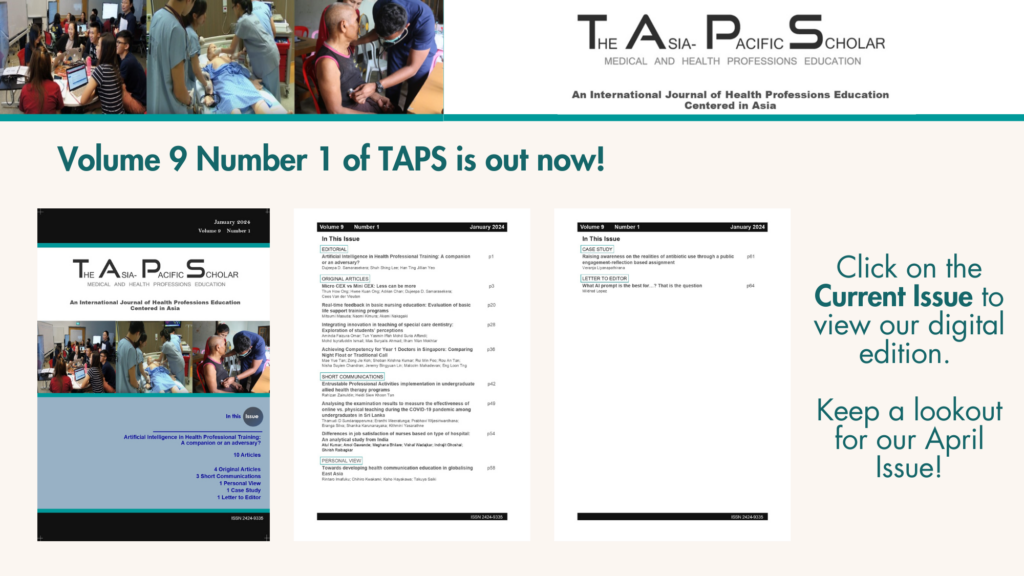
- Best Reviewer Awards 2022
TAPS would like to express gratitude and thanks to an extraordinary group of reviewers who are awarded the Best Reviewer Awards for 2022.
Refer here for the list of recipients. - Most Accessed Article 2022
The Most Accessed Article of 2022 goes to An urgent need to teach complexity science to health science students.
Congratulations, Dr Bhuvan KC and Dr Ravi Shankar. - Best Article Award 2022
The Best Article Award of 2022 goes to From clinician to educator: A scoping review of professional identity and the influence of impostor phenomenon.
Congratulations, Ms Freeman and co-authors. - Volume 8 Number 3 of TAPS is out now! Click on the Current Issue to view our digital edition.
- Best Reviewer Awards 2021
TAPS would like to express gratitude and thanks to an extraordinary group of reviewers who are awarded the Best Reviewer Awards for 2021.
Refer here for the list of recipients. - Most Accessed Article 2021
The Most Accessed Article of 2021 goes to Professional identity formation-oriented mentoring technique as a method to improve self-regulated learning: A mixed-method study.
Congratulations, Assoc/Prof Matsuyama and co-authors. - Best Reviewer Awards 2020
TAPS would like to express gratitude and thanks to an extraordinary group of reviewers who are awarded the Best Reviewer Awards for 2020.
Refer here for the list of recipients. - Most Accessed Article 2020
The Most Accessed Article of 2020 goes to Inter-related issues that impact motivation in biomedical sciences graduate education. Congratulations, Dr Chen Zhi Xiong and co-authors.