Isthmin-1 attenuates allergic Asthma by stimulating adiponectin expression and alveolar macrophage efferocytosis in mice
Isthmin-1 attenuates allergic Asthma by stimulating adiponectin expression and alveolar macrophage efferocytosis in mice
Jong Huat Tee, Udhaya Vijayakumar, Mahalakshmi Shanmugasundaram, Terence Y. W. Lam, Wupeng Liao, Yuansheng Yang, W. S. Fred Wong* and Ruowen Ge*
Abstract
Background Allergic asthma is a common respiratory disease that significantly impacts human health. Through in silico analysis of human lung RNASeq, we found that asthmatic lungs display lower levels of Isthmin-1 (ISM1) expression than healthy lungs. ISM1 is an endogenous anti-inflammatory protein that is highly expressed in mouse lungs and bronchial epithelial cells, playing a crucial role in maintaining lung homeostasis. However, how ISM1 influences asthma remains unclear. This study aims to investigate the potential involvement of ISM1 in allergic airway inflammation and uncover the underlying mechanisms.
Methods We investigated the pivotal role of ISM1 in airway inflammation using an ISM1 knockout mouse line (ISM1−/−) and challenged them with house dust mite (HDM) extract to induce allergic-like airway/lung inflammation. To examine the impact of ISM1 deficiency, we analyzed the infiltration of immune cells into the lungs and cytokine levels in bronchoalveolar lavage fluid (BALF) using flow cytometry and multiplex ELISA, respectively. Furthermore, we examined the therapeutic potential of ISM1 by administering recombinant ISM1 (rISM1) via the intratracheal route to rescue the effects of ISM1 reduction in HDM-challenged mice. RNA-Seq, western blot, and fluorescence microscopy techniques were subsequently used to elucidate the underlying mechanisms.
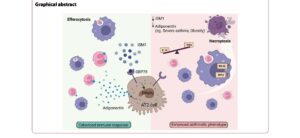
Results ISM1−/− mice showed a pronounced worsening of allergic airway inflammation and hyperresponsiveness upon HDM challenge. The heightened inflammation in ISM1−/− mice correlated with enhanced lung cell necroptosis, as indicated by higher pMLKL expression. Intratracheal delivery of rISM1 significantly reduced the number of eosinophils in BALF and goblet cell hyperplasia. Mechanistically, ISM1 stimulates adiponectin secretion by type 2 alveolar epithelial cells partially through the GRP78 receptor and enhances adiponectin-facilitated apoptotic cell clearance via alveolar macrophage efferocytosis. Reduced adiponectin expression under ISM1 deficiency also contributed to intensified necroptosis, prolonged inflammation, and heightened severity of airway hyperresponsiveness.
Conclusions This study revealed for the first time that ISM1 functions to restrain airway hyperresponsiveness to HDM-triggered allergic-like airway/lung inflammation in mice, consistent with its persistent downregulation in human asthma. Direct administration of rISM1 into the airway alleviates airway inflammation and promotes immune cell clearance, likely by stimulating airway adiponectin production. These findings suggest that ISM1 has therapeutic potential for allergic asthma.