The accumulation of dysfunctional giant mitochondria is a hallmark of aged cardiomyocytes. This study investigated the core mechanism underlying this phenomenon, focusing on the disruption of mitochondrial lipid metabolism and its effects on mitochondrial dynamics and autophagy, using both naturally aging mouse models and etoposide-induced cellular senescence models. In aged cardiomyocytes, a reduction in endoplasmic reticulum-mitochondrial (ER-Mito) contacts impairs lipid transport and leads to insufficient synthesis of mitochondrial phosphatidylethanolamine (PE). A deficiency in phosphatidylserine decarboxylase (PISD) further hinders the conversion of phosphatidylserine to PE within mitochondria, exacerbating the deficit of PE production.
This PE shortage disrupts autophagosomal membrane formation, leading to impaired autophagic flux and the accumulation of damaged mitochondria. Modulating LACTB expression to enhance PISD activity and PE production helps maintain mitochondrial homeostasis and the integrity of aging cardiomyocytes. These findings highlight the disruption of mitochondrial lipid metabolism
as a central mechanism driving the accumulation of dysfunctional giant mitochondria in aged cardiomyocytes and suggest that inhibiting LACTB expression could serve as a potential therapeutic strategy for mitigating cardiac aging and preserving mitochondrial function.
Chronic respiratory diseases such as asthma and chronic obstructive pulmonary disease afflict millions of individuals globally and are significant sources of disease mortality. While the molecular mechanisms underlying such diseases are unclear, environmental and social factors, such as cigarette smoke and obesity, increase the risk of disease development. Yet, not all smokers or obese individuals will develop chronic respiratory diseases. The mitogen-activated protein kinase p38α is abnormally active in such maladies, but its contribution, if any, to disease etiology is unknown. To assess whether p38α activation per se in the lung could impose disease symptoms, we generated a transgenic mouse model allowing controllable expression of an intrinsically active variant, p38αD176A+F327S, specifically in lung alveolar type 2 pneumocytes. Sustained expression of p38αD176A+F327S did not appear to induce obvious pathological outcomes or to exacerbate inflammatory outcomes in mice challenged with common respiratory disease triggers. However, mice expressing p38αD176A+F327S in alveolar type 2 cells and fed with a high-fat diet exhibited increased numbers of airway eosinophils and lymphocytes, upregulated levels of proinflammatory cytokines and chemokines including interleukin-1β and eotaxin, as well as a reduction in levels of leptin and adiponectin within the lung. Neither high-fat diet nor p38αD176A+F327S alone induced such outcomes. Perhaps in obese individuals with associated respiratory diseases, elevated p38α activity which happens to occur is the factor that promotes their development.
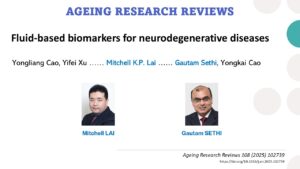
Neurodegenerative diseases, such as Alzheimer’s Disease (AD), Multiple Sclerosis (MS), Parkinson’s Disease (PD), and Amyotrophic Lateral Sclerosis (ALS) are increasingly prevalent as global populations age. Fluid biomarkers, derived from cerebrospinal fluid (CSF), blood, saliva, urine, and exosomes, offer a promising solution for early diagnosis, prognosis, and disease monitoring. These biomarkers can reflect critical pathological processes like amyloid-beta (Aβ) deposition, tau protein hyperphosphorylation, α-syn misfolding, TDP-43 mislocalization and aggregation, and neuronal damage, enabling detection long before clinical symptoms emerge. Recent advances in blood-based biomarkers, particularly plasma Aβ, phosphorylated tau, and TDP-43, have shown diagnostic accuracy equivalent to CSF biomarkers, offering more accessible testing options. This review discusses the current challenges in fluid biomarker research, including variability, standardization, and sensitivity issues, and explores how combining multiple biomarkers with clinical symptoms improves diagnostic reliability. Ethical considerations, future directions involving extracellular vehicles (EVs), and the integration of artificial intelligence (AI) are also highlighted. Continued research efforts will be key to overcoming these obstacles, enabling fluid biomarkers to become crucial tools in personalized medicine for neurodegenerative diseases.
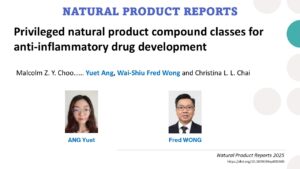
Privileged compound classes of anti-inflammatory natural products are those where there are many reported members that possess anti-inflammatory properties. The identification of these classes is of particular relevance to drug discovery, as they could serve as valuable starting points in developing effective and safe anti-inflammatory agents. The privileged compound classes of natural products include the polyphenols, coumarins, labdane diterpenoids, sesquiterpene lactones, isoquinoline and indole alkaloids, each offering a variety of molecular scaffolds and functional groups that enable diverse interactions with biological targets. From a medicinal chemistry point of view, natural products are both a boon and a bane. The multi-targeting nature of natural products is a boon in the treatment of multi-factorial diseases such as inflammation, but promiscuity, poor potency and pharmacokinetic properties are significant hurdles that must be addressed to ensure these compounds can be effectively used as therapeutics. In addition, there are continued controversies regarding the efficacies of some of these natural products that will continue to polarise their use. In this review, examples of natural products of six privileged compound classes will be discussed for their potential use and possible further development as anti-inflammatory drugs.
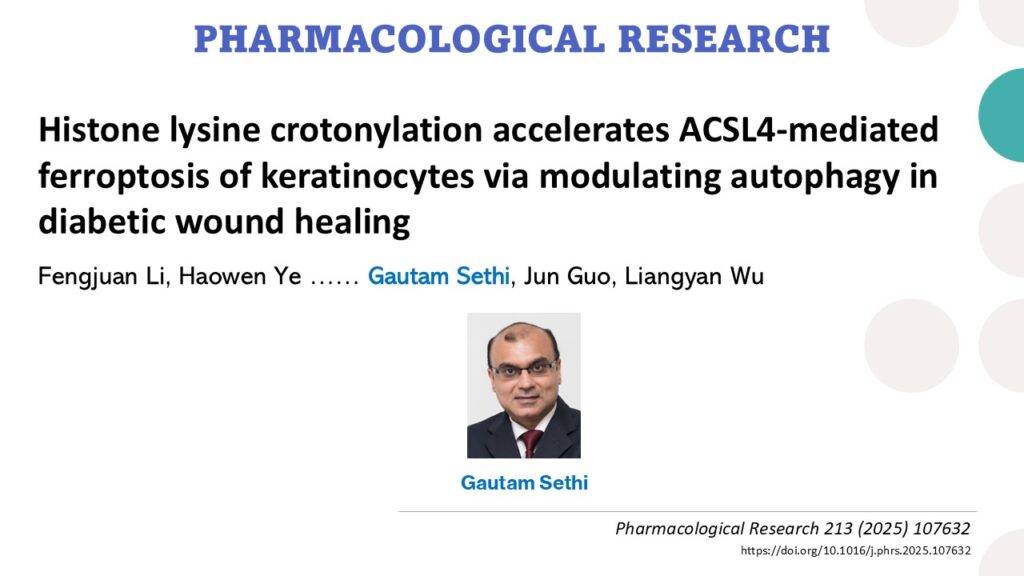
Dysfunction of keratinocytes affects diabetic wound healing, but underlying mechanisms have not been understood. This study examines crotonylation’s role in ferroptosis and autophagy in keratinocytes, particularly regarding ACSL4, using STZ-induced diabetic rats and high glucose-exposed keratinocytes to assess these processes. The ACSL4 knockdown was achieved using adenovirus in wounds to examine the impact of ferroptosis modulation on healing diabetic wounds. MB-3 was utilized to block the H3K27 crotonylation (H3K27cr) in order to clarify the regulatory function of crotonylation in both autophagy and ferroptosis. In STZ-induced diabetic skin and high glucose-exposed keratinocytes, ferroptosis mediated by ACSL4 and suppression of autophagic flux were demonstrated. Moreover, the downregulation of ACSL4 triggered ferroptosis in adjacent wounds of diabetic rats and improved wound healing. The degradation of ACSL4 may be observed via the autophagy-lysosome pathway in keratinocytes. Downregulation of SQSTM1 in diabetic keratinocytes leads to autophagy inhibition and modulates the protein level of ACSL4. Mechanistically, total crotonylation levels and H3K27cr were remarkably elevated in the skin and keratinocytes of diabetic rats; blocking high glucose-induced H3K27cr with MB-3 can enhance SQSTM1 transcription and expression while promoting autophagy and reducing ACSL4- induced ferroptosis in keratinocytes. Therefore, H3K27cr influences autophagy by adjusting SQSTM1 to facilitate ACSL4-triggered ferroptosis in diabetic keratinocytes. This study clarifies the relationships between acylation modifications, autophagy, and ferroptosis, while also offering mechanistic insights and potential therapeutic targets for issues associated with diabetic wound healing.
G protein-coupled receptors (GPCRs) are dynamic membrane receptors that transduce extracellular signals to the cell interior by forming a ligand–receptor-effector (ternary) complex that functions via allosterism. Peptides constitute an important class of ligands that interact with their cognate GPCRs (peptide-GPCRs) to form the ternary complex. “Biased agonism”, a therapeutically relevant phenomenon exhibited by GPCRs owing to their allosteric nature, has also been observed in peptide-GPCRs, leading to the development of selective therapeutics with fewer side effects. In this review, we have focused on the structural basis of signalling bias at peptide-GPCRs of classes A and B, and reviewed the therapeutic relevance of bias at peptide-GPCRs, with the hope of contributing to the discovery of novel biased peptide drugs.
Bile acid transporters (BATs) are integral membrane proteins belonging to various families, such as solute carriers, organic anion transporters, and ATP-binding cassette families. These transporters play a crucial role in bile acid transportation within the portal and systemic circulations, with expression observed in tissues, including the liver, kidney, and small intestine. Bile acids serve as signaling molecules facilitating the absorption and reabsorption of fats and lipids. Dysregulation of bile acid concentration has been implicated in tumorigenesis, yet the role of BATs in this process remains underexplored. Emerging evidence suggests that BATs may modulate various stages of cancer progression, including initiation, development, proliferation, metastasis, and tumor microenvironment regulation. Targeting BATs using siRNAs, miRNAs, and small compound inhibitors in preclinical models and their polymorphisms are well-studied for transporters like BSEP, MDR1, MRP2, OATP1A2, etc., and have shed light on their involvement in tumorigenesis, particularly in cancers such as those affecting the liver and gastrointestinal tract. While BATs’ role in diseases like Alagille syndrome, biliary atresia, and cirrhosis have been extensively studied, their implications in cancer warrant further investigation. This review highlights the expression and function of BATs in cancer development and emphasizes the potential of targeting these transporters as a novel therapeutic strategy for various malignancies.
Conventional immunotherapy has emerged as a key option for cancer treatment. However, its efficacy has been limited in urological cancers, especially prostate cancer, because of the immunosuppressive tumor microenvironment (TME), difficulty in drug delivery, aberrant immune response, and damage to normal cells. Bispecific antibodies (BsAbs) are engineered proteins with two different antigen-binding domains, designed using different technologies and in various formats. BsAb-based tumor immunotherapy has yielded optimistic results in preclinical and clinical investigations of many tumor types, including urological cancers. However, a series of challenges, including tumor heterogeneity, TME, Ab immunogenicity, adverse effects, serum half-life, low response rates, and drug resistance, hamper the application of BsAbs. In this review, we provide insights into the most common BsAb platforms with different mechanisms of action, which are under preclinical and clinical research, along with ways to overcome the challenges in BsAb administration for treating urological cancer.
Cancer is a systemic manifestation of aberrant cell cycle activity and dysregulated cell growth. Genetic mutations can determine tumor onset by either augmenting cell division rates or restraining normal controls such as cell cycle arrest or apoptosis. As a result, tumor cells not only undergo uncontrolled cell division but also become compromised in their ability to exit the cell cycle accurately. Regulation of cell cycle progression is enabled by specific surveillance mechanisms known as cell cycle checkpoints, and aberrations in these signaling pathways often culminate in cancer. For instance, DNA damage checkpoints, which preclude the generation and augmentation of DNA damage in the G1, S, and G2 cell cycle phases, are often defective in cancer cells, allowing cell division in spite of the accumulation of genetic errors. Notably, tumors have evolved to become dependent on checkpoints for their survival. For example, checkpoint pathways such as the DNA replication stress checkpoint and the mitotic checkpoint rarely undergo mutations and remain intact because any aberrant activity could result in irreparable damage or catastrophic chromosomal missegregation leading to cell death. In this review, we initially focus on cell cycle control pathways and specific functions of checkpoint signaling involved in normal and cancer cells and then proceed to examine how cell cycle control and checkpoint mechanisms can provide new therapeutic windows that can be exploited for cancer therapy.
Significance Statement: DNA damage checkpoints are often defective in cancer cells, allowing cell division in spite of the accumulation of genetic errors. Conversely, DNA replication stress and mitotic checkpoints rarely undergo mutations because any aberrant activity could result in irreparable damage or catastrophic chromosomal missegregation, leading to cancer cell death. This review focuses on the checkpoint signaling mechanisms involved in cancer cells and how an emerging understanding of these pathways can provide new therapeutic opportunities for cancer therapy.
Vascular endothelial growth factor (VEGF) is overexpressed in nasopharyngeal carcinoma and suppresses the anti-tumour immune response. Previous studies have shown that adding anti-VEGF treatment to PD-1 inhibition treatment strategies improves tumour response. We aimed to compare the efficacy of pembrolizumab, a PD-1 inhibitor, with or without bevacizumab, a VEGF inhibitor, in nasopharyngeal carcinoma.
Methods
In this randomised, open-label, phase 2 trial done at two hospitals (National University Cancer Institute and Tan Tock Seng Hospital) in Singapore, patients with platinum-resistant recurrent or metastatic nasophayngeal carcinoma were eligible if they were aged 21 years or older and had an Eastern Cooperative Oncology Group (ECOG) performance status of 0–1. Patients were assigned (1:1; using random permuted blocks with varying sizes of 4 and 6) to receive either intravenous pembrolizumab (200 mg) every 21 days or a combination of pembrolizumab with intravenous bevacizumab (7·5 mg/kg) administered 1 week prior to each dose, until radiographic disease progression, unacceptable toxicity, completion of 32 cycles, or withdrawal of consent. The study was open label, therefore no masking of treatment assignment was implemented. The primary endpoint was objective response rate, assessed using RECIST (version 1.1) by independent radiologists and analysed in the intention-to-treat population (ie, all randomly assigned patients). This trial is registered with ClinicalTrials.gov, NCT03813394, and enrolment has closed.
Findings
Between May 13, 2019, and Dec 6, 2023, we assessed 60 individuals for eligibility, 12 were excluded, and 48 were randomly allocated to pembrolizumab alone (n=24) or a combination of bevacizumab and pembrolizumab (n=24). The median age was 56 years (IQR 48–65), and 40 (83%) of 48 patients were male and eight (17%) were female. The median follow-up was 28·3 months (IQR 15·1–55·9). The objective response rate was significantly higher in the bevacizumab and pembrolizumab group (58·3% [95% CI 36·6–77·9] than in the pembrolizumab group (12·5% [2·7–32·4]; unadjusted RR 4·67 [95% CI 1·54–14·18]; p=0·0010). Grade 3 treatment-related adverse events occurred in two (8%) of 24 patients in the pembrolizumab group and in seven (29%) of 24 patients in the bevacizumab and pembrolizumab group; the most common severe or grade 3–4 treatment-related adverse events were thrombosis or bleeding (four [17%] of 24 patients in the bevacizumab and pembrolizumab group vs none of 24 patients in the pembrolizumab group), and others were transaminitis (none vs 1 [4%]), colitis (1 [4%] vs none]), cytopenias (none vs 1 [4%]), dermatological toxicities (1 [4%] vs none]), hypertension (1 [4%] vs none]), and proteinuria (1 [4%] vs none]). There were no grade 4 treatment-related adverse events or treatment-related deaths in either group.
Interpretation
Pembrolizumab in combination with bevacizumab was more efficacious than pembrolizumab monotherapy, with manageable toxicities in platinum-resistant nasopharyngeal carcinoma. If validated in a phase 3 trial, the combination therapy could be a new standard of care in this population of patients.