
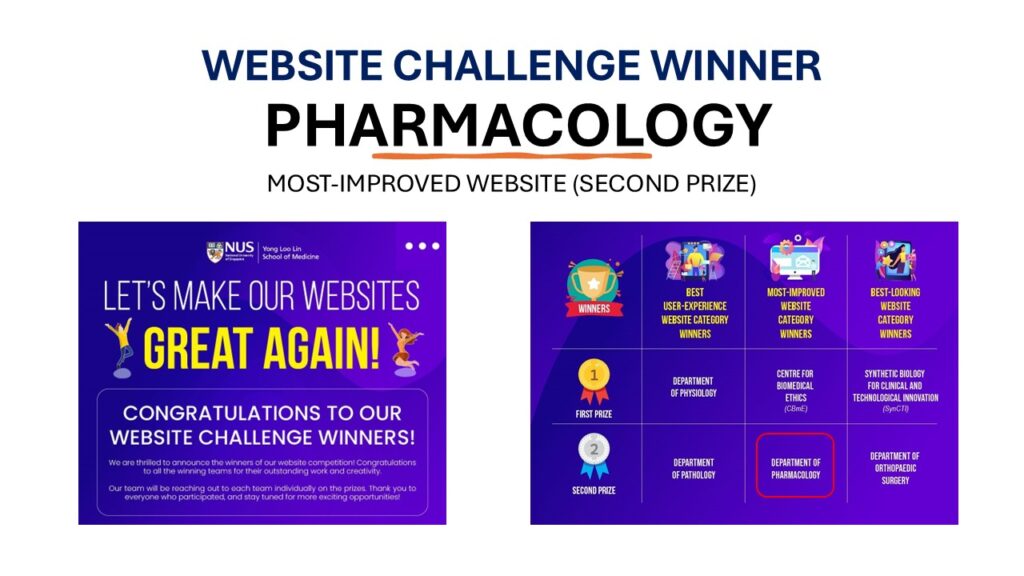
Winner of Website Challenge

Congratulations to Department of Pharmacology on winning the Website Challenge ‘Most-Improved Website’ (second prize)!
Winner of Website Challenge Read More »
Congratulations to Department of Pharmacology on winning the Website Challenge ‘Most-Improved Website’ (second prize)!
Winner of Website Challenge Read More »
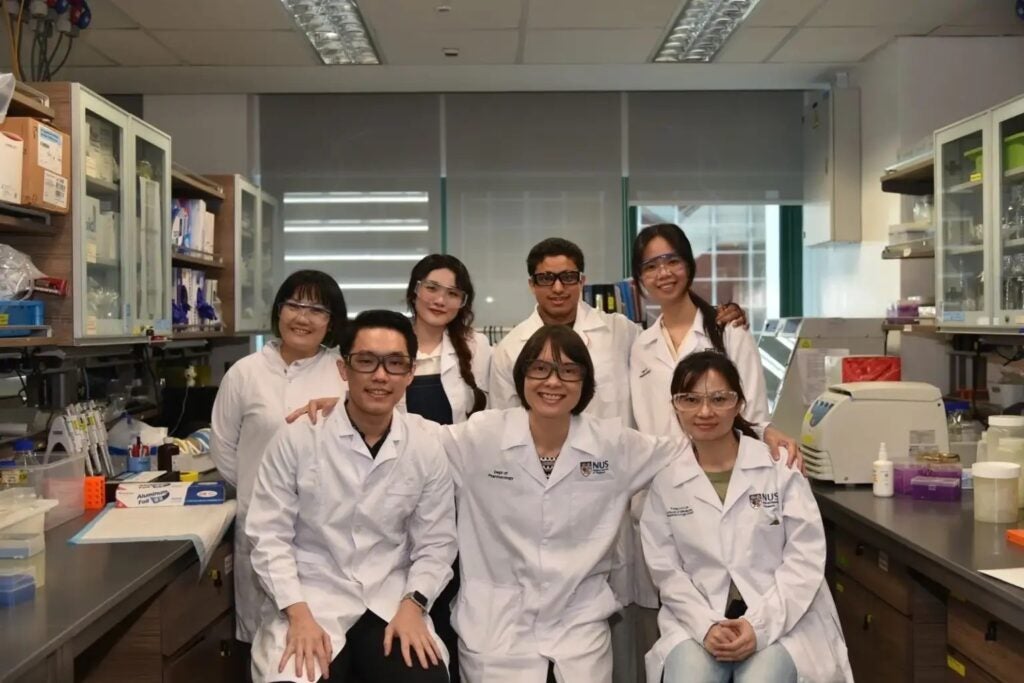
From left, front row: Brendon Yeo, Asst Prof Minh Le, Trinh Tran. Back row: Gao Chang, Yock Sin Lay, Dr Migara Jayasinghe, Rebecca Prajogo (Credit: NUS Medicine)
Lung cancer, specifically Non-Small Cell Lung Cancer (NSCLC)-the most common subtype of cancer contracted by patients who do not smoke, is a leading cause of cancer mortality and the second most diagnosed cancer globally. The rapid and inevitable emergence of drug resistance mechanisms caused by mutations in cancer severely outpaces the development of small molecule drugs. This phenomenon adds urgency for a new, customisable, safe, and effective anti-cancer therapeutic that could be designed, screened, and validated in a short amount of time.
A team of researchers, led by Assistant Professor Minh Le from the Institute for Digital Medicine (WisDM) and Department of Pharmacology at the Yong Loo Lin School of Medicine, National University of Singapore (NUS Medicine), has successfully demonstrated that nano-sized particles released by cells, such as red blood cells, could be repurposed to function as drug delivery platforms to carry antisense oligonucleotide (ASO) molecules targeting cancer cells in the lungs, thereby suppressing cancer progression. This study was conducted in collaboration with the Cancer Science Institute of Singapore (CSI Singapore) at NUS, Agency for Science, Technology and Research (A*STAR), National Cancer Centre Singapore (NCCS), and Duke-NUS Medical School.
Asst Prof Minh Le said, “Mutant Epidermal Growth Factor Receptors (EGFRs) are the most common driver of lung cancer among the Asian population. Therefore, we focused on targeting lung cancer caused by the mutant EGFR. Currently, drugs known as tyrosine kinase inhibitors are the standard of treatment, and they work by inhibiting the mutant EGFR protein to stop cancer progression. As the cancer cells may further mutate and resist these drugs, we sought to find a more effective way to target the cancer.”
In the study published in eBioMedicine, the authors looked toward ASOs to not only overcome the issue of drug resistance but also contribute to the development of precision medicine. Precision medicine tailors the treatment to individual patients and their disease, as compared to a “one-size fits all” broad spectrum therapy. ASOs are molecules that can stick to a specific part of a ribonucleic acid (RNA) and inhibit irregular activity. ASOs are a flexible tool that can be easily redesigned to target and fix problems in different genes. This advantage is critical in the context of NSCLC which is known to develop resistance against tyrosine kinase inhibitors. Furthermore, the ASOs can be customised to target unique mutations based on the cancer profiles of each individual patient. However, some disadvantages of ASOs are that they are easily degraded in the bloodstream, which results in diluted treatment at the tumour sites. This can be remedied with a method to hold the ASOs and deliver them directly to the tumour site.
To achieve that, the researchers utilised extracellular vesicles (EVs) derived from human red blood cells as a natural carrier to deliver the anti-cancer ASOs to the tumour site. To direct the ASO-loaded EV towards the tumour site, EGFR-targeting moieties were engineered onto the surface of the EVs. This primed the EV to home in on the cancerous cells. Furthermore, the ASO-loaded EVs were shown to exhibit a potent anti-cancer effect in various models of lung cancer, including patient-derived cells. The specific design of the ASOs allows them to suppress mutant EGFR, while leaving the normal EGFR unaffected. They also demonstrated that the ASO-loaded RBCEVs possessed potent anti-cancer effects against TKI-resistant cancer cells.
Associate Professor Tam Wai Leong, Deputy Executive Director of A*STAR Genome Institute of Singapore (A*STAR GIS), and co-corresponding author of the study, said, “The innovative use of extracellular vesicles as a delivery vehicle for nucleic acid therapeutics added a potentially powerful treatment modality for treating malignancies. The ability to precisely eliminate mutant EGFR cancer cells while sparing normal tissues will enable customised treatment for individual patients. This is a significant step towards addressing cancer drug resistance and advancing the application of personalised cancer medicine.”
Professor Goh Boon Cher, Deputy Director of CSI Singapore, Professor of Medicine at NUS Medicine and one of the authors of the study added, “This work is instrumental in breaking new ground for precise delivery of therapeutic RNA to tumour cells to destroy them by targeting their vulnerabilities. It is a proof of concept that can be broadly applied in other areas of cancer treatment.”
Read more in the press release here.
(source from https://medicine.nus.edu.sg/news/scientists-use-microcellular-drones-to-deliver-lung-cancer-killing-drugs/)
Scientists use microcellular drones to deliver lung cancer-killing drugs Read More »
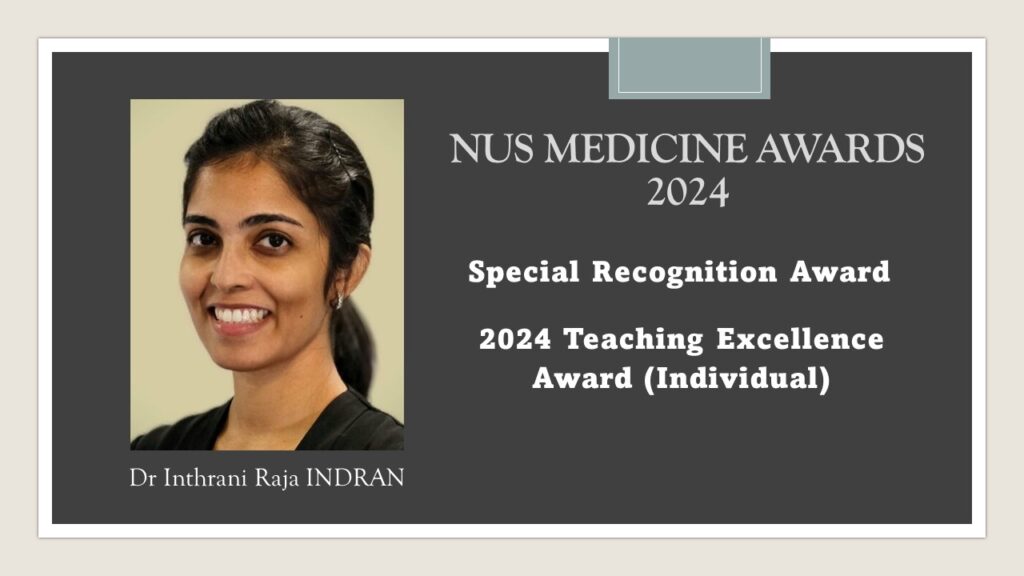
Congratulations to Dr Inthrani Raja Indran on receiving the NUS Medicine Awards 2024 (Special Recognition Award and Teaching Excellence Award).
Receiving two awards for education was a unique achievement among the awardees at the NUS Medicine Awards 2024. It is a testament to exceptional dedication and contributions to the field of medical education.
Recipient of NUS Medicine Awards 2024: Dr Inthrani Raja Indran Read More »

Congratulations to our faculty members and student on receiving the NUS Medicine Awards 2024.
Dr Inthrani Raja Indran – Special Recognition Award
Dr Inthrani Raja Indran – 2024 Teaching Excellence Award (Individual)
A/Prof Gavin Stewart Dawe – 2024 Teaching Excellence Award (Individual)
A/Prof Christopher Chen Li Hsian – Graduate Mentor of the Year Award
Dr Migara Jayasinghe Kavishka – Best Graduate Research Publication Award (Thesis Advisor: Assistant Professor Le Thi Nguyet Minh)
Recipients of NUS Medicine Awards 2024 Read More »
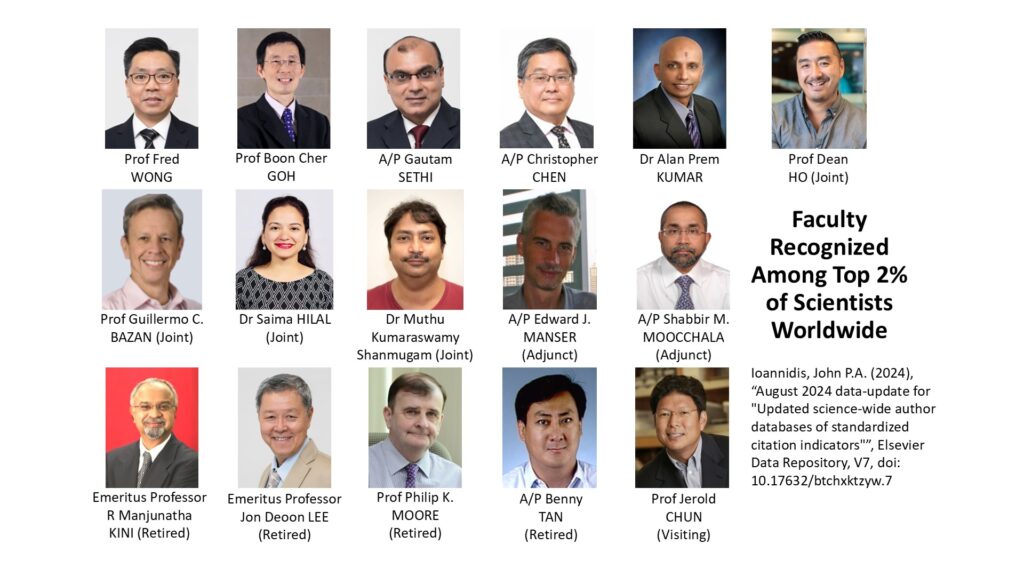
The Department of Pharmacology congratulates 16 faculty members on being recognized among the top 2% of scientists worldwide for citation impact in 2024. The analysis was initiated by Professor Ioannidis at Stanford University and published by Elsevier.
Congratulations to faculty members Professor Fred WONG Wai-Shiu, Professor Dean Ho, Professor GOH Boon Cher, Associate Professor Gautam SETHI, Associate Professor Christopher CHEN Li-Hsian, Dr Alan Prem KUMAR; joint faculty members Professor Guillermo C. BAZAN, Dr Muthu Kumaraswamy SHANMUGAM, Dr Saima HILAL; adjunct faculty members Associate Professor Edward J. MANSER, Associate Professor Shabbir MOOCHHALA; retired faculty members Emeritus Professor R. Manjunatha KINI, Emeritus Professor Edmund LEE Jon Deoon, Professor Philip KeithMOORE, Associate Professor Benny TAN Kwon Huat; and visiting professors Professor Jerold CHUN.
To view the full list of the world’s top 2% researchers by citation impact published on 16 Sep 2024 by Elsevier see https://elsevier.digitalcommonsdata.com/datasets/btchxktzyw/7.
Congratulations to Faculty Recognized Among Top 2% of Scientists Worldwide Read More »
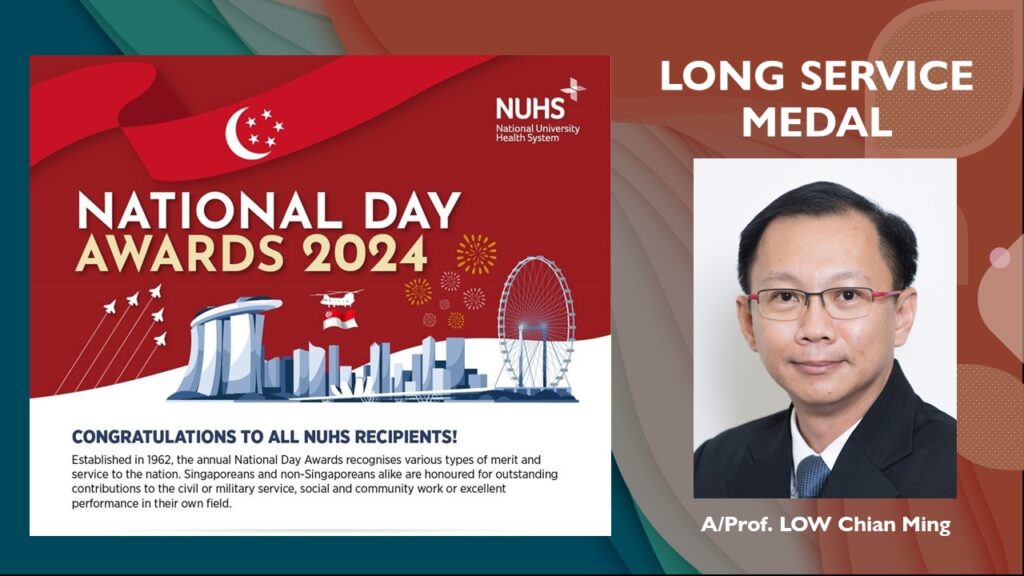
Congratulations to A/P LOW Chian Ming on receiving the National Day Awards 2024 (Long Service Medal).
Established in 1962, the annual National Day Awards recognises various types of merit and service to the nation. Singaporeans and non-Singaporeans alike are honoured for outstanding contributions to the civil or military service, social and community work or excellent performance in their own field.
National Day Award 2024 Recipient: A/Prof. LOW Chian Ming (Long Service Medal) Read More »
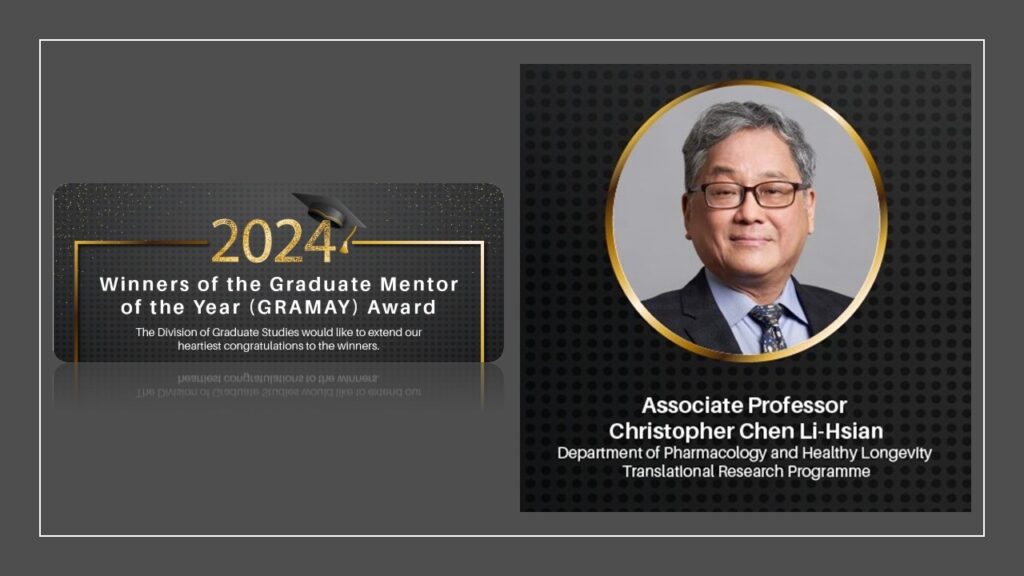
Congratulations to A/P Christopher CHEN Li-Hsien on receiving the Graduate Mentor of the Year (GRAMAY) Award 2024. The GRAMAY Award is an annual award that honors and celebrates faculty staff for their excellence in mentorship and the professional development of graduate students in the Yong Loo Lin School of Medicine. The award is given to recognize the important key roles played by the Faculty staff in inspiring and nurturing future biomedical- and clinician-scientists. The award recipients should have shown excellence in graduate supervision, intellectual and professional development as well as career development of their graduate students.
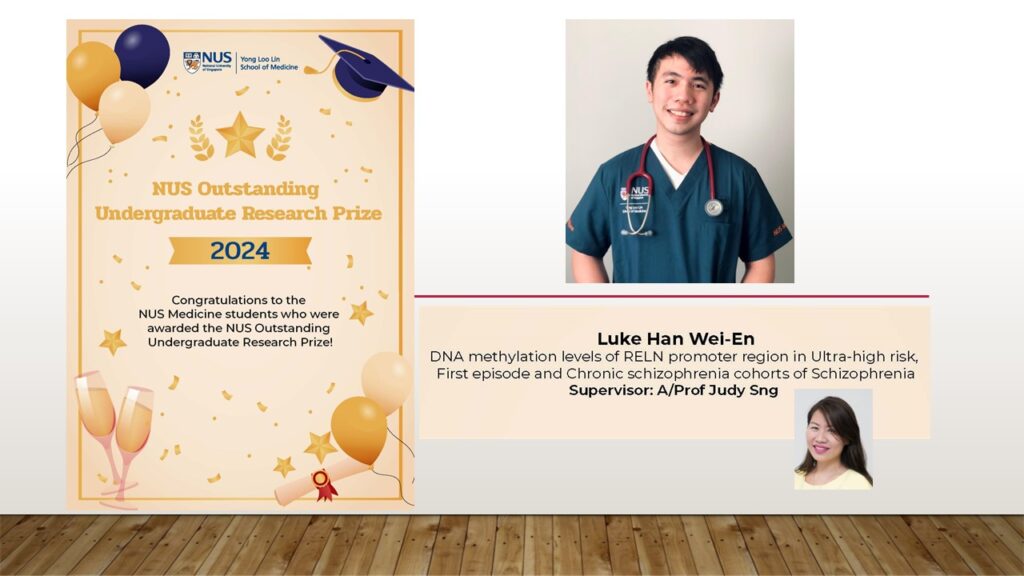
Congratulation to our student Luke HAN Wei-En who was awarded the Outstanding Undergraduate Research Prize 2024.
Research Title: DNA methylation levels of RELN promoter region in Ultra-high risk, First episode and Chronic schizophrenia cohorts of Schizophrenia
Thesis Advisors: A/Prof. Judy SNG
Awardee of Outstanding Undergraduate Research Prize 2024: Luke HAN Wei-En Read More »
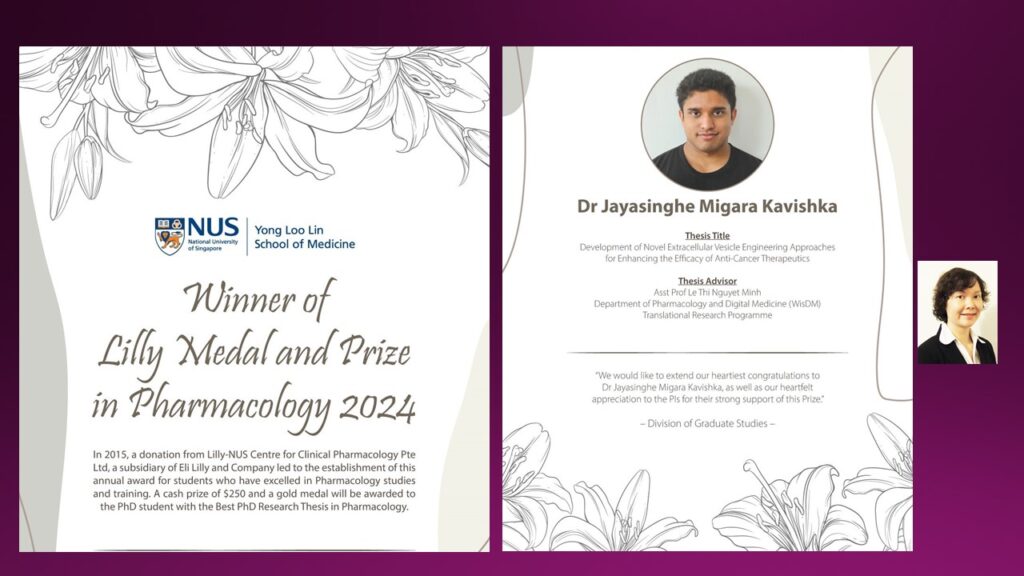
Congratulation to Dr Jayasinghe Migara KAVISHKA on being selected as the winner of Lilly Medal and Prize in Pharmacology 2024.
In 2015, Lilly-NUS Center for Clinical Pharmacology Pte Ltd, a subsidiary of Eli Lilly and Company, established this annual award for NUS students who have excelled in Pharmacology studies and training. a cash prize of $250 and a gold medal will be awarded to the PhD student with the Best PhD Research Thesis in Pharmacology.
Thesis Title: Development of Novel Extracellular Vesicle Engineering Approaches for Enhancing the Efficacy of Anti-Cancer Therapeutics
Thesis Advisors: Asst Prof. LE Thi Nguyet Minh
Winner of Lilly Medal and Prize in Pharmacology 2024: Dr Jayasinghe Migara KAVISHKA Read More »
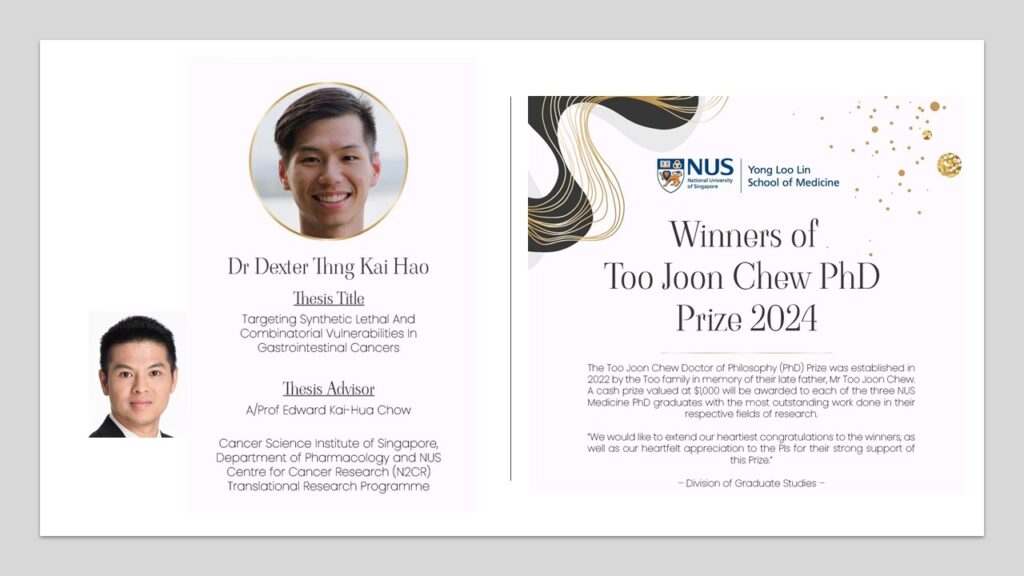
Congratulation to Dr. Dexter THNG Kai Hao on being selected as one of the winners of the Too Joon Chew PhD Prize 2024!
The Too Joon Chew Doctor of Philosophy (PhD) Prize was established in 2022 by the Too family in memory of their late father, Mr Too Joon Chew. A cash prize valued at $1000 will be awarded to each of the three NUS Medicine PhD graduates with the most outstanding work done in their respective fields of research.
Winner of Too Joon Chew PhD Prize 2024 Read More »


