News

Novel AI-powered eye scan predicts risk of cognitive decline and dementia

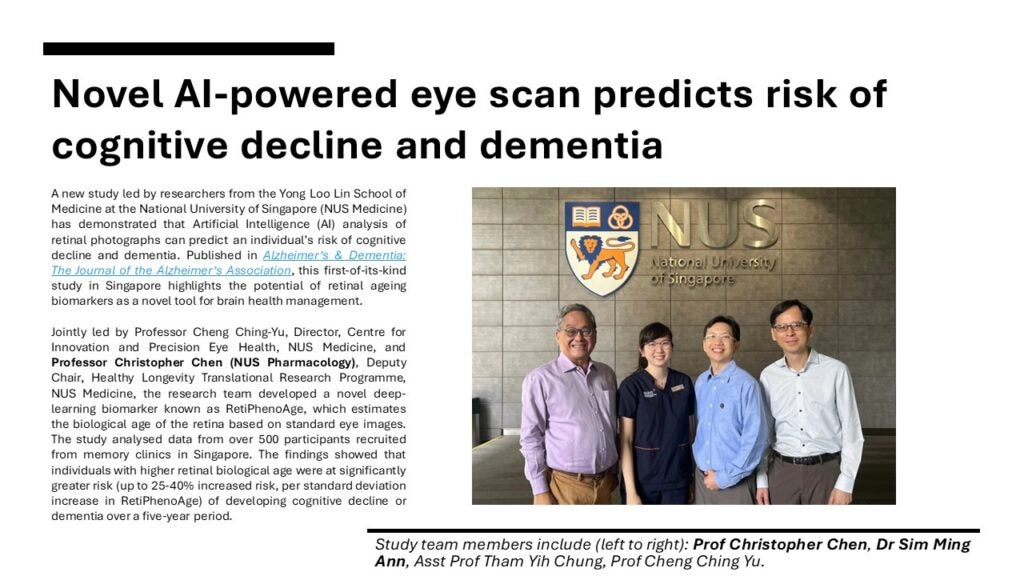
A new study led by researchers from the Yong Loo Lin School of Medicine at the National University of Singapore (NUS Medicine) has demonstrated that Artificial Intelligence (AI) analysis of retinal photographs can predict an individual’s risk of cognitive decline and dementia. Published in Alzheimer’s & Dementia: The Journal of the Alzheimer’s Association, this first-of-its-kind study in Singapore highlights the potential of retinal ageing biomarkers as a novel tool for brain health management.

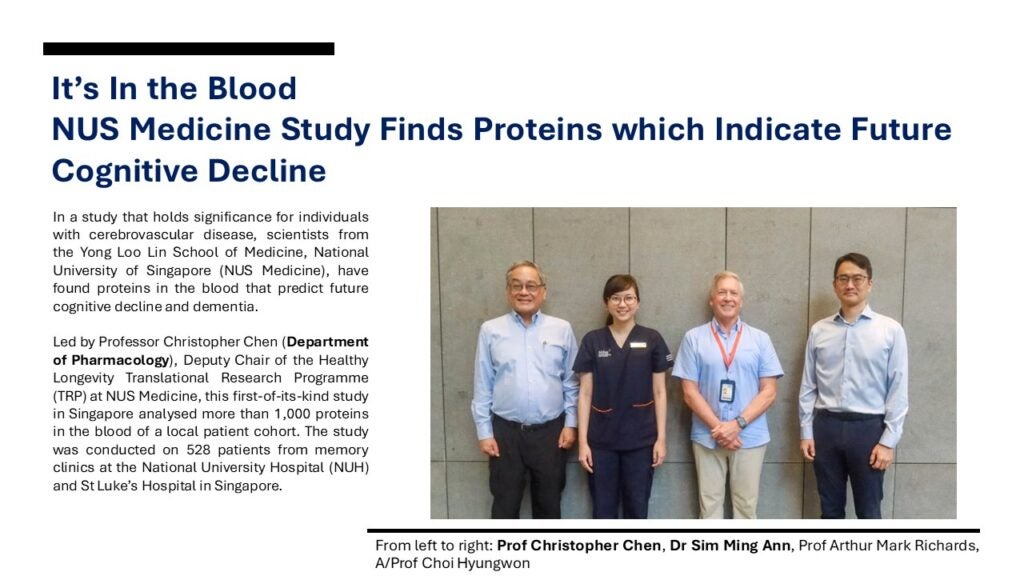
Jointly led by Professor Cheng Ching-Yu, Director, Centre for Innovation and Precision Eye Health, NUS Medicine, and Professor Christopher Chen, Deputy Chair, Healthy Longevity Translational Research Programme, NUS Medicine, the research team developed a novel deep-learning biomarker known as RetiPhenoAge, which estimates the biological age of the retina based on standard eye images. The study analysed data from over 500 participants recruited from memory clinics in Singapore. The findings showed that individuals with higher retinal biological age were at significantly greater risk (up to 25-40% increased risk, per standard deviation increase in RetiPhenoAge) of developing cognitive decline or dementia over a five-year period.

These findings were further validated in a larger population sample using data from more than 33,000 participants in the UK Biobank. In this cohort, elevated RetiPhenoAge was similarly associated with a higher risk of developing dementia over twelve years of follow-up, reinforcing its predictive utility across diverse populations. The study further showed that retinal ageing reflects key biological processes associated with neurodegeneration, with brain scans and blood markers used to validate RetiPhenoAge’s link to brain changes and ageing-related changes in blood proteins. While the retinal age algorithm has not yet been deployed within clinical practice, these associations suggest a novel alternative for the use of retinal ageing as a biomarker of cognitive health.

Prof Cheng said, “With RetiPhenoAge, we are able to non-invasively estimate an individual’s biological age, offering valuable insights for both cognitive health management and broader ageing research. This can help doctors identify people at risk of cognitive decline or dementia, before symptoms appear, enabling more targeted interventions. We hope to validate this screening tool in larger and more diverse populations, and assess its impact in clinical settings to guide earlier treatment of dementia.” Prof Cheng is also Principal Clinician Scientist at the Singapore Eye Research Institute.

Prof Chen added, “With dementia numbers rising globally, we urgently need tools that are both scalable and predictive. RetiPhenoAge could hold the key to community-level screening that is both effective and affordable. These findings bring us closer to developing simple and affordable screening modalities that can be integrated into routine health checks, enabling earlier detection of dementia risk and timely support.” Prof Chen is also from the Department of Pharmacology at NUS Medicine, and is the Director of the Memory, Ageing and Cognition Centre, NUHS and Visiting Consultant, Department of Psychological Medicine, National University Hospital (NUH).

Co-first authors of the study, Dr Sim Ming Ann and Asst Prof Tham Yih Chung, added, “We hope that these findings will lead to improvements in care, which will help doctors identify people at risk of dementia before symptoms appear, which may lead to earlier interventions and improved patient outcomes.” Dr Sim is a Consultant at the Ng Teng Fong General Hospital and NUH, and a PhD candidate at NUS Medicine, while Asst Prof Tham is from the Centre for Innovation and Precision Eye Health, NUS Medicine and a Clinician Scientist at the Singapore Eye Research Institute.

This study marks a significant advancement in the field of digital biomarkers and demonstrates the potential of combining AI with non-invasive imaging to tackle pressing healthcare challenges.  As RetiPhenoAge uses retinal scans from existing imaging tools already available in many Singapore polyclinics, it offers a convenient and scalable solution that can be seamlessly integrated into routine health checks. The research team is currently working to validate the biomarker across diverse populations in Asia and beyond, as well as to assess its applicability in both clinical and community healthcare settings.

Read more in the press release here.
Novel AI-powered eye scan predicts risk of cognitive decline and dementia Read More »

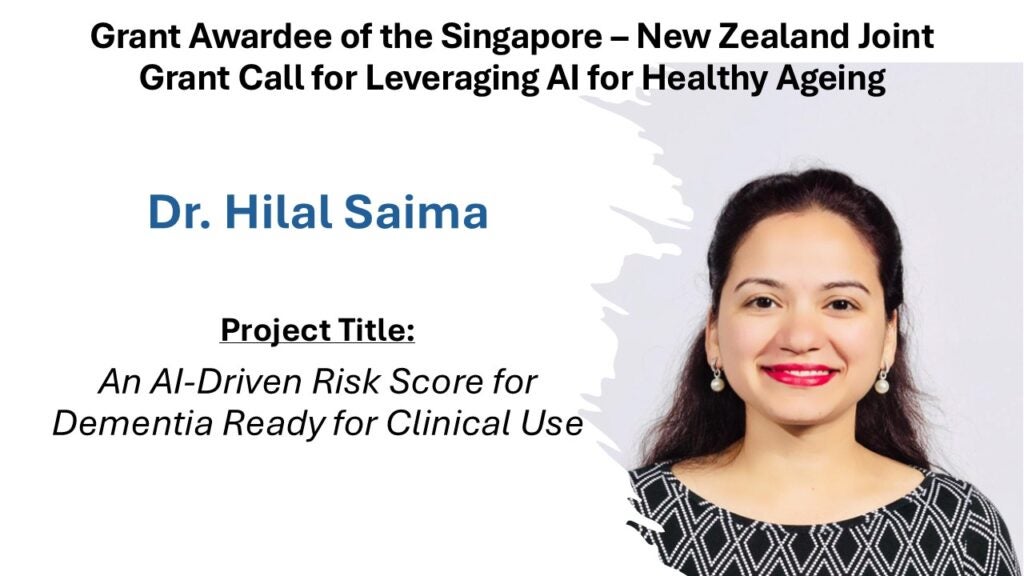
The Grant Awardees of the Singapore – New Zealand Joint Grant Call for Leveraging AI for Healthy Ageing: Dr. Hilal Saima


Congratulation to Dr. Saima Hilal (Joint Staff at NUS Pharmacology) on being selected as a recipient of the prestigious Singapore – New Zealand Joint Grant Call for Leveraging AI for Healthy Ageing. This international initiative, jointly launched by AI Singapore (AISG) and the New Zealand Ministry of Business, Innovation & Employment (MBIE) in December 2024, aims to spur scientific advancements and foster collaboration between Singaporean and New Zealand researchers in artificial intelligence (AI) and healthcare.

Dr. Hilal’s project, “An AI-Driven Risk Score for Dementia Ready for Clinical Use,” was selected after a competitive evaluation process involving research teams from both countries. She will lead the effort in partnership with Professor Lynette Tippett from the University of Auckland, combining expertise in neuroscience, AI, and clinical practice to develop an innovative tool that assesses dementia risk in older adults.

The grant will support the development and clinical validation of an AI-powered system capable of providing personalized dementia risk scores. Such a tool could revolutionize early detection and intervention strategies, improving quality of life for seniors and reducing healthcare burdens related to age-associated cognitive decline.

For more details: http://aisingapore.org/announcing-the-grant-awardees-of-the-singapore-new-zealand-joint-grant-call-for-leveraging-ai-for-healthy-ageing/

The Grant Awardees of the Singapore – New Zealand Joint Grant Call for Leveraging AI for Healthy Ageing: Dr. Hilal Saima Read More »

MSc in Medical Pharmacology Launch and Orientation Day

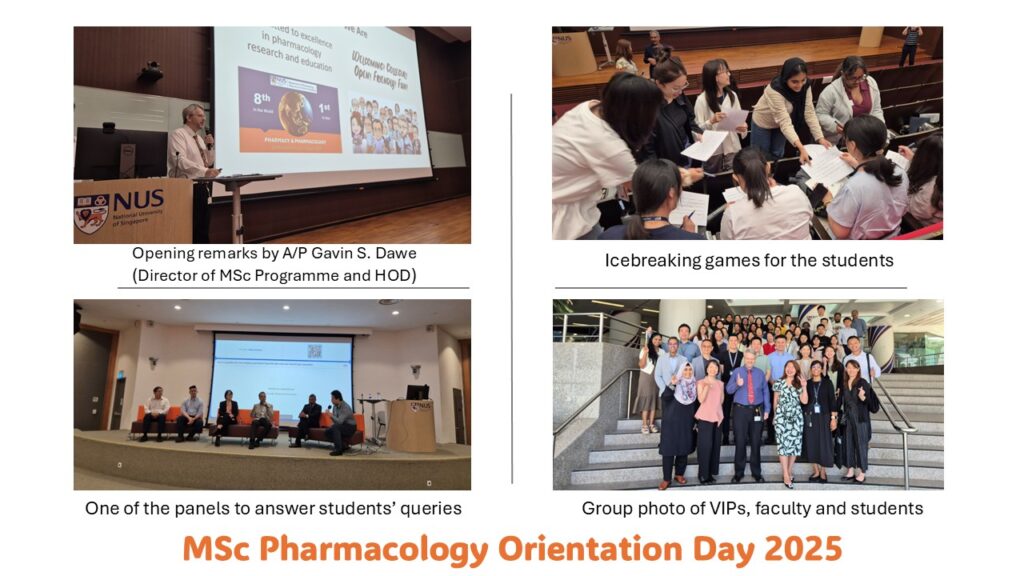
We are delighted to announce the successful launch of our new Master’s programme in Medical Pharmacology at the NUS Department of Pharmacology. Our inaugural orientation session was held on 5th and 6th August to warmly welcome the first cohort of students embarking on this exciting academic journey.

The event marked a significant milestone, introducing students to the programme structure, key academic and support staff, and the vibrant community they are now part of. A highlight of the session was the participation of our industry partners, who shared valuable insights into current trends in therapeutic discovery and development. Their perspectives provided students with a deeper understanding of the evolving pharmaceutical landscape and offered practical guidance on navigating their future careers.

This orientation also fostered meaningful connections—among students and between students and faculty members—setting the tone for a supportive and collaborative learning environment.

We look forward to walking alongside our students as they take this next step and are excited to see the contributions they will make to the field. Congratulations once again to our pioneering cohort, and welcome to the Pharmacology family!

MSc in Medical Pharmacology Launch and Orientation Day Read More »

Winner of NUS Medicine Excellence in Administration Awards 2025: Department of Pharmacology

Congratulations to Department of Pharmacology Team on receiving the award!

The award recognises teams who have delivered significant, School-wide initiatives or projects at NUS Medicine, resulting in measurable improvements and setting new benchmarks that advance the School’s vision and mission.

Winner of NUS Medicine Excellence in Administration Awards 2025: Department of Pharmacology Read More »

Winner of the Graduate Mentor of the Year (GRAMAY) Award 2025: Asst/P. Alan Prem Kumar

Congratulations to Asst/P Alan Prem Kumar on receiving the Graduate Mentor of the Year (GRAMAY) Award 2025. The GRAMAY Award is an annual award that honors and celebrates faculty staff for their excellence in mentorship and the professional development of graduate students in the Yong Loo Lin School of Medicine. The award is given to recognize the important key roles played by the Faculty staff in inspiring and nurturing future biomedical- and clinician-scientists. The award recipients should have shown excellence in graduate supervision, intellectual and professional development as well as career development of their graduate students.

Winner of the Graduate Mentor of the Year (GRAMAY) Award 2025: Asst/P. Alan Prem Kumar Read More »

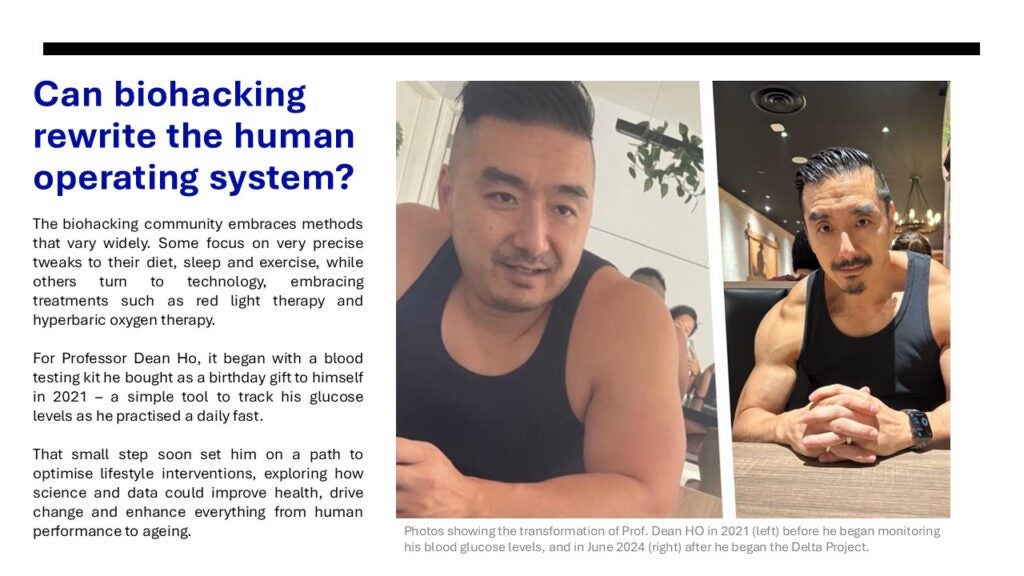
The Longevity Code: Inside the biohacking boom in Singapore (featuring Prof. Dean HO)

Today, biohacking is no longer the domain of Silicon Valley millionaires. It is gaining ground as a roadmap for living better, sharper and stronger. In Singapore, the movement takes on a more measured form, favouring science-backed habits over spectacle, and long-term health over overnight transformation.

Singapore-based biomedical scientist Dean Ho  (Joint Professor at NUS Department of Pharmacology), the director of the Institute for Digital Medicine, or WisDM, and the N.1 Institute for Health, exemplifies this approach with data-led experiments, using his own biology as both testing ground and record, his body serving as part lab, part living notebook.

For him, the future of longevity is not just about individual experimentation, but also about making personalization scalable.

Full Article: https://www.tatlerasia.com/power-purpose/innovation/inside-the-biohacking-boom-in-singapore


The Longevity Code: Inside the biohacking boom in Singapore (featuring Prof. Dean HO) Read More »

Department of Pharmacology Retreat 2025

Department of Pharmacology just wrapped up an incredibly refreshing, engaging, and insightful retreat! It was an invigorating experience to reconnect with colleagues, exchange ideas, and reflect on our shared passion for advancing pharmacology education and research. The thought-provoking sessions not only deepened our collective knowledge but also inspired new directions for our work ahead. Grateful for the camaraderie and the opportunity to recharge and reimagine our goals together. Looking forward to translating these insights into impactful actions for our students and the wider medical community! 

Department of Pharmacology Retreat 2025 Read More »

Promotion to Associate Professor: Dr. LE Thi Nguyet Minh

The Department of Pharmacology is delighted to announce the promotion of Dr. Minh LE to Associate Professor, in recognition of her outstanding contributions to research, education and mentorship.

Dr. Le has made significant strides in advancing scientific knowledge through her impactful research, which has been widely recognized both locally and internationally. As a mentor, Dr. Le has been a guiding force for many students and junior colleagues, fostering an environment of curiosity, critical thinking, and personal growth.

The Department wishes Dr. Le continued success and excellence in the years ahead.

Promotion to Associate Professor: Dr. LE Thi Nguyet Minh Read More »

Promotion to Associate Professor: Dr. Inthrani Raja INDRAN

The Department of Pharmacology congratulates Dr. Inthrani Raja Indran on her well-deserved promotion to Associate Professor, in recognition of her outstanding dedication and leadership in medical education.

Dr Inthrani has played a transformational role in enhancing student learning and mentorship since she joined NUS Medicine and her ongoing work will ensure sustainable growth of a student‑centred learning ecosystem at NUS Medicine.

Promotion to Associate Professor: Dr. Inthrani Raja INDRAN Read More »

Scroll to Top