Community-Driven Health Initiatives in Action!
Community Involvement
2023 - Present
Leads: Lynette Ha, Mary Ng & Gigi Toh
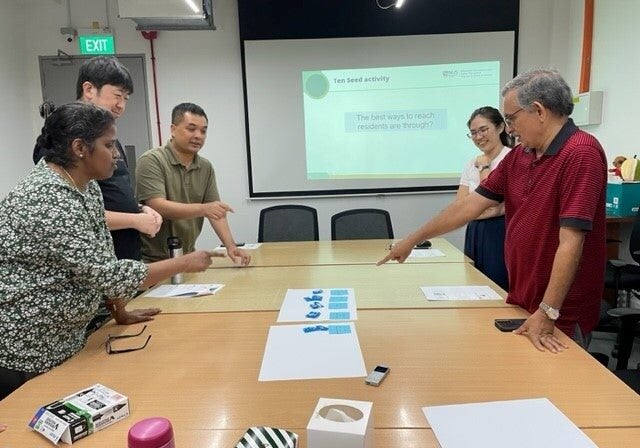
BISI and the NUHS Regional Health Service Office (RHSO) has teamed up with local community residential networks from Bukit Batok and Hong Kah North to actively shape impactful health interventions and strategies. Our first collaboration focuses on improving screening rates for diabetes, hypertension and high cholesterol.
This novel partnership between healthcare researchers and residents plays a vital role in enhancing the accessibility and effectiveness of health screening programmes.
The Resident Advisory Committee (RACs) and the BISI research team convene monthly in the evenings to foster dialogue, share updates on project milestones, and collaboratively plan the next steps. Depending on individual interest and commitment levels, RAC members have the opportunity to receive training as community researchers. This enables them to take on roles ranging from providing advice or actively participating to serving as key decision-makers in project design. Some of the work done thus far includes shaping strategies for screening and co-developing recruitment flyers and interview guides.
This co-design approach aims to enhance the relevance and impact of the study by ensuring that it is rooted in real-world experiences and needs of the community and empower residents by amplifying their voices in the research process. Such approaches have been widely reported in the health services literature, though little is known about how they might be implemented in Singaporean settings. BISI’s goal is to experiment with different ways of involving residents in our research, work through any challenges that may arise, and identify meaningful ways to involve residents on an ongoing basis. By prioritising inclusivity and collaboration, we aspire to develop potential blueprints for future initiatives seeking to engage community members.
Highlighting the impact of this partnership, RAC members will join BISI in co-presenting at the International Forum on Quality and Safety in Healthcare Conference in August 2025. Together, we will share our journey in building a collaborative environment that addresses the real-world needs and concerns of the community.

Determinants of chronic disease screening and development of implementation strategies to optimise chronic disease screening: an implementation science approach
2022 - present
Lead: Lynette Ha
Cardiovascular diseases (CVDs) are the leading causes of disability and mortality globally. Chronic diseases such as diabetes mellitus, hypertension and hypercholesterolemia (“DHL”) are established to be major risk factors of CVDs. To support early detection and management of CVD risk factors, regular health screening has been endorsed by governments around the world.
However, in Singapore, despite national promotion and incentives to participate in DHL screening, the aged-standardized proportion of eligible residents with no previous diagnosis of DHL being screened within the recommended screening frequency remains relatively low in Singapore (60.3%) (Ministry of Health, 2022). The profile of individuals who do not turn up for DHL screening has remained largely unknown, making them harder to reach by mainstream screening efforts. Existing literature that attempted to identify factors associated with CD screening has yet to organise factors influencing DHL screening uptake in a systematic manner, making it difficult to select, in a systematic way, a set of robust, evidence-informed, locally suitable strategies to promote DHL screening uptake. In addition, recent evidence reported that population-level screening programmes for CVD risk and risk factors had no effect on lowering CVD morbidity and mortality. It highlighted the importance of assessing post-screening follow-up to establish a diagnosis.
Using Implementation Science, this study aims to (1) identify factors influencing DHL screening uptake and follow-up, and (2) develop a pragmatic, evidence-informed and tailored toolkit of implementation strategies to promote DHL screening uptake and follow-up.
This work is done in collaboration with National University Health System (NUHS), Regional Health System Office (RHSO).
Chronic Disease Management Platform (CHAMP)
2023 - Present
Leads: Lynette Ha & Dr Laura Martinengo
The use of Artificial Intelligence (AI)-based chatbots in healthcare settings is increasing. AI-based chatbots may support real-time monitoring, self-management of chronic disorders and offer on-demand support and personalized services to patients and healthcare providers (HCPs). In the Western region of Singapore, an AI-based chatbot, the Chronic Disease Management Programme (CHAMP) was recently developed to support continuity of care, promote better use of resources and integrate patient data to national databases (EPIC/EMR) through a population-based approach to provide chronic disease management support to clinicians and residents using digital technology, AI and behavioural science.
This study aims to optimise the deployment of CHAMP across National University Health System (NUHS) polyclinics by developing effective implementation strategies and pilot-testing their effectiveness. Initial work includes steps towards implementation and evaluation of CHAMP for hypertension self-monitoring.
This work is done in collaboration with NUHS.