



Abstract:
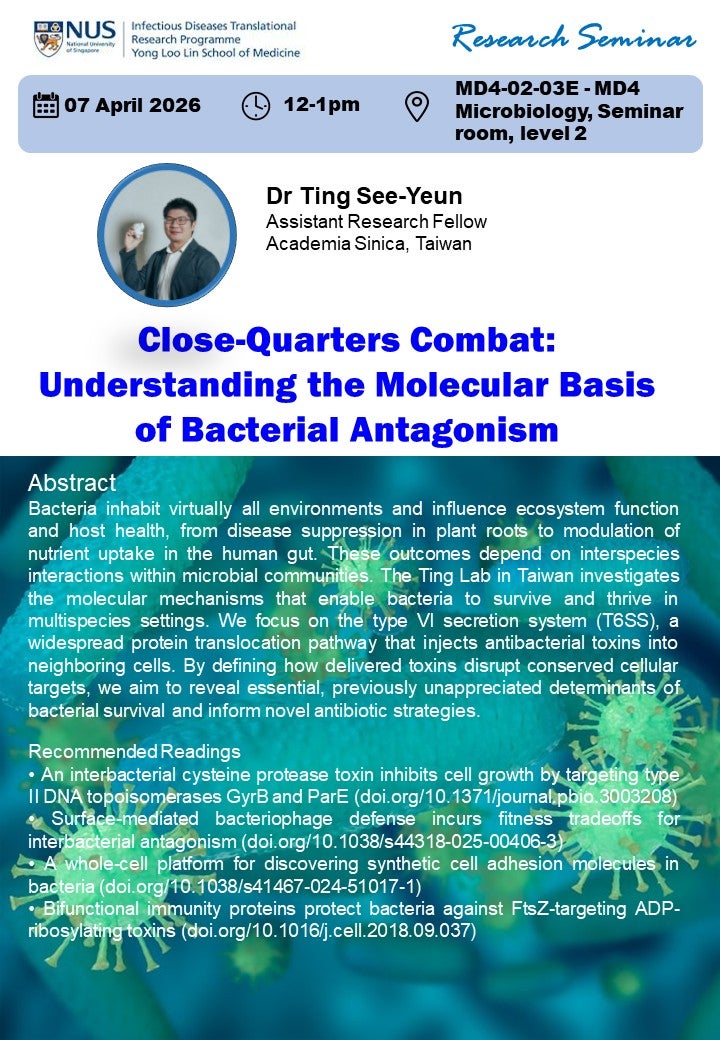
Bacteria inhabit virtually all environments and influence ecosystem function and host health, from disease suppression in plant roots to modulation of nutrient uptake in the human gut. These outcomes depend on interspecies interactions within microbial communities. The Ting Lab in Taiwan investigates the molecular mechanisms that enable bacteria to survive and thrive in multispecies settings. We focus on the type VI secretion system (T6SS), a widespread protein translocation pathway that injects antibacterial toxins into neighboring cells. By defining how delivered toxins disrupt conserved cellular targets, we aim to reveal essential, previously unappreciated determinants of bacterial survival and inform novel antibiotic strategies.
Recommended Readings:
- An interbacterial cysteine protease toxin inhibits cell growth by targeting type II DNA topoisomerases GyrB and ParE (doi.org/10.1371/journal.pbio.3003208)
- Surface-mediated bacteriophage defense incurs fitness tradeoffs for interbacterial antagonism (doi.org/10.1038/s44318-025-00406-3)
- A whole-cell platform for discovering synthetic cell adhesion molecules in bacteria (doi.org/10.1038/s41467-024-51017-1)
- Bifunctional immunity proteins protect bacteria against FtsZ-targeting ADP-ribosylating toxins (doi.org/10.1016/j.cell.2018.09.037)