



Abstract:
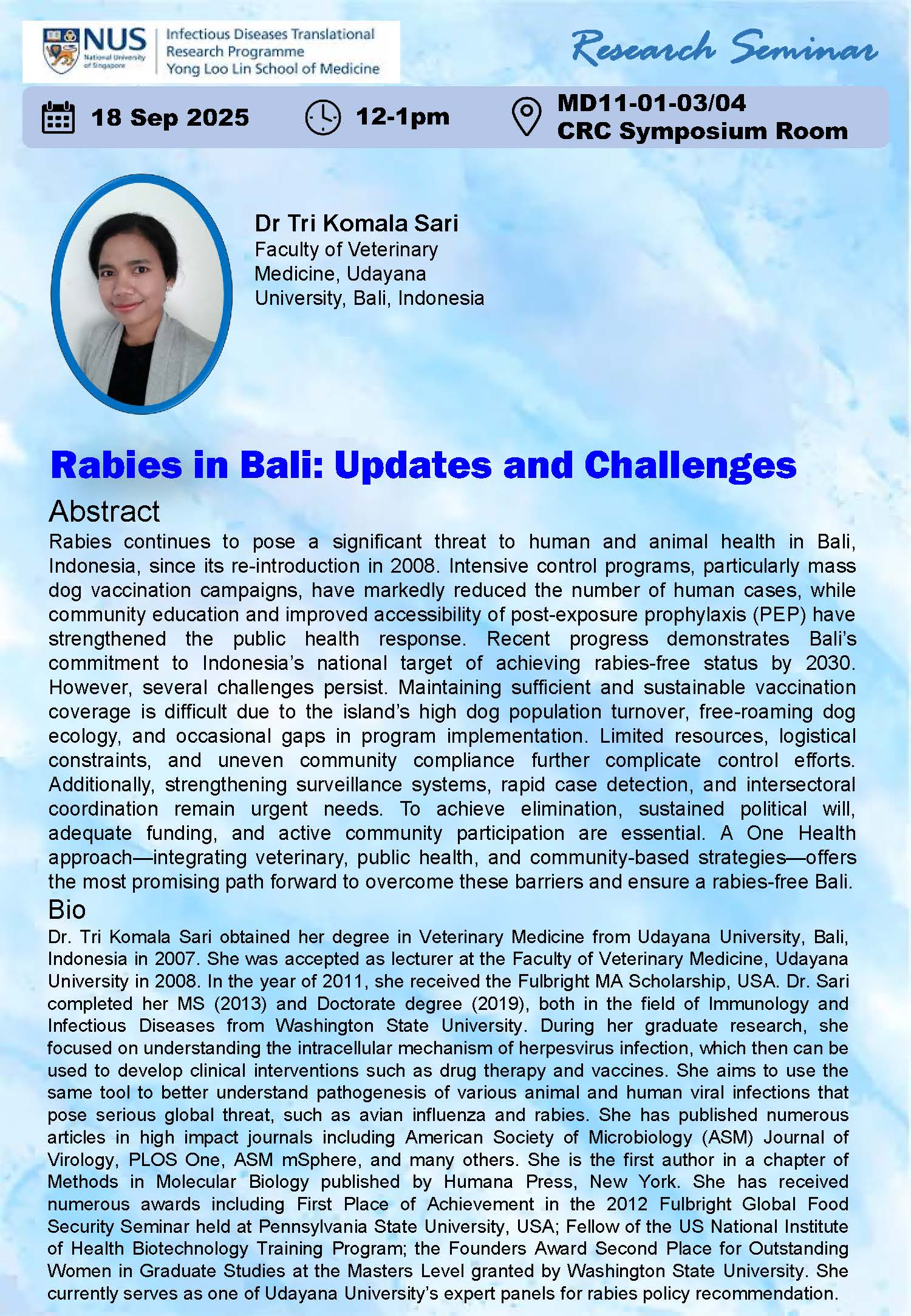
Rabies continues to pose a significant threat to human and animal health in Bali, Indonesia, since its re-introduction in 2008. Intensive control programs, particularly mass dog vaccination campaigns, have markedly reduced the number of human cases, while community education and improved accessibility of post-exposure prophylaxis (PEP) have strengthened the public health response. Recent progress demonstrates Bali’s commitment to Indonesia’s national target of achieving rabies-free status by 2030. However, several challenges persist. Maintaining sufficient and sustainable vaccination coverage is difficult due to the island’s high dog population turnover, free-roaming dog ecology, and occasional gaps in program implementation. Limited resources, logistical constraints, and uneven community compliance further complicate control efforts. Additionally, strengthening surveillance systems, rapid case detection, and intersectoral coordination remain urgent needs. To achieve elimination, sustained political will, adequate funding, and active community participation are essential. A One Health approach—integrating veterinary, public health, and community-based strategies—offers the most promising path forward to overcome these barriers and ensure a rabies-free Bali.
Biography:
Dr. Tri Komala Sari obtained her degree in Veterinary Medicine from Udayana University, Bali, Indonesia in 2007. She was accepted as lecturer at the Faculty of Veterinary Medicine, Udayana University in 2008. In the year of 2011, she received the Fulbright MA Scholarship, USA. Dr. Sari completed her MS (2013) and Doctorate degree (2019), both in the field of Immunology and Infectious Diseases from Washington State University. During her graduate research, she focused on understanding the intracellular mechanism of herpesvirus infection, which then can be used to develop clinical interventions such as drug therapy and vaccines. She aims to use the same tool to better understand pathogenesis of various animal and human viral infections that pose serious global threat, such as avian influenza and rabies. She has published numerous articles in high impact journals including American Society of Microbiology (ASM) Journal of Virology, PLOS One, ASM mSphere, and many others. She is the first author in a chapter of Methods in Molecular Biology published by Humana Press, New York. She has received numerous awards including First Place of Achievement in the 2012 Fulbright Global Food Security Seminar held at Pennsylvania State University, USA; Fellow of the US National Institute of Health Biotechnology Training Program; the Founders Award Second Place for Outstanding Women in Graduate Studies at the Masters Level granted by Washington State University. She currently serves as one of Udayana University’s expert panels for rabies policy recommendation.