-
Current status of medical education research in Japan: A meta-epidemiological investigation
Yuki Kataoka1,2, Hiraku Tsujimoto2, Yasushi Tsujimoto3, Yuka Urushibara-Miyachi4, Yuda Miyamoto5, Hideto Yasuda6, Hiromitsu Yamashita5, Ryohei Yamamoto6 & Hiroshi Nishigori7
1Department of Respiratory Medicine, Hyogo Prefectural Amagasaki General Medical Center, Japan; 2Hospital Care Research Unit, Hyogo Prefectural Amagasaki General Medical Center, Japan; 3Department of Nephrology and Dialysis, Kyoritsu Hospital, Japan; 4Science and Religion, School of Divinity, University of Edinburgh, Scotland; 5Outpatient Facility Kameda Clinic, Japan; 6Department of Intensive Care Unit, Kameda General Hospital, Japan; 7Center for Medical Education, Kyoto University, Japan
Abstract
Background: The representation of Japan in science has been decreasing. No data is available on the current status of medical education research in Japan.
Aim: The present study aims to describe the current status of medical education research in Japan.
Methods: We conducted a meta-epidemiological investigation of the conference abstracts from Japan for the Japan Society for Medical Education (JSME), the Association for Medical Education in Europe (AMEE) Conference, and Asia Pacific Medical Education Conference (APMEC) published between April 2012 and March 2017.
Results: A total of 1399 JSME conference abstracts and 193 AMEE conference and APMEC conference abstracts were published. From a total of 382 abstracts, 37 abstracts (10%) presented at the JSME 2014 conference were published as full papers. From a total of 39 abstracts, four (10%) abstracts presented at the AMEE Conference 2014 and APMEC 2014 from Japan were published, respectively. Exploratory analysis showed that the characteristics of abstracts were not related significantly with subsequent publication. Of the original articles, 0.46% (31/6727) from Japan were presented in 7 international medical education journals.
Conclusion: We found a low subsequent publication rate for Japanese conference abstracts and low representativeness in medical education journals. Further investigation to improve the number of publications is required.
Keywords: Medical Education Research, Postgraduate Education, Continuous Medical Education
-
The University of the East-Ramon Magsaysay Memorial Medical Center, Inc. medical students’ perception of the objective structured examination in pharmacology as an assessment tool
Chiara Marie Miranda Dimla, Maria Paz S. Garcia, Maria Petrina S. Zotomayor, Alfaretta Luisa T. Reyes, Ma. Angeles G. Marbella & Carolynn Pia Jerez-Bagain
Department of Pharmacology, College of Medicine, University of the East-Ramon Magsaysay Memorial Medical Center, Inc., Philippines
Abstract
The teaching of pharmacology prepares the medical sophomore to prescribe drugs on a rational basis. In small group discussions (SGDs), the evaluation of individual competence poses a challenge. Hence, the Objective Structured Examination in Pharmacology (OSEP) was initiated, to provide an additional, objective means of assessing individual performance. The OSEP is an oral, time-bound, one-on-one examination given at the end of the course, designed with a rubric for scoring. The aim of this study was to determine the students’ perceptions of the OSEP as an assessment tool. A survey was conducted on all pharmacology students of School Year 2016-17 as a post-activity evaluation for curricular improvement. After the approval of the institutional ethics review board was obtained, the data was collected retrospectively. The responses of participants who gave their informed consent were included in the study. The students’ perceptions were based on the level of agreement to sixteen statements, using a Likert Scale. The median score for each statement and the proportion with positive perception were computed. The positive perception was operationally defined based on a pre-determined median score. A total of 414 students participated in the study. The mean response rate was 99% and the median score for all statements revealed that 88%, 93% and 94% have a positive perception of the effectiveness, content and conduct of the OSEP, respectively. In conclusion, the medical students perceived the OSEP as an effective assessment tool that can provide an additional, objective means of evaluating individual performance in the course.
Keywords: Assessment Tool, Rubric, Rational Use of Medicines, Objective Structured Examination, Pharmacology, Oral Examination, Outcome-based Education, Small Group Discussion, Biomedical Science, Medical Education
-
Evaluation of a developmental paediatrics teaching programme for medical students
Yeleswarapu S. Padmini, Pratibha K. Agarwal & Lourdes M. Daniel
Department of Child Development, KK Women’s and Children’s Hospital (KKH), Singapore
Abstract
Introduction: The aim of the study was to evaluate the efficacy of the developmental paediatrics teaching programme for undergraduate medical students posted to the Department of Child Development (DCD), in a tertiary children’s hospital in Singapore.
Methods: Efficacy of the teaching program was evaluated objectively using multiple-choice questions (MCQs) and subjectively using a self-assessment evaluation form developed in-house. Feedback was obtained from the students and tutors at the end of the posting.
Results: 36 students participated in this evaluation. There was a significant positive difference in the pre and end of posting MCQ scores (p < 0.001). The difference in the students’ self-assessment of their knowledge and skills of child development before and at the end of their DCD posting was similarly positively significant (p < 0.001). Feedback from the students using a series of open-ended questions indicated that they had a very positive learning experience and this included learning beyond their stated learning objectives. Feedback from the tutors was reflective of some of the challenges they faced while teaching.
Conclusion: The integrated approach to teaching developmental paediatrics that includes didactic, reflective, interactive and problem-based learning results in a highly positive learning experience and enhances both the knowledge and skills in child development. This enables delivery of a holistic curriculum that goes beyond teaching mainly routine developmental assessment.
Keywords: Developmental Assessment, Developmental Paediatrics, Problem-based learning, Didactic Teaching, Medical Students
-
Learning perceptions of medical students engaged in clinical teaching postings in neonatal intensive care units
Stefan Kutzsche1 & Erwin Jiayuan Khoo2
1Centre for Education, International Medical University, Malaysia; 2Clinical School, International Medical University, Malaysia
Abstract
We are reporting the results of implementing Learning from Observation and Discussions at Clinical Campus International Medical University, Kuala Lumpur, Neonatal Intensive Care Unit (NICU). This initiative was conceived and successfully implemented with the aim to identify medical students’ learning perception from self-reported learning experiences. A total of 80 semester eight medical students were invited to participate in the study. A structured, validated and reliable instrument developed from a work skill development framework was used to assess students’ perception of learning through discussions and observations (Total D&O), input from their experience providing future ideas (Total Ideas) and guided ward rounds as a new learning format (Total Visit). Informed consent was obtained from 42 students who participated over the ten-month period of the study. Data was analysed with ANOVA and structural regression equation modelling. The study showed that both Total Visit and Total Discussion & Observation can predict Total Perception of Learning. According to student evaluations, the Total Visits rating was the best single predictor summarising positive perception of rounds at the neonatal intensive care unit based on the significance values, partial eta squared and power. Students ranked the process of guided rounds at the neonatal intensive care unit as valuable in providing educational experiences and integral to their learning perception.
Keywords: Perception of Learning, Bedside Teaching, Clinical Neonatology, Observational Learning
-
Medical education in Lao People’s Democratic Republic: The challenges students face in accessing learning resources
Annie L. Kilpatrick1,2, Ketsomsouk Bouphavanh3, Sourideth Sengchanh3, Vannyda Namvongsa3 & Amy Z. Gray1,2
1Centre for International Child Health, Department of Paediatrics, University of Melbourne, Australia; 2The Royal Children’s Hospital, Australia; 3Education Development Centre, Faculty of Medicine, University of Health Sciences, Lao People’s Democratic Republic
Abstract
Aim: To understand the needs and preferences of students at the University of Health Sciences (UHS) in Vientiane, Lao People’s Democratic Republic (PDR) in relation to access to educational materials in order to develop a strategy for development of educational resources for students at UHS.
Methods: We conducted a cross-sectional semi-structured survey of 507 students, staff and post-graduate residents from a range of faculties at UHS regarding current learning resources, access to educational aids and online learning. Focus groups of survey participants were conducted for in-depth understanding of desired materials and challenges faced.
Results: There was an overwhelming request by students for greater access to learning resources. The main areas of difficulty include English language capacity, limited local language resources alongside poor internet access and limited competence in navigating its use. Students would prefer learning resources in their own language (Lao); many potential study hours are being consumed by students searching for and translating resources.
Conclusions: Students in Lao PDR describe multiple barriers in accessing appropriate resources for their learning. Scoping current access and needs through this research has enabled us to better plan investment of limited resources for educational material development in Lao PDR, as well as highlight issues which may be applicable to other low resource setting countries.
Keywords: Medical Education, Student Preferences, University, Learning Resources, Low Resource Setting
-
Harnessing mobile technology to develop a sustainable on the go learning resource for junior doctors
Zhun Wei Mok, Jill Cheng Sim Lee & Manisha Mathur
Division of Obstetrics and Gynaecology, KK Women’s and Children’s Hospital, Singapore
Abstract
Introduction: At KK Women’s and Children’s Hospital’s (KKWCH) Department of Obstetrics and Gynaecology (O&G), a junior doctor’s handbook exists to guide safe practice. A challenge remains in ensuring relevant, current, and readily accessible content. The onus of re-editing is left to senior clinicians with heavy clinical and supervisory roles, leading to a lack of sustainability. Mobile applications (apps) can be a sustainable ‘just-in-time’ learning resource for junior doctors as they balance new responsibilities with relative inexperience.
Methods: The app was developed in-house with the Residency’s EduTech Office. A focus group comprising junior doctors identified content deemed useful. The alpha version was launched in August 2017 and trialled amongst the wider junior doctor population. Data on usefulness were collected through serial focus groups and analysed using grounded theory.
Results: An online survey disseminated to all 100 junior doctors showed that 100% owned a smartphone. 97.1% supported this new resource. Consultative discussions recommended inclusion of (i) Procedural and consent information; (ii) Risk calculators; and (iii) Clinical pathways and management algorithms. Mobile learning apps entreat the user to immediately reflect and conceptualise their concrete experiences, and actively experiment with the content to build on his/her current knowledge. Learners become stakeholders in creating their own learning material. Qualitative feedback indicated a continued interest to contribute, underscoring the app’s sustainability potential.
Conclusions: Apps can be a sustainable on-the-go resource developed by junior doctors, for junior doctors. Learners become stakeholders in creating their own learning material through continued reflection, conceptualisation and active experimentation. This can be scaled for wider clinical use.
Keywords: Sustainable Mobile Learning, Mobile Applications, On-the-Go Resource, Junior Doctors, Obstetrics and Gynaecology
-
Residents’ expectations and perceptions of clinical teaching activities in National Dental Centre Singapore
Marianne Meng Ann Ong1 & Sandy Cook2
1Department of Restorative Dentistry, National Dental Centre, Singapore; 2Academic Medicine Education Institute, Duke-NUS Medical School, Singapore
Abstract
Aim: To describe residents’ expectations of faculty using the One-Minute Preceptor (OMP) in microskills and their ratings of faculty performing them during clinical sessions.
Methods: Prior to the start of residency, residents were invited to participate in a survey on residents’ expectations of faculty performing the OMP microskills in clinical teaching activities using a 4-point Likert scale. At the end of Year 1, they rated faculty on their use of the OMP microskills using a 4-point Likert scale using a second survey.
Results: Sixteen Year 1 residents completed the first survey and 15 residents completed the second survey. Prior to residency, correcting mistakes with feedback was the highest rated microskill (3.78) and obtaining a commitment was the lowest rated (3.15). At the end of Year 1, residents rated faculty performing getting a commitment as the highest (3.63) and giving feedback the lowest (3.17).
Conclusion: In this small cohort of residents, expectations were high around the OMP microskills. Residents felt faculty performed them well in their first year of residency. However, residents view of the importance of the five OMP microskills by faculty differed from their perception of how well the faculty demonstrated them. Future studies could explore if residents’ perceptions of importance changed over time or were related to their view on the quality of performance by faculty. Faculty will be further encouraged to employ the five OMP microskills to maximise their teaching moments with residents managing patients in busy outpatient clinics in National Dental Centre Singapore.
Keywords: Learner Perception, Expectation, Evaluation, Clinical Teaching
-
Our journey through the Medical Grand Challenge 2017
Wenqi Chiew1, Zi Qiang Glen Liau2, Wen Guang Benson Ang1, Jolyn Moh3 & Wilson Wang1,2
1Yong Loo Lin School of Medicine, National University of Singapore, Singapore; 2Department of Orthopaedic Surgery, National University Hospital, Singapore; 3NUS Business School, National University of Singapore, Singapore
I. INTRODUCTION
Medical Grand Challenge (MGC) 2017 was the inaugural student-led medical innovation competition hosted by the Yong Loo Lin School of Medicine (YLLSOM) in National University of Singapore (NUS) which provided a platform for students from different faculties to come together to brainstorm for innovative solutions to real healthcare problems.
-
Research in Anaesthesia – The PEGASUS Journey
Sophia Tsong Huey Chew1,2,3 & Lian Kah Ti2,4,5
1Department of Anaesthesiology, Singapore General Hospital, Singapore; 2Yong Loo Lin School of Medicine, National University of Singapore; 3Duke-NUS Graduate Medical School, Singapore; 4Department of Anaesthesia, National University Hospital, 5National University Health System, Singapore
I. INTRODUCTION
We never quite know how a scientific journey pans out, or any journey for that matter. What started for us as a scientific quest to better understand local clinical data and practice in cardiac surgery is yielding answers of value locally and beyond. But the high hanging (and greater) fruit that is already coming of age is the formation of a growing community of younger researchers who not only share success with us in publication, but beyond this are actively expanding the research community through their own networks in research and mentorship.
-
Caribbean offshore medical schools – Accreditation and financial challenges
Pathiyil Ravi Shankar
Department of Medical Education, American International Medical University, Saint Lucia
I. INTRODUCTION
A. Why This is an Issue of Global Importance
Offshore Caribbean medical schools (OCMS) were first established in the late 1970s. In 2013 more than three-quarters of the United States (US) International Medical Graduates (IMGs) graduated from OCMS (Eckhert & van Zanten, 2015). Many also admit students from Asia (predominantly from South Asia) with many graduates returning home to practice medicine (Morgan, 2017). Students from the Middle East and West Africa, especially Nigeria and Ghana are also admitted. There has been no published study on these proportions but at the medical school where the author works over 70% of students are from South Asia and over 15% from Nigeria. The proportion at other medical schools varies and a comprehensive study may be required.
-
Response to: The Ownership Cycle and self-regulated learning
Ching-Hui Sia
Department of Cardiology, National University Heart Centre Singapore, Singapore
Abstract
Dear Editor,
I read with great interest the case study on “The Ownership Cycle and self-regulated learning” published by Jian Yi Soh in The Asia-Pacific Scholar (Soh, 2019) and congratulate the author for the development of this framework. The author describes how the teacher may encounter 2 different types of learners in the educational setting and how the ownership cycle may play a role in explaining difficult teaching encounters. He also proposes a 6-step intervention on how to help learners with difficulty.
-
The Author’s reply: The Ownership Cycle and self-regulated learning
Soh Jian Yi
Department of Paediatrics, Khoo Teck Puat-National University Children’s Medical Institute, National University Hospital, Singapore
Synopsis
Dear Sir/Madam,
Thank you for pointing out the similarities between the two Cycles and Professor Carol Dweck’s studies on Mindsets.
Professor Dweck’s mindsets are, in fact, part of the two Cycles. I agree with the need to provide more practical examples – the limitation here being the number of words I could pen in a journal article, plus the existence of the 200-page book of the same name, that does illustrate the exact examples you have asked for.
-
The Implications of Culture in the Education and Practice of Healthcare Professionals
1Judy McKimm & 2Hiroshi Nishigori
1Strategic Educational Development, Swansea University Medical School, Swansea University, United Kingdom; 2Center for Medical Education, Nagoya University Graduate School of Medicine, Japan
Abstract
It has been a pleasure for us to act as guest editors for this themed issue on the Implications of Culture in the Education and Practice of Healthcare Professionals. We thank the TAPS Editorial team, our reviewers, and authors for all their hard work and patience and we hope you enjoy this varied issue with articles from around the region, and the world.
-
Educational value of Curiosity
Dujeepa D. Samarasekera & Matthew C.E. Gwee
Centre for Medical Education (CenMED), NUS Yong Loo Lin School of Medicine,
National University Health System, Singapore“Curiosity… is the spark that can lead to breakthrough innovation. … it helps
produce more than new ideas.” (A. Ignatius, 2018).We believe that curiosity is vital to learning. Many studies have shown that if a student is curious or the subject matter generates learners’ curiosity, then the student learning is deeper and that they remember better (Dyche & Epstein, 2011; Yuhas, 2014).
-
Exploring factors that motivate and influence medical students to attend medical school
Tari Stowers1, Mataroria P. Lyndon2,3, Marcus A. Henning2, Andrew G. Hill3,4& Melinda Webber5
1Faculty of Education, The University of Auckland, New Zealand; 2Centre for Medical and Health Sciences Education, The University of Auckland, New Zealand; 3Counties Manukau District Health Board, New Zealand; 4South Auckland Clinical Campus, The University of Auckland, New Zealand; 5Te Puna Wānanga/School of Māori and Indigenous Education, The University of Auckland, New Zealand
Abstract
Introduction: This study explored motivation among a cohort of New Zealand medical students from The University of Auckland. The research questions were: 1) What motivates students to attend medical school? 2) What are the values, beliefs or cultural practices that influence students’ decisions to go to medical school? 3) How do students’ families influence their decisions to go to medical school?
Methods: Twenty medical students from The University of Auckland in Years Two and Five of a Bachelor of Medicine and Bachelor of Surgery (MBChB) degree participated in semi-structured focus group interviews. Two cohorts of medical students were involved, Māori and Pacific Admission Scheme students (MAPAS), and non-MAPAS students. An interpretive methodology was used, and data analysed using thematic analysis.
Findings: This study found both MAPAS and non-MAPAS students have intrinsic and extrinsic motivation to attend and continue medical school. However, the non-MAPAS students had more individualised motivations to study medicine whereas the MAPAS students were more motivated by collectivism. Family and cultural customs influenced MAPAS students’ motivation to study medicine. Non-MAPAS students were influenced by positive school experiences.
Common to both cohorts was the significant influence of family. Non-MAPAS students specified family members’ professions and educational support as influencing factors. In contrast, MAPAS students identified being motivated to study medicine to improve the financial and health situations of their families.
Conclusion: All students have different motivations for attending medical school which is influenced by their culture and environment. Culture encompasses the individual and their family, inclusive of ethnicity, beliefs, values and behaviours. Family plays a crucial role in motivating and influencing students to pursue medicine.
Keywords: Motivation, Medical Students, Culture, Indigenous, Ethnic Minority
-
FAIMER fellowship programs: An international, project-centered approach to improving health through health professions education
Julie Drendall & John J. Norcini
Foundation for Advancement of International Medical Education and Research, United States
I. INTRODUCTION
The Foundation for Advancement of International Medical Education and Research (FAIMER®) is a non-profit foundation committed to improving the health of communities by enhancing the quality of health professions education. This article highlights several of FAIMER’s international efforts, with particular emphasis on the fellowship programs developed in partnership with institutions in the Asia-Pacific region.
-
Integrating cultural awareness into busy residency training – What could work?
Cristelle Chow1, Raveen Shahdadpuri1 & Fred Stevens2
1KK Women’s and Children’s Hospital (KKH), Singapore; 2School of Health Professions Education, Maastricht University, The Netherlands
Abstract
Introduction: Provision of culturally sensitive healthcare improves patient-clinician relationships and health outcomes. However, traditional cultural competence training may inadvertently reinforce racial and ethnic biases and can be challenging to implement into busy residency programs. This study aimed to contribute evidence-based recommendations for cultural awareness training to be integrated into existing residency programs, to promote holistic and longitudinal learning of cultural awareness.
Methodology: This was a qualitative study of healthcare staff and patient experiences within a culturally diverse population and cultural awareness issues that arise in a tertiary academic paediatric hospital. Nineteen participants (six residents, four faculty, four nurses and five caregivers) were purposefully sampled and underwent semi-structured individual interviews. Transcribed interviews were analysed for emerging themes.
Results: From a multi-faceted perspective, cultural awareness issues that emerged included: 1) addressing the tension between residents’ instrumental and expressive behaviour in patient care, 2) cultural and ethnic bias of caregivers towards doctors, 3) residents’ concerns about difficult patients, 4) understanding patients’ perspectives and 5) bias within inter-professional relationships. As expected, residents’ learning experiences about cultural awareness occurred through on-the-job learning rather than formal curricula.
Discussion: Resource-intensive cultural competency curricula may not always be feasibly integrated into busy residency programs. However, some practical methods to facilitate longitudinal workplace-based learning of cultural awareness include: 1) firm and transparent hospital policies against discrimination and engaging residents into developing such policies, 2) faculty development and leadership training on cultural sensitivity and supporting victims of discrimination, 3) incorporating cultural sensitive communication into assessment methods, 4) utilising patients as educators and 5) ensuring inter-professional team diversity.
Keywords: Cultural Awareness, Professionalism, Postgraduate
-
The odyssey of medical education in Indonesia
Rita Mustika1,2, Hiroshi Nishigori3, Sjamsuhidajat Ronokusumo1 & Albert Scherpbier4
1Medical Education Department, Faculty of Medicine, Universitas Indonesia, Indonesia; 2The Indonesian Medical Education and Research Institute (IMERI), Faculty of Medicine, Universitas Indonesia, Indonesia; 3Center of Medical Education, Graduate School of Medicine, Kyoto University, Japan; 4Faculty of Health, Medicine, and Life Sciences, Maastricht University, Netherland
Abstract
Medical education in Indonesia has undergone a long journey. It began with the establishment of medical training for native youth in a military hospital in Jakarta during the Dutch colonial period in 1849. Since then, the number of medical schools has increased according to socio-political needs. Currently, there are 83 medical schools, public and private, which generate approximately 8000 graduates per year. The explosion in the number of medical schools challenged quality of medical education. Indeed, several curriculum changes and improvements applied to elevate the quality. Undergraduate program was initially implementing Dutch curriculum, but was then changed into American curriculum. The improvement continued by implementing the first and the second national curriculum. Since 2005 a national level competency-based curriculum (CBC) was carried out for undergraduate programs, while for postgraduate clinical training the CBC began later on. Moreover, Medical Internship Program and the National Competency-based Examination were introduced following the CBC. Nevertheless, some problems with advancement of medical schools were identified, including lack of staff and facilities, existing learning cultures and limitation of experts. Accordingly, many efforts have been made, including enactment of law on medical education and national accreditation. In the future, support from international organizations in terms of financial, consultation, faculty development and accreditation should be optimized. In addition, collaboration with medical education community elsewhere would be beneficial to overcome the challenges and promote the quality of medical education.
Keywords: Medical Schools, Curriculum Changes, Medical Education, Indonesia
-
A two-edged sword: Narrative inquiry into Japanese doctors’ intrinsic motivation
Hiroshi Nishigori1, Tomio Suzuki2, Tomoko Matsui3, Jamiu Busari4 & Tim Dornan5
1Centre for Medical Education, Nagoya University Graduate School of Medicine, Japan; 2Department of General Medicine, Osaka Medical College, Japan; 3Department of General Medicine, Nagoya University Graduate School of Medicine, Japan; 4Educational Development and Research Department, Faculty of Health, Medicine and Life Sciences, Maastricht University, The Netherlands; 5Centre for Medical Education, School of Medicine, Dentistry and Biomedical Sciences, Queen’s University Belfast, United Kingdom
Abstract
Introduction: Although retaining a healthy and motivated medical workforce is becoming an intractable problem, the intrinsic motivation that keeps doctors working for patients remains under-investigated. The 2011 Tōhoku earthquake and tsunami provided a unique opportunity for culturally situated research into doctors’ intrinsic motivation. The purpose of this study was to answer the research question: what motivates doctors to work for patients above and beyond expectations?
Methods: This paper reports a qualitative inquiry informed by semi-structured individual interviews with 15 Japanese doctors who had joined disaster relief activities, which uses the Bushidovirtue code as a conceptual framework. The authors read transcripts repeatedly and conducted a cross-case analysis to identify final themes and illustrative narratives.
Results: A young doctor wanted to learn by testing out his capabilities. A senior doctor yearned to be of value to others. Other participants told how identifying with victims motivated them. There were negative as well as positive motivations, exemplified by a participant whose sense that well-educated people had a duty to help was coupled with a wish to avoid being blamed by others.
Discussion: Volunteering met participants’ needs for self-esteem by restoring their relationships with patients to ones in which they had some measure of control. But avoiding being blamed or losing Meiyo(Honour) also motivated physicians to volunteer. Reinforcing the satisfaction of a job well done may help offset the lack of control, guilt, and shame that too easily results from the relentless pressures of workload and external accountability in today’s healthcare systems.
Keywords: Burnout, Bushido, Guilt, Intrinsic Motivation, Narrative Inquiry, Professionalism, Self-esteem
-
Lessons learnt in Sri Lanka as elective students
Klara E. Fransson1, Ingrid E. J. Lundahl1, Heidi K. Pasma1, Mohamed R. M. Rishard2 & Maduka de Lanerolle-Dias2
1Faculty of Medicine, Lund University, Sweden; 2Faculty of Medicine, University of Colombo, Sri Lanka
Abstract
Annually, a number of final year medical students from Lund University in Sweden travel to various healthcare facilities globally. We chose to go to the island of Sri Lanka, spending our elective at the department of Obstetrics and Gynaecology in Colombo. The dissimilarity between healthcare in Sweden and in Sri Lanka was evident throughout our stay. The design of healthcare facilities in Sri Lanka focused less on patient privacy and more on efficiency. The workload for doctors in Colombo was heavier than their Swedish counterparts. In general, outcome for Swedish patients is favourable when compared to Sri Lankan. We believe the difference in outcome is due to the unequal financial situations of the countries. Teaching approach in Sri Lanka diverted from Swedish practice by being more authoritarian but also exceedingly efficient. The large number of patients in wards and outpatient clinics allowed for us to experience a wide range of patient cases, offering important insights in medicine. It has been questioned whether the tradition of international electives is ethically justifiable. We therefore believe it important to stress that throughout our stay we were participating as observing students, not practicing doctors. We regard our elective a valuable experience, providing us with knowledge we will use in our future profession. Time spent observing Sri Lankan healthcare will also serve as a reminder to remain humble towards different cultures. We are now aware of the privileges we have, practicing medicine in a socioeconomically strong country.
-
Teaching the generalisable skills of cultural competency: A new educational intervention in New Zealand
Katharine D. Thomas1& Susie Schofield2
1Department of Family Medicine, Sackler Faculty of Medicine, Tel Aviv University, Israel; 2Centre for Medical Education, University of Dundee, United Kingdom
Abstract
Context: In the twentieth century “cultural” courses in medical education focused on imparting knowledge about ethnic and racial minorities. A new consensus has developed that emphasises a broader definition of culture: education should promote generalisable skills enabling effective interactions with all patients in our culturally complex world. In New Zealand, cultural competency is frequently taught within courses on the indigenous Māori people. This study evaluated whether a generalisable cultural competency intervention was acceptable and effective in this setting.
Methods: A generalisable cultural competency workshop was run for 17 general practitioners. A self-assessment questionnaire was completed by attendees and by a control group of 19 GPs. Participants provided feedback during the seminar and through standardised evaluation forms. Four medical education professionals were interviewed to explore their views on cultural competency education. The interviews were transcribed and thematically analysed.
Results: The questionnaires showed a non-significant, post-seminar increase in total cultural competency score by the seminar participants as compared with the control group (p= .33). Feedback was positive, with all respondents considering the seminar relevant to their needs. The interviewees supported generalisable cultural competency but lacked consensus around whether it should stand-alone or be embedded in ethnically-focused education.
Conclusions: This pilot study shows that participants found generalisable cultural competency education acceptable and that they perceived an improvement in their skills. Medical educators disputed the role of generalisable cultural competency. Further research is needed into how it can be utilised in New Zealand.
Keywords: Medical Education, Cultural Competency, Physicians
-
Can digital media affect the learning approach of medical students?
Sonali Prashant Chonkar1,2, Hester Lau Chang Qi2, Tam Cam Ha3, Melissa Lim2, Mor Jack Ng2 & Kok Hian Tan1,2,4,5,6
1Duke-NUS Medical School, Singapore; 2Division of Obstetrics & Gynaecology (O&G), Kandang Kerbau Women’s and Children’s Hospital (KKH), Singapore; 3The University of Wollongong, Australia, 4SingHealth Duke-NUS Joint Office of Academic Medicine, Singapore; 5Yong Loo Lin School of Medicine, NUS, Singapore; 6Lee Kong Chian School of Medicine, Nanyang Technological University, Singapore
Abstract
Background: Students’ learning approaches have revealed that deep learning approach has a positive impact on academic performance. There are suggestions of a waning interest in deep learning to surface learning.
Aim: To assess if digital media can reduce the incidence of surface learning approach among medical students
Method: A digital video introducing three predominant learning approaches (deep, strategic, surface) was shown to medical students between March 2015 and January 2017. The Approaches and Study Skills Inventory for Students (ASSIST), was administered at the beginning and end of their clinical attachment, to determine if there were any changes to the predominant learning approaches. A survey was conducted using a 5-point Likert scale to assess if video resulted in change.
Results: Of 351 students, 191 (54.4%) adopted deep, 118 (33.6%) adopted strategic and 42 (12.0%) adopted surface as their predominant learning approach at the beginning of their clinical attachment. At the end of their clinical attachment, 171 (49.6%) adopted deep, 143 (41.4%) adopted strategic and 31 (9.0%) adopted surface learning as their predominant learning approach. The incidence of students predominantly using surface approach decreased from 42 (12.0%) to 31 (9.0%), although not statistically significant. Qualitative feedback from students stated that they were more likely to adopt non-surface learning approaches after viewing the video.
Conclusion: This evaluation highlighted the potential of digital media as an educational tool to help medical students reflect on their individual learning approaches and reduce the incidence of surface learning approach.
Keywords: Learning Approaches, ASSIST, Digital Media, Video, Deep Learning, Surface Learning
-
Sinhala as the medium of instruction in medical education: Perception of medical students in Sri Lanka
Thilanka Seneviratne1, Kosala Somaratne2, Deelaka Bandara1, Vindya Alahakoon1, Dilan Bandara1, Randima Munasinghe1, Nabil Ilyas3, Thilini Subasingha4& P. V. R. Kumarasiri5
1Department of Pharmacology, Faculty of Medicine, University of Peradeniya, Sri Lanka; 2Base Hospital, Rikillagaskada, Sri Lanka; 3Teaching Hospital, Peradeniya, Sri Lanka; 4Lady Ridgeway Hospital, Colombo, Sri Lanka; 5Department of Community Medicine, Faculty of Medicine, University of Peradeniya, Sri Lanka
Abstract
Introduction: English is the medium of instruction in the medical faculties in Sri Lanka, although the majority of the students who admit to the medical faculties completed their secondary school education with Sinhala as their first language. This disparity presents a potential barrier to their assimilation of knowledge in medical education.
Objective: To assess the medical students’ perception of the medium of instruction in medical education.
Method: The medical students of the Faculty of Medicine, University of Peradeniya, Sri Lanka, enrolled from 2013 to 2017, whose first language is Sinhala were included in the study. Perceptions about the medium of instruction in medical education were assessed through an anonymous self-administered questionnaire, which used a five-point Likert scale for responses.
Results: From the total of 837 medical students, 665 (79.5%) participants had studied the General Certificate of Education – Ordinary Level (GCE O/L) in Sinhala and 172 (20.5%) in English. Eighty-eight percent (87.8%) had obtained an “A” grade for English Language in the GCE O/L examination. Over half (53.4%) of students responded that if medical textbooks were available in Sinhala, it would have increased their understanding of medical concepts. Nearly two-thirds (61%) responded that they perceived their performance in clinical examinations would have improved if those were carried out in Sinhala.
Conclusion: The findings reveal the positive perception of students towards using their first language in medical education. Specifically, students feel that concepts of medicine would be better understood if medical textbooks were available in Sinhala and that they could have performed better if examinations were done in Sinhala, their first language.
Keywords: Mother Tongue, Native Language, First Language, Sinhala, English, Medical Education
-
Trends of clarification purpose of medical education research in the Asia-Pacific region: A scoping review
Wee Shiong Lim1, 2, Kar Mun Tham3, Fadzli Baharom Adzahar, Han Yee Neo4, Wei Chin Wong1, Issac Lim2, Charlotte Ringsted5 & Dujeepa D. Samarasekera6
1Department of Geriatric Medicine, Institute of Geriatrics & Active Aging, Tan Tock Seng Hospital, Singapore; 2Health Outcomes and Medical Education Research, National Healthcare Group, Singapore; 3Department of Anaesthesiology, SingHealth, Singapore; 4Department of Palliative Medicine, Tan Tock Seng Hospital, Singapore; 5Centre for Health Science Education, Faculty of Health, Aarhus University, Denmark; 6Centre for Medical Education, National University of Singapore
Abstract
Background: In recent years, the Asia-Pacific region has become a hotbed of activity in medical education. Little is known about the progress in advancing the field through clarification research studies situated within a strong conceptual framework vis-a-vis descriptive (“What was done?”) and justification (“Did it work?”) research purposes. We aimed to determine the trend in clarification as opposed to descriptive and justification research purposes in the Asia-Pacific region over a 5-year period.
Methods: We conducted a scoping review of original research abstracts presented at the 2008, 2010 and 2012 Asia Pacific Medical Education Conferences. All eligible abstracts were classified as descriptive, justification or clarification using the modified Cook (2008) research purpose framework. All abstracts were reviewed by two researchers, with disagreement resolved by consensus. We performed trended Chi-square tests followed by logistic regression adjusted for covariates, to determine the longitudinal trend in clarification studies.
Results: Our sample comprised 517 abstracts (2008:136; 2010:195; 2012:186). There was a significant trend towards an increase in clarification studies from 2008 to 2012 (4.4% vs 8.7% vs 12.9%, p=.001), even after excluding submissions from non-Asian countries. When adjusted for covariates, abstracts in 2012 significantly predicted a clarification research purpose compared to 2008 (OR 2.74, 95% CI 1.04-7.23). A non-descriptive study design also significantly predicted clarification studies (OR 7.07, 95% CI 3.17-15.75).
Conclusions: Our results of a trend towards increased clarification research purpose affirm the longitudinal progress in quality of medical education research in the Asia-Pacific region. Efforts should be made to promote non-descriptive study designs that are undergirded in clarification research purpose.
Keywords: Medical Education Research, Clarification Research Purpose, Asia-Pacific, Scoping Review
-
Patients’ decision-making in the informed consent process in a hierarchical and communal culture
Astrid Pratidina Susilo1, Brahmaputra Marjadi2,3, Jan van Dalen4& Albert Scherpbier4
1Faculty of Medicine, University of Surabaya, Indonesia; 2Faculty of Medicine, Universitas Wijaya Kusuma Surabaya, Indonesia; 3School of Medicine, Western Sydney University, Australia; 4Faculty of Health, Medicine, and Life Sciences, Maastricht University, The Netherlands
Abstract
Objective: To investigate patients’ decision-making in the informed consent process in a hierarchical and communal culture.
Methods: This qualitative study took place in an Indonesian hospital and was conducted in line with the Grounded Theory approach. Fifteen patients and twelve family members were interviewed to understand the patients’ decision-making process and factors that contributed to this process. Interview transcripts were analysed using the constant comparison method.
Results: Patients used information to develop an explanation of their illness and treatment. They consented to a medical procedure if information from their physicians matched their own explanation. An increasing severity of the disease urged patients to decide, even when a satisfying explanation had not been developed. A hierarchical relationship between physicians and patients hampered patients’ discussing concerns or sharing emotions with their physicians. To maintain a harmonious relation with their physicians, patients accepted that some questions remained unanswered even after a decision had been made.
Conclusion: The strong hierarchical and communal context added to the complexity in the physician-patient relationship and consequently influenced patients’ decision-making. In addition to strengthening physicians’ communication skills, involving other health professionals as patient advocates or mediators is recommended to ensure patients make voluntary and informed decisions.
Keywords: Decision-making, Informed Consent, Hierarchical Culture, Communal Culture, Grounded Theory
-
What drives attrition amongst obstetrics and gynaecology residents in Singapore?
Jill Cheng Sim Lee1, Xiang Lee Jamie Kee2, Sharon Wiener-Ogilvie3, Bernard Su Min Chern1, 4 & Chee Yang Chin5
1Division of Obstetrics and Gynaecology, KK Women’s and Children’s Hospital (KKH), Singapore; 2Yong Loo Lin School of Medicine, National University of Singapore (NUS), Singapore; 3NHS Education for Scotland, United Kingdom; 4SingHealth Duke-NUS Obstetrics and Gynaecology (OBGYN) Academic Clinical Programme, Singapore; 5Department of Cardiovascular Medicine, National Heart Centre Singapore (NHCS), Singapore
Abstract
Background: Resident attrition is costly but literature studying the motivations behind it in obstetrics and gynaecology (OBGYN) is lacking.
Objectives: We aimed to study the relationship between prior specialty-appropriate work experience and risk of attrition amongst OBGYN residents in Singapore, and identify factors placing residents at greater risk of attrition.
Methods: This nationwide mixed methods case control study studied all OBGYN residents in Singapore for the 2011 and 2012 intakes. A pre-piloted questionnaire was used to identify work experience and risk factors related to resident attrition. Structured interviews were conducted with a subgroup of participants chosen for diversity of educational background, work experience, and position towards residency.
Results: 28 of 33 (84.8%) eligible residents participated in this study. Female (40.9% vs. 0%), married (50.0% vs. 22.2%) and Singaporean (38.1% vs.14.3%) residents more often considered attrition from training. Those accepted into residency after graduation were 33% less likely to have considered leaving. No statistical difference was observed between residents with prior work experience and those without (38.9% vs. 20.0%, p=0.417). All interviewees believed that prior experience informs expectations and eases initial learning. Low job satisfaction related to mismatched expectations was the most quoted reason for considering attrition. 85.7% of interviewed residents were concerned about competing work and family demands.
Conclusions: Lack of specialty-appropriate work experience contributes to misinformed training expectations and increased attrition risk. Residents who have considered attrition may still desire career longevity in their specialty. Reduction in mismatched expectations promises to improve job satisfaction and translate to career longevity.
Keywords: Resident Attrition, Obstetrics and Gynaecology, Work Experience
-
The hidden curriculum in peer-assisted learning: An exploration of case discussions and journal clubs at a Thai medical school
Amnuayporn Apiraksakorn1 & Stella Howden2
1Khon Kaen Medical Education Centre, Khon Kaen Hospital, Thailand; 2Centre for Medical Education (CME), School of Medicine, University of Dundee, United Kingdom
Abstract
Peer-assisted learning (PAL) is a common feature of health professions education, characterised as learning from and teaching others who are from a similar background. Evaluations of PAL identify a range of positive outcomes for peer tutors/tutees but rarely address the hidden curriculum, which is a by-product of the learners’ educational experiences, shaped by wider organisational influences and culture. The aim of this case study was to explore the hidden curriculum associated with two modes of PAL used in the final year of an undergraduate medical programme in Thailand: Case Discussions and a Journal Club. A naturalistic evaluation approach, incorporating multiple data sources, was used to explore students’ perspectives on PAL (interviews), student and faculty behaviours during PAL (observation) and the school’s formal/written curriculum (document analysis). Three themes emerged from the thematic analysis of student interviews, triangulated with the observational data (reflecting positive and negative aspects of PAL): 1) developing self as a doctor; 2) learning through dialogue and feedback; and 3) barriers to learning. New insights were gained in relation to the influence of norms and social interactions i.e. recycling materials for Case Discussions and student difficulties with English language journals. Some of the barriers to learning are inherently connected to the study context and recommendations can be made locally for PAL review, however, revealing what is being learned, in the medical habitus, intended and unintended outcomes, highlights the importance of considering the hidden curriculum as an integral part of PAL planning, implementation and evaluation.
Keywords: Peer-assisted Learning, Peer Teaching, Hidden Curriculum, Medical Students, Medical Education
-
Depression and stressful life events among medical students during undergraduate career: Findings from a medical school in South Asia
Dakshitha P. Wickramasinghe, Isuru S. Almeida & Dharmabandhu N. Samarasekera
Department of Surgery, Faculty of Medicine, University of Colombo
Abstract
Purpose: Medical students face significant psychological stress and adverse life events throughout their student career. The aim of this study was to assess the prevalence of depression among medical undergraduates in a medical faculty in Sri Lanka.
Methods: A cross-sectional study using a self-administrated, validated questionnaire was conducted among 300 undergraduate medical students of the University of Colombo, Sri Lanka. Prevalence of depression was assessed using Beck Depression Inventory (BDI). The data were analysed by the Mann-Witney U-test. P values less than 0.05 were considered statistically significant.
Results: Three hundred students participated in the study (male: female: 111: 189). Overall, 19% (male: female: 25:32) of students were identified as depressed. Depression was most common among 1st year (25%) students followed by final year (20%) and 3rd year (12%) students respectively. Depression was more common in students who were living in rented rooms compared to those residing in hostels and home (22%, 19.1% and 13.3%, respectively). Depression was less prevalent in students who participated in extracurricular activities than those who did not (11.9% vs 23.6%, P<0.05, Mann-Whitney U-test). There were 2 students with extreme depression.
Multivariate analysis identified residency outside the city and adverse life events to be associated with a higher risk of depression and extracurricular activities to be associated with a lower risk.
Conclusions: 1st year and female medical students had a higher prevalence of depression while those who participated in extracurricular activities had lower rates. A system should be established to identify students with depressive features early.
Keywords: Medical students, Depression, Stress, Sri Lanka
-
Transnational clinical teacher training: Lessons learned and cross-cultural implications
Ardi Findyartini1, Justin Bilszta2, Jayne Lysk2& Diantha Soemantri1
1Faculty of Medicine, Universitas Indonesia, Indonesia; 2Melbourne Medical School, University of Melbourne, Australia
Abstract
Introduction: Transnational faculty development initiatives (FDIs) constitute a strategy to improve the quality of the teaching staff in medical schools. This study evaluates feedback from participants of an FDI designed as part of a collaborative transnational partnership between researchers of an Australian and an Indonesian medical school.
Methods: The FDI was a three-day program that explored four major topics: effective clinical teaching, methods of teaching and supervising in clinical settings, assessment of clinical learners and clinical education in practice. These topics were identified through comprehensive needs analysis and curriculum blueprinting exercises. Each participant (n= 27) submitted one piece of reflective writing and one critical appraisal or teaching/assessment assignment on each topic. Using a thematic analysis approach, two researchers independently reviewed each participant’s written assignments to identify emerging themes.
Results: Five core themes were identified. Most revolved around the benefits of the training, especially the learning issues that the participants identified during the FDI and how they could be applied to their local contexts. Additional themes covered participants’ views on the delivery of the FDI and cross-cultural implications. Peer observation of teaching, qualitative assessment and feedback provision were also significant issues raised by the participants.
Conclusions: This study presents important lessons for cross-cultural adaptation of best practices in the development and delivery of transnational FDIs.
Keywords: Faculty Development, Transnational, Collaboration, Cross-cultural, Clinical Teacher
-
Health promotion campaign from student approach – The lesson learned for the upcoming medical doctor; The effects of a campaign to reduce consumption of sugar-sweetened beverages in medical students
Nattabborn Bunplook1, Mechita Kongphiromchuen1, Priyapat Phatinawin1 & Panadda Rojpibulstit2
1Medical Education Centre Buddhasothorn Hospital, Faculty of Medicine, Thammasat University, Thailand; 2Department of Biochemistry, Preclinical Science Institute, Faculty of Medicine, Thammasat University, Thailand
Abstract
Aim: To encourage first year medical students to have better health by drinking more water and being role models in health promoting lifestyle.
Methods: The campaign was launched in February 2016 with seven main activities, convinced via social networking apps (Line and Facebook). The pre and post questionnaires were launched via Google Forms regarding the effective activities and participants’ drinking behaviour. Data were analysed by descriptive statistics and dependent t-test.
Results: Response rate for the questionnaire was 74.71% (127/170). After 4 weeks of the campaign, the average water intake was significantly increased (t = 6.359, p < 0.05). The average consumption of sugar-sweetened beverages was significantly decreased (t = -8.256, p < 0.05). Additionally, when comparing from the seven activities, the most top three preference activities are ‘Info & suggestions’, ‘Sugar Hunt’ and ‘Sugar Free Be Rich’.
Conclusions: Nowadays, people are preferring to consume sugary drinks instead of regular water and many may assume that computer games and social media are prevalent issues. But in reality if we use technology wisely, it would even provide us with a much more efficient method to reach the target group. Our study, thereby, then brings upon the appropriate aspect of games and social media in order to resolve the current issues. However, some activities have to be improve to attract more of the target group and the duration of the campaign should be increased for better long-term behavioural change.
Keywords: Health Promotion, Medical Students, Obesity, Lifestyle
-
Characterisations of Māori in health professional education programmes
Caitlin Harrison1, Rhys Jones2 & Marcus A. Henning3
1The University of Auckland, Aotearoa, New Zealand; 2Te Kupenga Hauora Māori, The University of Auckland, Aotearoa, New Zealand; 3Centre for Medical and Health Sciences Education, The University of Auckland, Aotearoa, New Zealand
Abstract
Formal Indigenous health curricula often exist in institutional contexts that tacitly condone racist discourses that are at odds with the goal of developing culturally safe health professionals. Recognition of the impact of informal and hidden curricula on learners has increased, yet few studies have provided empirical evidence about this aspect of health professional education. This study sought to examine characterisations of Māori (Indigenous New Zealanders) in learning environments at the University of Auckland’s Faculty of Medical and Health Sciences. A cross-sectional study design based on the Stereotype Content Model elicited student perceptions (n = 444) of stereotype content in undergraduate nursing, pharmacy and medical programmes. The Stereotype Content Model identifies interpersonal and intergroup perceptions in relation to warmth and competence. These perceptions are considered fundamental and universal to the impressions people form when meeting one another. Stereotyping is associated with distinct affective and behavioural responses that can lead to discrimination. In this study, students rated perceived warmth and competence characterisations pertaining to four target ethnic groups (Māori, Pacific Nations, Asian and Pākehā/European). Characterisations of Māori warmth were rated lower than Pacific Nations peoples, comparable to Pākehā/European and higher than characterisations of Asian peoples. In reference to competence characterisations, Māori were rated equal to Pacific Nations peoples and lower than both Asian and Pākehā/European peoples. This study’s results highlight a degree of incongruence between the University of Auckland’s formal Māori Health curricula and messages conveyed in the broader institutional context, with implications for educational outcomes and students’ future clinical practice.
Keywords: Indigenous Health, Health Professional Education, Stereotype Content Model, Informal/Hidden Curriculum
-
Clickers: Enhancing the residency selection process
Jill Cheng Sim Lee1, Muhammad Fairuz Abdul Rahman1, Weng Yan Ho1, Mor Jack Ng2, Kok Hian Tan1,2 & Bernard Su Min Chern1,2
1Division of Obstetrics and Gynaecology, KK Women’s and Children’s Hospital, Singapore; 2SingHealth Duke-NUS Obstetrics and Gynaecology (OBGYN) Academic Clinical Program, SingHealth Duke-NUS Academic Medical Centre, Singapore
Abstract
Background: Residency selection panels commonly use time consuming manual voting processes which are easily subjected to bias and influence of others to select successful candidates. We explored the use of an electronic audience response system (ARS) or ‘clickers’ in obstetrics and gynaecology resident selection; studying the voting process and examiner feedback on confidentiality and efficiency.
Methods: All 10 interviewers were provided with clickers to vote for each of the 25 candidates at the end of the residency selection interview. Votes were cast using a 5-point Likert scale. The number of clickers provided to each interviewer was weighted according to the rank of the interviewer. Voting scores and time for each candidate was recorded by the ARS and interviewers completed a questionnaire evaluating their experience of using clickers for resident selection.
Results: The 10 successful candidates scored a mean of 4.28 (SD 0.27, range 3.86-4.73), compared to 2.99 (SD 0.71, 1.50–3.79) for the 15 unsuccessful candidates (p<0.001). Average voting time was 26 seconds per candidate. Total voting time for all candidates was 650 seconds. All interviewers favoured the use of clickers, for its confidentiality, instantaneous results, and more discerning graduated response.
Conclusion: Clickers provide a rapid and anonymous method of collating interviewer decisions following a rigorous selection process. It was well-received by interviewers and highly recommended for use by other residencies in their selection process.
Keywords: Resident Selection, Clickers, Electronic Audience Response System
-
“Modified World Café” workshop for a curriculum reform process
Ikuo Shimizu, Junichiro Mori & Tsuyoshi Tada
Centre for Medical Education and Clinical Training, Shinshu University, Japan
Abstract
Consensus formation among faculties is essential to curriculum reform, especially for the clinical curriculum. However, there is limited evidence on the model of workshop that is necessary for curriculum reform. In the current project, we aimed at developing a beneficial workshop method for building consensus and reaching educational goals in curriculum reform. We compared the two types of workshop models. First, we conducted workshops using standard group work model with fixed group members. Then we used a revised workshop model. In the revised model, all but one group member moved their seats after the first round of discussion. In addition, we reserved time for plenary presentations and discussions after each round. We called the model “Modified World Café” workshop named after World Café, a collaborative dialogue method. With this design, not only we were able to achieve significant improvement of appropriate products and better consensus, but also attained several educative goals. Since the model combines characteristics of the standard group work and World Café concept, it might be useful in facilitating the sharing of new knowledge and creating consensus.
Keywords: Curriculum Reform, Workshop, Consensus Building, World Café
-
Doctors as objects of worship: Reconsidering doctors’ competency based on cultural context
Mariko Morishita1 & Hiroshi Nishigori1,2
1Medical Education Center, Graduate School of Medicine, Kyoto University, Japan; 2Center for Medical Education, Graduate School of Medicine, Nagoya University, Japan
I. INTRODUCTION
Doctors’ competency is one of the central themes of medical education, which has focused on the knowledge, skills, and morals of doctors. However, as doctors in Japan, we often wonder how we are perceived by patients and located in their belief systems. How we should be as doctors, which is often defined by lists of competencies produced by medical associations in various countries (including Japan), is not the same as what patients want us to be. This notion came to mind from anecdotes and the first author’s experience, as described below.
-
Transformation of medical education over the years – A personal view
Oh Moh Chay
Department of Paediatrics, Respiratory Medicine Services, KK Women’s and Children’s Hospital, Singapore
I. INTRODUCTION
Over the years, medical education has invariably changed. When faculty meet to discuss the performance and attitude of young doctors, the question of what had happened to medical education often arise, intuitively pointing fingers to changes in medical education as the root cause of the problem.
-
The impact of graduate-entry medicine degree programme students’ prior academic and professional experience on their medical school journey
Simon Tso1,2
1Department of Dermatology, University Hospitals Coventry and Warwickshire NHS Trust, Coventry, United Kingdom; 2Warwick Medical School, University of Warwick, Coventry, United Kingdom
I. GRADUATE-ENTRY MEDICINE DEGREE PROGRAMMES
Graduate-entry medicine degree programmes exist in many countries. In the UK, graduate-entry medicine degree programmes began in 2000 and accounted for approximately 10% of the annual intake into all undergraduate medicine academic programmes (Garrud, 2011). There had been relatively few studies exploring the impact of prior experience on graduate-entry medical students’ medical school journey. Rapport and colleagues (2009) reported prior work and life experience had a significant and positive impact on medical students’ degree programme experience. Their prior experiences had helped them understand complex concepts in professionalism, ethics and reflective learning, as well as how to manage patient encounters (Rapport et al., 2009). On the other hand, the authors noted the nature of medical students’ previous degree subjects had ‘virtually negligible effects’ on their current degree programme experience (Rapport et al., 2009). Gallagher and Hoare (2016) explored the transition experience of New Zealand medical students that were health professionals. The authors reported these medical students retained a number of generic core skills (e.g. patient communication, professionalism, teamwork, familiarity with the health care environment) from their previous health profession role and were able to apply these skills to their medicine degree programme (Gallagher and Hoare, 2016).
-
The Ownership Cycle and self-regulated learning
Jian Yi Soh
Department of Paediatrics, Khoo Teck Puat-National University Children’s Medical Institute, National University Hospital, Singapore
I. INTRODUCTION
Teachers in various settings worldwide meet with a variety of learners. Some are adept and master their lessons quickly; some less so; and some have persistent difficulties with their lessons. The difficulties can extend beyond the academic; conduct, professionalism and resilience are all important, especially in undergraduate and postgraduate learners. Inability to accept poor results, to admit failure so as to learn from it, can create learners who become withdrawn and resistant to constructive feedback and sincere attempts to help them. “No insight” and “unmotivated” are common terms used in the hallways and discussion rooms to describe these learners. Based on these twin assumptions, teachers strive to extend more help, more resources and more constructive feedback to these learners, and often find that there is little or no improvement despite the vast amounts of energy and time expended.
-
Tri-Generational Homecare, a student-led inter-professional project
Celine Yi Xin Tham
Department of Social Work, Faculty of Arts and Social Sciences, National University of Singapore, Sing
Abstract
This paper was first published in TAPS Volume 3 Number 1 as an Original Article.
Announcements
- Best Reviewer Awards 2024
TAPS would like to express gratitude and thanks to an extraordinary group of reviewers who are awarded the Best Reviewer Awards for 2024.
Refer here for the list of recipients. - Most Accessed Article 2024
The Most Accessed Article of 2024 goes to Persons with Disabilities (PWD) as patient educators: Effects on medical student attitudes.
Congratulations, Dr Vivien Lee and co-authors! - Best Article Award 2024
The Best Article Award of 2024 goes to Achieving Competency for Year 1 Doctors in Singapore: Comparing Night Float or Traditional Call.
Congratulations, Dr Tan Mae Yue and co-authors! - Fourth Thematic Issue: Call for Submissions
The Asia Pacific Scholar is now calling for submissions for its Fourth Thematic Publication on “Developing a Holistic Healthcare Practitioner for a Sustainable Future”!
The Guest Editors for this Thematic Issue are A/Prof Marcus Henning and Adj A/Prof Mabel Yap. For more information on paper submissions, check out here! - Best Reviewer Awards 2023
TAPS would like to express gratitude and thanks to an extraordinary group of reviewers who are awarded the Best Reviewer Awards for 2023.
Refer here for the list of recipients. - Most Accessed Article 2023
The Most Accessed Article of 2023 goes to Small, sustainable, steps to success as a scholar in Health Professions Education – Micro (macro and meta) matters.
Congratulations, A/Prof Goh Poh-Sun & Dr Elisabeth Schlegel! - Best Article Award 2023
The Best Article Award of 2023 goes to Increasing the value of Community-Based Education through Interprofessional Education.
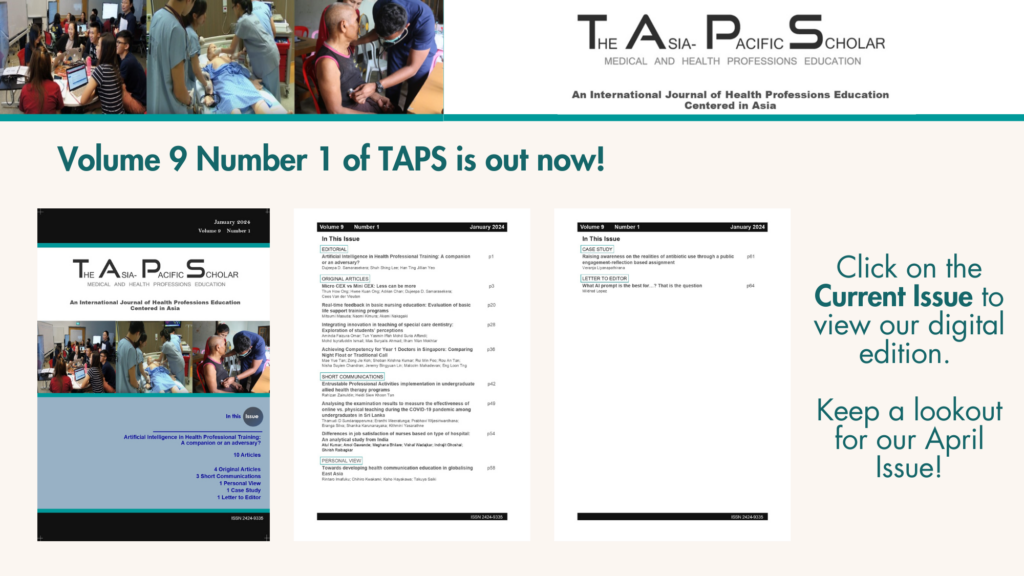
Congratulations, Dr Tri Nur Kristina and co-authors! - Volume 9 Number 1 of TAPS is out now! Click on the Current Issue to view our digital edition.
- Best Reviewer Awards 2022
TAPS would like to express gratitude and thanks to an extraordinary group of reviewers who are awarded the Best Reviewer Awards for 2022.
Refer here for the list of recipients. - Most Accessed Article 2022
The Most Accessed Article of 2022 goes to An urgent need to teach complexity science to health science students.
Congratulations, Dr Bhuvan KC and Dr Ravi Shankar. - Best Article Award 2022
The Best Article Award of 2022 goes to From clinician to educator: A scoping review of professional identity and the influence of impostor phenomenon.
Congratulations, Ms Freeman and co-authors. - Volume 8 Number 3 of TAPS is out now! Click on the Current Issue to view our digital edition.
- Best Reviewer Awards 2021
TAPS would like to express gratitude and thanks to an extraordinary group of reviewers who are awarded the Best Reviewer Awards for 2021.
Refer here for the list of recipients. - Most Accessed Article 2021
The Most Accessed Article of 2021 goes to Professional identity formation-oriented mentoring technique as a method to improve self-regulated learning: A mixed-method study.
Congratulations, Assoc/Prof Matsuyama and co-authors. - Best Reviewer Awards 2020
TAPS would like to express gratitude and thanks to an extraordinary group of reviewers who are awarded the Best Reviewer Awards for 2020.
Refer here for the list of recipients. - Most Accessed Article 2020
The Most Accessed Article of 2020 goes to Inter-related issues that impact motivation in biomedical sciences graduate education. Congratulations, Dr Chen Zhi Xiong and co-authors.