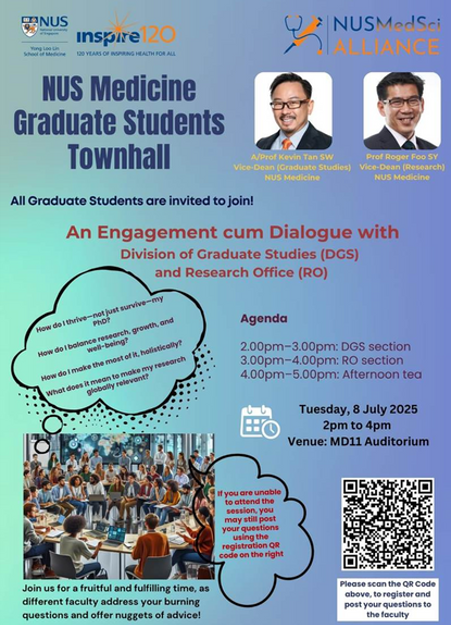
An Engagement cum Dialogue with Division of Graduate Studies (DGS) & Research Office (RO)
Dr Yu Haojie
Assistant Professor
Dept of Biochemistry
Precision Medicine
Research Interests:
My lab at NUS aims to establish an integrative and systematic approach to uncover novel regulators of cardiometabolic diseases by leveraging human GWAS data, cell type-specific eQTL, single-nucleus RNA sequencing & chromatin accessibility profiling, and CRISPR/Cas9-based functional screening. In addition, we have a strong focus on GPCRs and their roles in disease regulation. To advance therapeutic development, we utilize high-throughput compound screening and AI-driven ‘hit-to-lead’ optimisation to identify and refine novel GPCR-targeting therapies.
Potential Clinical Partnership:
We seek to collaborate with clinician to acquire patient-derived samples (plaques and liver) for single-nucleus RNA sequencing and chromatin accessibility profiling.
My lab at NUS aims to establish an integrative and systematic approach to uncover novel regulators of cardiometabolic diseases by leveraging human GWAS data, cell type-specific eQTL, single-nucleus RNA sequencing & chromatin accessibility profiling, and CRISPR/Cas9-based functional screening. In addition, we have a strong focus on GPCRs and their roles in disease regulation. To advance therapeutic development, we utilize high-throughput compound screening and AI-driven ‘hit-to-lead’ optimisation to identify and refine novel GPCR-targeting therapies.
Potential Clinical Partnership:
We seek to collaborate with clinician to acquire patient-derived samples (plaques and liver) for single-nucleus RNA sequencing and chromatin accessibility profiling.
My laboratory focuses on: -Biology of aging; -Proteostasis; – Mitochondria and NAD+ metabolism; – Preclinical models of neuromuscular disease (e.g. C. elegans, cell lines, rodents).
Potential Clinical Partnership:
Access to clinical samples for analyses of NAD+ metabolites in different cohorts (e.g. elderlies, chronic diseases)
Observatory studies linking energy metabolites to clinical phenotypes
Pilot/Intervention studies in humans with novel NAD+ precursors studied in my lab
mTORC1 signaling and muscle aging: Understanding how mTORC1 pathway disrupts proteostasis and contributes to sarcopenia.
Sex differences in muscle aging: Investigating how biological sex influences proteostasis mechanisms and responses to anti-aging interventions.
Potential Clinical Partnership:
One area where collaboration would be particularly impactful is the development of a non-invasive biomarker for mTORC1-associated sarcopenia. This project would aim to:
Identify circulating factors (e.g., plasma proteins, miRNAs, metabolites) that reflect mTORC1 activity and proteostasis status in skeletal muscle.
Correlate these biomarkers with muscle strength, composition, and functional assessments in older adults.
Lay the groundwork for early detection tools and monitoring response to targeted therapies, such as mTORC1 inhibitors or proteostasis enhancers.
My lab focuses primarily on pandemic sciences, with a particular interest in ‘bat viruses’ and ‘antibodies.’ Our team leverages surrogate systems to accurately quantify neutralizing antibodies, which are key immune biomarkers responsible for protection against viral diseases. Through surveillance, we aim to identify infectious disease threats in the region and better prepare for future pandemics, including the development of universal vaccines and therapeutic antibodies.
Potential Clinical Partnership:
To understand the correlates of protection, we aim to analyze clinical samples from patients infected with respiratory diseases, such as RSV and influenza viruses.
Discovery, engineering, and design of CRISPR and novel bacterial defense systems with the aim of developing innovative platforms for disease diagnosis and treatment.
Mine and characterize new CRISPR or other novel defense systems
Develop a sensitive and high-throughput RNA detection platform
Develop a precise and highly efficient knock-in platform in eukaryotic cells
Develop a precise and non-cytotoxic RNA knock-down platform
Develop a long-range genome knock-out platform
Develop a spatial, sequential RNA recording platform
Potential Clinical Partnership:
Our laboratory develops technologies for practical clinical applications, such as the DNA microarray-based multiplex disease detection platform, which relies on collaboration with clinicians to obtain patient samples—including those from sepsis cases. Additionally, our large-scale gene insertion research in eukaryotic cells, relevant to CAR-T cell therapy, underscores the importance of clinician partnerships.
At the NUS Yong Loo Lin School of Medicine, my research is dedicated to advancing precision oncology in breast and gynecological cancers by targeting nuclear receptor signaling and RNA helicases. By identifying predictive biomarkers and developing targeted therapeutics, my work aims to enhance drug efficacy, personalize treatment strategies, and ultimately improve patient survival and quality of life.
Potential Clinical Partnership:
Enhancing Immunogenicity in Triple-Negative Breast Cancer (TNBC): Our in-house drug development program focuses on modulating the tumor microenvironment to boost immunogenicity in TNBC.
Biomarker-Driven Optimization of Platinum Therapy in Ovarian Cancer: We are translating the clinical relevance of a key biomarker to refine patient selection for platinum-based therapies in ovarian cancer.