Issue 57
Feb 2026
THE BANYAN TREE
Within the next decade, it is projected that nearly a third of Singaporeans will be aged 65 and above, a demographic shift driven by longer life expectancy and declining birth rates. This ageing population presents growing challenges for our healthcare system, prompting a major transformation through Healthier SG, launched in 2022. The initiative focuses on proactive prevention, encouraging healthier lifestyles and anchoring residents with family doctors and healthcare professionals—supported by community care.
Optometrists, legislated by the Optometrists and Opticians Board (OOB) in 2008 as primary eye care professionals, are key partners in this preventive care model. As demand for eye care increases with age-related conditions, strengthening the clinical capabilities of community optometrists is essential to ensure accessible and sustainable care.
To support this, Yong Loo Lin School of Medicine, National University of Singapore (NUS Medicine) offers specialised Continuing Education and Training (CET) courses aligned with the Competency Framework of Clinical Optometry and Community Screening (COCS), an initiative by the Ministry of Health. These programmes aim to upskill community-based optometrists in the detection and co-management of common age-related eye diseases.
Two Graduate Certificates, namely, (i) Detection and Co-management of Anterior Eye Diseases, Cataract, and Glaucoma (GC-DCAEDCG), and (ii) Recognising and Co-managing Common Retinal Diseases (GC-RCRD) are designed for OOB-registered optometrists with degree qualifications. These courses enhance clinical confidence and capability in managing age-related eye conditions, such as cataract, diabetic retinopathy, age-related macular degeneration, and glaucoma.
Integrated teaching modalities for clinical excellence
The courses adopt a comprehensive instructional model combining face-to-face tutorials, video-recorded lectures, hands-on workshops and immersive clinical attachments in hospitals and polyclinics. The clinical placements provide direct patient care under the supervision of specialist ophthalmologists and Community Eye Clinic (CEC) optometrists from National University Hospital (NUH), Singapore National Eye Centre and NUH Polyclinics. Complementary hands-on workshops with real patients further reinforce diagnostic and procedural competencies.
This robust training framework is led by distinguished ophthalmologists with diverse subspecialties, clinical optometrists with extensive experience in CECs, and senior academic faculty from the university. Their combined expertise ensures that the programme remains academically rigorous and directly aligned with contemporary clinical practice.
Future plans
The NUS Department of Ophthalmology will continue to offer targeted educational programmes for local optometrists, strengthening their confidence and capability to deliver high-quality primary eye care in the community. To ensure the success and reach of these initiatives, we will strengthen collaboration with public and private healthcare institutions by sharing best practices and coordinating training and evaluation efforts, so that primary eye care continues to grow and evolve to meet community needs.
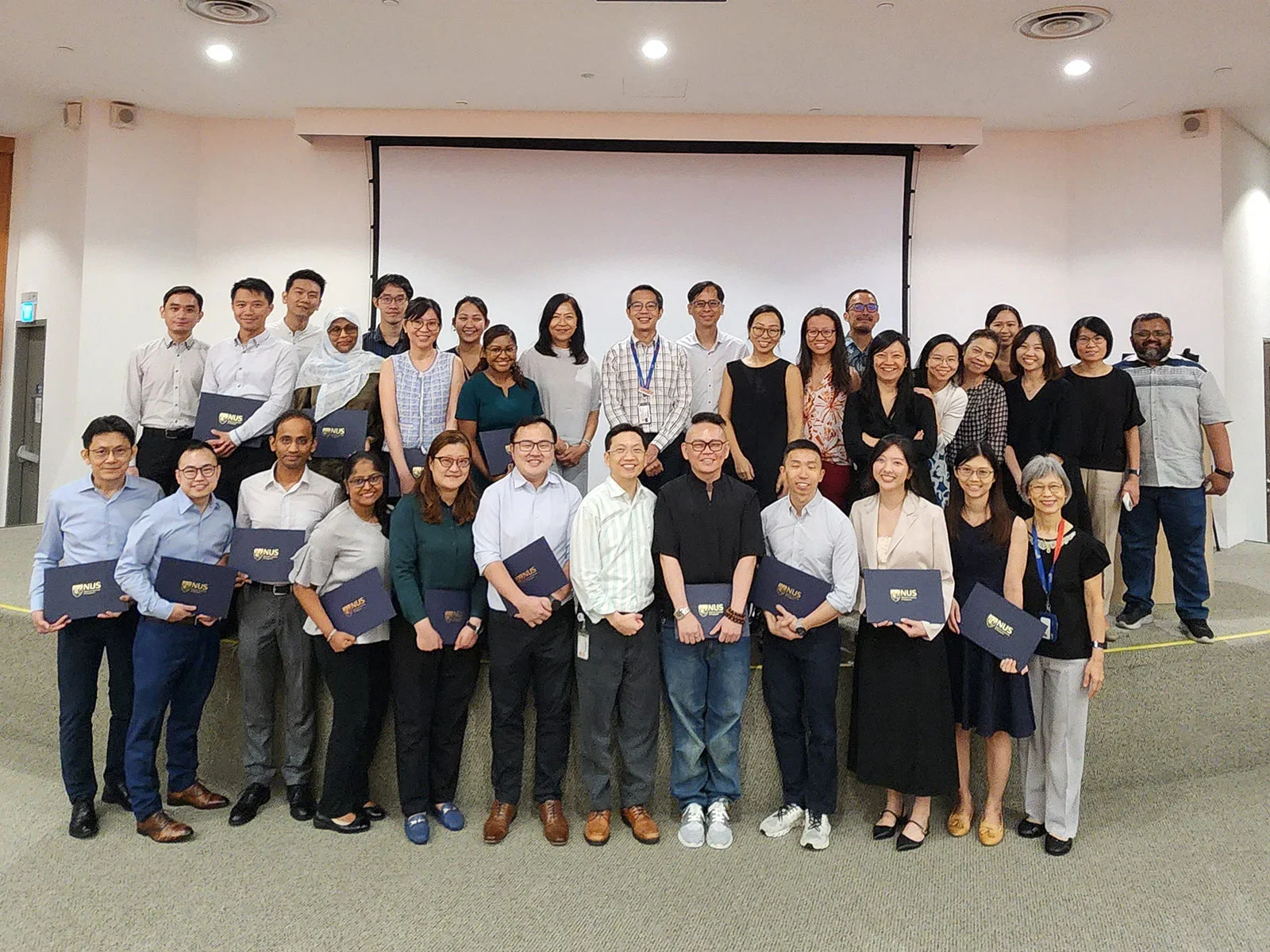
Insights [verbatim] from successful graduates:
I am so grateful for the knowledge, guidance, and friendships gained. This journey has truly elevated our optometry practice and deepened our purpose.”
Thank you to the programme organising committee, CEC Optometrists, and Ophthalmologists for making this learning journey so rich and fulfilling. I am grateful for your patience and support. I have grown and improved so much through this programme. A big thank you also to my course mates—I have learnt a lot from each of you, and I am glad we made it through together.”
Courses offered in the Graduate Certificates
Designed with working professionals in mind, these courses offer the flexibility needed to pursue advanced training while remaining in full-time roles.
(i) Detection and Co-Management of Anterior Eye Diseases, Cataract and Glaucoma (semester-long)
Modules |
Detection and Co-Management of Anterior Eye Diseases, Cataract & Glaucoma |
Credit Units |
1 |
Advanced Clinical Techniques for Anterior Eye Disease, Cataracts and Glaucoma |
4 |
2 |
Age Related Cataract and Symptomatic Anterior Eye Diseases |
3 |
3 |
Glaucoma Detection & Monitoring |
3 |
(ii) Recognising and Co-Managing Common Retinal Diseases (semester-long)
Modules |
Recognising and Co-Managing Common Retinal Diseases |
Credit Units |
1 |
Ocular Pharmacology for Clinical Optometrists |
2 |
2 |
Advanced Clinical Techniques for Retinal Diseases Detection and Management |
4 |
3 |
Common Retinal & Other Symptomatic Posterior Eye Diseases |
5 |
Register your interest in the next run by clicking this link.

This column is dedicated to the pursuit of continuous learning and development and takes its name from the banyan tree. It has roots that grow deep, anchoring it firmly in the soil. The tree spreads its shade wide and far and provides space for reflection and discussion. We invite you to come and take a seat under its shade.
More from this issue