Issue 57
Feb 2026
PEOPLE OF NUS MEDICINE
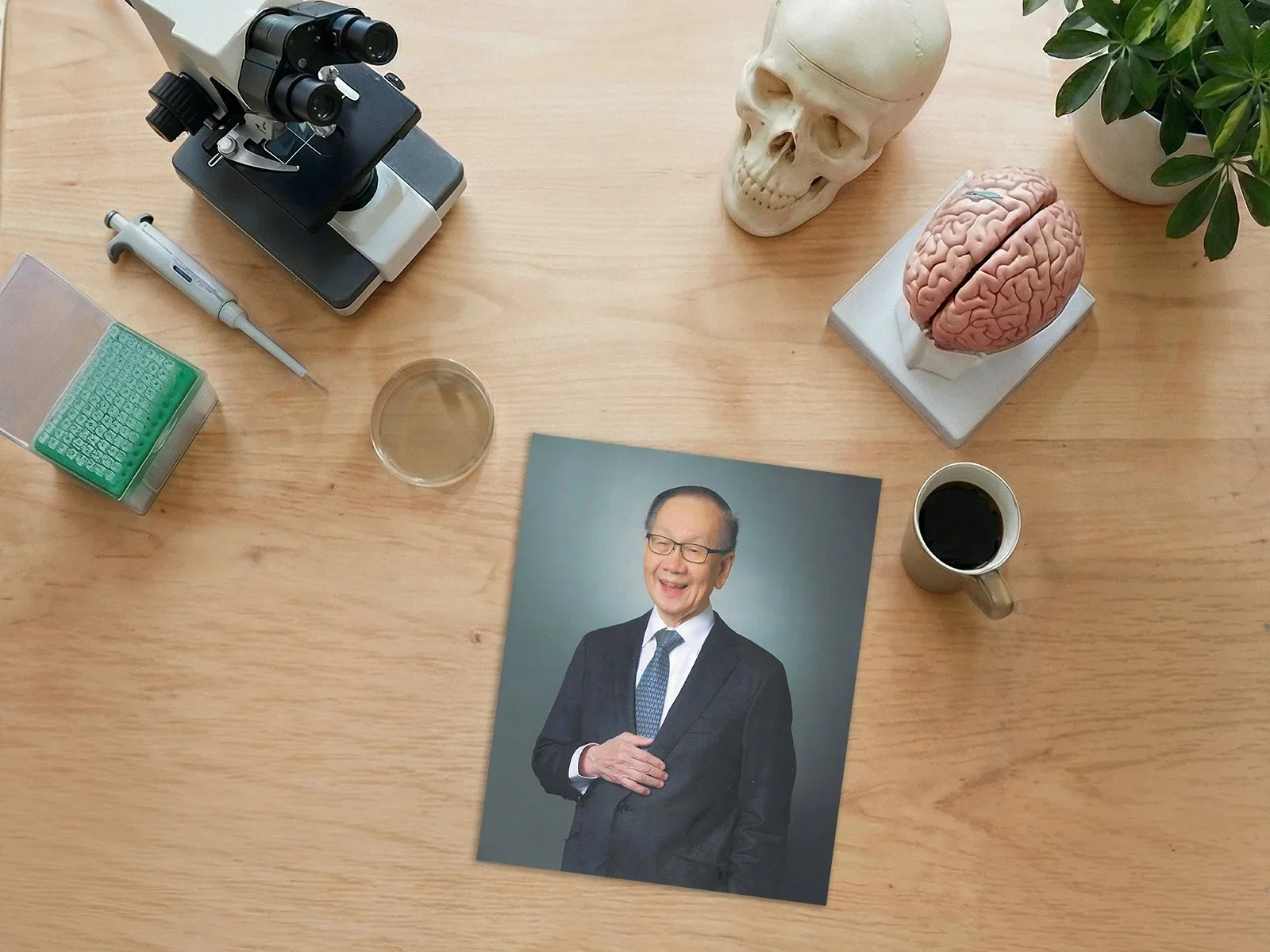
At 89, an abiding passion for teaching and unquenchable love for research sees University Professor Lim Pin still holding weekly tutorials for undergraduate students when MediCine met with him in August last year. Not for him a more sedate pace of work or the well-earned, laid back, leisurely pursuits of retirement after a life devoted to clinical practice, research and university administration. Not when his twin passions—teaching tomorrow’s doctors and tracking the progress of medical research—continue to beckon.
Retirement is a non-starter for the clinician-scholar who headed the then University of Singapore for 19 years, from 1981 to 2000. Under his watch, the university rose to international prominence. “I am a workaholic. I am supposed to be retired, but the medical school has very kindly offered post-retirement employment—giving me continued access to the library and feeding my appetite for reading up on what’s going on around the world,” said the grandfather of 10. His two sons and a daughter are all medically trained. His wife Shirley, a lawyer he met when they were both in England, passed away a few years ago. In his 2020 book, Recollections: Meeting Challenges and Seizing Opportunities, he dedicates a chapter to her. “In a way, this book is my ode to her and our lives together,” he wrote.
Prof Lim’s journey into a lifetime of medical service began when the Raffles Institution schoolboy was awarded the Queen’s Scholarship to study Medicine at Cambridge University. “I have always found medicine very fulfilling as a human person, being able to help other people in a very direct way. I enjoy simple things in my leisure, playing with my grandchildren, going on short trips. I am not the type to take long holidays. My mind is too active and after a while, I will ask myself if there are no better things to do! Oh, I exercise regularly, going to the gym and cycling. I believe it has helped me keep my mind alert,” he said in an earlier interview with SMA News (Nov 2005).
After graduating with an undergraduate medical degree from Cambridge University in 1963, he worked as a registrar at King’s College Hospital, London, and gained admission as a member of the Royal College of Physicians in 1965 before returning to continue medical practice at the Singapore General Hospital and then as Senior Consultant in Endocrinology at National University Hospital (NUH). He earned his Doctorate in Medicine from Cambridge in 1970 and was elected Fellow of the Royal College of Physicians in 1976. In 1978, he became full professor and Head of the Department of Medicine, National University of Singapore (NUS). He is also an Emeritus Consultant in Endocrinology in NUH and Professor of Medicine at Yong Loo Lin School of Medicine, National University of Singapore (NUS Medicine).
The quest for biomedical knowledge and understanding
His passion for research traces back to 1966, when he first returned to Singapore to work as a doctor and medical lecturer at the then-University of Singapore’s Department of Medicine. He would see patients and teach medical students during the day and work on his research in the evenings and on weekends.
With a young family to raise, time was precious. “There was no such thing as protected time for research then.” His research specialties in calcium, magnesium and bone metabolism, thyroid diseases and fuel metabolism in diabetes have led to more than 100 published papers.
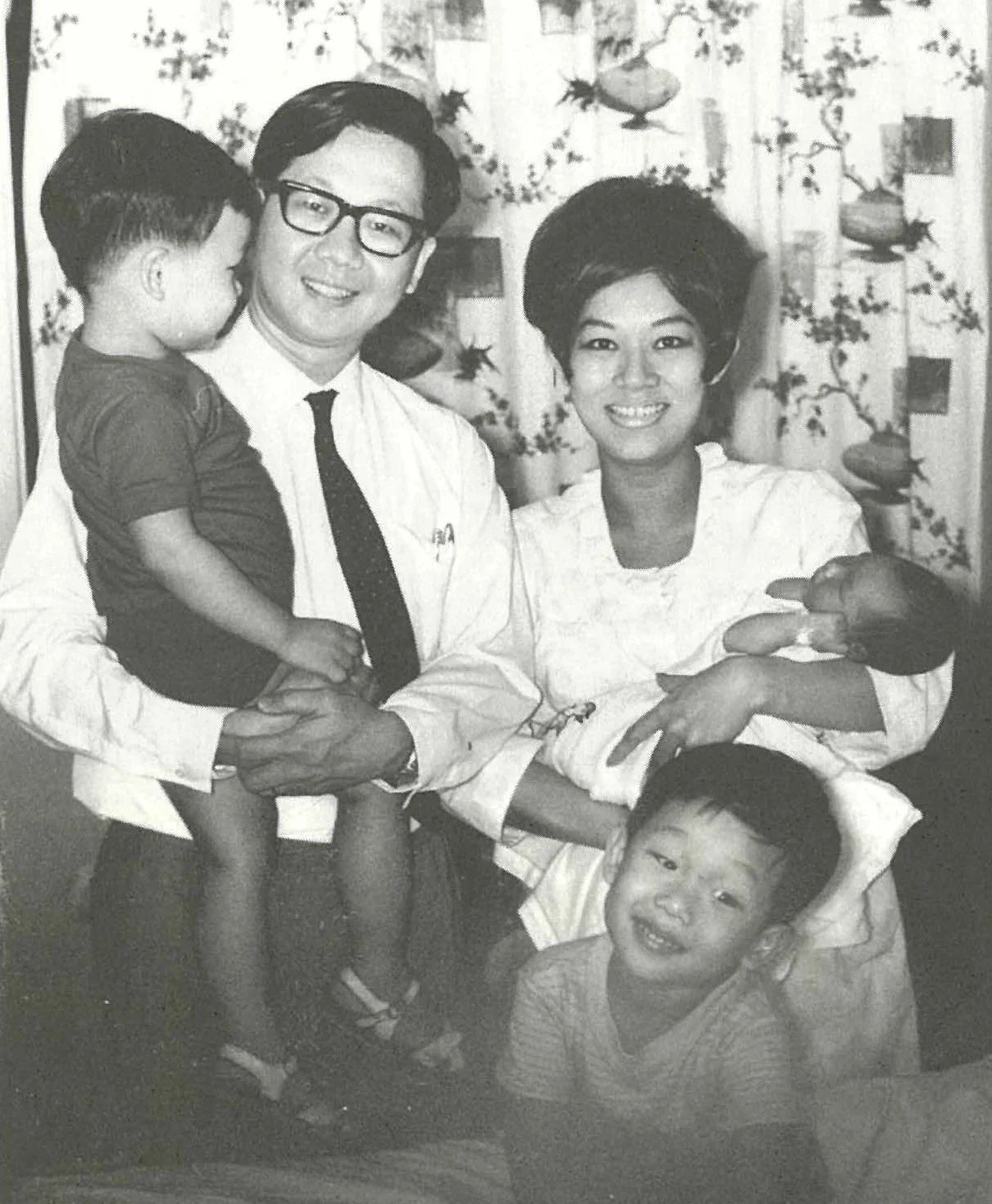
Prof Lim’s young family in 1966.
Medical research is fundamental to better patient care. Absent the quest for understanding of disease etiology, solutions as well as medical progress would come to a standstill. “I enjoy seeing the new ground that research uncovers and learning about its potential to do good for patients. For example, a new discovery to treat a disease that was previously incurable, or a new way to investigate a complex problem that ultimately leads to a solution,” he said.
But the young university grappled with many competing needs, funding for biomedical research was limited and laboratory facilities were basic. “We were new, young, and unknown to industries and the global research community,” he recalled. “We also couldn’t count on our young government for research funding because they had other more pressing uses for the nation’s resources. So despite the potential, there was little interest in research then.”
“So what did we do? We went next door—for example, to the hospital’s biochemistry department—to see what we could do together. We didn’t just share ideas and whatever equipment we could afford to buy, but also collaborated on joint authorship of publications. In the process, we cultivated a multidisciplinary research culture that continues to this day.”
Planting seeds
Medical research goes hand-in-hand with education, a belief that Prof Lim put into practice at the university. “I had been convinced that university education should train students to learn independently and adapt to change for the rest of their working life,” he wrote in Recollections1. Where students once gathered en masse for lectures, Prof Lim implemented the small-group lecture-tutorial system: “students wouldn’t just regurgitate book knowledge, but actively explore problems, find solutions and think creatively.”
He also felt that Singapore needed to nurture all-round thinkers who were exposed to various methodologies of problem-solving and in various different disciplines. Thus, the university launched semester modules that were made up of central core subjects as well as unrestricted smaller elective modules. Students were introduced to project-based work, field studies and business entrepreneurship. They, as well as academic staff, went overseas for electives and sabbaticals and foreign academics were invited to Singapore to interact with the university. “I enjoy teaching. When I teach, I don’t just focus on imparting knowledge or theories. Instead, I pose questions to get students thinking about the problem and engage them in discussions,” he shared. “I always tell my students that what I share in class are only seeds—and it’s up to them to germinate and nourish those seeds into something bigger.”
Prof Lim’s teaching philosophy has clearly resonated with his students, evidenced by the various teaching awards that decorate his office walls and shelves. He added, “I also make it a point to ensure that my students feel seen, heard and included. Taking the time and effort to understand them and their perspectives is often all it takes to keep their enthusiasm going. I think because of this—or maybe I’m just lucky—I cannot remember a single instance of a bad student in all my years of teaching. I still look forward to going to class today,” he added.
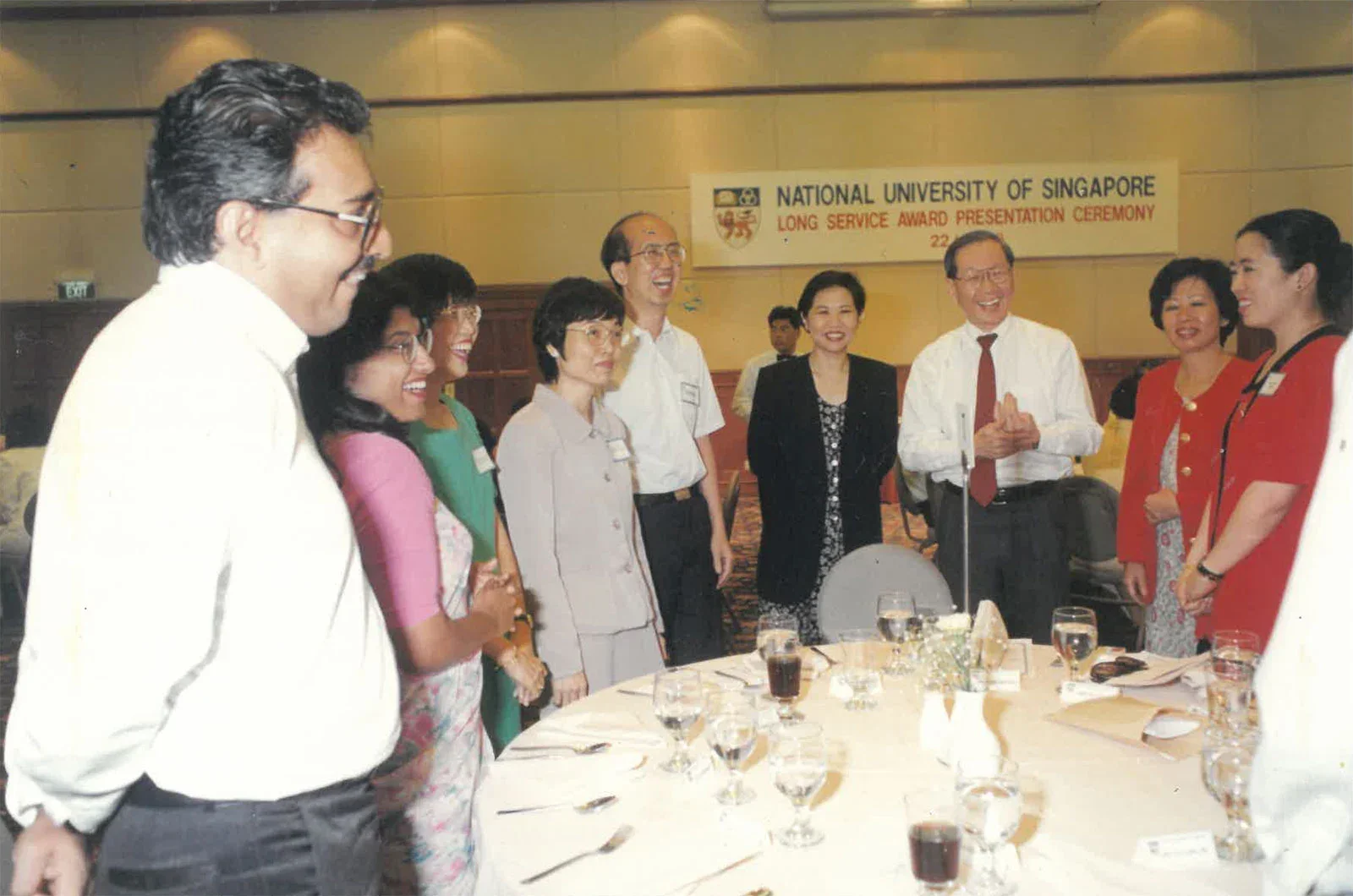
At the University Long Service Awards event.
His students hold him in the highest regard, said Professor Roger Foo, NUS Medicine Vice-Dean (Research) and Director of the Cardiovascular Research Institute. “Prof Lim is to us, and so many generations of NUS medical graduates, much more than just a role model. He was NUS Vice-Chancellor when I was a medical student. We held him in utter awe and respect—he exuded scholarliness in every exchange that I recall. He remains passionate about his calling and is in tune with where medicine and science are going globally. Unreservedly, he offers his support for all the research our school pushes hard at today. Limitless intellectual curiosity and drive, razor keen memory, gracious courtesy—that is Prof Lim and we celebrate him and what he has done for NUS, medicine and science in Singapore.”
Even so, Prof Lim didn’t want his own children to study Medicine at NUS. “I wanted my children to study overseas not because I did not think highly of our own university, but really because I wanted them to compete and get into medical school on their own merit. I was also conscious of my own position in the university and wanted to avoid any perception of nepotism or unfair advantage given to my children for admission to the highly competitive Faculty of Medicine.”
“The art of medicine, or what I call medical humanity, has been somewhat over-shadowed by medical science and technology,” he told SMA News in the same earlier interview. “Perhaps some of us have become over-reliant on technology and hence think, why bother with asking the patient when a simple blood test or scan will provide me with the answer. This approach overlooks the importance of the clinical judgement and the value of rapport in healing. I cannot over-emphasise the role of trust and communication in making patients feel better and actually become better. Medical science and technology are essential but insufficient for good patient care and have to be combined with bedside skills and medical humanity for synergy to maximise impact.”
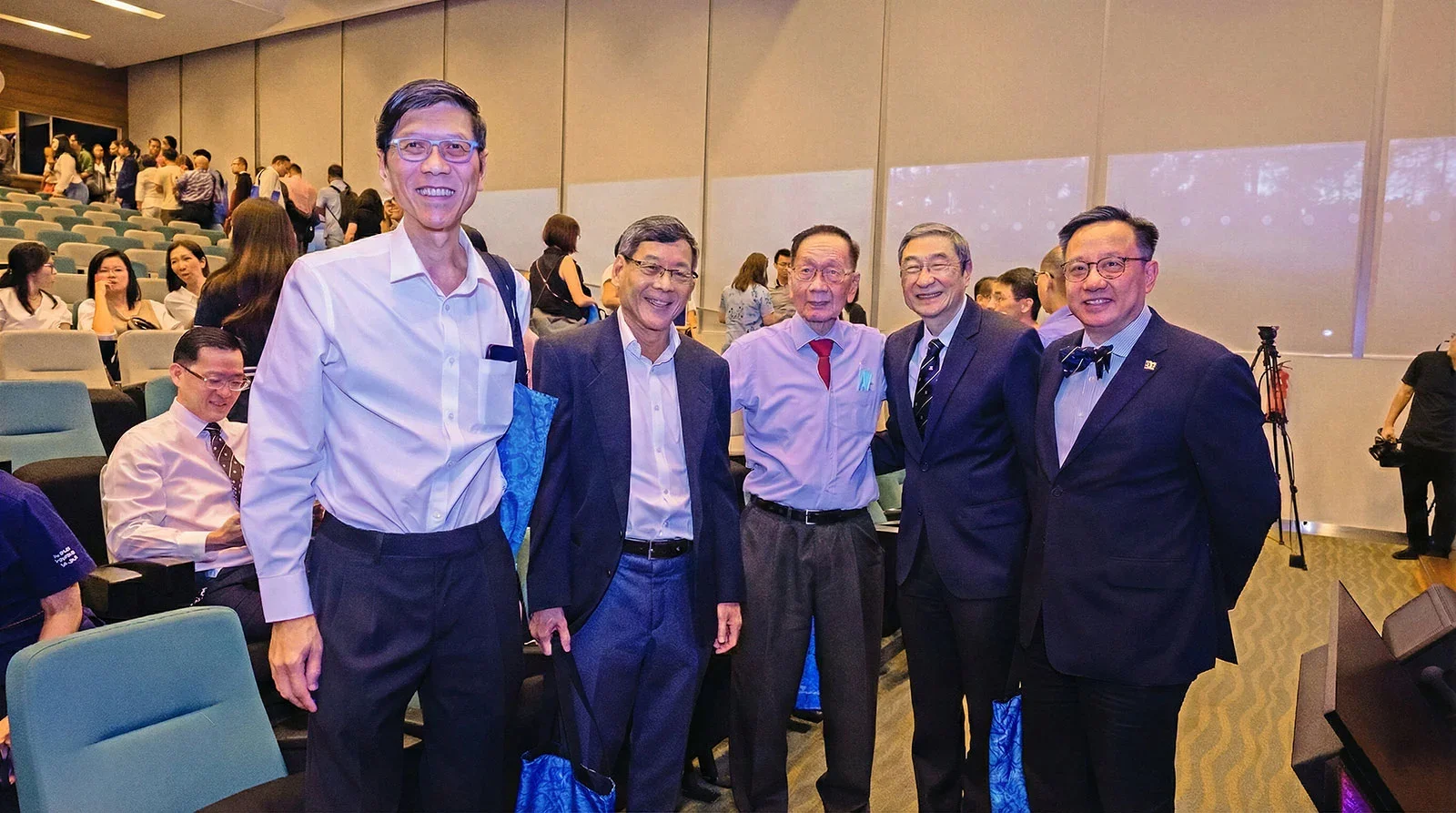
(Left to right) Prof Tan Chorh Chuan, Permanent Secretary (National Research and Development), National Research Foundation; Prof Yeoh Khay Guan, Chief Executive, National University Health System; University Prof Lim Pin; Prof John Eu-Li Wong, Executive Director, Centre for Population Health, NUS; and Prof Chong Yap Seng, Dean, NUS Medicine, at the NUS Medicine 120th Anniversary staff celebration on 2 July 2025.
Putting Singapore and the university on the world map
Prof Lim Pin’s contribution to education is not limited to the classroom. As NUS’ longest-serving vice-chancellor, he was instrumental in shaping Singapore’s broader education landscape. He made research one of his priorities, persuading the Singapore Government to invest large amounts of money into new projects and to recruit researchers from overseas.
Looking back on this period of his career fondly, he said, “Singapore was a young nation then—we wanted to create high value-adding industries with well-paying jobs here. We were very clear about not wanting to settle for just being technicians, but to rise above that. That’s where the university played a key role. We needed high-calibre, educated people who were both capable of helming the industries and keeping them running, as well as innovating and creating new things.”
By 2000, the research and development budget had increased. NUS forged links with local and international companies, while the foundations for research institutions like the Institute of Systems Science, NUS; the Institute of Molecular and Cell Biology and the National Science and Technology Board (later renamed A*STAR) were laid. Probably unknown to today’s generation of university staff and students, it was Prof Lim who introduced the internet on campus. It was soon introduced throughout Singapore: “This facility has practically put NUS and Singapore on the world map. We definitely achieved what we set out to do, and more. The fact that the Presidents of Nanyang Technological University and Singapore Management University, Professor Ho Teck Hua and Professor Lily Kong were both from NUS says it all.”
“Prof Lim’s legacy is woven into the fabric of Singapore Medicine, which has advanced because of the foresight, courage, determination and commitment of generations of visionary leaders who dared to dream and worked to turn those dreams into reality,” said NUS Medicine Dean Professor Chong Yap Seng. “We ride on the shoulders of these giants, among whom stands University Professor Lim Pin. His faithful and unwavering leadership as Vice-Chancellor over the years laid the foundations for NUS’ success, even as his superior medical acumen and keen intellect contributed immensely to the growth and development of education and research at NUS Medicine.
Retirement will come, but not just yet. For University Professor Lim Pin, who also continues to chair the NUHS Fund (a charity established to provide financial support to needy patients), winter is far from being a season of discontent. Not when there are still students to teach, patients to attend to and the latest research programmes to keep track of.
Recollections: Meeting Challenges and Seizing Opportunities, Lim Pin, Candid Creation Publishing, 2020.
https://www.nlb.gov.sg/main/article-detail?cmsuuid=a018a745-e6ab-42e3-b3ce-75c4315a8501.
https://www.sma.org.sg/sma_news/3711/feature.pdf.
More from this issue
PEOPLE OF NUS MEDICINE
Running a Marathon for Women’s Health
SCIENCE OF LIFE
Alcoholism’s Genetic Link