The event drew a wide array of
300
participants from numerous countries

Issue 57
Feb 2026
ETHICALLY SPEAKING
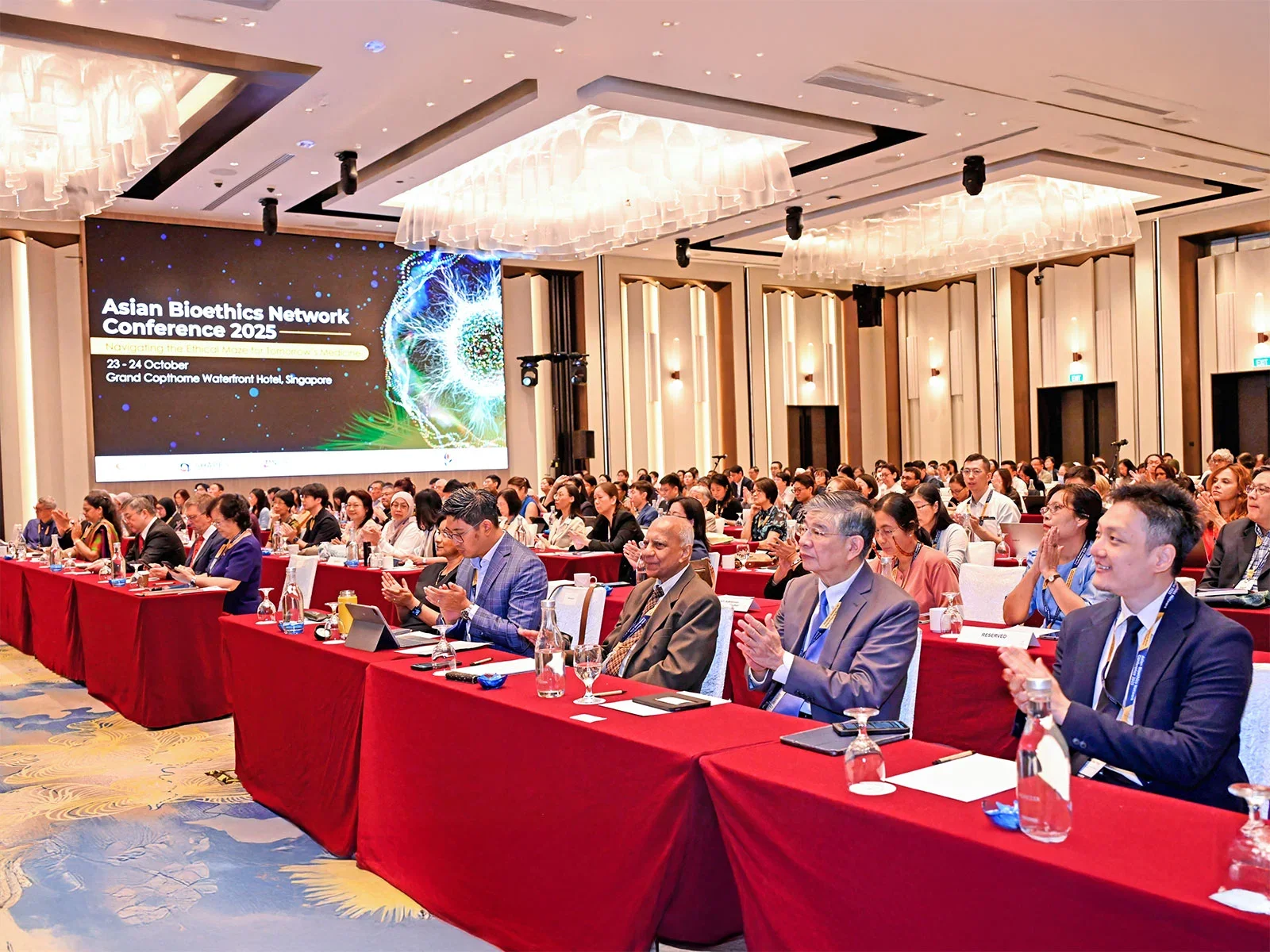
Participants at the ABN Conference 2025.
From artificial intelligence (AI) to traditional medicine, the Asian Bioethics Network (ABN) Conference 2025 examined the vital role of ethics in shaping responsible health innovation. Bringing together more than 300 participants from across continents, the ABN Conference 2025 in Singapore tackled the ethical challenges emerging from rapid medical and technological advances.

The ABN Conference 2025 (23 and 24 October) in Singapore brought together a diverse group of experts to explore the complex ethical dimensions of contemporary healthcare. Co-organised by the Centre for Biomedical Ethics (CBmE) at the Yong Loo Lin School of Medicine, National University of Singapore (NUS Medicine) and the Bioethics Advisory Committee (BAC), with support from the Ministry of Health (MOH), the conference served as a crucial platform for international collaboration and dialogue on pressing bioethical issues. The event was graced by Guest-of-Honour, Professor Kenneth Mak, Director-General of Health, MOH.
The conference highlighted the rapidly evolving healthcare landscape, shaped by advances in AI, longevity science, and traditional medicine. Participants also discussed the need for strong ethical frameworks to guide innovation, and ensure responsible implementation. As Adjunct Professor (Dr) Raymond Chua highlighted, regulations alone are insufficient; ethics must be integrated from the outset to serve as a “compass pointing us in the right direction.”
The event drew a wide array of 300 participants from numerous countries, including the US, South Korea, UK, New Zealand, Australia, China, Myanmar, Indonesia and India, reflecting its broad international reach and the global relevance of its themes.
The conference commenced with addresses from Mr Gregory Vijayendran SC, Deputy Chair of the BAC, and Dr Sumytra Menon, Director, CBmE, NUS Medicine, and Guest-of-Honour, Prof Mak. The conference also featured the launch of the BAC’s Ethical, Legal and Social Issues Arising from Human Nuclear Genome Editing (HNGE) publication and Biomedical Ethics in Singapore: Cases and Commentary Book.
Day One commenced with a keynote by Professor Julian Savulescu, Head, CBmE, NUS Medicine, on “How to Form Ethical Policy: Collective Reflective Equilibrium.” Prof Savulescu discussed the intricate process of developing ethical policies, advocating for a method that involves a continuous interplay between general principles and specific judgments, aiming to achieve a coherent and justified set of beliefs. This approach, he argued, is crucial for navigating complex bioethical challenges and ensuring that policies are both principled and practical.

Adj Prof (Dr) Raymond Chua, CEO of the Health Sciences Authority and Deputy Director-General of Health, MOH, kickstarted Day Two with a keynote presentation, exploring “Is Ethics an Important Component of Regulations in Tomorrow’s Healthcare?”. He noted that while regulations are vital for ensuring the safety and efficacy of medical innovations, they have limits when it comes to addressing broader societal and moral questions. Regulations, he explained, can define the technicalities of clinical trials but cannot determine fairness in access, cultural sensitivity, or public acceptability. Adj Prof (Dr) Chua called for ethics to be embedded into regulatory frameworks from the start, not as a brake, but as a “compass pointing us in the right direction” toward safe, humane, and inclusive healthcare.
Other sessions across the two days delved further into ethical and regulatory challenges across healthcare, longevity, and traditional medicine. Plenaries covered AI applications in colonoscopy, IVF, mental health, and diabetic retinopathy, addressing liability, algorithmic bias, and the use of “digital psychological twins” in informed consent. Longevity discussions examined public attitudes, global equity and debates over a “normal” lifespan. Sessions also addressed precision medicine, genomic research governance, microbial genomics, and ethical dilemmas in biological research, alongside the integration of traditional, complementary, and integrative medicine (TCIM), considering patient preferences, alternative treatments, and regulation of practices such as traditional Malay medicine, fostering transdisciplinary knowledge exchange.
The ABN Conference 2025 concluded with a closing address by Associate Professor Devanand Anantham, Chair of the National Medical Ethics Committee, marking a meaningful exchange on the ethical challenges and opportunities shaping modern healthcare. With engaging discussions on AI, longevity, and traditional medicine, the conference reinforced its role as a key platform for advancing bioethical dialogue and guiding responsible innovation.
Prof Savulescu discussed the intricate process of developing ethical policies, advocating for a method that involves a continuous interplay between general principles and specific judgments, aiming to achieve a coherent and justified set of beliefs. This approach, he argued, is crucial for navigating complex bioethical challenges and ensuring that policies are both principled and practical.
More from this issue