30-minute fMRI scans deliver up to
22%
in cost savings while retaining or even improving prediction accuracy

Issue 56
Nov 2025
SCIENCE OF LIFE
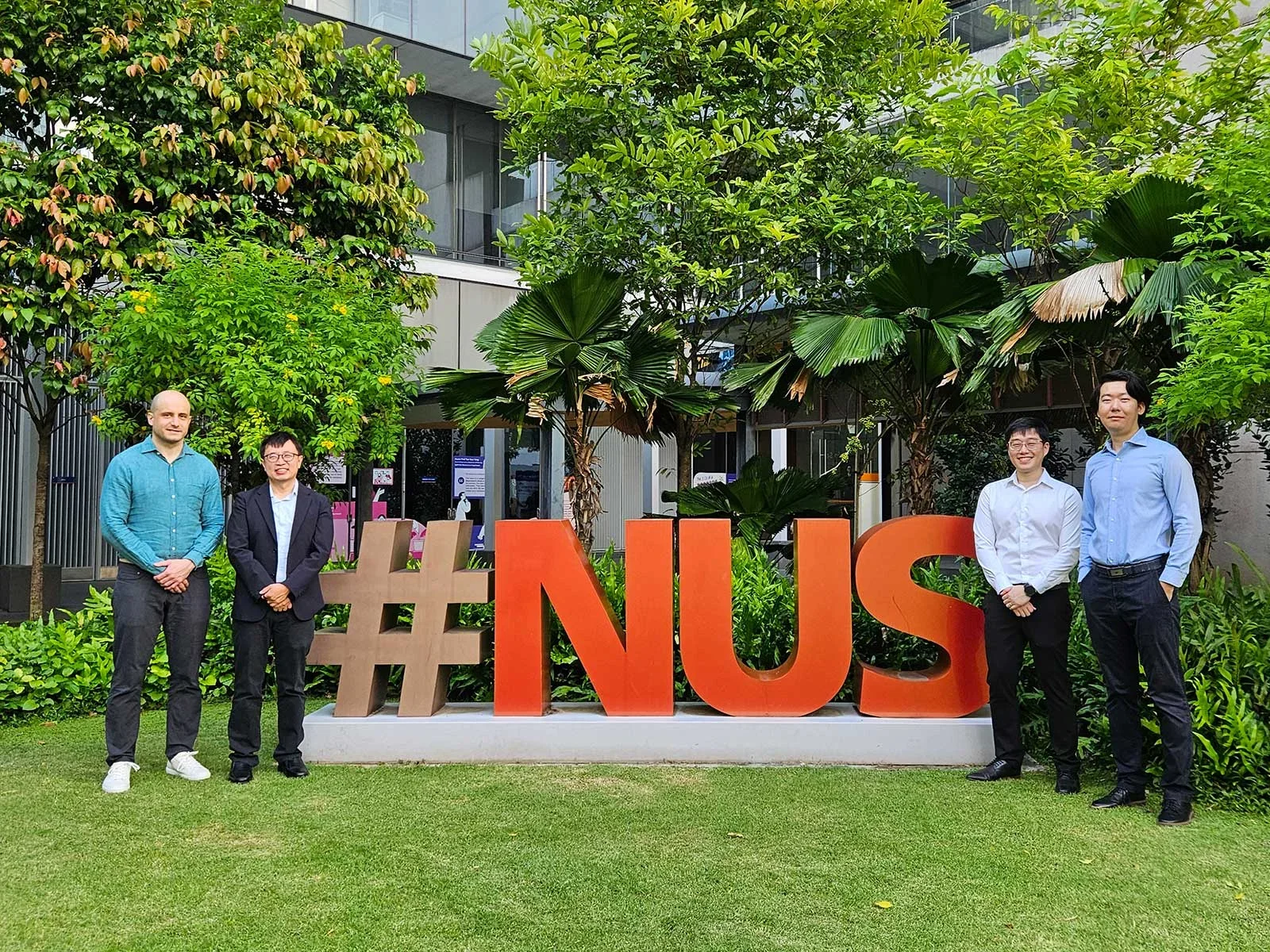
The research team from the Centre for Sleep and Cognition, NUS Medicine, (left to right): Dr Csaba Orban, A/Prof Thomas Yeo, Dr Leon Ooi, Dr Shaoshi Zhang. Photo credit: NUS Medicine.
Researchers from the Yong Loo Lin School of Medicine, National University of Singapore (NUS Medicine) have found that scanning fewer people but for longer durations may offer better value and accuracy in brain-based AI predictions. The study, published in Nature, showed that 30-minute functional MRI (fMRI) scans strike the optimal balance between data quality and cost, resulting in savings of up to 22% in overhead costs. These insights challenge current neuroscience norms and support more efficient approaches to developing personalised brain health interventions.
Traditional thinking in neuroscience emphasises collecting massive datasets by scanning thousands of people for brief durations, usually around 10 minutes for fMRI. Artificial Intelligence (AI) models can then be trained to use the brain scans to make predictions of individual-level traits or outcomes. These traits and outcomes might include cognitive abilities (e.g. memory, executive function), mental health indicators and clinical outcomes (e.g. risk of Alzheimer’s disease). Yet as participant numbers climb, so do the costs: even a brief scan can turn expensive once the hidden costs of recruiting, scheduling, and administratively tracking those volunteers are factored in. Short scans also may not capture enough high-quality information to make reliable personalised predictions.

So while AI models trained on large datasets are increasingly seen as the key to unlocking personalised treatments for brain disorders, the rising costs of scaling AI posed the question of whether it is more cost‐effective to scan more people for a short time, or fewer people for longer?
A study—published in the journal Nature—from a team led by Associate Professor Thomas Yeo from the Centre for Sleep and Cognition, NUS Medicine, now offers a clear answer: 30-minute fMRI scans deliver up to 22% in cost savings while still retaining or even improving prediction accuracy.
Working with collaborators around the world, including Professor Thomas Nichols from the University of Oxford and Professor Nico Dosenbach from the Washington University in St. Louis, the researchers developed a mathematical model that predicts how changes in scan time and the number of participants affect the performance of brain-based AI models. The team validated their model using nine international imaging datasets encompassing thousands of individuals of varying ages, ethnicities, and health statuses. They found that their model can be used to customise study design to maximise prediction accuracy and minimise cost. Scanning each person for 30 minutes provides a sweet spot to maximise prediction accuracy and minimise research costs.
“For years, the mantra has been ‘bigger is better’. We’ve chased ever-larger cohorts without asking how long each person should be scanned. We show that in brain imaging, ‘bigger’ doesn’t have to mean larger cohorts. It can also mean more data per person,” said A/Prof Yeo. “In essence, we can get the best of both worlds—better prediction at a lower cost.”
For years, the mantra has been ‘bigger is better’. We’ve chased ever—larger cohorts without asking how long each person should be scanned. We show that in brain imaging, ‘bigger’ doesn’t have to mean larger cohorts. It can also mean more data per person. In essence, we can get the best of both worlds—better prediction at a lower cost.”
This finding could reshape how researchers design neuroscience and mental health studies, especially for hard-to-recruit populations, such as patients with rare neurological conditions. The team is now refining their model using real-world clinical data and emerging brain imaging technology. Their goal: make it even easier for researchers and health systems worldwide to design smarter, more cost-effective brain studies. By helping studies collect better data for less money, the work could shape future research in neurology and psychiatry—and guide national and global efforts towards more personalised, affordable healthcare.
Prof Nico Dosenbach, a neurologist from the Washington University in St. Louis and co-author of the study, added, ““his is a game-changer for the field. It gives research teams a rigorous, quantitative way to design smarter studies, especially critical as we move towards precision neuroscience. Longer scans mean better estimates of brain connectivity, which translates into more reliable links to cognition and clinical symptoms.”
The study was jointly first authored by Dr Leon Ooi, Dr Csaba Orban, and Dr Shaoshi Zhang, research fellows in the laboratory of A/Prof Yeo who is the senior and corresponding author of the study.
More from this issue


PEOPLE OF NUS MEDICINE
Asian Focus, Global Impact: Understanding Heart Disease in the Asian Context