Issue 56
Nov 2025
PEOPLE OF NUS MEDICINE

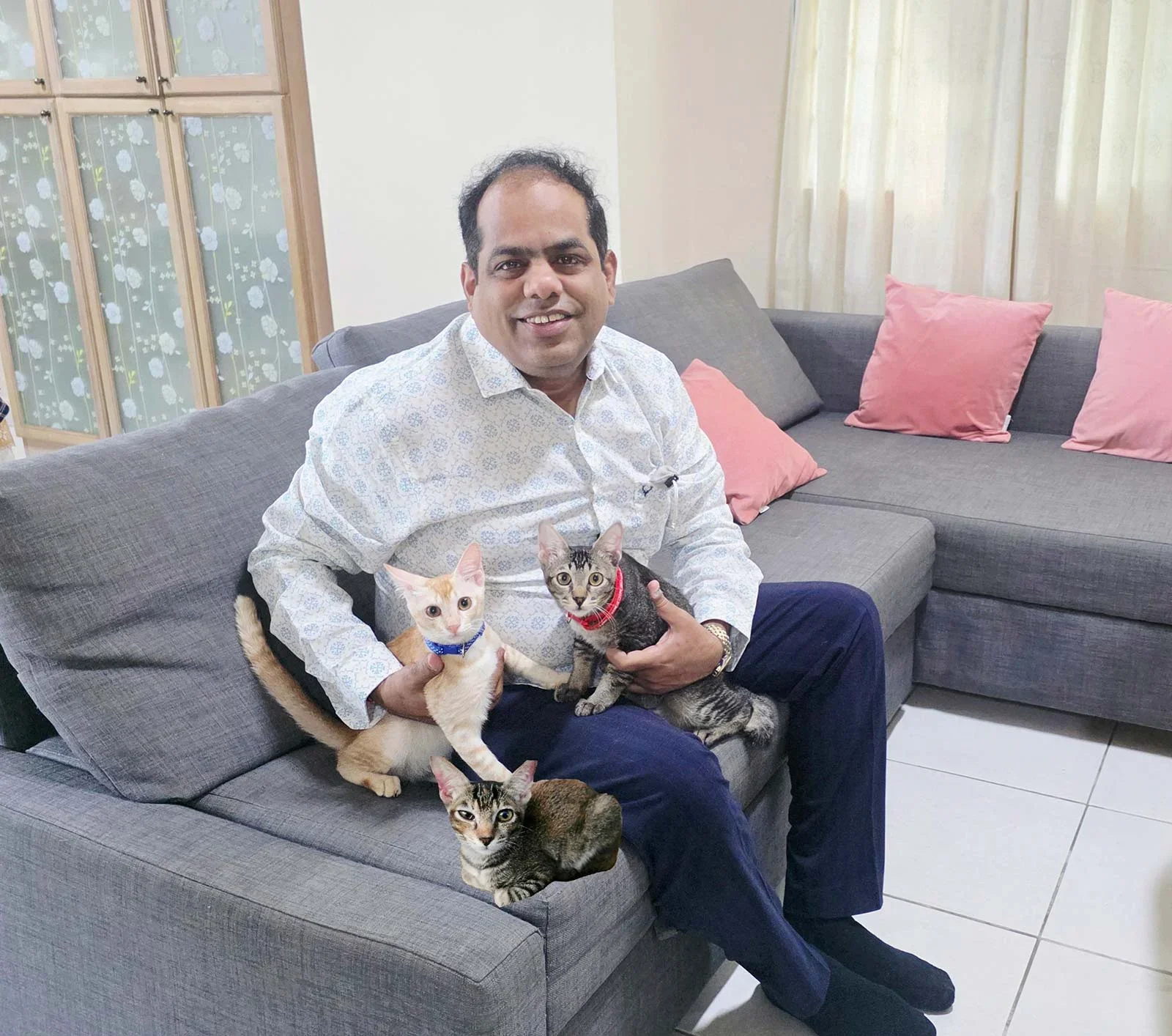
For the past eight years, Associate Professor Srinivasan Dinesh Kumar has kept a nightly dinner appointment—with 21 community cats.
But every now and then, he gets stood up by his dinner dates. When that happens, like a worried parent, the 54-year-old Medical Science Lead for Cardiovascular System Block and Lead of Continuing Education and Training (Anatomy) at Yong Loo Lin School of Medicine, National University of Singapore (NUS Medicine) makes another round later in the night, “The typical time I feed them is between 7pm and 8pm. That is when I make my rounds around my estate and the neighbouring school in Dover. If I don’t see them during this time, I’ll worry if they were held up for some reason, hadn’t eaten and are waiting for me to come around with the food.”
Usually, they will be waiting when he comes around the second time at about 10pm. “I am a happy man—once I see and feed them.” He also foots the bill for these dinners, “I need to order fresh cat food every two to three days because I can go through 18 to 20 cans a day. On average, that works out to a few hundred dollars per month.”
A quiet kind of joy
His care for these stray cats extends beyond food to include expenses for rehoming before adoption, as well as vet visits for mandatory microchipping, vaccination, sterilisation or treatment when they fall sick. With one trip to the vet easily costing a few hundred dollars or more, A/Prof Srinivasan once spent close to a thousand dollars on vet fees for an aged cat with kidney failure. “Vets are even more expensive than human doctors. Sometimes, I can’t help but question my own career choice,” he joked. Costs aside, there is also the constant juggling to fit caring for his feline friends into his academic work schedule.
“It’s not always easy,” he said, “but it is a long-term commitment and a meaningful part of my life. Almost like a mindfulness practice between meetings and classes—it is part of my daily rhythm, bringing me a quiet kind of joy.”
Awakenings
It’s a joy he discovered eight years ago. “I wasn’t always a pet person. Since young, I was taught that pets—and in particular, cat fur—could cause allergies and asthma. So I kept my distance from them, and naturally, the idea of adopting one was out of the question.”
The turning point came in 2017 when he became Hall Resident Fellow (RF) of Temasek Hall and lived on campus. Frequent visits from one of the Hall’s resident cats, Oreo, prompted him to try feeding her—except he didn’t know what to give the animal.
“She seemed hungry, so I tried sharing my food. It quickly became clear she didn’t like it,” he recalled with a smile. “Eventually, I approached someone from NUS CatCafé who explained that there is specific food for cats.”
Just like that, he began feeding one cat regularly, then four—and now 21. His journey as a cat feeder has unfolded in tandem with his growing love for cats. He shared, “I feel a sense of responsibility and affection for these community cats. They’ve become part of my extended family, and caring for them has been a deeply fulfilling experience.”
A close collegial affair
When his tenure at Temasek Hall ended, A/Prof Srinivasan moved out, but his care for community cats continued. “I don’t see these cats as ‘just animals’. To me, they are like family—so just like how we find time for the people who matter, I make time for them too.”
Even when he travels overseas for conferences, meetings, or holidays, the care doesn’t stop. He arranges with close friends or trusted colleagues to help care for the cats in his absence. “I am very grateful to them for stepping in. But at the same time, I always make it a point to keep my overseas trips brief—so that I can return to check on the cats myself,” he mused. “It’s a balancing act, but one that I take on with intention and heart. In many ways, these cats have given me as much comfort and companionship as I have tried to give them.”
That is why he names the cats he cares for. Over the years, A/Prof Srinivasan has named many—Oreo, Whitey, Angel, Reverse Oreo, more recently the cats near his place: Goldie, Bourbone, Whiskie, Zebra, Baby and Tyson, and Bourbone’s kittens: Jerry, Tobby and Lilly.
“I believe giving them names is the first step in seeing them not just as strays, but as lives that matter,” he explained. “Names give them identity, a sense of belonging, and they help me keep track of their personalities and histories.”
And then there were three
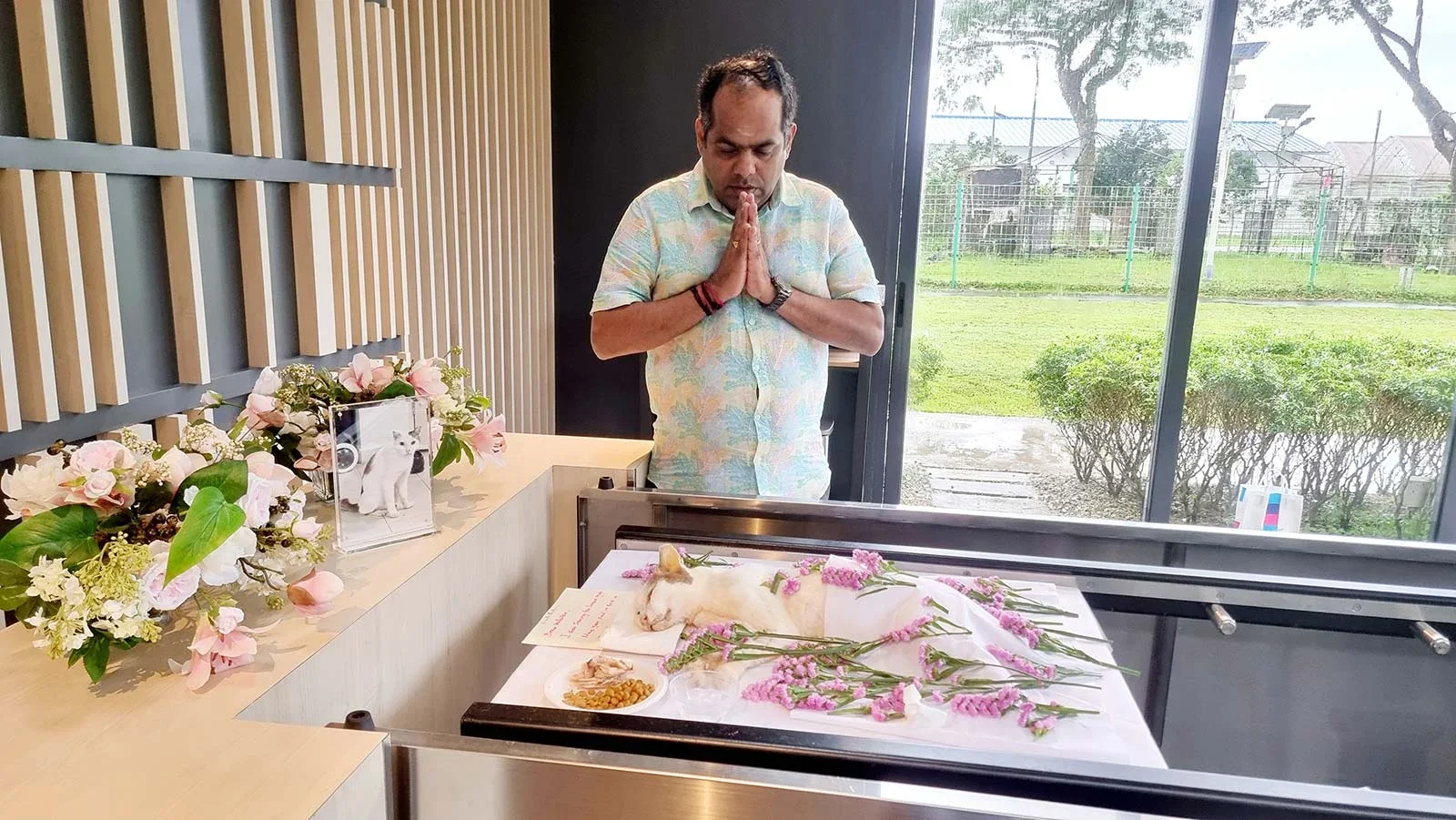
Despite being the community cats’ ardent advocate and protector for years, A/Prof Srinivasan had no cat of his own—until very recently. “Many of these cats are already used to being outdoors and have bonded with their environment. So instead of removing them from their familiar space, I try to care for them where they are—making sure they are safe, fed and not alone,” he said. “However, a spate of recent events where three of the cats I had been caring for were forcefully relocated without notice, made me decide to adopt three kittens.”
He added, “Cats and cat feeders are a mistaken lot. Contrary to beliefs that they dirty the place, cats usually cover their urine and excretion. Similarly, cat feeders usually clear up the leftover food after the cats are done eating. So the community would do well to show kindness and patience to both.”
That experience reminded me how even the smallest life, when treated with dignity, responds with silent gratitude. It reinforced my commitment to stand by them in moments of vulnerability. In many ways, it mirrors what we do in Medicine and education: being present for others, not just when it’s convenient, but especially when it’s hard.”
Life lessons
He gets emotional talking about his journey with his furry friends. Once, during his days at Temasek Hall, one of the cats he cared for—Whitey—became very ill. “During her last days, she was frail and unwell, but she would always walk to me and remained by my side. Cats can’t speak, but they communicate in other ways,” he said.
“That experience reminded me how even the smallest life, when treated with dignity, responds with silent gratitude. It reinforced my commitment to stand by them in moments of vulnerability. In many ways, it mirrors what we do in Medicine and education: being present for others, not just when it’s convenient, but especially when it’s hard.
In caring for his felines, the teacher in A/Prof Srinivasan learned precious lessons. “Through caring for community cats, I’ve learnt to notice subtle changes: when something is wrong, when they are unwell or simply need comfort. That attentiveness also carries into how I engage with students and colleagues—and shaped my understanding of compassion. Just as I would not force a stray to come close, I wouldn’t rush a student who is struggling. Over time, with presence and respect, they always respond,” he smiled.
That may also explain his many achievements in teaching and mentoring, which include the NUS Medicine Innovative Teaching Excellence Award (2025), NUS Medicine Outstanding Mentor Award (2025), NUS Medicine Mentees’ Choice Award (2024), NUS Annual Teaching Excellence Award (University Level, 2022), NUS Medicine Teaching Excellence Awards (2020, 2021, and 2022), and NUHS Teaching Excellence Award (2020) and the Distinguished Long Service to Education Award (2015) from Ministry of Education (MOE), Singapore.
“My work with community cats has shaped how I understand compassion. True compassion isn’t loud or grand—it’s quiet, consistent, and often unnoticed. Whether I am caring for a cat, mentoring a student, or listening to a patient’s concerns, I believe that showing up and truly seeing the other person (or animal) as deserving of care is the first and most important step.”
More from this issue