
Issue 56
Nov 2025
NURSING

The inaugural Doctor of Nursing Practice programme and three new Master’s programmes from Alice Lee Centre for Nursing Studies (NUS Nursing), National University of Singapore Yong Loo Lin School of Medicine, will help to develop Nursing leadership locally and globally, while deepening expertise in community health, critical care and infection control.
“Nurses, as architects of care and patient advocates, are increasingly taking on leadership roles not only in management but also in specialised clinical areas that address the needs of Singapore’s healthcare system. With the introduction of the Doctor of Nursing Practice and Master’s in Community Health, Critical Care Nursing and Infection Prevention and Control programmes, we aim to provide a platform for current nurses to upskill, lead care teams and drive better patient outcomes. This is also a means to attract and retain nurses, and further professionalise and elevate the Nursing profession in Singapore,” said Professor Liaw Sok Ying, Head of NUS Nursing.
The Doctor of Nursing Practice launched on 1 August 2025 is a two-year, part-time programme that aims to equip senior, experienced nurses who hold a Master’s degree with advanced clinical expertise, critical thinking, and leadership capabilities, enabling them to lead clinical innovation in healthcare settings. Aligned with international standards, the programme prepares nurses to deliver high-quality, evidence-based care, lead multidisciplinary teams, and drive healthcare innovation and policy. Its introduction marks a significant milestone in the evolution of Singapore’s Nursing education, underscoring the profession’s expanding role in managing complex patient needs and delivering patient-centred care. The programme also affirms the country’s commitment to lifelong learning and professional development.
Designed to support the nurses’ professional development through a work-study arrangement, the Doctor of Nursing Practice will allow them to upskill in tandem with their job responsibilities. The inaugural run of the programme in August 2025 admitted 16 local and international students.

The inaugural cohort of the Doctor of Nursing Practice had their first lesson on 19 August 2025. They were joined by Programme Directors, Associate Professor Zhou Wentao, Deputy Head (Postgraduate Programmes) (first row, third from right) and Professor Vivien Lim (first row, second from right).
To further strengthen professional development across the Nursing and healthcare workforce, NUS Nursing has also introduced three new stackable, work-study Graduate Certificate-to-Master’s pathways to meet the growing demand for highly competent nurses in community health as well as in critical care Nursing and infection control.
In response to Singapore’s rapidly ageing population, the Master of Community Health (via the Graduate Certificate in Integrated Health) prepares a future-ready healthcare workforce. Designed for nurses, allied health practitioners, and administrators, it equips them with clinical expertise and advanced knowledge to deliver patient-centred care in the community. With emphasis on social determinants, collaboration, and sustainable practices, the programme nurtures leaders in Nursing homes, end-of-life care, and integrated health services. It supports the national shift towards preventive, community-based care that is resilient and responsive to population needs.
The Master of Science in Critical Care Nursing (via the Graduate Certificate in Critical Care Nursing) trains nurses to manage complex, life-threatening patient conditions through evidence-based practice and interprofessional collaboration. The programme builds on lessons from the COVID-19 pandemic, when Singaporean nurses had to rapidly upskill to care for critically ill patients in intensive care.
The Master of Science in Infection Prevention and Control (via the Graduate Certificate in Infection Prevention and Control) develops expertise in infection surveillance, outbreak management, antibiotic stewardship, and quality improvement. Covering microbiology, immunology, and infectious diseases, it trains professionals to assess threats and apply evidence-based strategies in clinical and public health settings. Informed by COVID-19 lessons, the course combines international best practices with crisis preparedness, preparing leaders in infection control.
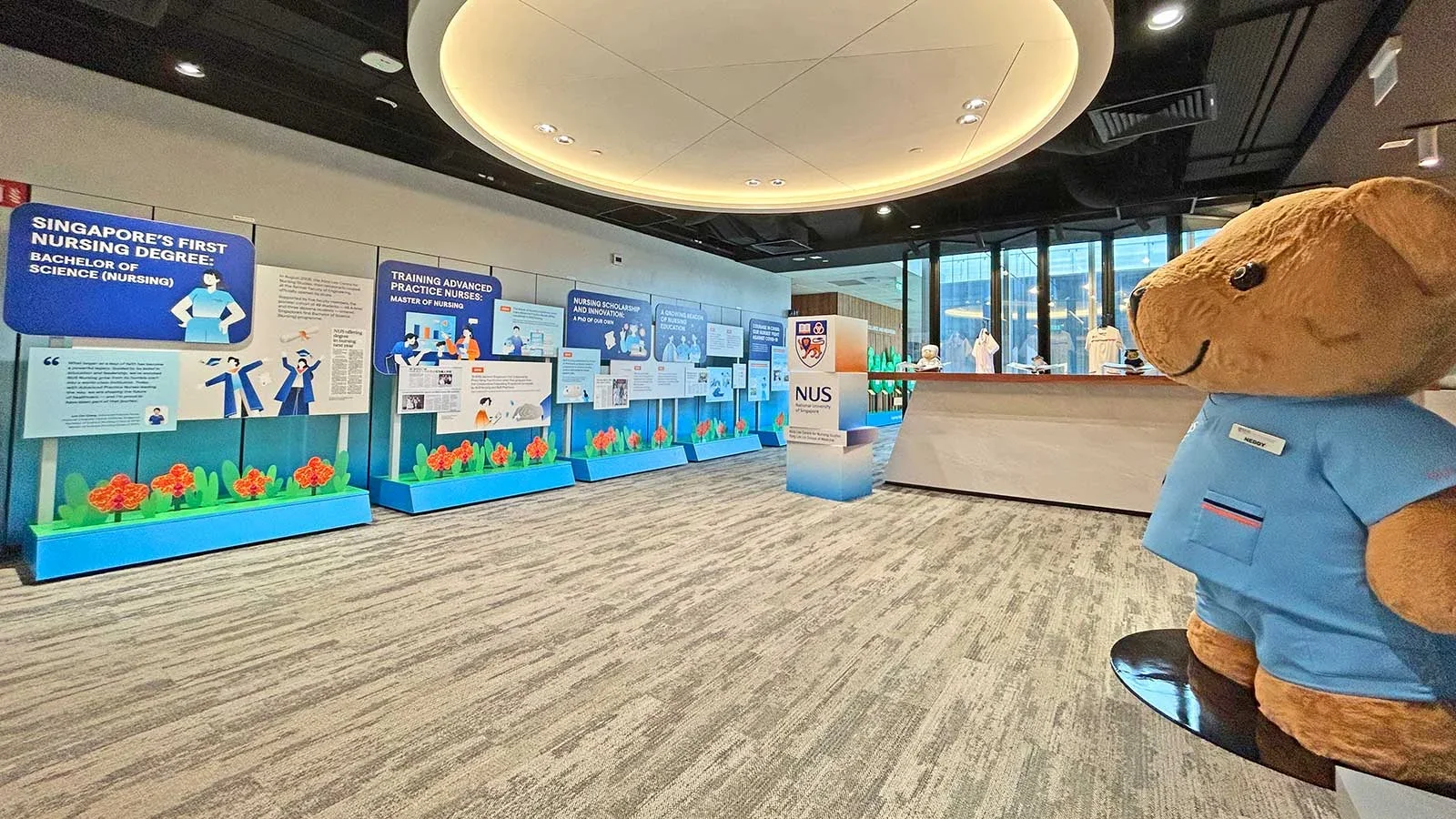
Marking its 20th anniversary, NUS Nursing also launched a Nursing Education Gallery at MD6, showcasing the evolution, milestones, and impact of Nursing education and practice in Singapore over the past 20 years. In addition to Singapore’s Nursing history, the gallery also showcases NUS Nursing’s impactful research work and achievements of its alumni.
More from this issue

ETHICALLY SPEAKING
Science, Ethics, and Babies: Rethinking Three-Parent IVF for Singapore

PEOPLE OF NUS MEDICINE
The Cat Whisperer