A GloW study found that the risks of cardiovascular disease and type 2 diabetes can be reduced by over
80%
through lifestyle changes

Issue 56
Nov 2025
INSIGHTS

Mention “women’s health” and reproductive and maternal health comes to mind. But the Founding Director of the Global Centre for Asian Women’s Health (GloW) at the Yong Loo Lin School of Medicine, National University of Singapore (NUS Medicine), Professor Zhang Cuilin, aims to change that.
“Women’s health has traditionally been thought of as pregnancy or other conditions unique to women,” she said. “But it goes beyond that. For example, the leading cause of death for women in Singapore is cardiovascular disease (CVD)—a condition common to both men and women. Mental health is often overlooked as well.”
That is why GloW is taking a holistic approach—with its key research areas encompassing cardiometabolic health, reproductive health, cancer screening and prevention, ageing and longevity, and mental health and wellness.
While women’s holistic well-being is at the heart of GloW, its focus is more inclusive than exclusive. “People might wonder, what about the health of other populations—like men or children? Well, GloW’s focus may be on women—but we are really using it as a vehicle to influence the health of society and entire populations,” Prof Zhang said.
Distinctively, GloW operates on the core tenet that women’s health is central to the well-being of families and society. “Research has shown the impact that maternal health has on future generations, in addition to the significant roles that women play in caring for their families,” Prof Zhang explained. “Happy and healthy women are the foundations for a happy and healthy society—and even the world.”
GloWing the seed
A clinical epidemiologist and physician scientist based in the US National Institutes of Health (NIH) for almost 15 years, Prof Zhang was working on maternal and women’s health projects and saw the significant knowledge gaps for healthcare research on Asian women.

She said, “Despite Asians making up 60% of the global population, there was little quality data available on Asian women. Compounded by the fact that women are typically underrepresented in clinical trials and that US research on minority populations typically focused on African Americans or Latin Americans—I felt the need to do more for Asian women.”
The numbers back this up. Even though women form almost half of the world’s population, they constitute approximately only 40% of clinical trial participants in the US for selected conditions1. This gap persists even for conditions where female patients are more common, such as psychiatric disorders. Despite women making up 60% of the patient population for psychiatric disorders, they constitute only 42% of study participants. In the same vein, Asians remain underrepresented in clinical trials—forming 11% of participants globally2.
GloW in action
Almost two years since launch, GloW researchers’ findings include the discovery that a non-fasting blood test taken during the first trimester of pregnancy could improve detection of gestational diabetes mellitus (GDM)3.
This is significant, as women with GDM—and their children—have a higher risk of developing diabetes and cardiovascular diseases throughout their lifetimes4. Furthermore, compared to other populations, Asian women have a higher risk of developing GDM—affecting one in five expectant mothers in Singapore, Prof Zhang said.
GDM is typically diagnosed at the midpoint of pregnancy when it is too late to prevent adverse effects such as high blood pressure or premature delivery. With their study published in BMC Medicine, the GloW team is now looking to further validate their findings, opening the door to early GDM prevention before symptoms or complications arise.
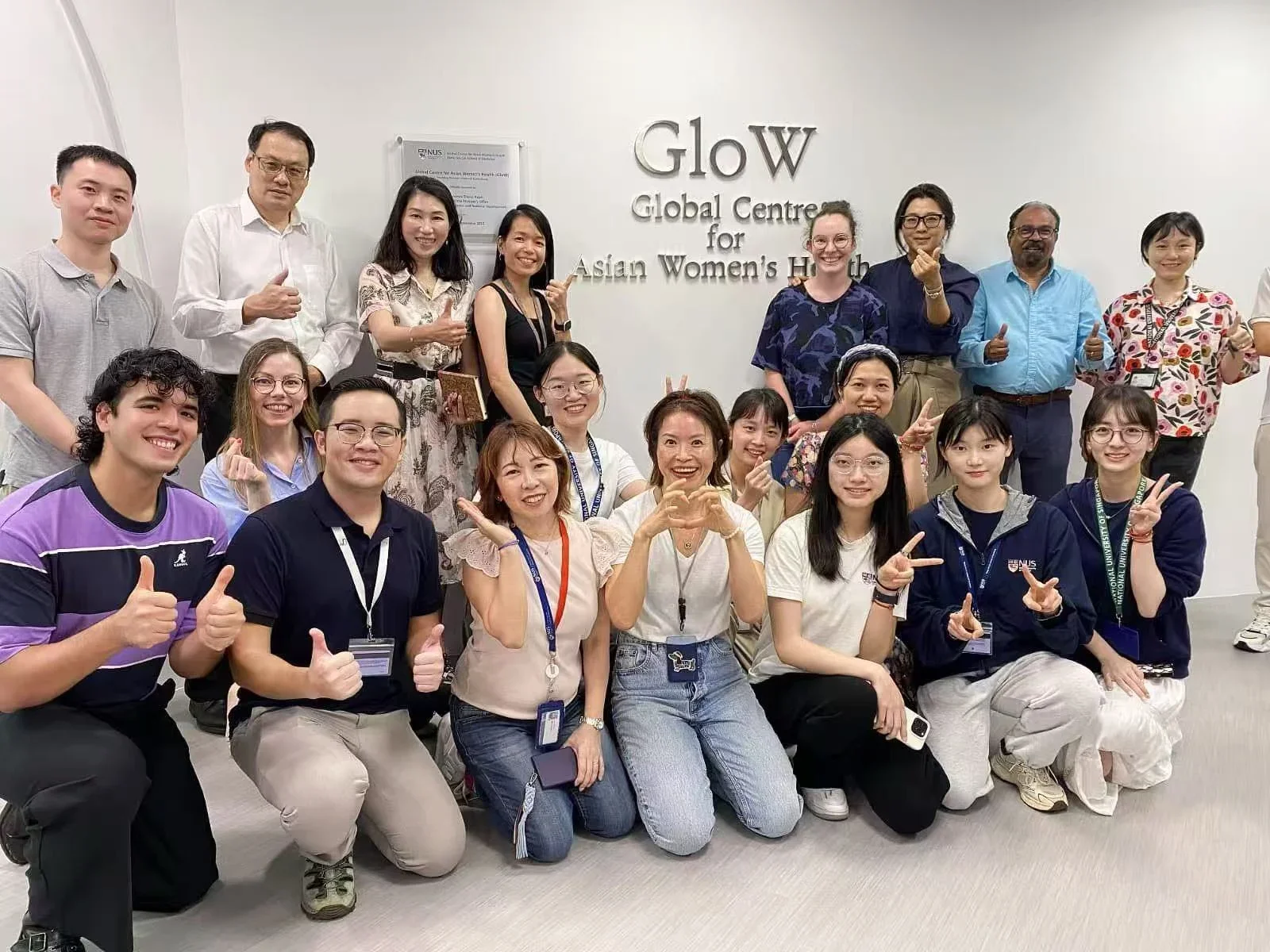
Another initiative that Prof Zhang and team are working on is the Asia-Mediterranean Diet Study—a randomised controlled trial to explore the health benefits of a localised Mediterranean diet (A+MEAL Study). “The Mediterranean diet is well-known for being healthy while tasting good. But how do you adapt this for Asian populations where the usual Mediterranean ingredients might be pricy or unavailable? That’s why we are doing this trial to see how local participants respond to a Mediterranean-inspired Asian diet,” Prof Zhang said.
“Through evaluating participant responses, we hope to see how feasible—in terms of both affordability and acceptance—such a diet would be for Asians,” she continued. For the study, the team has incorporated locally-sourced ingredients such as bok choy and local fish into the menu, all while following the principles and nutrition composition of the traditional Mediterranean diet.
Recruitment is ongoing, but even at this early stage, the team has already seen promising developments—with the trial serving as a vehicle to educate participants and get them ‘addicted’ to healthy behaviour. “We recently held a nutrition workshop for trial participants, and it was heartening when they started telling us how they wanted to share what they learnt with their family and friends.”
Towards GloWing at scale
Prof Zhang and her team at GloW are going the extra mile to raise awareness of the importance of holistic women’s health. Recent milestones include the NUS Medicine-Harvard Chan Women’s Health Initiative, a partnership with the Harvard T.H. Chan School of Public Health to advance women’s health research, training and advocacy, as well the launch of the Master of Science in Nutrition and Lifestyle Medicine (MSc NLM). Classes for the MSc NLM will commence in January 2026.
The success of the third edition of GloW’s annual Women’s Health Conference was another achievement for women’s health advocacy. Held in Paris for the first time from 24 to 26 September 2025, the conference was hosted by one of GloW’s close partners, the Université Paris Cité’s Institute for Women and Interdisciplinary Research in Science and Health (iWISH) and co-organised with the Harvard T.H. Chan School of Public Health and Stanford University.
Prof Zhang credits the conference with igniting both local and global interest in GloW and women’s health—”These high-profile events featuring world-leading women’s health experts are central to raising awareness and sparking interest among researchers, investors and policymakers. They complement our ongoing research and collaboration efforts, helping to inform local and even global communities about the work we do at GloW.”
Encouragingly, Prof Zhang has observed an uptick in interest and awareness of women’s health globally. She said, “The World Economic Forum’s Global Alliance for Women’s Health—where Prof Chong and I were invited to join their community of Champions for Women’s Health—was launched last year, and recently in August, the Gates Foundation announced a US$2.5 billion investment in women’s health. It’s very heartening to see this convergence of interest and efforts!”
She continued, “Historically, women’s health has been underfunded. So with this momentum, I hope we can have more people investing in women’s health—because it will also benefit society and future generations.”
Prof Zhang expressed hope for GloW’s growth. “Besides ensuring GloW’s sustainability, I hope GloW can one day become the go-to for major aspects for Asian women’s health. People would come to us for women’s health from healthcare practices to public education. We hope to have satellite centres all over the world that cater to their respective populations for Asian women’s health—there can be a GloW in Boston, another in Paris or India, for example. We welcome and embrace partnership to make this possible.”

Prof Zhang was recently appointed to the International Advisory Board (IAB) of The Lancet Obstetrics, Gynaecology, & Women’s Health. With few high‐impact journals in the field of women’s health, this new journal led by experts like Prof Zhang is set to elevate research quality and bring greater mainstream visibility to the topic.
I got into medicine because…
“My dad decided that we needed to have a doctor in the family—I was picked because I was good at studies. But after my residency, I felt like I could better improve patients’ health from the population level. That’s why I eventually went to the US to train in clinical epidemiology.”
Research is…
“Endlessly interesting. When you review literature to know what’s been done, come up with your hypothesis and test it—it’s such a creative process. Of course, it can be painful sometimes. But for projects like a new cohort study or clinical trial, I always think of it like building a gold mine for this and future generations.”
The thing that keeps me going for research…
“Is translating it to the clinical and community level. Translation is not easy, but it’s always on my mind.”
That’s why I always ask my students…
“’So what? What are the clinical or public health implications?’ I’m always pushing them to think deeper and really dig into the problem so our work can have real life implications.”
My secret to staying on top of everything…
“Is exercise. I try to run or do yoga at least three times a week. It really helps to keep my energy levels up even when my schedule is packed. Sometimes, I invite my team members to join me so we can recharge, have fun and catch up at the same time.”
Next, I want to…
“Build a multi-country study (either an observational or intervention study, or a hybrid one) following women at high risk of non‐communicable diseases after pregnancy. Pregnancy offers a unique time window to identify these women at higher risk—and I hope we can use it for early intervention before they develop such chronic conditions.”
https://www.sciencedirect.com/science/article/abs/pii/S1551714422000441?via%3Dihub.
https://www.nature.com/articles/s41572-021-00316-8.
https://bmcmedicine.biomedcentral.com/articles/10.1186/s12916-025-04258-w.
https://www.nuhs.edu.sg/patient-care/find-a-condition/diabetes-mellitus/what-is-diabetes/gestational-diabetes.
https://www.ahajournals.org/doi/10.1161/JAHA.124.038936.
https://www.bmj.com/content/349/bmj.g5450.
More from this issue
AFFAIRS OF THE HEART
Stopping Tuberculosis and its Effects On the Heart: The Search for Solutions