Issue 55
Sep 2025
DOSSIER

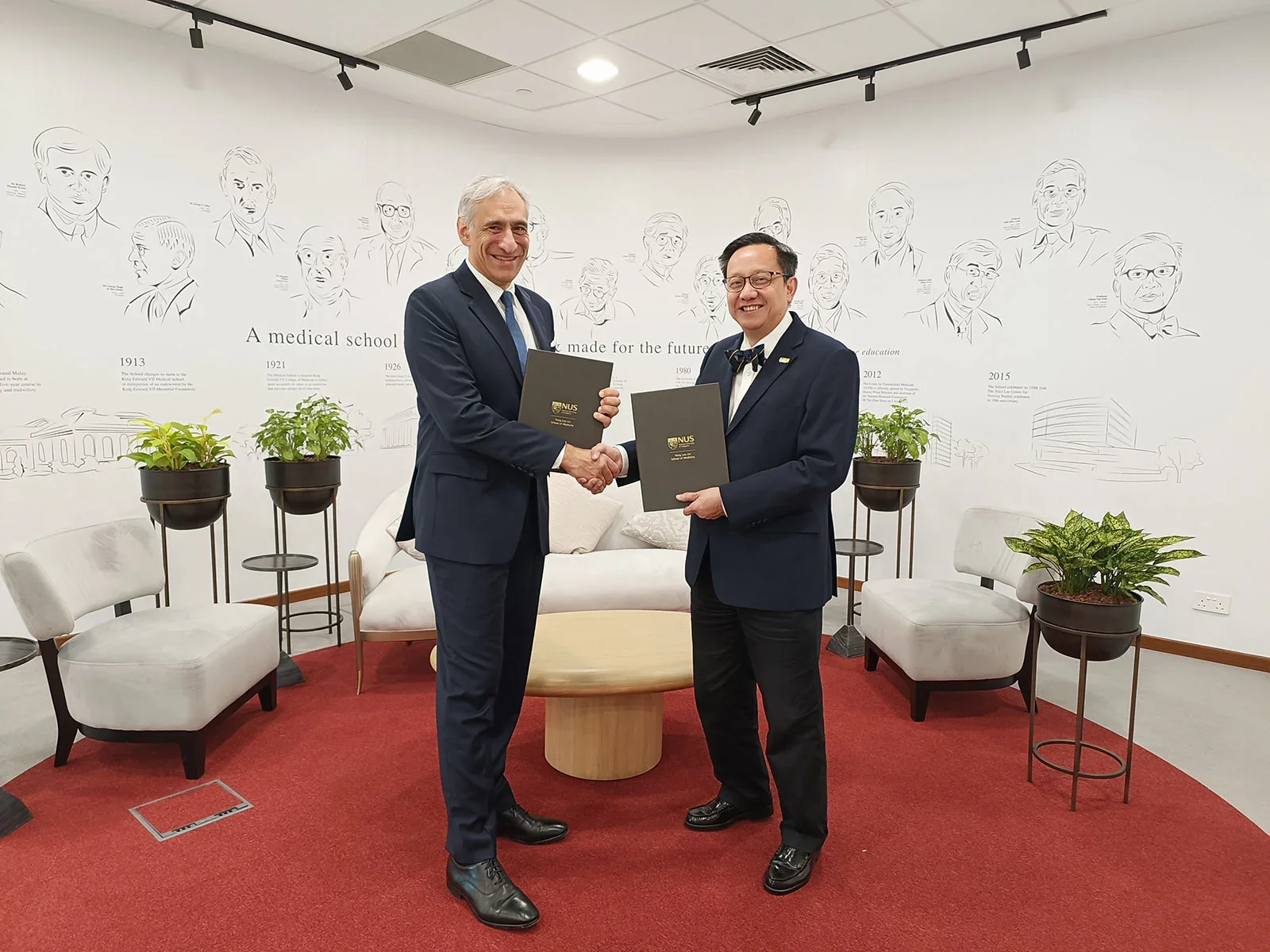
The Heinz College of Information Systems and Public Policy will work with the Yong Loo Lin School of Medicine, National University of Singapore (NUS Medicine), the School of Computing (NUS Computing), and the firm FriendsLearn, to promote joint research and development activities of mutual interest. The research will use artificial intelligence (AI) in precision prevention of disease via innovative digital therapeutic solutions such as digital vaccines.
“Research thrives on collaboration. We’re proud to join forces in this partnership, combining our faculty’s strengths in AI and healthcare to drive purposeful and precise innovation alongside leading researchers,” explained Professor Ramayya Krishnan, Dean of Heinz College. “This undertaking will strengthen our work across disciplines, countries, and enterprises.”
Professor Chong Yap Seng, Lien Ying Chow Professor in Medicine, Dean of NUS Medicine added, “At NUS Medicine, we are focused on driving a transformative shift from healthcare to health through boldly progressive education and research, powered by technology. Digital technology, data analytics, and AI hold immense potential to revolutionise health. Through this collaboration, we will be able to accelerate intelligent application of big data, AI, and modern technologies that can improve health outcomes across generations and bring us closer to achieving health equity.”
One of the primary areas of work will be identifying opportunities for exchanges, cooperation, and joint research and development in relation to the Digital Vaccine Project1. The project entails the context-sensitive design and extensive field evaluation in school settings of an AI-powered, gamified digital therapy solution on mobile devices for trustworthiness, health literacy, and health outcomes related to healthy lifestyles and precision prevention of disease in children. Digital vaccines use neurocognitive training, implicit learning, and immersive gaming in regular “doses” to encourage healthier behaviours in children, safely and effectively priming neurodevelopment and gut biome health. This induces and reinforces changes at the neuro-physiological level underlying behaviours and choices during the critical habit-forming stage of childhood.
At NUS Medicine, we are focused on driving a transformative shift from healthcare to health through boldly progressive education and research, powered by technology. Digital technology, data analytics, and AI hold immense potential to revolutionise health. Through this collaboration, we will be able to accelerate intelligent application of big data, AI, and modern technologies that can improve health outcomes across generations and bring us closer to achieving health equity.”
This effort is led by Rema Padman, Trustees Professor of Management Science and Healthcare Informatics in the Heinz College, with collaborators Professor Rahul Ladhania at the University of Michigan School of Public Health, Assistant Professor Ai Peng Tan at NUS Medicine and Associate Professor Sharon Tan at NUS School of Computing. “We are really motivated by the opportunity to address a public health challenge worldwide of health promotion for disease prevention early in life so that children learn about healthy lifestyles in a fun and exciting way,” says Prof Padman.
“This collaboration exemplifies the power of cross-disciplinary partnerships, uniting the expertise of academic institutions and innovative companies to push the boundaries of what is possible. By integrating Health IT, including AI, digital technology and health interventions like digital vaccines, we are not only reshaping the future of healthcare but also fostering a deeper, shared understanding of how we can create long-term, sustainable improvements in health outcomes,” said Professor Tan Kian Lee, Tan Sri Runme Shaw Senior Professor and Dean, NUS School of Computing.
FriendsLearn, a biological and health technology company with offices in San Francisco and Chennai, India, is a pioneer of digital vaccines and a transnational partner with Carnegie Mellon of the Digital Vaccine Project.
“It is a pioneering step for Governments of advanced countries and the world’s leading academic institutions to collaborate across disciplines by utilising AI to solve real problems. This trend in shifting conviction to invest based on the enormous economic and societal value for a nation, signals a significant inflection point for shaping the health of the future of humanity,” said Bhargav Sri Prakash, founder and CEO of FriendsLearn.
The project will also involve exchanging scientific, academic, technical, and related information of mutual interest, for which each party holds intellectual property rights, and identifying opportunities for commercialising them. In addition, the universities and FriendsLearn will organise and take part in joint academic and scientific activities such as seminars and conferences.
https://www.cmu.edu/heinz/digital-vaccine-project/index.html.
More from this issue