Issue 54
Jul 2025
THE LAST MILE
By Dr Noreen Chan, Senior Consultant, Division of Palliative Medicine, National University Cancer Institute, Singapore
A heartfelt message to our younger colleagues.
In my family, there has been a doctor or two every generation, starting with my grand-uncle Dr Chia Chin Tiong who qualified at Edinburgh University. Over the decades, society and the practice of Medicine has changed so much, that if I and my grand-uncle time-travelled to each other’s eras, we would be amazed and discombobulated in equal measure.
Yet, as much as practice has changed, I like to think that the fundamental goal of Medicine has not. We remain members of the healing professions, although the way we embody our professional values has to move with the times. As someone who is getting closer to retirement, it is timely for me to reflect on how Medicine and its practitioners should adapt, even as we speed onwards into the 21st century.
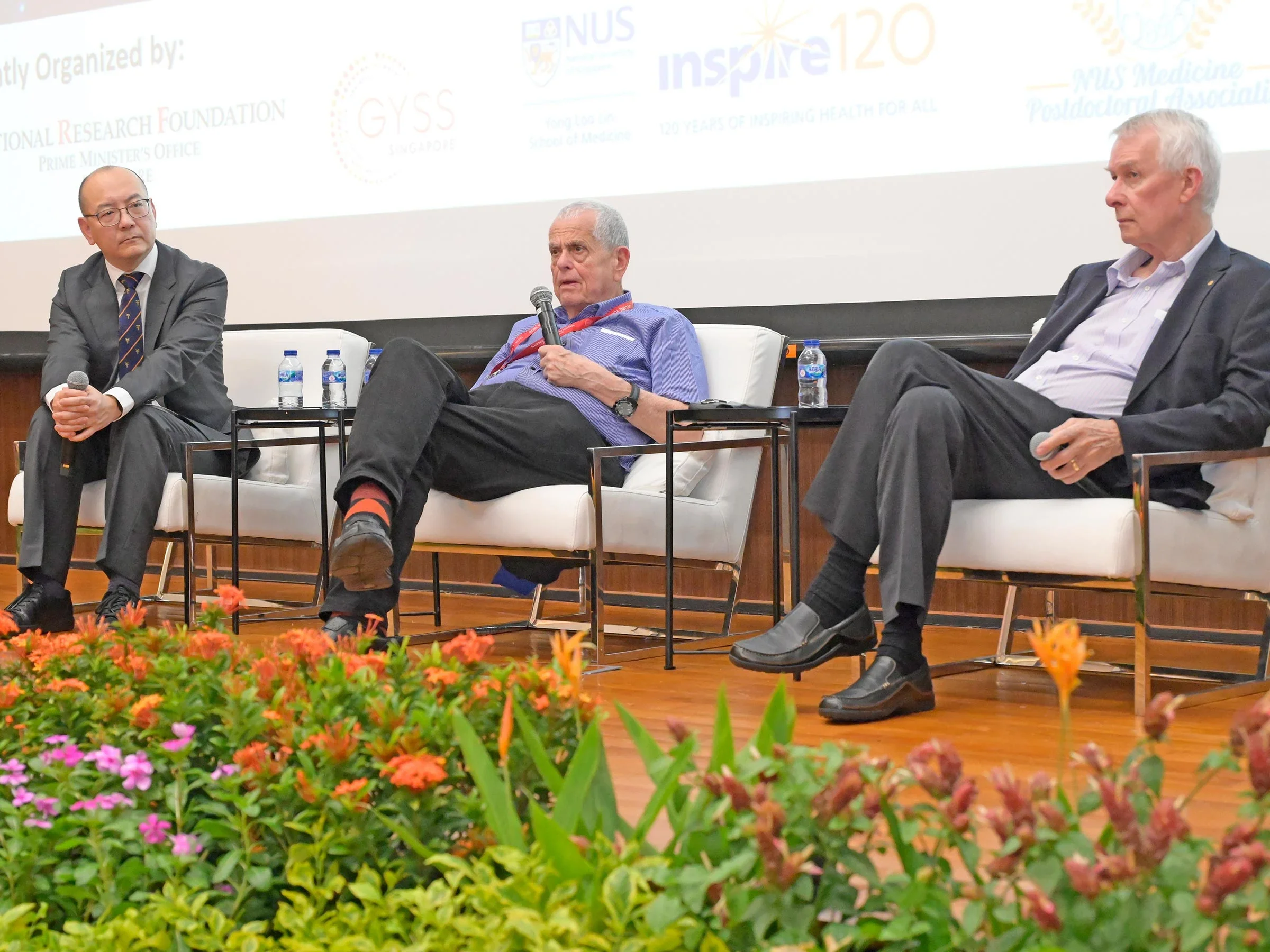
This year’s APMEC (Asia Pacific Medical Education Conference) theme was “Developing Holistic Healthcare Practitioners for a Sustainable Future”. In his opening address, Yong Loo Lin School of Medicine, National University of Singapore (NUS Medicine) Dean Chong Yap Seng referred to an article published in the Straits Times on 18 August 2020, “Training Doctors for a Post-Pandemic World”. In summary, the article made four main points:
• |
Doctors of the future must appreciate that “healthy lives include physical, mental, social and spiritual well-being”. |
• |
In this chaotic world of misinformation and fake news, they must “guard the sanctity of inquiry, critical thinking and scientific evidence in guiding decision making”. |
• |
It is no longer sufficient to be a good and competent doctor, “they must become global-minded leaders contributing to the betterment of well-being for humanity as a whole”. |
• |
The last point included the educators—that all should adopt an “attitude of humility” and be open to change. |
All very admirable, but a big ask all the same. Not only must our future doctors be holistic, they need to be future-ready. By implication, their educators need to be future-ready too! While there is no one definition, most would agree readiness to face an uncertain future includes elements of adaptability and resilience. Change is inevitable—it is not humanly possible to keep up with the vast amount of information accumulating every second; therefore it is no longer sufficient to memorise lots of facts—it is more useful to be able to search, curate, analyse and apply information in a “just in time” manner.
I am confident that our universities will adapt their curricula and teaching even though this may take a little while. So in the meantime, I have a few suggestions to all the future doctors and my younger colleagues, since some of you may be caring for me one day!
Remember I am a person with a disease, not a disease with a person attached.
Often, when I go through the medical notes of a patient who has been referred to me, there is so much information about the disease and the treatment—even down to the gene level—but there is hardly anything about who the patient is as a person. There is a difference between disease and illness—disease is about anatomy, physiology, biochemistry, blood test results, images on a screen; illness is what we experience as a result of disease(s). Eric Cassell wrote in 1982 “Suffering is experienced by persons, not merely by bodies”: your body may undergo investigations and treatment for a disease, but you as a person will live with the illness (as will your family). Somewhere between these two realities lies the interface of the science and art of Medicine.
People are inherently messy; they are often unpredictable and uncontrollable and they come with equally diverse and sometimes, surprising opinions, as well as family members and friends. While it is understandable why doctors find it more expedient to just focus on the disease, it is in the humanity of our practice that we find challenges and frustrations, as well as rewards and life lessons. And frankly, if you are unable to engage with the “human-ness” of your patients’ lives, then AI can probably do a better job than you for the technical bits. It will soon.
There is a difference between disease and illness—disease is about anatomy, physiology, biochemistry, blood test results, images on a screen; illness is what we experience as a result of disease(s).
Care and treatment are not the same thing.
It always annoys me when I read or hear about withdrawal of care from a patient, because what we really mean is we are withdrawing a treatment that is not working anymore. Treatment like mechanical ventilation or dialysis can be life-saving for many, but in certain situations, it will not make a person better, but may actually prolong suffering. Treatments for diseases have their limits, but care is limitless. Care never stops, only the kind of care changes. We just need to know when and how to change gears.
Medicine does not exist in a vacuum, and neither do you.
It is ironic that in our hyper-connected 21st century, humanity is more divided and at odds, more individuals feel isolated and anxious, our planet and whole existence is more threatened than ever before. Yet humans are social creatures and for millennia we have gathered in groups for protection and mutual benefit. Those who sought isolation were the exception and often did so for religious purposes.
You have to accept that your world is bigger than your family, your neighbourhood, and even your country and region. There is too much conflict, inequality, injustice and suffering in the world to just look away. The COVID-19 pandemic taught us that no one is safe until we are all safe, and now even the health of our planet is threatened. We need to find meaningful connections and be stronger together, because our existence depends on it.
Be comfortable around diversity and contrary opinions. Every voice counts.
In an increasingly polarised world, where social media algorithms push you down rabbit holes of your own opinions, it can be tempting to ignore all the dissenting voices. But as a doctor, you have a duty of care to all who need your help, even those whose views and behaviours are very different from, or even repugnant to you. Similarly, we need to be able to share space with diverse voices, and to discuss—I stress, politely and openly—about how we can be different and similar at the same time. Not better or worse, just different.
Bit by bit, work consumes our hours and we have to let go parts of our other selves to get everything done in time. Then one day, you wake up and realise you have locked away so much that you have lost yourself.
Nurture your own holistic self.
As important as it is to be a holistic medical practitioner, it is equally if not more important, to be a holistic person. I read somewhere this saying, which could be an Indian proverb “Everyone is a house with four rooms, a physical, a mental, an emotional and a spiritual. Most of us tend to live in one room most of the time, but unless we go into every room, every day, even if only to keep it aired, we are not a complete person.“
This can be challenging when you are a busy young student or doctor, rushing from one task to another. I know, I and your seniors have been there. Bit by bit, work consumes our hours and we have to let go parts of our other selves to get everything done in time. Then one day, you wake up and realise you have locked away so much that you have lost yourself.
It is desirable to polish your professional CV (curriculum vitae or literally course of one’s life), but please do find time to work on your “other CV”, those aspects of your life that spark joy and creativity, that nourish and sustain your spirit. By all means attend to your bank account, but remember to deposit into your spiritual account, because that is what you will need to draw on in times of fear, doubt, or pain.
I want you to be competent, compassionate and creative doctors, but I also want you to be happy and balanced individuals, working on being the best version of yourselves.
Click here to read the Straits Times article, “Training Doctors for a Post-Pandemic World”.

More from this issue
PEOPLE OF NUS MEDICINE
In the Neighbourhood of Excellence: Deepening NUS Medicine’s Legacy