Issue 54
Jul 2025
SPECIAL FEATURE
By Associate Professor Cuthbert Teo, Editorial Advisor, SMA News, Singapore Medical Association
This 14-part series on the history of Medicine in Singapore was originally published by the Singapore Medical Association.
In 1920, approval was given to build a new College building, designed by Major PH Keys. The foundation stone was laid on 6 September 1923 and the new building was opened officially on 15 February 1926 by the Governor of the Straits Settlements (SS), Sir Laurence Nunns Guillemard. After the completion of the College of Medicine Building (COMB) in 1926, the Tan Teck Guan Building was then occupied by the Department of Anatomy and an extension of the building housed the dissection room.
The first floor of the COMB housed the Council Chamber, the Principal’s Chambers, administrative and department offices, the Keith Museum (which later housed the Medical Library located in the centre of the first floor, in an 80 feet by 26 feet room) with courtyards on either side (one courtyard was near where the pond at Singapore Medical Council is now situated), the Department of Biochemistry, a student laboratory and the Department of Materia Medica (pharmaceutics and pharmacy). The mezzanine floor was part of the library. Services provided by the library were rather limited, and students were allowed to take out certain books on long-term loan as personal textbooks, for books were a rare commodity in those days. On the second floor, there was a main lecture hall (later the New Lecture Theatre), two lecture rooms (later Allen and Farris Lecture Theatres), the Department of Biology and the Department of Bacteriology with its Bacteriology Student Laboratory. Level three housed the Department of Physiology. There was no central staircase; instead a pair of staircases led to the mezzanine floor.
The building’s design, the work of architects Keys and Dowdeswell, is reminiscent of classical Greek monuments such as the Acropolis of Athens. Allegorical bas-relief sculptures and moulding on both sides of the facade depict the teaching and practice of medicine. These were conceived by the Italian artist, Cavaliere Rudolfo Nolli (who also designed similar ornamentation on the facade of the Old Supreme Court building), and executed by Mr J Sharpe Elliot. The sculptures are surrounded by moulded plastered architraves with a circular motif. The building is fronted by eleven sculptured timber doors. These doors stand behind the fluted columns of the Doric colonnades. Over the central doorway is a bas-relief of a Roman eagle, which classically signifies a civil or official building.
In 1920, the Medical Student’s Recreation Club began publishing a student magazine, The Medico, for a period of four years. In one issue, Prof CJ Smith had this to say about the local medical students: “The students here, compared with those at home, were too gentle and timid, and their manners were too good for medical students.” Around 1921, there was a first attempt to form a corporate medical body, and the Graduates Association was founded with Dr EW de Cruz as president. However, it became defunct.1
The Students Medical College Graduates Association was inaugurated on 5 September 1923 by a group of graduates of the medical school at a meeting of the fifth Congress of the Far Eastern Association of Tropical Medicine in the Victoria Memorial Hall. It was managed by a committee of 12 with Dr Chen Su Lan as the president. The main aim of the association was to make the College a University and to elevate the status of its graduates from assistant surgeons to medical officers. On 27 December 1930, at a meeting held at the Europe Hotel, the name of the association was changed to the Alumni Association of King Edward VII College of Medicine. (The name was further changed to Alumni Association of King Edward VII College of Medicine and Faculty of Medicine, University of Malaya, in 1952.) In 1948, the association formed a building subcommittee to look into the building of a clubhouse. An application was made to the Government, in 1952, for the lease of a site in the General Hospital (GH) compound. The application was approved and a 99-year lease on the site was granted at an annual rent of S$1. On 3 April 1954, the foundation stone for the association’s building given by the Government was laid by the Director of Medical Services, Dr WJ Vickers. On 10 October 1955, the Medical Centre at GH on 4A College Road was officially opened by the Vice-Chancellor, Sir Sydney Caine. In the early years, the activities were limited because graduates were scattered all around Malaya.
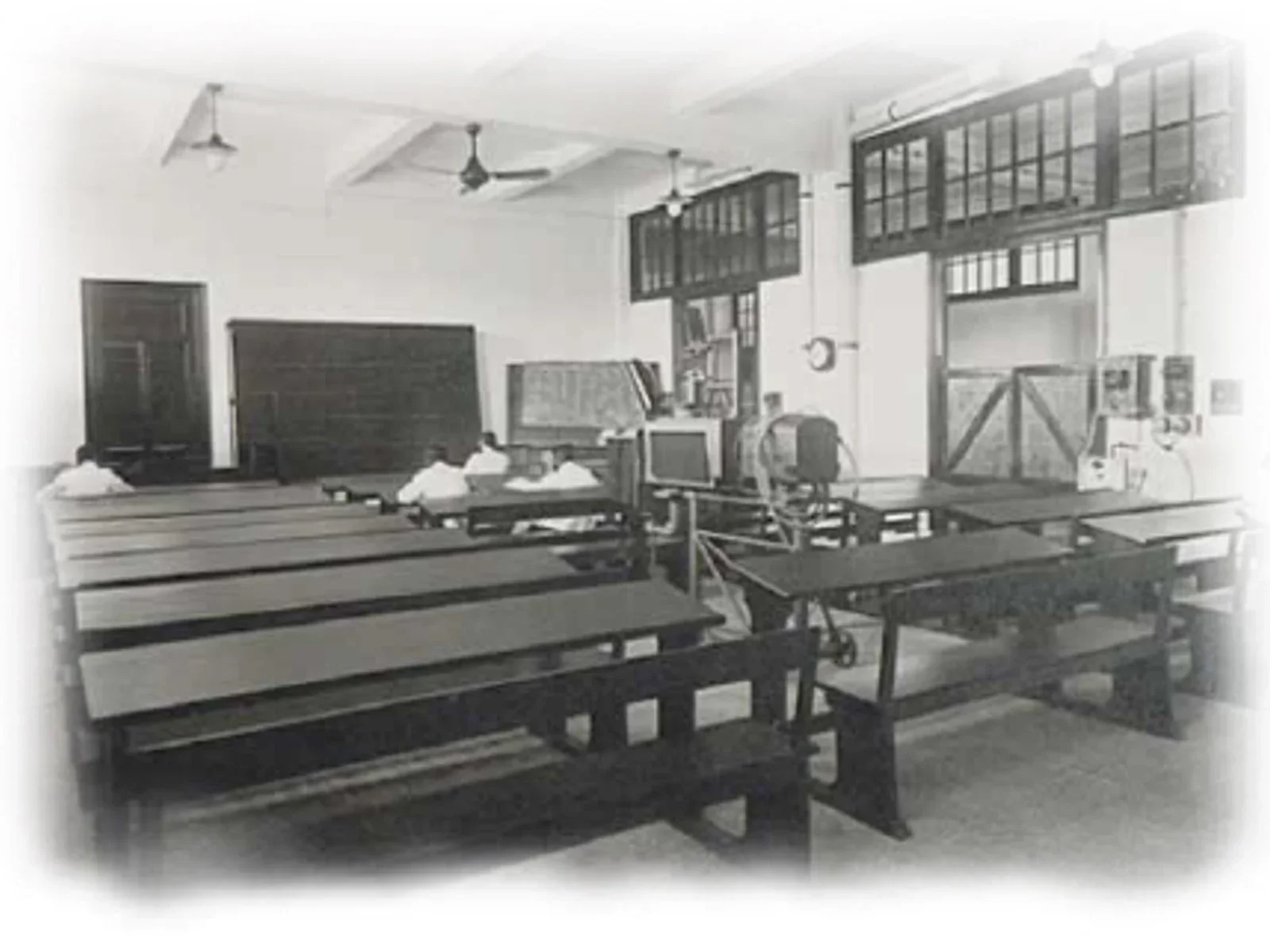
Lecture room, College of Medicine. Photo credit: SGH Museum.
In January 1957, the Constitution was changed and the association was reconstituted with three branches: Northern, Central and Southern. In the 1960s, the centre was renovated, and housed the Singapore Medical Association (with Dr Arthur Lim as President), the Academy of Medicine, the College of General Practitioners, the Singapore Dental Association, the Pharmaceutical Society of Singapore, and the Singapore Government Medical and Dental Officers’ Association. The Centre had a lecture theatrette, swimming pool and dining facilities (the caterer, Ah Foo, was said to have been curt to everyone in his broken English). The lecture theatrette’s slide projector and sound system were under the charge of a Malay man named Bakri, who was remembered as being very quiet. Doctors who attended talks at the theatrette called him MOHD (most observant house doctor), because he sat through all the meetings and lectures.
In the basement, there were two billiard tables. One table was bought from the UK with funds donated by two doctors from Penang, Dr Mahathir from Kedah and Dr Tow Siang Yew. The second table was later donated by Dr Chen Su Lan. The billiards room had an attendant, Ah Poh, who demonstrated snooker tricks. Annual reunions began in 1963. In 1985, the land on which the Centre was standing was acquired for the Central Expressway and the association moved temporarily to Houseman’s Quarters. On 3 August 1988, Dr Kwa Soon Bee (then Permanent Secretary for Health and Director of Medical Services, appointed 1984, retired 1996) assisted the association with obtaining the use of the old Department of Scientific Services Building at the junction of College and Outram Roads. The Alumni Association building was renovated and occupied in December 1989, and officially opened by Dr Kwa on 21 July 1990. Later, the Association Alumni and the Gordon Arthur Ransome Memorial Fund Committee (of which Dr Chee Phui Hung was chairman), presented the Ministry of Health with two large oil paintings, which now hang at the COMB. When the Alumni moved out of its building in 1988, Dr Chen’s billiard table was transferred to the Singapore General Hospital Recreational Club (doctors’) lounge, while the first table was transferred to the Pathology Department’s Recreational Club. The first table was eventually refurbished to its original state in 1994 and restored to its rightful place in the billiard room of the Alumni building, courtesy of Tun Dr Mahathir.
In 1924, the College was apparently briefly closed.2 The closure partly reflected the anti-colonial attitude in Malaya, grouses between European staff of the College and GH and the principal Dr GH MacAlister, as well as a lack of dialogue between the European administrative staff of the College and the students. The precipitating event was a trivial one. One night, a student violinist and saxophonist of the Federated Malay States (FMS) Hostela at Sepoy Lines started playing tunes, attracting the attention of the European sisters staying at the nearby Sister’s Quarters, who lined up and cheered. Someone (who was probably opposed to fraternisation with the natives) informed Dr MacAlister. He put up a notice that such un-gentlemanly behaviour should cease and the notice was slashed. This led to the student representatives of the FMS Hostel and the Medical College Union being summoned and told off by the principal. The following week, the students decided to boycott a social event in which the Governor would be giving away sports prizes.
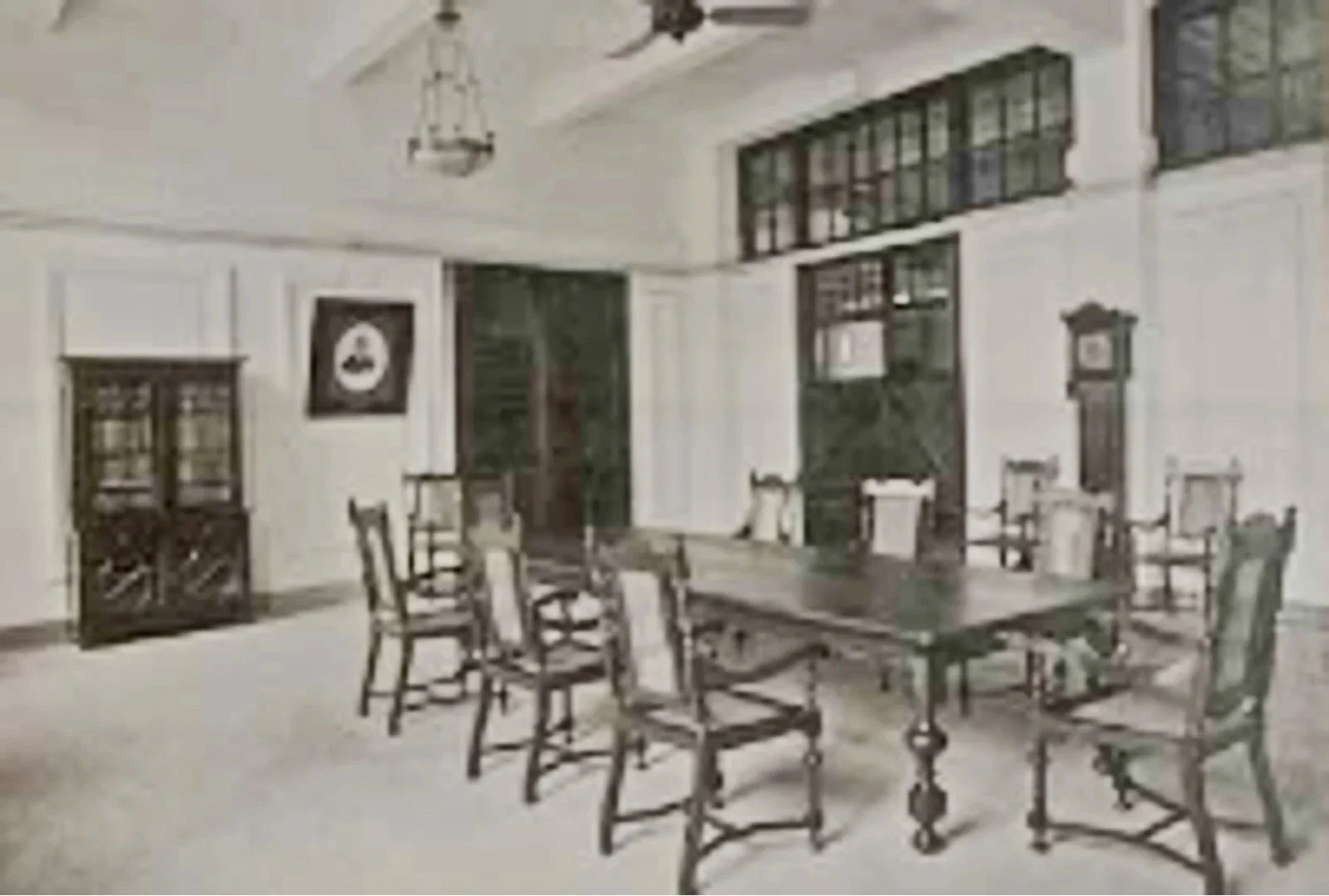
Council Chamber, College of Medicine. Photo credit: SGH Museum.
The College Council, however, took the view that the students, in absenting themselves from the function, had insulted the Governor and, in turn, His Majesty the King. The College was thus closed and the students expelled from the hostel. Later, some non-hostelite students apologised to the principal and the College was re-opened. A Commission of Enquiry set up by the College maintained that the students had indeed insulted the King, and meted out severe punishment to the students involved. One student was expelled from the College, some were suspended for one year, many for six months, and all those due to sit for their examinations were prevented from doing so.
The Department of Bacteriology was established in 1925, led by Prof A Neave Kingsbury.3 Besides activities such as teaching, routine bacteriological diagnosis and vaccines production, research work was also performed on viral diseases and leprosy.
In 1926, the College and its hospitals were inspected by Sir Richard Needham, Inspector of the General Medical Council (GMC). In his report, Sir Needham told the GMC that, in his opinion, the graduates should be awarded the MBBS because of the high standard of the College. He wrote: “In as much as the Singapore diploma is in no way inferior to the recognised MBBS degree, the letters ‘LMS Singapore’ frequently give the wrong impression, at all events to the public, of the professional status of the holder. In course of time no doubt a university will be established in Singapore which will provide for the students of the College an MBBS degree.”
In 1926, Dr JC Tull succeeded Dr Finlayson as the next Government Pathologist. He was also the honorary physician to the Governor of Singapore. A chair in Pathology was created at King Edward VII College of Medicine, and Dr Tull concurrently held the Chair in Pathology until his retirement in 1936.
In 1928, the SS Government appointed its first pharmacist, Mr T Roebuck, at the GH, and the Medical College appointed him as its lecturer in pharmacy. In 1929, the School of Dentistry was established in the College and produced its first dental graduates in 1933.
The 1929 class of medical students was the first batch to undergo the six-year medical course initiated at the recommendations of the GMC. Among the graduating students were Drs ES Monteiro, Benjamin Sheares (born 12 August 1907, Dr Sheares became Malaya’s first local professor of obstetrics and gynaecology in 1951, and Singapore’s second President on 2 January 1971, an office he held until his death on 12 May 1981), N Amad, RG Gunatilika, Lim Eng Cheang, Benjamin Chew (founder of the Singapore Anti-tuberculosis Association) and AW Moreira.
In 1933, Sir Richard Needham inspected the College, and again he reported its high standards to the GMC. In 1934, the Registration of Pharmacists Ordinance was passed, establishing a Pharmacy Board. When the Ordinance was enforced in 1935, 42 persons were registered as pharmacists. In October 1935, the College introduced a Diploma in Pharmacy course, and in the same year, the School of Pharmacy was established.

A/Prof Cuthbert Teo is trained as a forensic pathologist. The views expressed in the above article are his personal opinions, and do not represent those of his employer.
Soh CS. The Alumni Story. In: Lim KH, ed. At the Dawn of the Millennium: 75 Years of Our Alumni. Singapore: Singapore University Press, 2000:49-52.
Sandosham AA. Old Times at King Edward VII College of Medicine. In: Lim KH, ed. At the Dawn of the Millennium: 75 Years of Our Alumni. Singapore: Singapore University Press, 2000:218-24.
Taylor MB, Chow VTK. The Evolution of Teaching and Learning Medical Microbiology and Infectious Diseases at NUS. Annals Acad Med 2005; 34(6): 98C-101C.
Note:
The FMS Hostel or Federated Malay States Hostel at Sepoy Lines was so named because a Sultan had donated the money for building it. It was the predecessor of King Edward VII Hall at that site. The FMS Hall had been built in 1916, during which time TTSH Student’s Hostel for 50 students also opened. The FMS Hostel was built at the expense of the Governor Sir Arthur Henderson Young (Governor 2 September 1911 to 17 February 1920), and was said to have been an imposing four-storey building overlooking the GH. It housed 72 male students, and before the Club House was built, its only social life was said to have been a billiards table, which was sold by the College to pay the debts of students who had been suspended in 1924. The playing field behind the hostel was opened on 14 December 1932 by Sir Cecil Clementi (Governor 5 February 1930 to 9 November 1934). Female students lived in the YMCA at Fort Canning (and later in bungalows at Mt. Rosie and Holne Chase in Grange Road, and later at Eusoff College in Evans Road). The Holne Chase Bungalow was later used by the Singapore Anti-Narcotics Association to house addicts undergoing treatment.
More from this issue
SPECIAL FEATURE
A Glimpse into the Past – Medicine in Singapore (Part 6)
AFFAIRS OF THE HEART
Seeing Cardiovascular Disease in a New Light