
Issue 54
Jul 2025
SPECIAL FEATURE
By ASSOCIATE Professor Cuthbert Teo, Editorial Board Member, SMA News, Singapore Medical Association
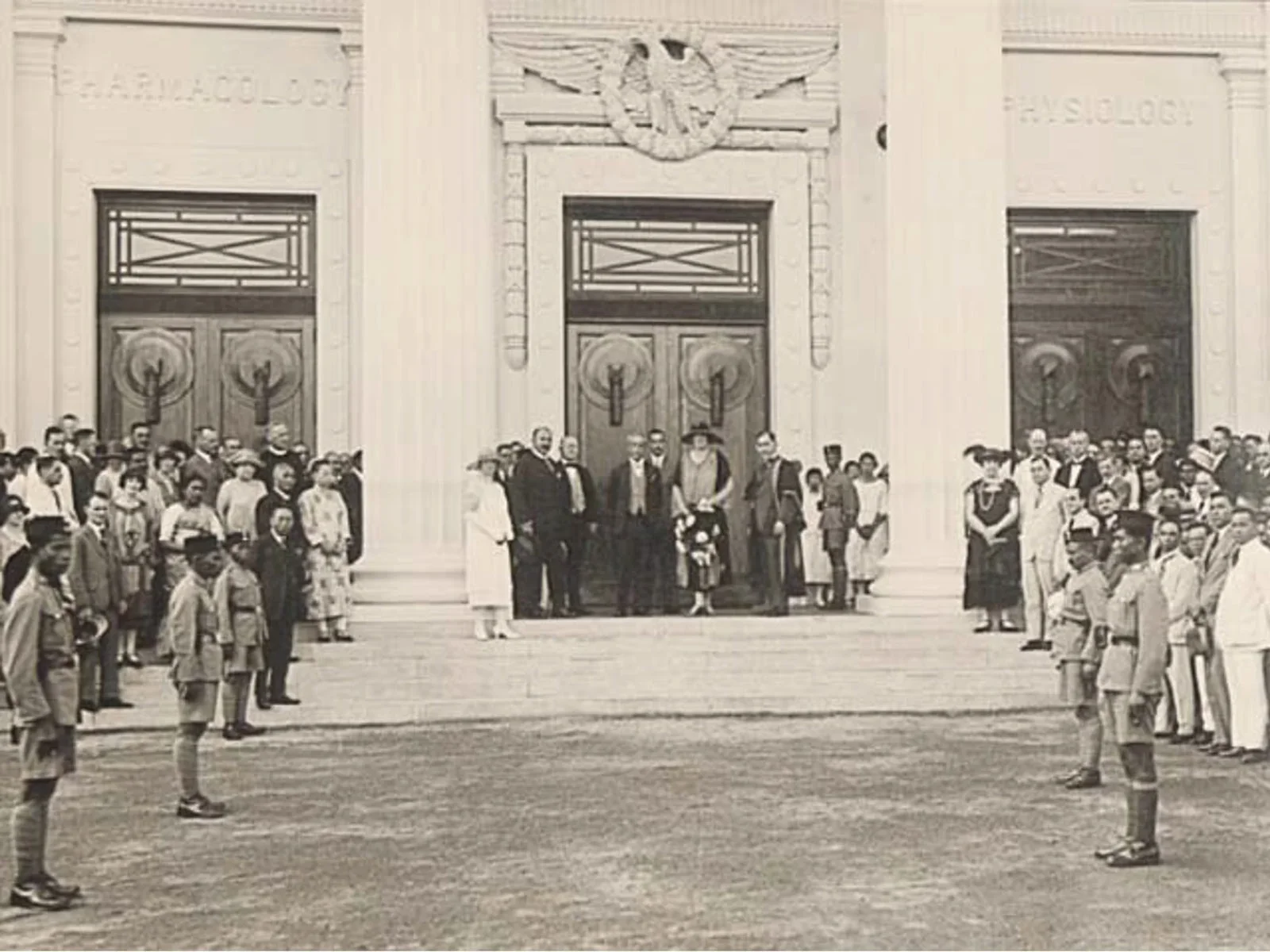
This 14-part series on the history of Medicine in Singapore was originally published by the Singapore Medical Association.
In 1906, the Medical Student’s Recreation Club was set up at the site of the former railway station to offer sport facilities. In 1907, introductory classes in clinical medicine and clinical surgery were held at the General Hospital (GH), and a new lecture theatre with 120 tiered seats was built in the school. In the same year, students began to learn practical pharmacy at the Government Outdoor Dispensary at Kandang Kerbau Hospital (KKH) and gynaecology at two wards meant for prostitutes. The Government Analyst’s laboratory was also shifted to Sepoy Lines that year.
In 1908, students began attending clinical medicine at the GH and minor surgery at Rumah Miskin in Balestier, the latter being better staffed and under the charge of Dr GA Finlayson, the Government Pathologist from 1905 to 1926. Ophthalmology was taught by Dr FW Moore at Tan Tock Seng Hospital (TTSH) and clinical surgery by Major EM Pilcher. There was a good deal of surgical training at TTSH; by 1910, 583 operations had been performed, with the technique of spinal anaesthesia and iodine disinfection of the skin being practised during operations.
On 3 February 1909, Dr Gerald D Freer was transferred to Selangor as Senior Medical Officer. Before he left, the medical students presented Dr Freer with a farewell scroll contained in a beautiful silver cylindrical scroll-holder, measuring 10.5 inches in length and three inches in diameter. Made in Canton, China, the holder was beautifully chased with magpies among prunus blossoms and branches. An undated inscription on the silver scroll-holder reads: “To/ Dr GD Freer/ From the Students/ Medical School/ Singapore”.1 The current whereabouts of the scroll is, however, unknown.
In February 1909, Dr Robert D Keith succeeded Dr Freer as Principal, while Dr SM Livesey succeeded Dr Keith as Physiologist and Assistant Pathologist. Dr Livesey obtained the Fellowship of the Royal College of Surgeons of Edinburgh in 1911, but resigned in January 1912, as the school had no Chair of Surgery. In June 1912, Dr J Gray, the resident medical officer (MO) at TTSH was appointed to the newly created post of Surgeon to the Singapore hospitals. In June 1913, Dr Gray was appointed Surgeon to the Penang hospitals. Dr ED Whittle, who had been appointed MO in Penang in December 1909, took over as Surgeon to the Singapore hospitals, Lecturer in Surgery to the Medical School and Visiting Surgeon to TTSH. The MO in charge of TTSH was Dr JR McVail, who also officiated as Surgeon of TTSH because the post was not officially created until 1914, when it was taken up by Dr CJ Smith, who was transferred from the Federated Malay States Medical Service.

Biochemical Laboratory, College of Medicine. Photo credit: SGH Museum.
In 1914, 1,853 operations were performed at TTSH (1,443 in 1913 and 941 in 1912). At the GH, 261 operations were performed in the first-, second- and third-class wards, while 861 operations were performed in the native ward. At the women’s hospital at KKH, 78 major and minor operations had been performed by then. At the medical school, the surgical subjects taught included surgical anatomy by Dr TD Kennedy; anatomy and osteology surgery by Dr ED Whittle; clinical surgery by Drs ED Whittle, CJ Smith and JR McVail; and ophthalmology by Dr FW Moore. By this time, the principal of the medical school said that the teaching of surgery and clinical surgery “is now greatly improved by the establishment of a highly efficient permanent surgical staff”. Unfortunately, Dr Whittle and his wife were tragically killed in January 1915 during the Sepoy Mutiny in Singapore.
In May 1910, the first batch of seven medical students (known as the “Magnificent Seven”) graduated from the Straits Medical School with a Licentiate in Medicine and Surgery (LMS). Among them were Drs SR Krishnan from Seremban; John Ganaparagasam from Selangor; Chen Su Lan, Mark W Chill and Edwin Williborod de Cruz from Singapore; John Scott Lee from Ipoh and William F Carnegy from Penang.
In a 1973 Alumni Association newsletter,2 Dr EW de Cruz gave an account of his experience, written in a steady handwriting, which was the joy of nurses and dispensers: “… In all, I spent four years in Malacca, 20 years in Singapore and 13 years in Penang, serving the government. …All through my life, I endeavoured to live up to the principle which Dr Finlayson had inculcated in the first batch of students. “If you want to take up medicine,” he said, ‘don’t do it for gain. Do it for good.’” Dr de Cruz, who died in March 1974, was the last surviving member of the first batch of seven doctors who graduated in 1910.
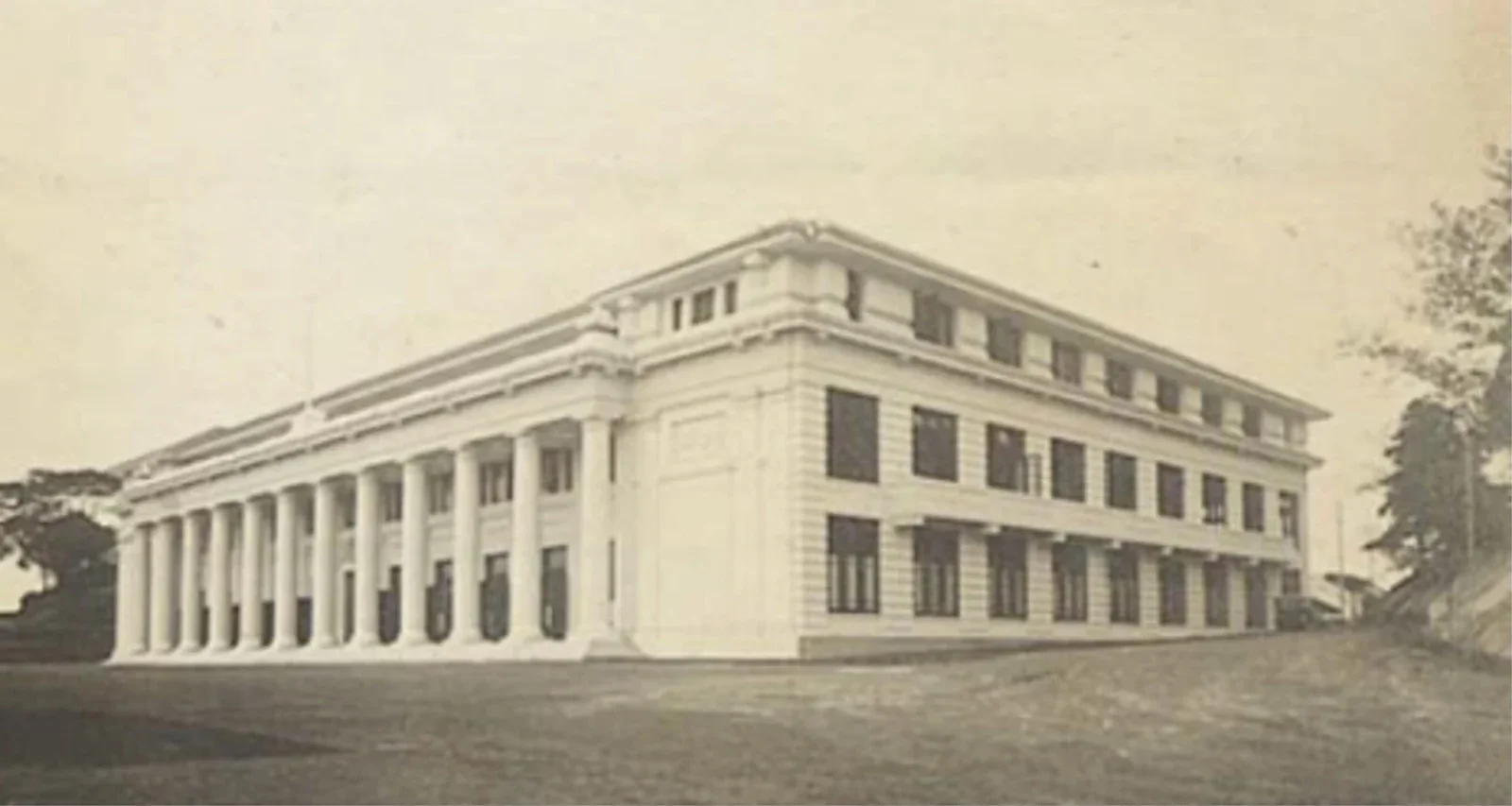
King Edward VII College of Medicine. Photo credit: SGH Museum.
Dr Teh Lean Swee, who was admitted into the College in 1910 as the fifth batch (before any one had graduated) and graduated in 1914, wrote about Dr RD Keith in a 1969 Alumni Association newsletter:3 “… he did put his heart and soul to reorganising the LMS (Licentiate in Medicine and Surgery) curriculum with a few professors as lecturers. But unfortunately, sarcoma of the rectum forced him to retire early to Scotland before achieving success. However, through the untiring efforts of his successor, Dr MacAlister, the Singapore LMS was at last recognised. … The memory of Dr RD Keith has aroused in me a sense of gratitude and honour, and to pay tribute to my alma mater, especially to the teaching staff, whom I still vividly remember…”
By 1915, there were 59 graduates, 117 by 1920 and 233 by 1930. In 1916, the LMS was recognised by the General Medical Council of the United Kingdom (GMC). At that time, local graduates of the Medical College could only look forward to careers as assistant apothecary, hospital dresser and sub-assistant surgeon. They could not become MOs, a post reserved only for Europeans. The locals were called “Asiatics” by the Europeans.
In 1911, the new Tan Teck Guan Building was added to the medical school. It was built from funds donated by a Chinese benefactor, Mr Tan Chay Yan, in memory of his father, Mr Tan Teck Guan (sometimes spelt as Tan Teck Gein). This building served as the administrative block, containing the Principal’s and clerk’s offices, a new medical library, reading room, lecture room and pathology museum.
In 1912, the medical school received a large donation (S$120,000) from the King Edward VII Memorial Fund started by Dr Lim Boon Keng in 1905, for the founding of the Medical School. On 18 November 1913, the name of the school was changed to King Edward VII Medical School. In 1919, the GMC warned the college of possible de-recognition if standards of teaching and examination were not maintained. Thus, the government in Singapore contributed more resources to the school, and professors were soon being appointed. In 1921, the name was changed again, to King Edward VII College of Medicine, to reflect its academic status.

A/Prof Cuthbert Teo is trained as a forensic pathologist. The views expressed in the above article are his personal opinions, and do not represent those of his employer.
Cheah JS. Approaching 100 Years of Medical and University Education in Singapore. (Editorial). Singapore Med J 2003; 44:1-4.
de Cruz EW. Reminiscences. In: Lim KH, ed. At the Dawn of the Millennium: 75 Years of Our Alumni. Singapore: Singapore University Press, 2000: 393-6.
Teh LS. From an early alumnus – why come to a reunion? In: Lim KH, ed. At the Dawn of the Millennium: 75 Years of Our Alumni. Singapore: Singapore University Press, 2000: 397-9.
More from this issue
SPECIAL FEATURE
A Glimpse into the Past – Medicine in Singapore (Part 5)
ALL IN THE FAMILY
Towards Better Patient-Centred Care